

Nearly half of Japanese adults in their 30s are doing nothing to build their financial assets. Our latest research found that 47.7% report no asset-building activity, the highest proportion of any age group surveyed. Almost one in three (31.4%) also say they do not actively manage their money.
Japan has spent years encouraging people to invest rather than keep all their savings in the bank. The expansion of its tax-advantaged NISA scheme has helped bring millions into the investment market. Yet our research found that nearly half of those in their 30s report neither saving nor investing to build their financial assets.
Part of what makes this generation interesting is how differently their lives are taking shape. Japanese people are marrying later, fewer are having children, and some continue living with their parents well into their 30s. A 35-year-old might be saving while living at home, paying rent on a single income, or supporting a family. Their financial circumstances, and what they can realistically put aside, may be very different.
For Japanese banks and insurers, marriage, children, and buying a home have traditionally been opportunities to introduce new financial products. But what happens when those milestones are delayed or never happen? At 35, age alone tells us surprisingly little about someone's financial position, their priorities, or whether they're ready to invest.
Why the 30s stand out
The pattern becomes clearer when we compare generations. Among Japanese adults in their 20s, 40.5% report no asset-building activity. That rises to 47.7% among those in their 30s, before falling to 40.9% in their 40s and 35% in their 60s. Everyday money management follows a similar pattern. Nearly a third (31.4%) of people in their 30s say they do not manage their finances at all, compared with 19.5% of those in their 40s.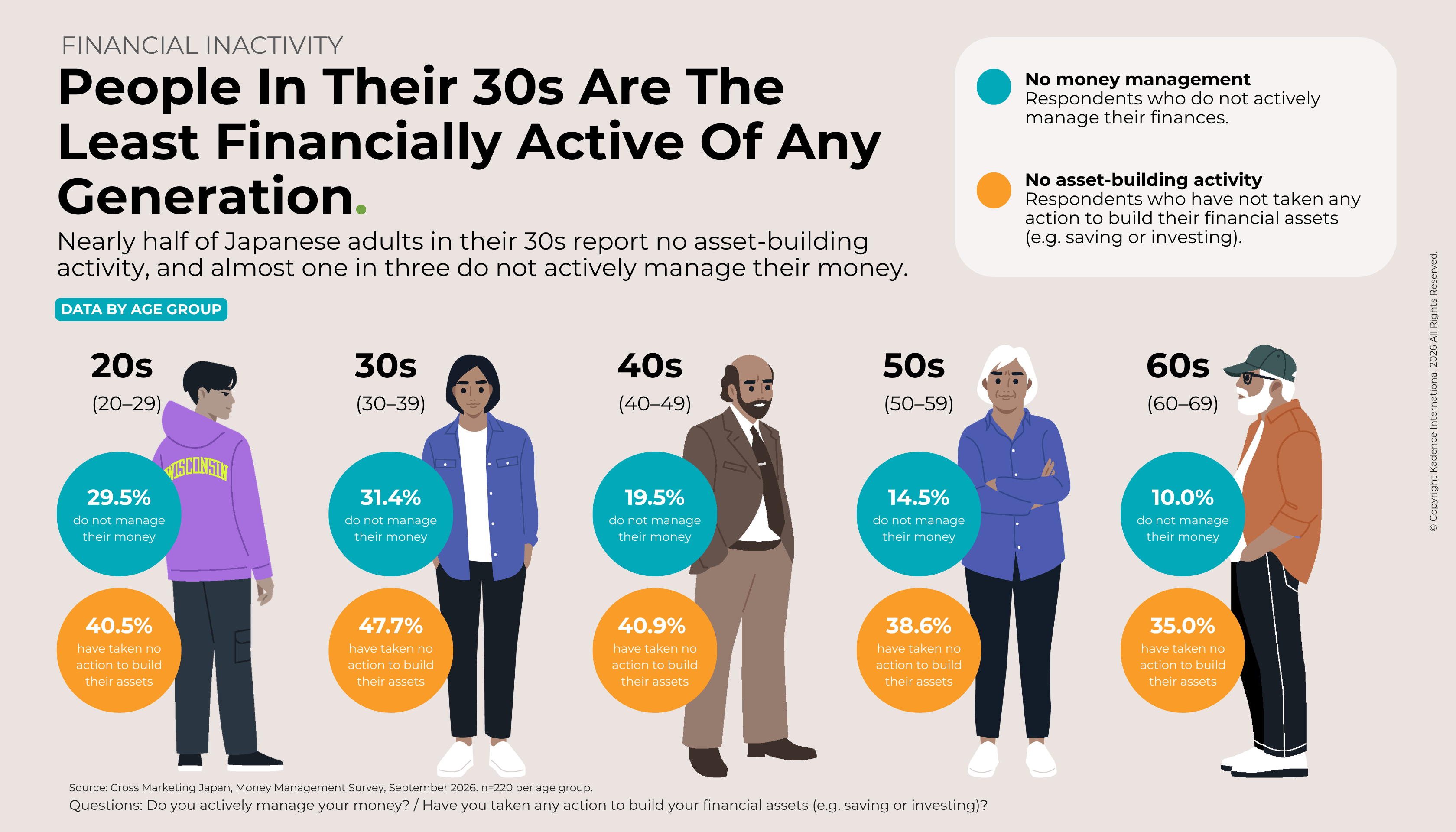
What caught our attention was how few respondents in their 30s said they were interested in investing or building assets but found it difficult. Just 5% selected this response, the lowest proportion of any age group. A further 11.4% were unsure how to save for the future, while the same proportion described money management as bothersome.
We should be careful not to interpret those answers as evidence of financial confidence. Someone who has never seriously considered investing may not regard it as difficult. Equally, someone who understands the process may have little money available to invest. The survey doesn't distinguish between these situations, and that distinction matters.
The question is what is keeping these consumers out of the investment market. Some may understand the products perfectly well but have no spare income to invest. Others may have savings but see little reason to move them out of the bank. Our research points to a gap in participation, although the reasons for it may be quite different from one consumer to another.
The changing economics of adulthood
Marriage, homeownership and children have traditionally influenced when Japanese consumers begin making major financial decisions. A mortgage brings new insurance requirements, children create longer-term savings commitments, and marriage often changes how household finances are managed. Yet these milestones no longer occur at the same ages or necessarily in the same order.
Japan's 2020 census found that 51.8% of men and 38.5% of women aged 30–34 had never married. Even among those aged 35–39, the figures were 38.5% and 26.2%, respectively. For a country where marriage has historically been closely associated with starting a family, these are significant proportions.
The change is also visible in household composition. In 1990, couples with children accounted for 37.3% of Japanese households. By 2020, that share had fallen to 25%. Over the same period, couples-only households increased from 15.5% to 20%.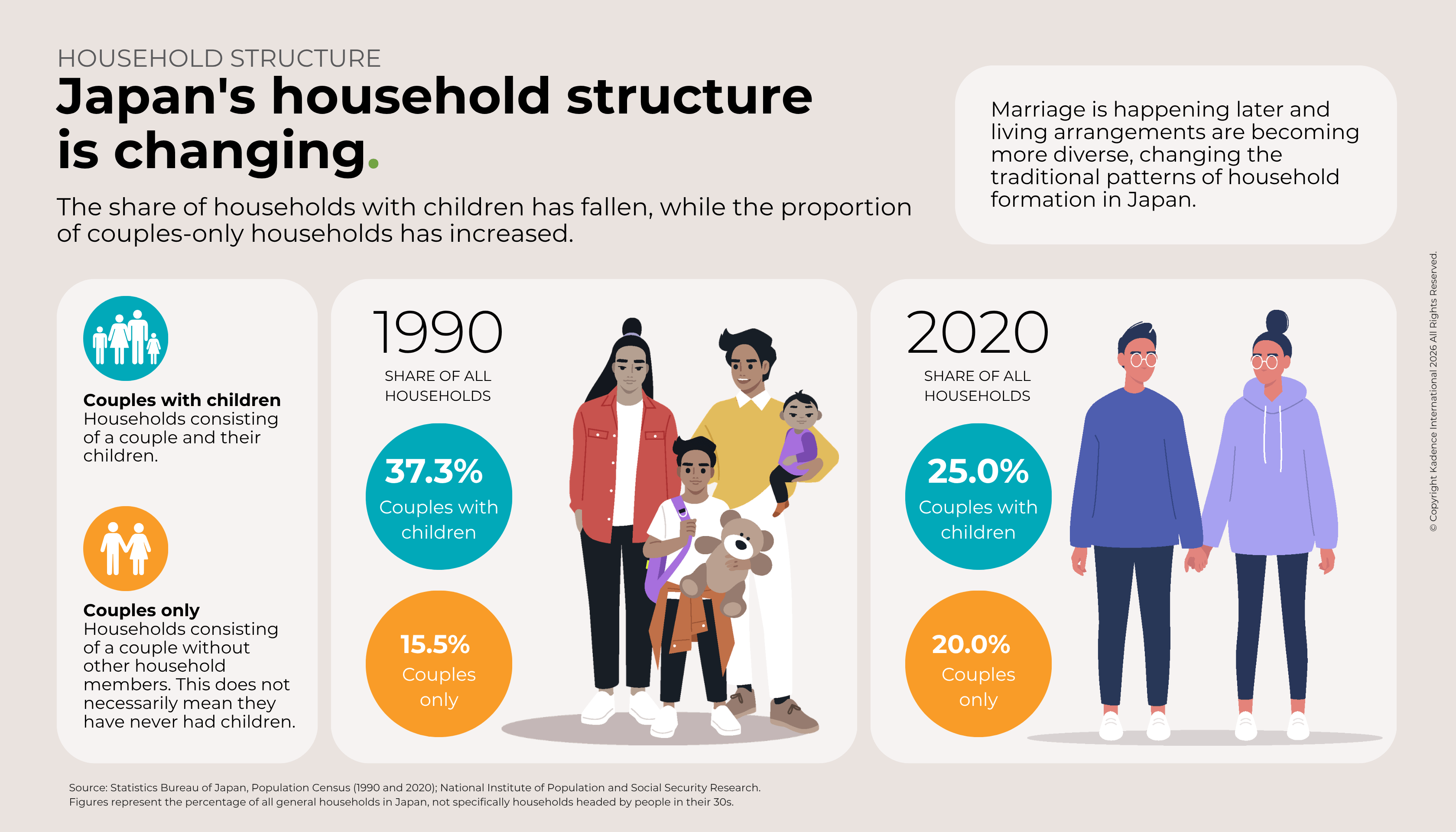
Consider what this means for financial planning. Someone living with their parents may be able to save a considerable portion of their salary, depending on their contribution to household expenses. A single person renting in Tokyo faces a very different monthly budget. Meanwhile, a dual-income couple without children may have more room for discretionary spending or investment than a household paying for childcare and education.
We cannot assume which of these consumers is more financially secure. Living with parents, for example, can be a practical choice rather than a sign of financial difficulty. Nor does remaining unmarried necessarily mean someone has fewer financial responsibilities.
The wealth divide within one generation
Japan's household financial data reveals just how misleading averages can be. According to the Japan Financial and Economic Education Centre's (J-FLEC) 2025 survey, single-person households headed by someone in their 30s held an average of ¥5.01 million (approximately US$31,600) in financial assets. Among households with two or more people, the figure was more than double, at ¥10.96 million (US$69,200).
Those numbers suggest a generation accumulating considerable wealth. Look at the median, however, and a different picture emerges. For people living alone, it falls to just ¥1 million (US$6,300). Even among larger households, the median is ¥3.11 million (US$19,600), less than a third of the average.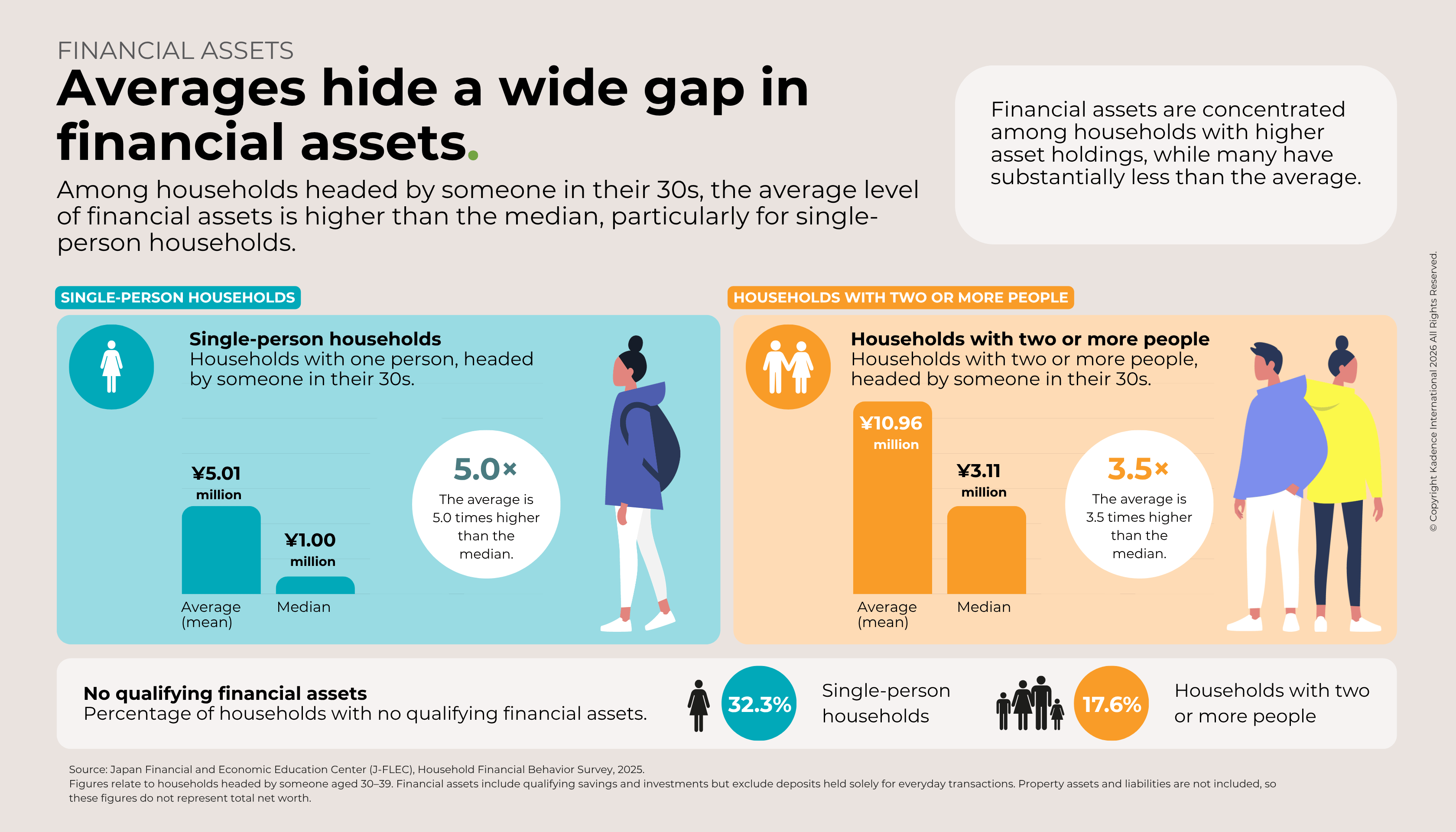
Household size also tells us relatively little about an individual's financial security. Two incomes can make saving easier, but a larger household doesn't necessarily have two earners. Someone living alone may own their home outright, while a couple with substantial savings could also be carrying a large mortgage. Neither situation is fully captured by financial asset figures, which exclude property and outstanding debt.
Consider what the median represents here. Half of single-person households in their 30s have no more than ¥1 million in qualifying financial assets. For someone in that position, an investment proposition focused on long-term wealth accumulation may compete with the more immediate concern of establishing a financial cushion. At the other end of the distribution are consumers who may already be considering how best to invest their accumulated savings.
Both groups appear in the same age bracket, but their starting points are very different.
How SBI Securities is making investing more accessible
SBI Securities offers an interesting example of how Japan's investment industry is trying to reach people who have never considered themselves investors. In October 2024, the company launched a national advertising campaign featuring Mana Ashida, one of Japan's most recognisable young actresses. The creative was deliberately approachable, using a familiar face and simple language to introduce a subject that many consumers have traditionally associated with financial expertise and experience.

IMAGE CREDIT: PRTimes.jp
The advertising was supported by SBI's ZERO Revolution initiative, which had already eliminated trading commissions on eligible domestic stock transactions. With the expansion of NISA providing additional tax advantages, the practical cost of starting to invest had fallen considerably.
Mana Ashida has been a familiar face in Japanese households since childhood. Audiences have watched her grow from a child actress into a young adult, giving her a recognition that spans generations. In SBI's campaign, she brings a sense of familiarity to a subject traditionally associated with financial expertise. The advertising places investing in a more everyday context, without relying on promises of investment performance or the authority of a financial expert.
SBI has not published campaign results that would allow us to determine how many previously inactive consumers began investing as a result of the advertising. Nor was the campaign aimed specifically at people in their 30s.
SBI's strategy makes sense for someone interested in investing but hesitant to begin. Lower fees remove a cost, while familiar advertising helps make the prospect less intimidating. Our research, however, suggests that hesitation may only be part of the picture. With just 5% of respondents in their 30s describing investing as difficult, there may be a much larger group for whom investing is simply not a priority. A campaign designed to make investing easier may have limited impact on consumers who have no immediate reason to start investing.

Where Japan's financial brands may be missing the market
There is a potential blind spot in how Japan's financial institutions measure customer growth. A new investment account doesn't necessarily represent someone who has been persuaded to invest for the first time. It could just as easily belong to an existing investor opening another account or someone who had already decided to enter the market. Those are very different outcomes from a customer acquisition perspective, even if they look equally encouraging in the headline figures.
Our research suggests that Japan's financially inactive consumers may have very different reasons for not investing. Some may have sufficient income but prefer to keep their savings accessible, while others manage on limited disposable income or support family members. There may also be consumers who simply see little reason to invest, regardless of what they can afford. The survey doesn't specify how many fall into each group, but treating them as a single audience risks overlooking what is actually influencing their decisions.
This also changes how we should judge the success of investment marketing. A campaign might generate thousands of new accounts while doing little to persuade people who have never invested before. For a bank, those accounts represent genuine business growth. But for Japan's wider investment market, the more revealing measure is how many people are investing for the first time.
For international brands operating in Japan, understanding where consumers choose to keep their money, what they are prepared to spend and which financial commitments they are postponing could reveal opportunities across housing, insurance, travel and retail. A consumer who has money in the bank but is reluctant to invest presents a very different commercial opportunity from someone whose income barely covers their living expenses.
Reaching the next generation of wealth builders
Japan's investment industry has good reason to celebrate the growth of NISA. Millions of accounts have been opened, and investing is reaching a wider audience. But our research points to a substantial group of 30-somethings whose financial behaviour has yet to reflect that momentum.
There is a difference between winning a customer who is ready to invest and persuading someone who has never seen investing as part of their financial future. The first is largely a question of which provider they choose. The second requires a much better understanding of what they can afford, what they value, and what might persuade them to begin.
Japan has made investing easier. The next test is whether that progress can reach people who have so far found little reason, or little opportunity, to participate.

Understand Japan's consumers with Kadence International
Japan's consumer market requires more than an understanding of demographics or purchasing trends. At Kadence International, our researchers bring deep knowledge of Japanese culture, attitudes and consumer behaviour, helping international brands understand how people make decisions and what influences their choices.
Whether you're entering Japan, developing new products or trying to reach consumers your existing marketing isn't connecting with, we combine local expertise with international research experience to identify opportunities that might otherwise go unnoticed.
Looking to grow your brand in Japan? Get in touch with our team to discuss how we can help.
About the research
The findings in this article are drawn from the Money Management Survey (2026), conducted by Cross Marketing Japan, a sister company of Kadence International. Both companies are part of the Cross Marketing Group. The research was conducted online using the QiQUMO survey platform between September 18 and 19, 2026, among 1,100 men and women aged 20–69 across Japan's 47 prefectures. The sample included 220 respondents in each age group, with an equal split between men and women. The findings reflect respondents' self-reported financial behaviours and attitudes. Original research: Money Management Survey (2026) – Cross Marketing Japan
FAQs
Why are people in their 30s in Japan not building wealth?
Research conducted in September 2026 found that 47.7% of Japanese adults in their 30s reported no asset-building activity. Possible contributing factors include income constraints, housing costs and changing financial priorities. However, the research does not establish a single cause. Financial circumstances also vary considerably between people living alone, with parents or in multi-person households.
How much savings does the average 30-year-old in Japan have?
Why are Japanese people getting married later?
Marriage patterns in Japan have changed alongside employment conditions, living costs, personal priorities and attitudes toward family life. Japan's 2020 census found that 51.8% of men and 38.5% of women aged 30–34 had never married. Delayed marriage and increasingly diverse household structures are changing when consumers encounter traditional financial milestones such as homeownership, insurance and family savings.
What is NISA in Japan and how does it work?
NISA, or Nippon Individual Savings Account, is a Japanese government-backed tax-advantaged investment scheme. It allows eligible residents to invest in qualifying financial products without paying Japanese tax on eligible investment gains and dividends. The expanded scheme introduced in January 2024 offers an annual investment allowance of up to ¥3.6 million and a lifetime tax-exempt holding limit of ¥18 million, making long-term investing more accessible.
How can banks and financial brands attract younger consumers in Japan?
Banks, insurers and fintech companies can improve their relevance by understanding consumers' financial circumstances rather than relying on age-based segmentation alone. Research into household structure, income, existing assets and barriers to participation can reveal underserved groups. Simplified investment products, transparent pricing, accessible communications and financial services tailored to different living arrangements may help brands engage first-time investors and build longer-term customer relationships.