

Around the world, consumers expect transactions to happen instantly, at any hour, and increasingly care less about which institution sits behind the payment than whether the experience is fast, simple, and reliable.
That shift in behaviour is beginning to reshape banking itself. Payments can now be initiated through wallets, marketplaces, and apps, while the money itself remains with a bank in the background. The Bank for International Settlements’ Project Agorá has brought together major central banks and more than 40 financial institutions to test tokenised commercial-bank deposits and central-bank money on shared infrastructure, opening the door to transactions that can carry conditions, rules, and instructions within the payment itself.
AI pushes the model even further with software agents that can search, compare, recommend, and prepare transactions on a customer’s behalf, creating new questions around authorisation, discretion, liability, and intent. If a customer delegates part of a financial decision to software, the bank may need to understand not only who is acting, but whether the action reflects what the customer actually intended.
For decades, banks held the money, verified the customer, provided the interface, moved the payment and controlled most of the relationship. That bundle is beginning to come apart, with different companies and technologies taking ownership of different pieces.
Over the next 20 years, banks could find themselves operating in a system where money is programmable, AI agents act on behalf of customers, identity becomes a service in its own right, payment rails behave more like shared infrastructure, and cross-border banking feels much closer to moving money domestically.
7 shifts that could reshape banking
1. Money itself becomes programmable
Project Agorá is one of the clearest signs that programmable money is moving beyond theory. In July 2026, 28 financial institutions and central banks across Asia, Europe, and North America completed real-value transactions using tokenised commercial bank deposits and central bank reserves. The test covered 17 scenarios, and settlement took about 80 seconds on average.
The 80-second settlement time is striking, but the bigger development is what can happen inside the transaction. Hyun Song Shin, BIS economic adviser and head of research, describes tokenisation as combining record-keeping with “the rules and logic that govern transfers.” In practice, that means money can be set to move when certain conditions are met, with built-in payment, settlement, and compliance rules.

Photo credit: Bloomberg, Hyun Song Shin
J.P. Morgan is already using this model commercially through Kinexys. Its blockchain business has processed more than $3 trillion since launch and now supports 24/7 payments, on-chain FX, and programmable treasury across eight currencies.
Over time, banks may increasingly determine not just where money moves, but when and under what conditions.
2. AI agents become bank customers
India is preparing for a world in which some payments are initiated by software rather than by a person tapping a screen. Its proposed Unified Agent Protocol would allow AI agents to make small UPI payments under preset rules, with built-in spending limits, identity checks, and liability controls.
Mastercard has already completed authenticated agentic-commerce transactions in India using cards issued by Axis Bank and RBL Bank, with merchants including Swiggy, Instamart, Vodafone Idea, Tira, and Zepto.
Mastercard’s trial points to a much bigger change if agentic payments scale. An AI agent could eventually pay bills, move spare cash into savings, compare financial products, renew subscriptions, or choose how to pay for a purchase within limits set by the customer. Banks would then be serving both the account holder and the software acting on their behalf, with products, permissions, and safeguards designed for each. Authorisation and liability will still matter, but so will a more commercial question: which bank becomes easiest for an AI agent to use?
3. The bank account stops being the main interface
In the UK, open banking now supports more than 19 million active user connections and more than 40 million payments a month. Around 80% of API traffic is generated by account-information services, where customers allow third parties to pull financial data from their banks and use it elsewhere.
Those connections are pulling more financial activity outside the bank’s own app. A budgeting service can bring several accounts into a single view, a retailer can offer account-to-account payments at checkout, and a lender can assess affordability without sending the customer back to their bank.
All this will create a much looser relationship between the account and the customer experience. A bank can hold the deposit while another company becomes the place where the customer checks balances, moves money, compares options, or decides what to do next.
Wallets, marketplaces, fintechs, and eventually AI assistants could take on more of that front-end role. The bank would still provide the account and the underlying regulated infrastructure, while another company would become the place where the customer actually manages the relationship.

4. Banking starts becoming public infrastructure
The World Bank is helping more than 80 countries build or expand digital public infrastructure covering payments, digital identity, and secure data exchange. There is still a long way to go: only 8% of lower-middle-income countries currently have fast, inclusive payment systems.
Some of the biggest changes are happening in countries where access itself has been the problem. In the Philippines, the national PhilSys identity program has helped open 8 million new bank accounts. In Nigeria, more than 100 million National Identity Numbers have now been issued, linking more people to formal services and digital payments.
As governments build shared systems for identity, payments, and data, banks may have less reason to build every part of the customer journey themselves. They can plug into common infrastructure and compete through the services layered on top of it, including lending, advice, wealth, fraud protection, and other financial products.
5. Identity becomes a financial product
Digital identity is moving beyond just proving who someone is when they open an account. The next step is a reusable identity that can travel with the customer across financial services, commerce, travel, government services, and digital platforms.
The World Bank estimates that 2.9 billion people still lack digital IDs suitable for online transactions, while banks in mature digital markets face the opposite problem: synthetic identities, deepfakes, and AI-generated fraud are making it harder to verify a person's identity.
Companies are starting to build identity systems that work across services rather than inside a single account. Mastercard’s Account Owner Verification, for example, uses open-finance data and more than 100 million financial institution connections to check whether a customer’s identity details match existing records.
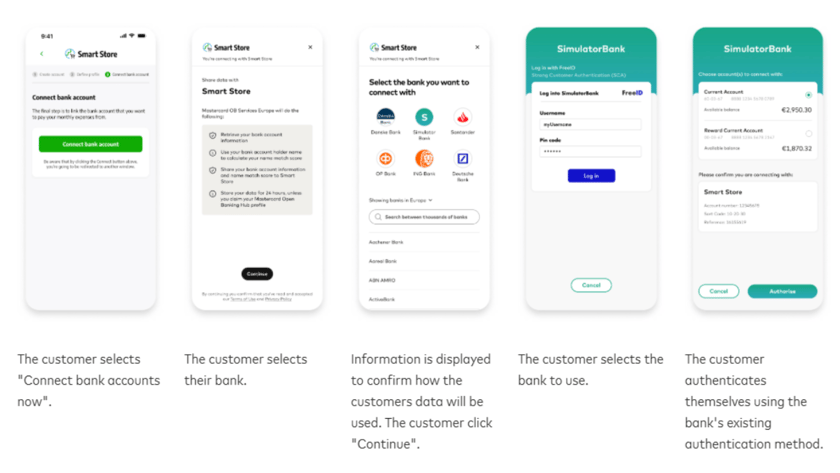
Image Credit: Mastercard
Over time, banks could use the identity systems they already maintain for far more than account opening. A verified bank identity could help customers sign up for other services, authorise an AI agent, prove product eligibility, or move between platforms without repeatedly submitting documents and personal information. That turns identity from a compliance task into something customers can actually use.
6. Fraud prevention moves from identity to intent
Bank fraud systems have traditionally focused on whether the person making the transaction is really the account holder. AI makes that question less useful on its own.
A customer can be genuine and still be manipulated into approving a scam. An AI agent can be properly authorised and still go beyond what the customer intended. A synthetic voice or video can persuade someone to send money themselves, leaving the transaction technically authorised even though the decision was compromised.
Fraud systems will need to look beyond identity and examine the context around the decision: what the customer normally does, what an agent was authorised to do, what the transaction was for, and whether the action matches the customer’s instructions.
Mastercard chief digital officer Pablo Fourez puts the problem plainly: “How do we know an agent is doing exactly what we asked and nothing more?” Mastercard is working with Google on Verifiable Intent, which is designed to show what a user actually authorised an AI agent to do. The question is shifting from “is this really you?” to “is this really what you asked for?”
7. Cross-border banking starts behaving like domestic banking
More than 70 countries now have domestic instant-payment systems that can move money in seconds at very low cost. The next step is connecting those systems to one another. BIS-backed Project Nexus is being taken into live implementation by the central banks of Indonesia, Malaysia, the Philippines, Singapore, and Thailand, with the aim of letting cross-border payments move between national systems in under a minute in most cases.
Europe is moving in the same direction. Since October 2025, the ECB’s TIPS system has allowed cross-currency payments between the euro area, Sweden, and Denmark to settle in seconds. It is now working on links with Switzerland and Brazil, as well as a wider Nexus connection.
Payments that now pass through correspondent banks, cut-off times, prefunding, and rounds of reconciliation could increasingly move through linked national systems in near real time.
That would make cross-border payments faster and easier, but it would also put pressure on the fees and processes that have grown up around the complexity of cross-border payments. Banks would still have an important role in foreign exchange, compliance, credit, and trade finance, but simply moving money from one country to another may become a much less distinctive service.

What this means for banks
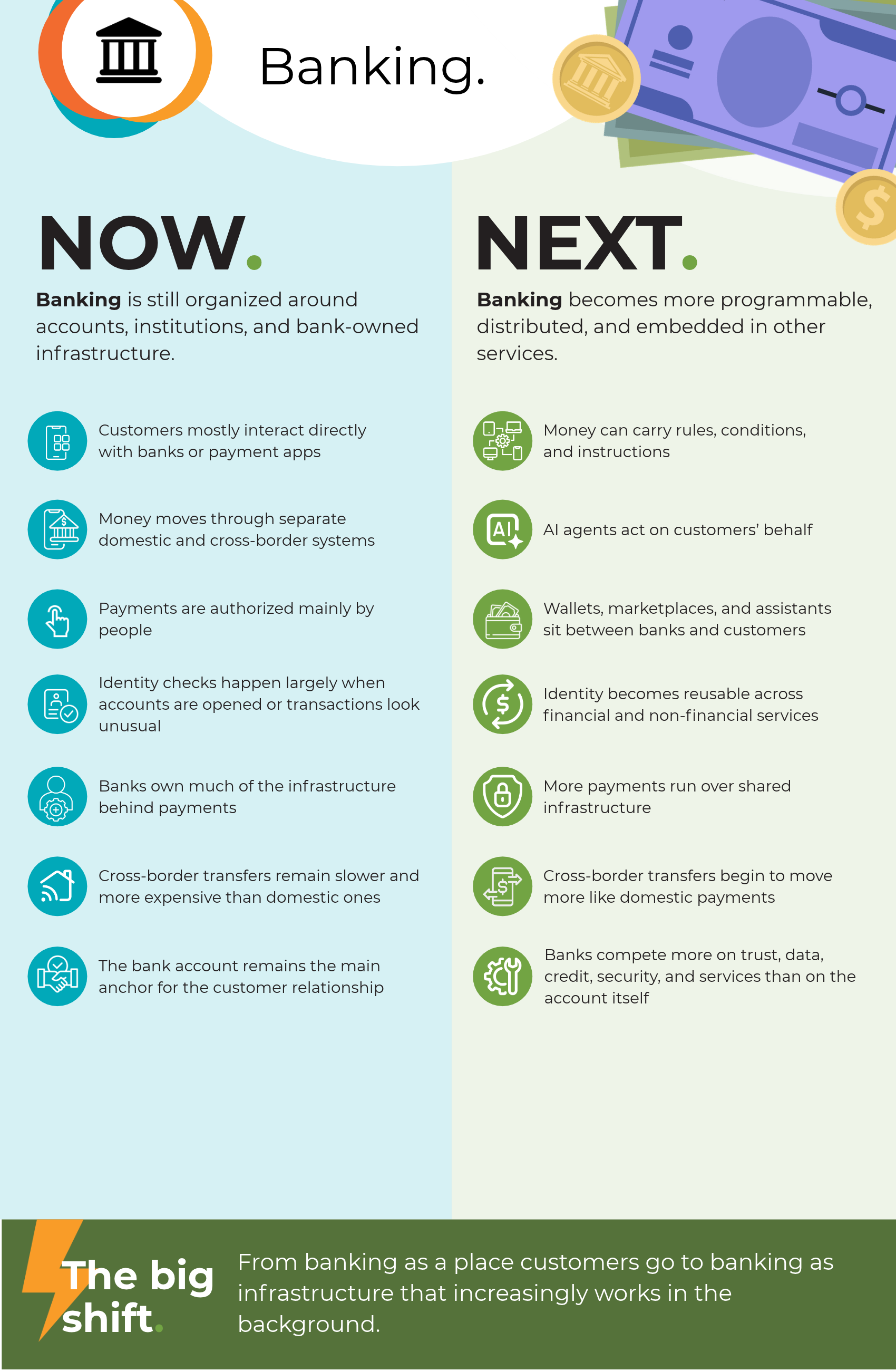
Banks are unlikely to disappear from the system, but they could end up doing more of the regulated, capital-intensive work while other companies take a larger share of the customer relationship.
If the payment starts in a wallet, the recommendation comes from an AI assistant, identity is verified elsewhere, and the transaction runs over shared infrastructure, the bank may still hold the deposit without controlling much of what the customer sees or does.
A bank may know where the money is held, but another company may know what the customer is trying to buy, what they compared first, whether they need credit, and what they are likely to do next. Those signals sit closer to the decision and can shape which product gets chosen, when credit is offered, and who gets the next interaction.
Banks still bring things that are difficult to replicate: trust, balance-sheet strength, credit, fraud protection, years of financial history, and the ability to operate safely at scale. The problem is that those strengths may sit further from the customer if wallets, marketplaces, or AI assistants become the place where products are compared and decisions are made.
Margins could move as well with payments that once generated fees becoming cheaper as shared rails and instant settlement expand. Cross-border services could become less lucrative if more of the friction disappears. At the same time, spending on fraud, identity, cybersecurity, AI controls, and infrastructure is likely to rise.
Some of the value may end up sitting behind the scenes. Banks that can verify identity, authorise agents, detect manipulated behaviour, manage programmable payments, and connect easily into external platforms may become more useful to customers and partners even if their own brand is less visible in the transaction.
That creates a different kind of competition. Banks will still compete with other banks, but also with wallets, fintechs, tech companies, marketplaces, payment networks, identity providers, and AI platforms. In many cases, the fight will be over who controls the point of decision rather than who holds the account.
The winners are likely to be the banks that can do both: remain trusted financial institutions while becoming easy to plug into, easy to partner with, and difficult to replace.
Which trends deserve investment?
Not every shift needs the same level of investment today. Programmable money and faster cross-border settlement are already far enough along to justify serious work in treasury, payments, and infrastructure. The technology is being tested by central banks and used commercially by large financial institutions, so the question is increasingly whether it creates enough value to change how money moves.
AI agents deserve a different kind of attention. The opportunity is large, but the rules around authorisation, liability, fraud, and consumer protection are still taking shape. Banks should be researching where customers are comfortable delegating decisions, what limits they expect, and how much control they want to keep.
Identity and intent sit somewhere in between. The problem is already here, with synthetic identities, deepfakes, and authorised payment scams forcing banks to rethink how they verify people and transactions. Investment in these areas is less about predicting the future and more about keeping pace with fraud that is already becoming harder to detect.
Shared payment infrastructure will vary more by market. In countries where governments and central banks are quickly building common rails, banks may need to rethink which parts of the customer journey they still need to own. In other markets, the change will be slower.
The most useful research now is not asking whether these technologies will exist. It is about finding out where customers will trust them, where they will hand over control, which services they still want from a bank, and which parts of the relationship they are willing to move elsewhere.
Talk to Kadence
Banking is moving into areas where technology, regulation, and customer behaviour will not develop at the same pace. The opportunity is in knowing which changes are ready to scale, which still depend on trust or regulation, and where customers will accept a different kind of banking relationship.
Kadence helps financial services brands understand how those shifts are playing out across markets, what customers are ready for, and where investment is most likely to pay off.
Talk to Kadence about where the banking industry is heading NEXT.
FAQs
What will banking look like in the future?
Banking is likely to become more embedded, automated, and less tied to a single institution. Customers may use wallets, marketplaces, AI agents, and shared payment systems while banks continue to provide deposits, credit, identity, security, and regulated financial infrastructure behind the scenes.
How will AI change banking?
AI is moving beyond customer service and fraud detection. Software agents are beginning to compare products, prepare transactions, and act on a customer’s behalf. That will force banks to rethink authorisation, liability, fraud controls, and how much financial decision-making customers are willing to delegate.
What is programmable money?
Programmable money is money that can carry rules or conditions as part of the transaction. A payment could be released only when certain requirements are met, compliance checks are completed, or another event takes place. Banks and central banks are already testing these models using tokenised deposits and central-bank money.
Will banks lose control of the customer relationship?
They could lose parts of it. Customers increasingly make payments and financial decisions through apps, wallets, marketplaces, and other platforms rather than directly through their bank. Banks may still hold the money while another company controls the interface, product recommendation, or point of purchase.
How will digital identity change banking?
Digital identity could move beyond account opening and fraud checks. Verified identity may eventually be used across banking, commerce, travel, government services, and AI-enabled transactions, allowing customers to prove who they are without repeatedly submitting the same documents and information.