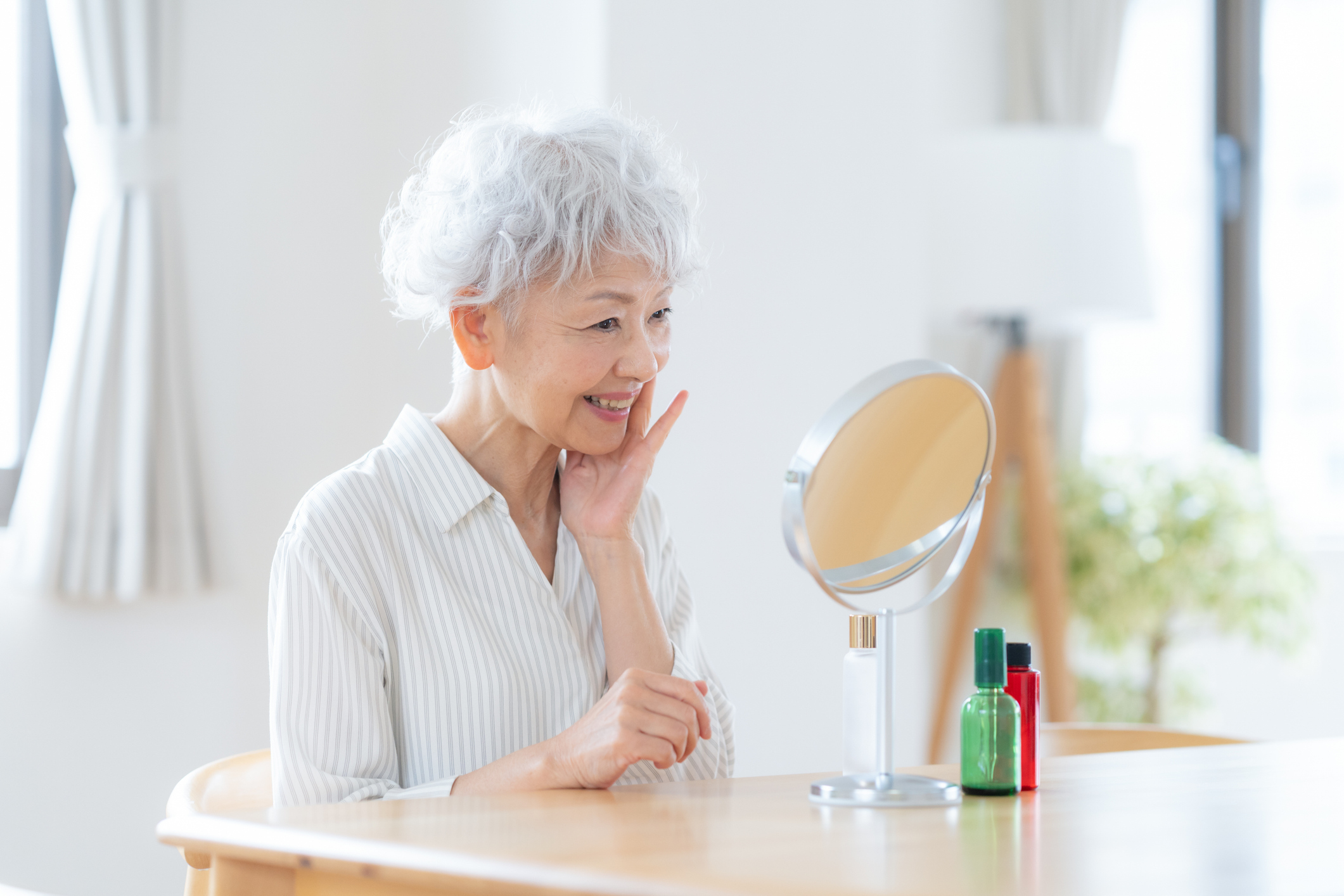

In February 2025, Yoshiko Abe joined a makeup class at her Tokyo housing complex, shortly before her 89th birthday. As reported by The Associated Press, Abe remains active and goes to the gym daily. The class gave her an opportunity to return to cosmetics after several years away.
The session was part of Shiseido’s beauty education work with older people. Keio University business professor Akira Shimizu told the Associated Press that older Japanese consumers remain interested in clothing, makeup, luxury and health products. He described them as “cool grandpas and cute grannies.” In the class, cosmetics formed part of a wider routine involving activity, confidence and social participation.
In 2025, people aged 65 and over accounted for 29.4 per cent of Japan’s population, or 36.19 million people, according to Japan’s Ministry of Internal Affairs and Communications. More than 9.3 million people in that age group were still working in 2024.
The Japanese beauty market is moving in more than one direction. Shiseido, the Japanese cosmetics company, shifted the communication focus for MAQuillAGE, its makeup brand, toward people in their 20s. Kao, the Japanese consumer goods company, created UNLICS, a cosmetics brand for Gen Z men.
For brands allocating product, media and innovation budgets, the question is what age-based segmentation leaves out about the customer, the purchase occasion and the problem a product is expected to solve.
Older consumers are not one beauty market
The 65-plus figure shows the size of the population. It does not show who is still working, travelling, experimenting with new products, maintaining a long-established routine or dealing with changes in eyesight and dexterity.
Consider a working consumer in her 60s who wants makeup that lasts through a long day, a frequent traveller in her 70s who values portability and speed, or someone in her 80s who needs a dispenser that is easier to press. Each person falls within the same age bracket. The purchase occasion is different.
Japan’s official household expenditure data provides another view. The 2024 Family Income and Expenditure Survey, available through the country’s e-Stat statistics portal, includes cosmetics spending data by the household head's age. It does not identify the individual products bought, the brands chosen or whether the household will continue purchasing from the same company.
The household remains the unit of measurement. A product team still has to determine whose routine, need, or difficulty falls within the spending figure.
Recruitment spending leaves the next purchase unanswered
Kao’s launch of UNLICS demonstrates how the company approaches recruitment. The cosmetics brand was created for Gen Z men who see beauty as more than conventional grooming. Its launch included makeup, skin care, digital tools and beauty influencers involved in product development and communication.
Kao reported a 17 per cent rise between 2017 and 2021 in the number of teenage and male consumers in their 20s purchasing cosmetics. Its research identified an even complexion, confidence and self-expression among the reasons men gave for using beauty products. UNLICS was developed around those findings.
MAQuillAGE has taken a different route. Its brand manager described a move away from television advertising toward digital content, usage tips and recommendations that consumers would want to share, according to Shiseido.
Neither launch shows what happens after the product trial. A customer who frequently changes brands and purchases selectively produces a different revenue pattern than one who maintains a trusted routine. Brand records and customer research have to distinguish between those relationships.
The same budget can fund recruitment, product renovation, customer support or loyalty activity. Choosing one use limits the others.

Hair care shows the cost of a broad product brief
The demographic story can make a larger anti-ageing skin-care pipeline appear to be the obvious response. Hair-care research points to a more specific set of needs.
Mintel’s research on Japan’s hair-care market found that younger women were more likely to buy new treatment products, while older consumers showed greater interest in products addressing age-related hair concerns. Among women aged 60 to 69, 11 per cent said they would buy two-in-one shampoo, and 10 per cent said they wanted products for hair regrowth and thinning.
A two-in-one product reduces the number of steps in a routine. A product for thinning hair addresses a different concern. The formula, claims, packaging and route to market would have to respond to different reasons for purchase.
Mintel’s figures do not show whether the appeal of two-in-one shampoo comes from convenience, fatigue with a long routine or a desire to spend less time on hair care. They do not show whether interest in thinning products is prompted by a visible change, a loss of confidence or advice from a salon or retailer.
The brief still has to specify when the product is used, what problem it solves and why someone would switch.
Packaging can reveal what surveys miss
Shiseido’s BENEFIQUE case provides a direct view of a problem that appeared during use.
Users told the company that the pump on a BENEFIQUE lotion and emulsion bottle was difficult to press. The bottle also became unstable as the contents ran down. One comment came from a woman in her 70s, who said the dispenser was hard to use.
Shiseido shortened the bottle, made the pump easier to press and widened the base. The revised container was more stable and easier to store in a vanity drawer, according to the company’s sustainability reporting.
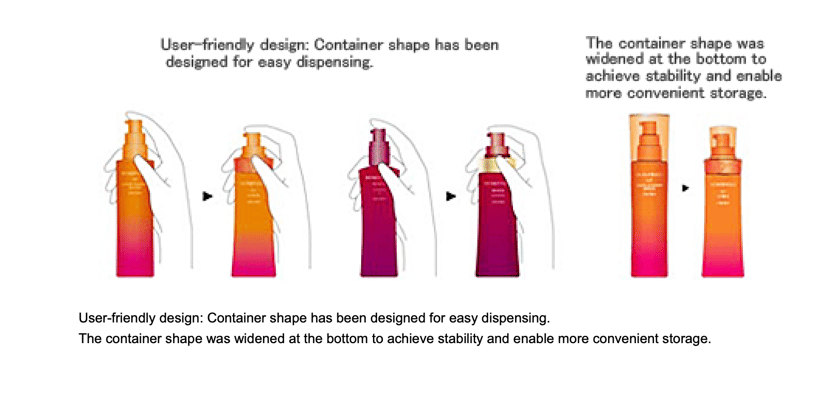
Image: Shiseido Company, Limited.
The difficulty emerged through a sequence of ordinary actions: opening, holding, dispensing and storing the product. A conventional age profile would not identify that sequence.
Shiseido’s work on PRIOR, its beauty brand for middle-aged consumers, followed a similar principle. Designers used repeated trials and sensitivity testing to develop packaging that was easier to handle without abandoning visual appeal. The polyhedral shape helped prevent slipping, while the cap was refined to allow consumers to open it without straining.
The unresolved question is whether the same problem appears often enough across related products to justify applying the change more widely.
Marketing can change the audience around a brand
KATE, Kao’s makeup brand, used anime, music and a virtual character in its 2025 “LIGHTS ON SHADOW” campaign. The campaign connected KATE’s shadow-enhancing makeup with Japanese beauty culture, animation and music across several Asian markets. Kao has identified KATE as one of its strategic global growth brands.
Kao said the campaign was intended to expand KATE’s international presence and express its makeup philosophy through a broader cultural partnership. It establishes what the investment was designed to do. It does not show whether consumers returned to the brand or spent more after seeing it.
A consumer can comment on a campaign without becoming a frequent buyer. Another can produce little visible social activity and continue purchasing through stores, recommendations or a familiar routine.
The cultural setting can alter who sees a brand as relevant. A youth-oriented campaign can attract new attention while making some existing customers feel that the brand has moved away from them. The choice of brand architecture determines what happens to that attention.
Customer value is a financial question
Younger consumers are often treated as long-term prospects, while older consumers are treated as a declining base. The assumption can enter customer-value models before it appears in a product plan.
A regular buyer later in life can generate more current revenue than a younger consumer who switches brands and makes selective purchases. That buyer may also respond to new products within a trusted category. This is a commercial possibility, not a conclusion established by Japan’s demographic data.
Purchase frequency, switching behaviour, category involvement, response to new products and willingness to pay provide a clearer view of the relationship. Official expenditure data can show how spending varies by the age of the household head, but it cannot indicate whether the purchase came from a committed beauty user, a first-time buyer, or someone shopping for another household member.
The return required from adapting an existing product depends on which of those relationships the company is trying to change.
The portfolio decision comes before the next market
A Japanese growth plan in the beauty and personal care category has to decide what evidence would justify changing the product, the package, the proposition or the brand.
A specific hair concern may support a product adaptation. A shorter routine may require a different formulation or usage message. A packaging problem may justify a change across several lines rather than a specialist offer. A makeup occasion may call for guidance and communication rather than another product.
The available evidence is uneven. Spending data can indicate the size of the households involved, while brand records reveal what customers do over time. Interviews and observed use provide the closer view of why a product enters, stays in or leaves a routine.
Before carrying the plan into another market, companies will have to determine which customers receive a new product, which receive a more usable version of an existing one and which do not justify another line.
Market research can show which differences affect the product, the package, or the customer's value. Kadence International helps beauty companies make those decisions in Japan before committing to another line or wider investment.
FAQs
What is age-based segmentation in the beauty industry?
Age-based segmentation groups consumers according to age. In Japan, the article shows why age alone may not reveal differences in routines, purchase occasions, product needs or customer value.
Why is Japan’s aging population important to beauty brands?
People aged 65 and over represented 29.4 per cent of Japan’s population in 2025. Their continued activity, employment and engagement with beauty make the group commercially significant, but it is not a single market.
What can beauty brands learn from Shiseido’s makeup classes?
Shiseido’s classes show that makeup can be connected to confidence, dexterity, social participation and active later life. They also show why beauty engagement cannot be measured only through age or spending data.
How can packaging research help beauty companies?
Observed use can reveal problems that surveys miss. Shiseido’s BENEFIQUE case showed how an unstable bottle and difficult pump led to changes in the container’s shape, base and dispenser.
What research should beauty brands conduct in Japan?
Brands can combine household spending data, customer records, interviews and observed-use research. Together, these methods can show who buys, how often they buy, what problems they encounter and whether a new product or improved existing offer is justified.