

Indonesia's economy grew by 5.29% in the second quarter of 2026. Yet that growth has not been accompanied by the expansion of the middle class that many businesses anticipated.
Working with brands here in Indonesia, I keep coming back to one question: If our economy continues to grow, why are so many households still struggling to achieve the financial security traditionally associated with middle-class status?
Rising household incomes have long featured in growth projections for Indonesia, particularly in consumer categories where businesses expect people to buy more frequently and gradually trade up. But the growing number of Indonesians classified as aspiring middle class does not necessarily mean more households can afford those purchasing habits.
A company can be right about Indonesia's economic prospects and still overestimate demand for its products. The difference between a consumer who aspires to buy something and one who can afford to buy it regularly has direct consequences for market sizing, pricing, and investment.
The middle class is moving in the wrong direction
Indonesia's shrinking middle class is not simply a legacy of the pandemic. The decline continued into 2025, while the number of people aspiring to join it kept growing.
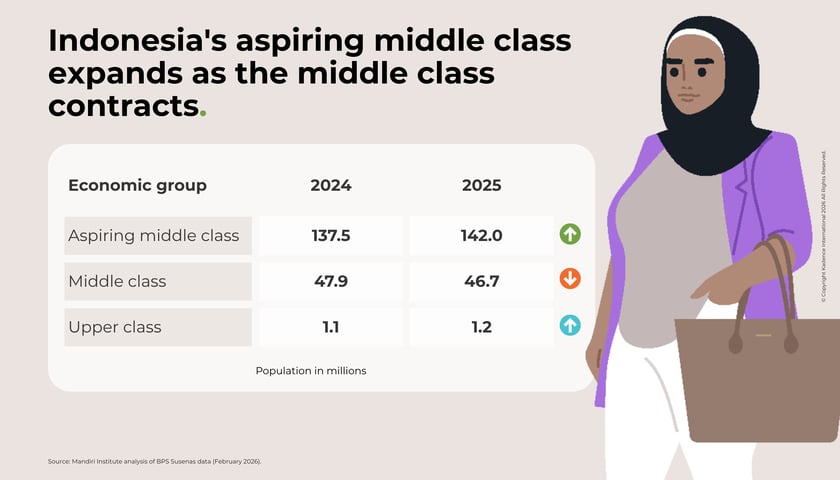
According to Mandiri Institute's analysis of BPS data, the middle-class population fell from 47.9 million in 2024 to 46.7 million in 2025. Meanwhile, the aspiring middle class grew from 137.5 million to 142 million, and the upper class increased slightly from 1.1 million to 1.2 million.
These groups are defined by how much people spend, rather than what they earn. BPS classifies the aspiring middle class as those spending between 1.5 and 3.5 times the national poverty line, while the middle class spends between 3.5 and 17 times that amount.
Wisnu Setiadi Nugroho, an economist at Universitas Gadjah Mada, has highlighted the difficult position of the aspiring middle class. Many households earn enough to fall outside government assistance programs but still have little financial protection when unexpected expenses arise.
It's tempting to see Indonesia's growing aspiring middle class as good news for consumer brands. But if that group keeps growing while the middle class itself gets smaller, we need to ask what's happening to people's ability to move up. More Indonesians may be earning enough to get by without necessarily earning enough to get ahead.
The problem starts with the quality of jobs
Indonesia is creating jobs, but too few offer the earnings and stability that allow households to move comfortably into the middle class. Having a job and being financially secure are not necessarily the same thing.
The World Bank's June 2026 Indonesia Economic Prospects report puts the scale of the problem into perspective. In 2018, 14.5% of Indonesian workers earned middle-class wages. By 2025, that figure had fallen to 7.1%.
And this is not limited to lower-skilled employment. Over the same period, real wages declined by approximately 1% per year in medium-skilled occupations and by 2% per year in high-skilled roles. Among university-educated workers, the proportion in formal wage employment dropped from 74.1% to 67.8%.
We can see why this matters when we consider how Indonesian households manage their finances. A regular salary may cover daily expenses without leaving much room for savings, unexpected costs, or larger purchases. Even modest income gains may not translate into increased spending if households remain concerned about their financial security.
The consequences extend beyond today's household spending. When even skilled workers struggle to improve their real earnings, the route into the middle class becomes less predictable. For companies counting on Indonesian consumers gradually trading up as their careers progress, that creates a problem with the assumptions behind long-term growth forecasts.

How much room is left after food?
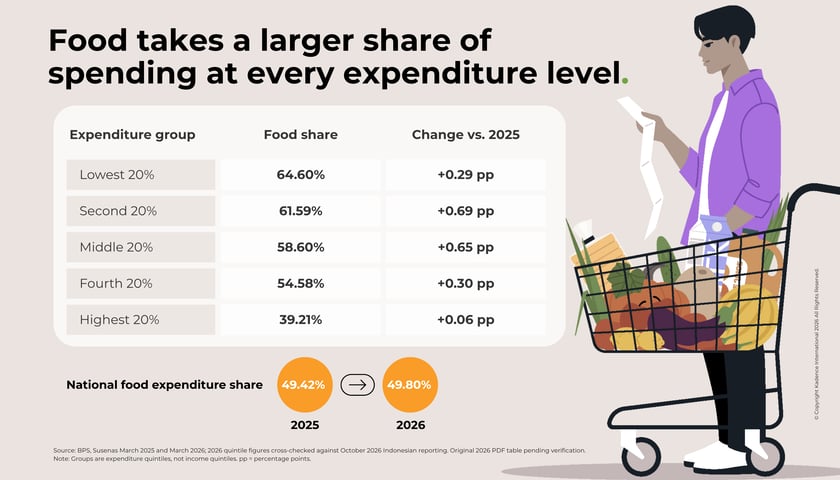
The latest figures from Statistics Indonesia (BPS) show that food accounted for 49.80% of household expenditure in March 2026, up slightly from 49.42% a year earlier. The national average, however, conceals a much bigger divide in how Indonesian households spend.
Among the lowest-spending 20% of households, nearly two-thirds of expenditure (64.60%) goes toward food, compared with 39.21% among the highest-spending 20%. For one group, food purchases consume most of the household budget. For the other, there is considerably more room to decide where the money goes.
Food's share increased across all five expenditure groups, with the largest rises among the second and middle quintiles. The increases were modest, but the differences between households are anything but.
A larger share of spending on food doesn't necessarily mean households are cutting back elsewhere. Prices and purchasing habits can shift these proportions without a corresponding fall in spending on other categories. The figures show how household budgets are distributed, not why consumers make particular choices.
Two Indonesian households may shop at the same retailers, use the same digital platforms, and buy many of the same brands, yet make very different decisions about what deserves a place in their budgets. One might wait for a promotion, another might switch pack sizes, while a third continues paying more for products they consider worth it. Those choices are difficult to explain through expenditure statistics alone.
Indonesian consumers are not simply trading down
Financial pressure doesn't stop Indonesian households from spending on the occasions that matter to them. During Ramadan 2024, NielsenIQ found that overall household expenditure rose by approximately 20% compared with the preceding period, while spending on fast-moving consumer goods (FMCG) increased by less than 10%. The gap suggests that much of the additional spending was directed beyond everyday consumer goods.
Leisure and fashion accounted for much of the additional spending, reflecting the importance of Lebaran preparations. Even while choosing more affordable everyday products, consumers continued to spend on clothing and experiences associated with the holiday.
Indonesians were making different trade-offs depending on what they were buying. More affordable food and beverage brands gained ground, while premium beauty, personal-care, and healthcare products continued to attract spending. Online sales also rose by more than 20%, with promotions and competitive prices helping to drive purchases.
Ramadan is a distinctive spending period, and these findings should not be taken as representative of the entire year. They do, however, expose a weakness in the assumption that financially pressured consumers simply trade down. The more useful question is which products Indonesians are prepared to economise on and which they continue to prioritise, even when household budgets are tight.
Are smaller packs creating growth or protecting sales?
Small packs have been part of Indonesian retail for decades. You'll find them in neighbourhood warungs and modern retailers, bought by consumers across income groups for all sorts of reasons. The interesting question today is whether those reasons are changing.
In 2025, Unilever Indonesia highlighted Rp1,000 (US$0.06) Bango soy sauce and Rp500 (US$0.03) Rinso detergent packs as part of its affordability strategy. In the first half of 2026, the company reported domestic sales growth of 7.1% and underlying volume growth of 7.3%, alongside improvements in distribution and retail execution. We don't know how much of that growth came from smaller packs.
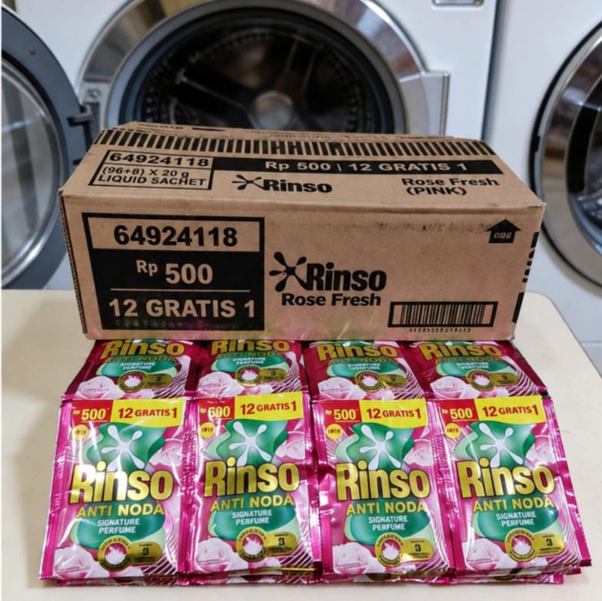
Image credit: Shopee.co.id
Price per use isn't always the deciding factor for Indonesian shoppers. Someone may know perfectly well that buying a larger pack works out cheaper, but still choose a sachet because they have a limited amount to spend that day. Others buy small quantities because they're convenient, because they want to try something new or because they simply don't need more.
I'd be interested in whether more households are moving from larger packs to smaller ones, and whether they're shopping more frequently while spending less overall. Equally important is whether these formats are bringing new customers into a brand or simply helping existing customers continue buying it.
Those patterns can produce similar sales figures but have very different implications for a company's business. Recruiting new households creates opportunities to build future demand. Retaining customers who are under financial pressure may require a different approach to pricing, pack sizes, and profitability.
Small-pack sales have never told the whole story of Indonesia's consumer market. Today, with pressure on household purchasing power, I'd be particularly cautious about treating stronger volumes as evidence that consumers are becoming more prosperous.

Where Indonesia's next consumer growth may come from
Indonesia has 142 million people classified as the aspiring middle class. It's a figure that naturally attracts the attention of global brands, but it tells us little about the size of the market for any particular product. Even households within the same economic group may have very different spending priorities, access to retail, and willingness to pay.
The national decline also conceals a more uneven picture across Indonesia. Mandiri Institute's provincial analysis found that the middle class increased in West Java and East Java in 2025, even as it contracted nationally. Other provinces saw their middle-class populations shrink.
From Jakarta, it's easy to underestimate how much consumer markets differ across Indonesia. Success in the capital tells us surprisingly little about how a product will perform in Surabaya, Medan, or Makassar. The retail channels people use, the brands available to them, and the prices they encounter can vary considerably. So can the reasons they choose one product over another.
Working with both Indonesian and international brands, I've seen how easily national market projections can obscure the differences between regional markets. A strong forecast for Indonesia as a whole won't tell a company where to launch a premium range, which products need a more affordable price point, or whether expanding distribution beyond Java will generate enough demand to justify the investment.
The questions I would want answered before making those decisions go well beyond household income. When consumers have more money available, which categories benefit? Are premium purchases becoming regular habits or remaining occasional treats? Where are people willing to pay more for better quality, and where are they unwilling to pay more?
None of those questions can be answered by knowing how many Indonesians fall into each economic group. They require consumer research across Indonesia's urban and rural markets, looking at what people buy, how often they buy it, and what they're willing to pay. Research concentrated in Jakarta or other major cities risks overlooking differences in purchasing power, shopping habits, and access to products elsewhere in the country.
Indonesia's consumer opportunity hasn't disappeared because its middle class has contracted. But the next phase of growth is unlikely to follow a predictable path from rising incomes to higher spending. It may come from smaller cities, from products that fit how households actually manage their money, or from categories consumers continue to prioritise even when budgets are tight. For brands investing in Indonesia, the challenge is finding those pockets of demand before committing to the wrong assumptions about who their customers will be.
At Kadence Indonesia, we help brands understand how consumers make purchasing decisions, what drives their spending priorities, and where opportunities for sustainable growth exist. Speak with our Indonesia team about research to inform your market entry, pricing, and portfolio decisions.
FAQs
Why is Indonesia's middle class shrinking despite economic growth?
Economic growth has not consistently translated into better-paid, secure employment. Real wage pressure and the concentration of jobs in lower-productivity sectors have limited household purchasing power, leaving fewer Indonesians able to maintain middle-class consumption levels.
How many Indonesians are in the middle class in 2025?
According to Mandiri Institute's analysis of Statistics Indonesia (BPS) data, approximately 46.7 million Indonesians, or 16.6% of the population, were middle class in 2025, down from 47.9 million in 2024.
What is Indonesia's aspiring middle class?
Indonesia's aspiring middle class comprises people whose consumption expenditure is between 1.5 and 3.5 times the national poverty line. In 2025, this group numbered approximately 142 million people, representing 50.4% of the population.
How are Indonesian consumer spending habits changing?
Consumers are becoming more selective, seeking affordable alternatives in some categories while maintaining spending on products and experiences they value. Purchasing decisions increasingly reflect household budgets, perceived benefits, promotions, and occasions such as Ramadan and Lebaran.
What does Indonesia's changing middle class mean for consumer brands?
Brands cannot rely on national economic growth or income classifications alone to forecast demand. Understanding regional differences, household spending priorities, and willingness to pay can help businesses make better decisions about market expansion, product portfolios and pricing.