

Retail depends heavily on what shoppers encounter before they make a decision.
That is why brands pay for shelf position, retailers optimise category pages, and trade promotion absorbs such a large share of commercial budgets. The commercial value is not limited to helping people find what they already want. It comes from shaping what they consider in the first place.
The retail buying process is changing. A shopper looking for a carry-on, a moisturiser, or a television can now describe the need, set a few constraints, and receive a narrowed set of options before reaching a store, marketplace, or brand site. The retailer may still complete the sale, but it may no longer control the full path that led to it.
Browsing was part of the business model
The stakes are easier to see in the evidence on merchandising. In supermarket field experiments, endcap displays produced average brand-sales lifts of 346% at the front of the store and 416% at the rear. Other studies have found that changing where a product sits within an assortment can alter attention and choice. These effects help explain why physical shelf position, homepage placement, sponsored listings, recommendation modules, and promotional displays command so much investment.
The underlying mechanism is simple: exposure changes what gets considered.
Research published in the Journal of Consumer Research found that broader visual attention increased in-store exploration and affected unplanned purchasing. The researchers noted that exposure can activate “forgotten or new needs” or purchases that were not fully formed before the shopper encountered the product.
A large part of retail has been designed around exactly those moments. The shelf edge, the endcap, the category page, and the recommendation carousel all create opportunities for a brand to enter the decision before the shopper has settled on an answer.
The money attached to those opportunities is substantial. Consumer goods companies routinely allocate significant portions of revenue to trade promotion, while global retail media spending is estimated at $184 billion in 2025.
The more product discovery shifts into a filtered, pre-screened environment, the less certain it becomes that those traditional exposure points will carry the same influence. That shift is already evident in how consumers use Artificial Intelligence.
AI is moving upstream in the shopping journey
McKinsey research across France, Germany, and the UK found that 38% of consumers were already using AI tools to research products and services or decide what to buy. Among those users, 63% used AI to compare brands, models, prices, and reviews; 55% used it to learn about a category or product; and 46% used it for discovery or inspiration.
That places AI inside the consideration process, where much of the commercial value in retail is created. A shopper can now reach a retailer having already narrowed the category, compared specifications, established a price range, and ruled out brands.
Adobe’s US research points in the same direction. In a survey of more than 5,000 consumers, 38% reported using generative AI for online shopping. Among those users, 73% said it had become their primary source of product research. Traffic arriving at retail sites from generative AI sources also spent longer on site, viewed more pages, and bounced less often than traffic from other channels.
Adobe’s mid-2025 data showed AI-referred visitors were still less likely to convert than other traffic, even as that gap narrowed. But conversion is not the most important signal here.
By the time these shoppers reach a retailer, some of the work has already been done. Brands have been compared, options filtered, and the field narrowed.
That is the shift retailers need to watch. The sale may still happen on their site, but the shortlist may not.

From assortment to shortlist
A retailer can carry hundreds of relevant products, but an AI-generated answer can reduce that assortment to a handful of recommendations before the shopper arrives. At that point, the competitive set has already been narrowed.
Research on ranked recommendations has shown that consumers presented with a defined set of options are more likely to enter “choice mode,” evaluating the alternatives in front of them rather than continuing to search. Separate work on selective attention has found that products receiving more attention are also more likely to be chosen later.
For established brands, that can reinforce advantages already built through scale: large volumes of reviews, broad availability, detailed product information, and strong digital distribution. Newer and smaller brands face a different problem. A product that does not make the initial recommendation set may never enter the shopper’s field of view.
A broad assortment only creates commercial opportunity if shoppers see enough of it to compare, trade up or switch. If an external system has already reduced the field to three or four products, the rest of the range may never get that chance.
For retailers, the practical consequence is immediate: assortment breadth can remain intact while effective visibility shrinks. But filtering is only half of the story. AI is also starting to introduce products that consumers were not already considering.
AI can create the consideration set too
Visa’s 2026 US research found that nearly 40% of respondents had bought something they would not otherwise have considered because of an AI tool or agent. That is a different form of discovery from the one retailers have traditionally engineered, but the commercial effect can be similar: a product enters the decision because it was surfaced at the right moment.
The difference is in who controls that moment. In a store, discovery can come from placement, adjacencies, packaging, displays, or promotions. Online, it can come from search ranking, sponsored listings, recommendation modules, or homepage merchandising. In an AI-mediated journey, discovery increasingly depends on how the system interprets the shopper’s request and which products it deems relevant enough to mention.
A lesser-known brand can now enter consideration without winning a premium shelf position or buying its way to the top of a category page. It can also disappear from the decision entirely if the system does not surface it.
For brands, being available is no longer the same as being visible. A product can sit in the retailer’s assortment, rank well in traditional search, and still be absent when a consumer asks an AI system what to buy.
Search made intent visible. AI makes discovery harder to read.
A consumer typing “Jeeps for sale in my area” or “most durable luggage for overseas travel” was telling the market exactly what they wanted. Over time, businesses learned to compete for that demand through organic search, paid search, marketplace rankings, retail media, and content tailored to specific queries.
The rules were never static, but they became legible enough to build around. Marketers could see search terms, measure traffic, track conversions, compare paid and organic performance, and refine their positioning.
An AI request itself can contain far more information than a search query. A shopper can specify budget, destination, past frustrations, preferred features, and even what they have already ruled out. What marketers cannot see as clearly is how that information is translated into a recommendation, or why one product makes the list while another disappears.
Nor is there one system to optimise against. ChatGPT, Gemini, Perplexity, Amazon, Alibaba, and retailer-owned assistants can draw on different product feeds, web sources, commercial relationships, and ranking systems.
For a large brand, that creates a new measurement problem. Strong performance in Google search or on Amazon no longer guarantees equivalent visibility elsewhere. The same consumer need can produce a different shortlist depending on where the question is asked.
Search gave marketers a reasonably clear view of how demand reached them. AI inserts another decision layer between the expression of intent and the products that make it through.

The next shelf is made of data
For brands, appearing in these recommendation environments starts with something less glamorous than creative: product information.
Price, availability, specifications, reviews, claims, use cases, and differentiating attributes all help determine whether a product can be matched confidently to a request. Product data that once sat largely inside e-commerce operations is becoming part of the visibility infrastructure.
New products start with a thinner evidence base. Established brands may already have years of reviews, distribution history, third-party coverage, and detailed product data available to recommendation systems. A new product launch does not. Clear attributes, credible claims, strong product information, and early evidence, therefore, become more important for confidently matching the product to a consumer need.
This is not simply another version of search optimisation. Search rewarded visibility against a query. AI systems are being asked to interpret the problem behind the query and decide which products belong in the answer.
Retail needs new measures of visibility
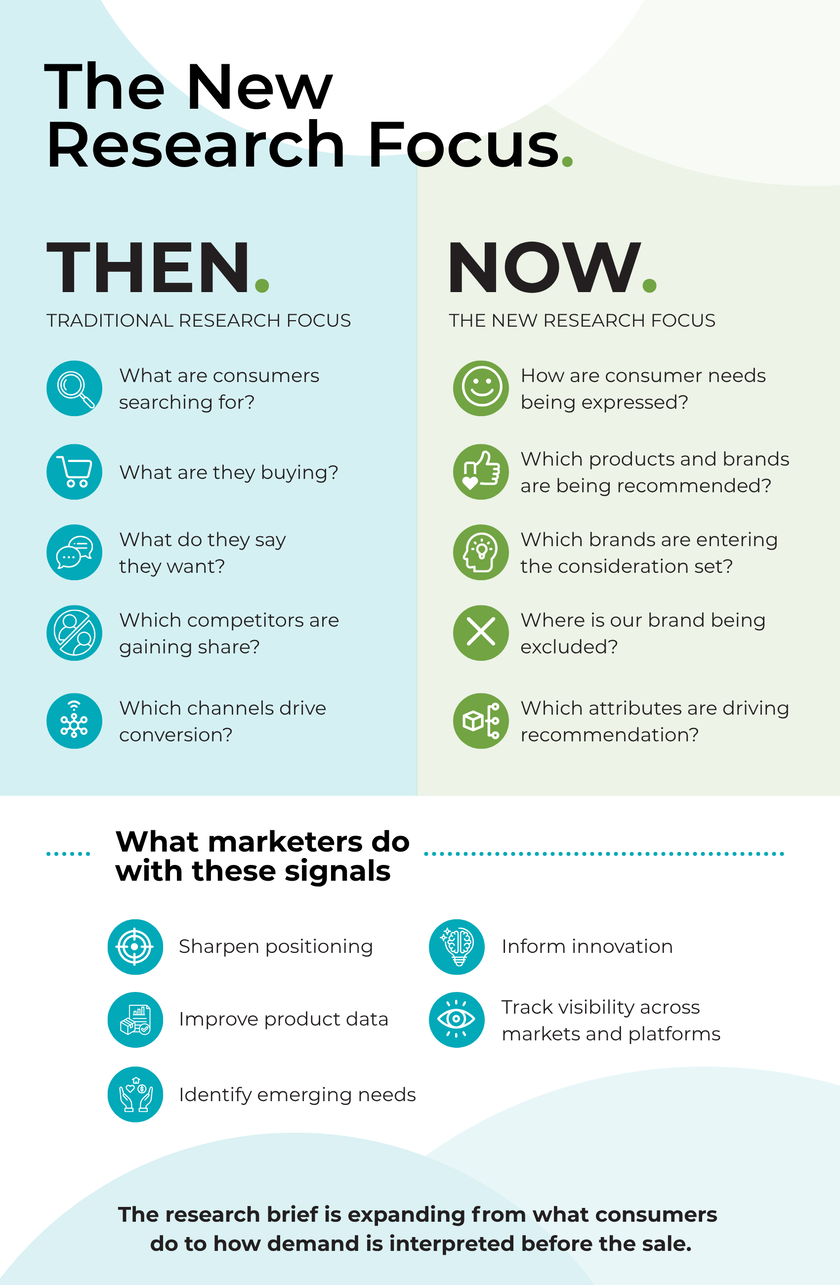
Search also gave marketers rankings, impressions, clicks, and conversions. Retail media added attributable placements. None captures whether a brand is consistently entering AI-generated consideration sets.
One way to measure that visibility is to start with the shopping missions consumers actually bring to the category. Run the same needs across major AI and retail platforms and track which brands appear, which competitors are compared, which attributes are cited, and where a brand drops out altogether. Those results can then be read alongside brand tracking, search behaviour, retail performance, and qualitative research.
The result is not another SEO score. It is evidence of how a category is being interpreted before a purchase takes place — evidence that can inform positioning, product claims, retail feeds, launch strategy, and ultimately product development.
For global companies, the differences may be as revealing as the averages. A product could be highly visible for one need state in the US and absent from the same conversation in Japan or Germany. A challenger could begin appearing in recommendations well before its awareness scores move enough to attract attention in a traditional tracker.
The signals may arrive before the sales do
Sales, search behaviour, consumer research, and competitive activity already tell retailers how a category is moving. Recommendation environments offer another view: how consumers are framing the problem before those changes become obvious in market share.
A luggage company might start seeing durability paired with repairability and airline compliance. An automotive brand might find insurance costs appearing in EV comparisons alongside range and charging. In skincare, barrier repair might begin to displace anti-ageing in the language surrounding the category.
Those signals are not consumer truth on their own. Their value comes from comparison with search behaviour, social listening, qualitative research, brand tracking, and sales. When several sources begin pointing in the same direction, marketers have an earlier indication that the category itself may be shifting.
That expands the research brief: not only what consumers search for, say, and buy, but also how their needs are interpreted, which products are recommended to them, and where a brand is absent.
If your category is starting to shift, the important question is not simply whether AI is influencing discovery. It is where that influence is changing consideration, which brands are gaining visibility, and what new needs are emerging before they show up in sales.
Kadence helps global brands answer those questions through market research that connects consumer behaviour, brand tracking, qualitative insight, and emerging signals across markets.
If you want to understand how AI is reshaping product discovery in your category, get in touch.
FAQs
How is AI changing the way consumers shop?
AI is increasingly influencing the research and consideration stages of shopping by helping consumers compare products, narrow choices, and discover brands before they reach a retailer’s website or store.
Will AI replace product search and browsing?
Not entirely. Search and browsing will remain important, but AI is adding another layer between consumer intent and the products that enter consideration.
How can brands improve visibility in AI shopping recommendations?
Brands need clear, structured product information, strong differentiation, accurate availability and pricing data, credible claims, and enough supporting evidence for recommendation systems to interpret the product confidently.
What should marketers measure as AI becomes part of product discovery?
Marketers should track which brands appear in AI-generated recommendations, which attributes drive inclusion, which competitors are grouped together, and where their brand is excluded from the consideration set.
How can market research help brands understand AI-driven shopping?
Market research can connect AI recommendation data with brand tracking, search behaviour, qualitative insight, social listening, and sales data to identify emerging needs and changes in consideration before they become obvious in market performance.