

Search engines have long dominated how consumers research products, but social media is becoming an increasingly important source of information. Product recommendations now appear alongside entertainment, personal conversations, professional reviews, and advertising, often within the same platforms.
The latest research shows consumers moving between these sources as they investigate potential purchases. Social media may introduce a product, while customer reviews, independent comparisons, or retailer information influence whether it makes the final shortlist. These interactions are becoming harder to separate as platforms introduce shopping features, AI-generated recommendations, and new ways to organise consumer reviews.
Trust is also becoming more complicated. Influencers can command substantial audiences while facing questions about sponsorship and authenticity. Online communities offer detailed product experiences but are vulnerable to manipulation. Even search results increasingly combine commercial information with recommendations and opinions from other sources.
Purchasing behaviour differs considerably across countries and generations. Social commerce is deeply integrated into some markets, while others retain strong preferences for established search, review, and retail platforms. Younger consumers are more likely to use social media and AI-assisted tools, although frequent use does not necessarily indicate greater confidence in their recommendations.
These developments raise a more difficult question than where consumers first encounter a brand: which information do they believe, what changes their minds, and how reliably can those influences be measured?

Where Consumers Research Brands Is Changing
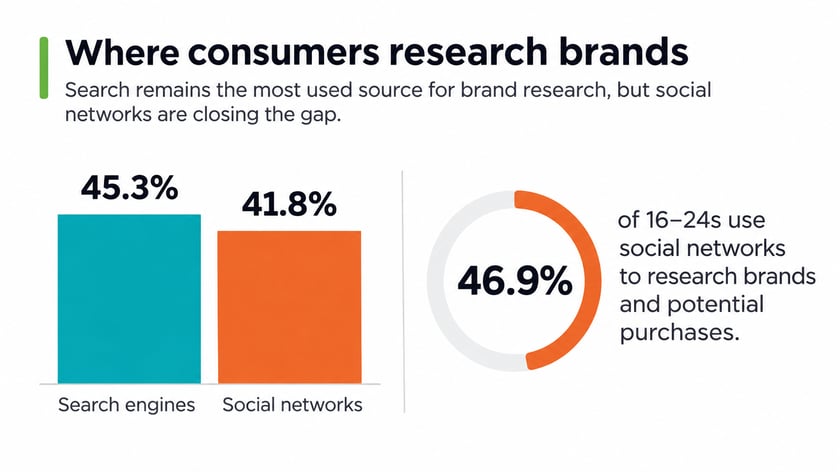
Social media is gaining ground as a source of product information, particularly among younger consumers. The latest global research shows that social networks have overtaken search engines as the leading brand research destination for 16–24-year-olds.
The change extends beyond TikTok and Instagram. Reddit is becoming increasingly relevant to product research, with consumers using community discussions to compare products, investigate complaints, and assess experiences beyond promotional claims.
In late 2026, Reddit began testing Reddit Reviews, which uses AI to organise existing discussions into dedicated product pages. Reddit estimates that approximately 40% of conversations on its platform are commercial in nature, and the initial rollout covers around 10,000 products across beauty, electronics, fashion, and home goods.
The commercial opportunity is clear. Reddit can make years of consumer experiences searchable and accessible at the point of consideration. But organising community opinions into shopping resources also increases the incentive for brands to influence those conversations. The credibility that attracts consumers could become harder to preserve.
Google is adapting in parallel, incorporating AI-generated answers, shopping information, videos, and community discussions into search results. Product research increasingly takes place across platforms that combine independent opinions with commercial content.
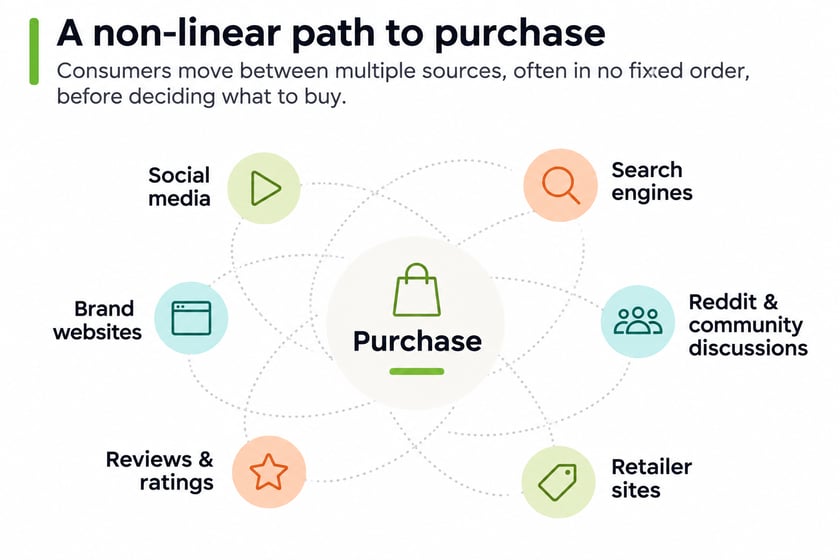
This creates a measurement problem. A Reddit discussion may influence consideration without generating referral traffic. A social video may attract millions of views without changing purchase behaviour. Traditional channel metrics capture exposure and traffic more readily than the contribution of individual information sources to a decision.
Understanding that contribution requires examining the content consumers encounter, the claims they investigate, and which sources ultimately affect their choices.
The Same Purchase Journey Looks Different Around the World
China's digital commerce ecosystem illustrates how closely product discovery and purchasing can operate. Xiaohongshu (RedNote) has become an influential source of consumer reviews and recommendations, particularly in beauty and lifestyle categories. Douyin combines short-form video, livestream shopping, and integrated purchasing, allowing recommendations to translate directly into transactions.
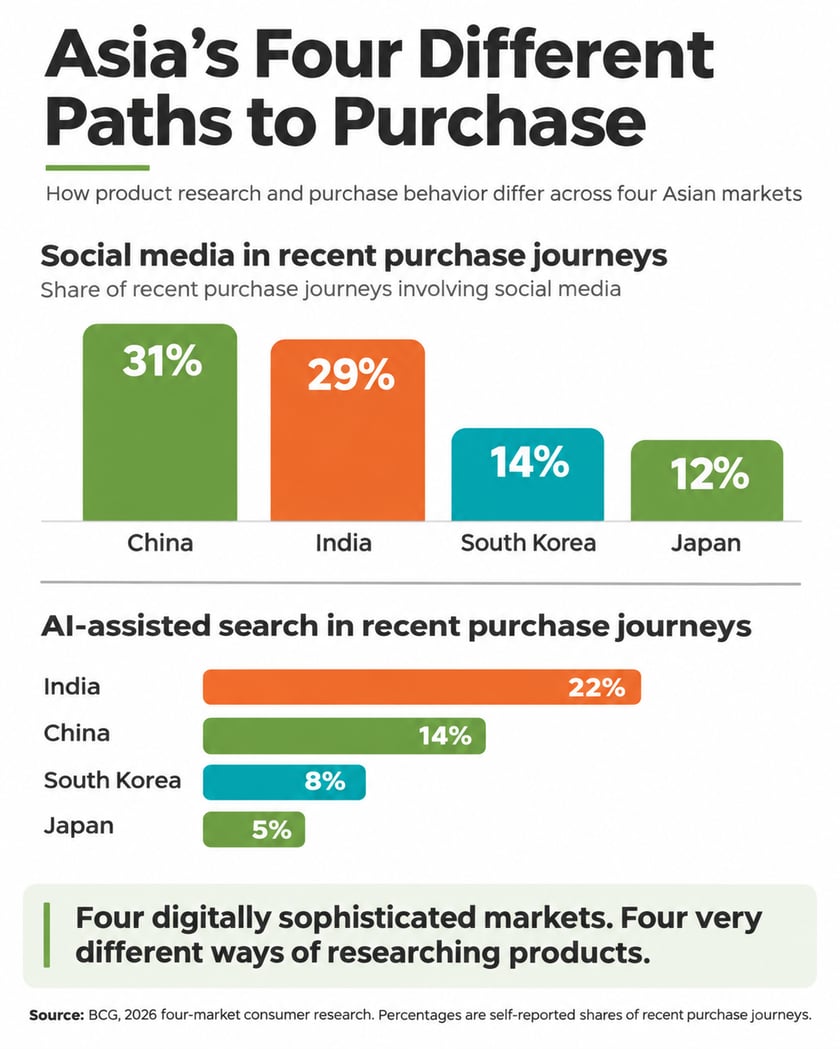
India's purchasing environment is developing differently. Alongside social media and marketplaces such as Amazon and Flipkart, AI-assisted research is gaining traction. Recent research found that large language model searches appeared in 22% of Indian purchase journeys, compared with 14% in China, 8% in South Korea, and 5% in Japan. Among respondents across these markets who used AI search, more than half said it influenced their eventual brand choice.
Japan and South Korea remain more oriented toward established online research channels. Japan's @cosme and Kakaku.com provide specialist reviews, rankings, and comparisons, while South Korea's Naver combines search, blogs, product information, and shopping. These environments allow consumers to access user-generated recommendations without necessarily relying on conventional social networks.
The variation is significant. Four digitally sophisticated markets have developed different relationships between social content, independent product information, and retail. Standardised international channel comparisons can miss these differences when they measure platform use without examining what consumers actually do within each platform.
Social Commerce in Europe and North America
The geographical divide extends beyond Asia. Recent international research found that 87% of surveyed Chinese consumers had purchased a product after discovering it through social media, compared with approximately one-third in Germany, the UK, and the US.
TikTok Shop is changing the European landscape. Established in the UK since 2021, it expanded into Germany, France, and Italy in March 2025, introducing integrated shopping and livestream commerce to additional markets. In Germany, reported shopper adoption exceeded 15% within its first year.
In the US, TikTok Shop operates alongside powerful established retailers, including Amazon and Walmart. Social platforms increasingly generate product awareness and purchasing opportunities, but established ecommerce businesses continue to play major roles in product comparison and transactions.
The commercial implications differ by category. Beauty and fashion lend themselves to demonstrations and creator recommendations, while financial services, insurance, and expensive household purchases typically require more extensive evaluation.
A useful international comparison therefore needs to account for category, platform functionality, and the role each information source plays in the purchase. Social media usage alone cannot establish whether consumers are discovering products, evaluating alternatives, or completing transactions.
Generations Are Changing How Brands Earn Consumer Trust
Social media plays a much greater role in purchasing decisions among younger consumers, although its influence extends well beyond product discovery. Recent research across five markets found that Gen Z was significantly more likely than Baby Boomers to cite social media as an influence on purchasing decisions.
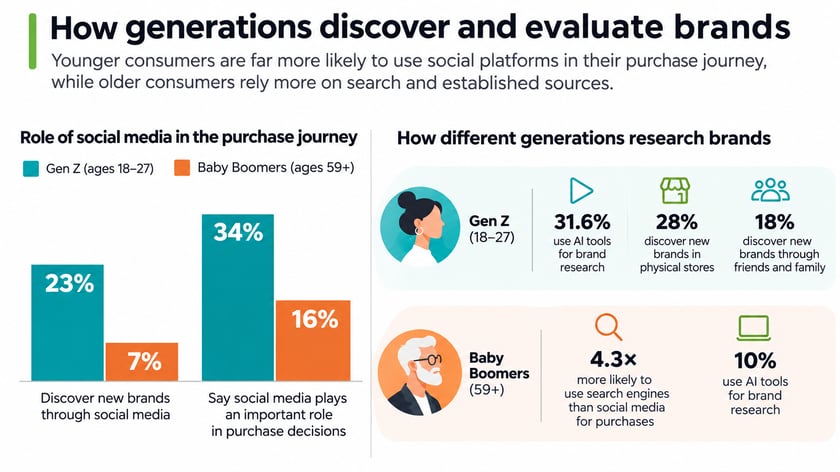
Yet physical stores remain an important source of discovery for Gen Z, alongside recommendations from friends and family. Younger consumers are using a broader mix of information sources, with social media and AI-assisted research becoming established parts of that mix.
Greater use does not necessarily reflect greater confidence. Recent international research found that Gen Z expressed relatively low trust in social media and generative AI as sources of product information. Younger consumers may turn to these platforms frequently while remaining sceptical of the recommendations they encounter.
Older consumers continue to favour search engines. Among internet users aged 65 and above, search is more than four times as likely to be used for purchase research as social networks. AI-assisted research also shows a pronounced age difference, with adoption considerably higher among younger adults.
These patterns suggest that generation influences where consumers look for information, but credibility may depend more heavily on the source, the product category, and the evidence supporting a recommendation.
A more useful approach to generational research would examine which sources consumers consult, where they seek independent confirmation, and what persuades them to accept or reject a product claim. Those answers may vary as much within generations as between them.
The Influencer Trust Problem
Influencer marketing has become an established part of product discovery, but commercial partnerships are creating greater scrutiny of the recommendations consumers receive. Recent US research shows that younger consumers continue to trust creators, even as concerns about sponsorship disclosure and authenticity grow.
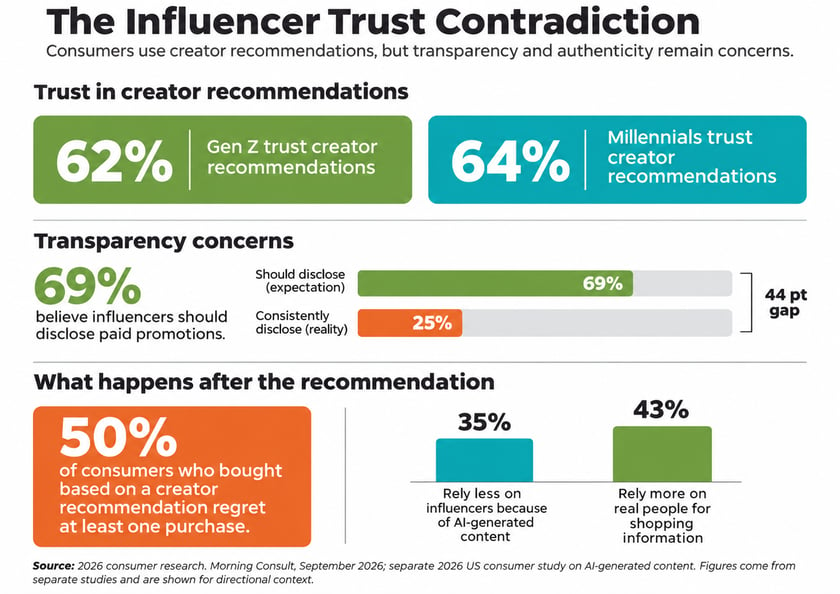
Purchase regret adds another dimension. Half of surveyed consumers who had purchased following a creator recommendation reported regretting at least one purchase. While this does not establish that the recommendations were misleading, it raises questions about how effectively creator-led content communicates product suitability and realistic expectations.
Credibility also varies by creator. Demonstrated expertise, a history of reliable recommendations, and transparency about commercial relationships may matter more than audience size alone. The growing volume of AI-generated content adds further uncertainty about whether recommendations reflect genuine product experience.
Consumers Are Becoming More Selective About Advertising
Advertising avoidance is also influencing the information consumers encounter. Recent US research found widespread efforts to avoid advertising, including paying for subscriptions that reduce exposure. Willingness to pay for ad-free social media is higher in the US than in Great Britain, although neither market shows majority interest.
Yet advertising continues to generate purchases. International research found that 38% of consumers said a social media advertisement could encourage them to buy from a brand.
The findings point to greater selectivity rather than wholesale rejection of commercial content. Consumers can respond to relevant advertising while questioning sponsored endorsements, avoiding intrusive formats, and seeking independent confirmation.
The research priority is identifying which sources consumers consider credible within a category, how commercial disclosure changes that assessment, and whether trust translates into consideration and purchase. Creator engagement, community sentiment, and advertising response each capture part of that behaviour, but none independently establishes purchasing influence.
What Brands Need to Know About Purchase Influence
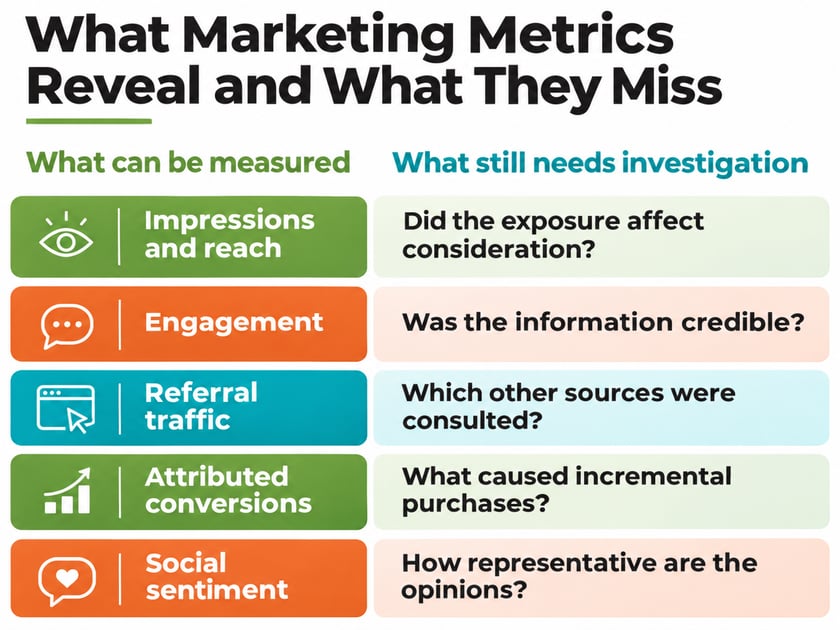
As product research spreads across more platforms, a growing proportion of the information shaping consumer decisions sits outside brands' owned channels. Marketing teams can measure impressions, engagement, referral traffic, and conversions, but these metrics provide limited visibility into how consumers evaluate information or resolve doubts before purchasing.
A customer who discovers a product through Instagram may subsequently investigate complaints on Reddit, compare alternatives through Google, and purchase from a retailer. Conventional attribution may credit the final interaction, while the information that established confidence in the product remains largely invisible.
Recent international findings reinforce the need to examine channel reach and influence separately. A platform can feature prominently in purchasing journeys without being the source consumers consider most credible. Conversely, a specialist review or independent recommendation may influence a decision despite attracting relatively little traffic.
Measuring What Changes Consumer Decisions
Understanding purchase influence requires more than asking consumers which channels they use. Research should establish what information they sought, which alternatives they considered, where doubts emerged, and what ultimately resolved them.
Several approaches can provide complementary evidence:
Recent-purchase research can reconstruct how consumers investigated an actual purchase, identifying sources that introduced products, helped eliminate alternatives, or reinforced a final decision. Interviewing recent buyers and nonbuyers can reveal differences that conventional customer satisfaction surveys miss.
Decision diaries capture product research while it happens, reducing reliance on retrospective accounts. They can document repeated searches, changing preferences, abandoned options, and the influence of recommendations encountered across platforms.
Social listening and review analysis can identify recurring concerns, competitor comparisons, and emerging product expectations. These findings are particularly useful for developing research hypotheses, although the views expressed in online communities cannot be assumed to represent the wider customer base.
Controlled experiments can test whether the source of a recommendation changes its perceived credibility or influence. Presenting equivalent product claims through different sources, with sponsorship disclosures controlled, can help isolate the effect of credibility from the appeal of the product itself.
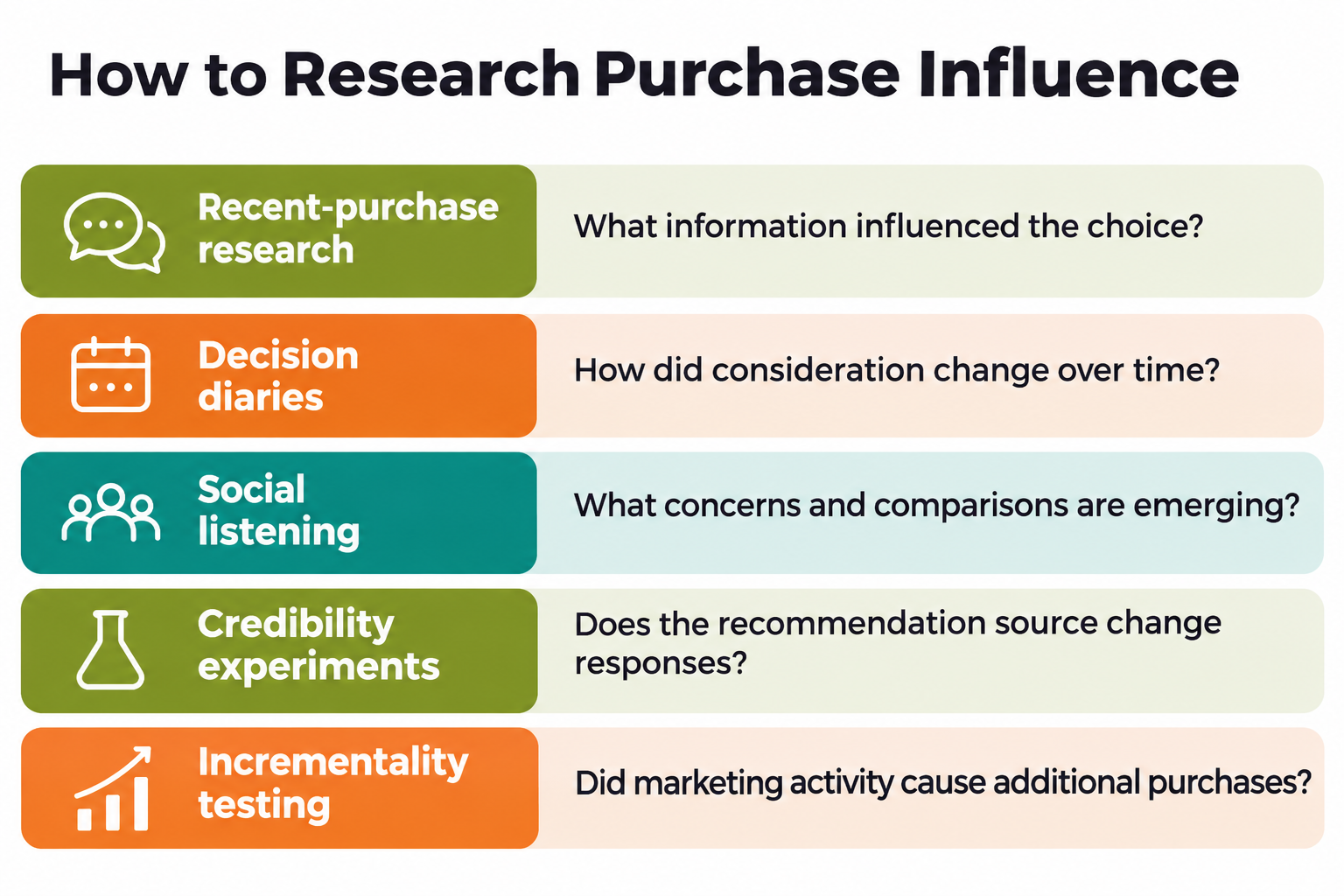
The distinction between reported influence and demonstrated effects is important. Consumers may identify a particular recommendation as decisive, but that does not establish whether they would have purchased without it. Where investment decisions warrant it, controlled experiments and incremental sales measurement can provide stronger evidence of causality.
International Research Needs More Than Consistent Questions
The geographical differences identified in this article also have implications for multinational research programs.
A survey asking consumers whether they use social media to research products may produce comparable percentages across countries while capturing very different activities. In China, respondents may be referring to integrated content and commerce environments. In Japan, product comparisons may take place predominantly through specialist websites. In other markets, social media may introduce products that are subsequently evaluated through retailers or search engines.
Research instruments need sufficient local detail to capture these differences without sacrificing comparability. That includes identifying the actual platforms used, the activities undertaken within them, and the information consumers consider credible.
Category differences deserve similar attention. The evidence required to choose a moisturiser may be quite different from that needed to purchase a vehicle or select a financial product. Researching trust without accounting for the nature and consequences of the purchasing decision risks producing findings that are too broad to guide action.
The most valuable outcome is a clearer understanding of which information sources contribute to consideration, which resolve uncertainty, and where consumers abandon brands during evaluation. These findings can inform content development, channel investment, retail partnerships, and product communications.

Where Consumer Trust Goes Next
The growing number of sources influencing purchase decisions has exposed a weakness in conventional marketing measurement. Brands can track where consumers encounter products, but identifying which information earns their confidence and changes their choices remains considerably harder.
The challenge is particularly pronounced across international markets, where the same platforms serve different purposes, and consumers rely on different sources of evidence.
A more complete understanding of purchase influence requires combining behavioural evidence with research into how consumers evaluate claims, compare alternatives, and establish trust. Those findings offer a stronger basis for decisions about brand communications, channel investment, and market strategy.
Understand What Influences Your Customers
Consumer trust is shaped by experiences, recommendations, and information sources that vary across markets and audiences.
Kadence International helps global brands understand how consumers make decisions through customer journey research, brand tracking, qualitative research, and cross-market studies.
Our local research teams combine an understanding of consumer behaviour with the market context needed to interpret findings accurately and identify opportunities for growth.
Speak to our team about understanding your consumers and the factors influencing their purchasing decisions.
FAQs
How is social media changing the way consumers research brands?
Social media is becoming a major source of product discovery and research, particularly among younger consumers. Global 2026 research found that 41.8% of online adults use social networks to investigate brands and potential purchases, compared with 45.3% using search engines. Consumers increasingly combine social recommendations with search, reviews, and retailer information before purchasing.
Do consumers trust influencers and sponsored recommendations?
Trust varies by age, perceived expertise, and transparency. Recent US research found that 62% of Gen Z and 64% of Millennials trust creator recommendations. However, concerns remain about sponsorship disclosure and the authenticity of recommendations. Brands should distinguish creator engagement from the credibility consumers assign to individual claims.
How does consumer trust differ across international markets?
Purchasing journeys vary substantially by market. Social media plays a prominent role in China and India, while consumers in Japan and South Korea rely more heavily on established online research environments. Local shopping platforms, retail infrastructure, and consumer information habits can influence how people evaluate products and recommendations.
What should brands measure beyond social media engagement and conversions?
Brands should examine where consumers discover products, which sources they consult during consideration, what information they trust, and why they accept or reject competing brands. Recent-purchase research, decision diaries, social listening, and controlled experiments can provide evidence that conventional engagement and attribution metrics may not capture.
How can market research identify what influences purchasing decisions?
Market research can combine interviews about recent purchases, longitudinal decision diaries, qualitative research, behavioural evidence, and experimental testing. These methods help identify how consumers evaluate information, which recommendations they consider credible, and what changes their preferences. Controlled experiments and incrementality testing can provide stronger evidence of causal influence than stated preferences alone.