

Subscription businesses have spent years selling the promise of predictable revenue. The number may be steady. The risk beneath it is not.
A customer who pays but rarely uses the service remains profitable today. Contacting that customer without a clear reason can turn passive revenue into an active cancellation decision. The value of inactivity data lies elsewhere: it shows which revenue may be vulnerable when a renewal approaches or when a customer signals intent to leave.
Full-price retention remains the best outcome. A revised plan can preserve most of the revenue when the original offer no longer fits. A pause becomes useful when the need is temporary, while reactivation begins only after cancellation cannot be prevented.
The question is how much of today’s recurring revenue will survive the next spending review, and whether the company is ready with the right response when that revenue comes under pressure.
Churn Is Losing Its Meaning
Churn can rise even when customer preference has not changed. Recurly, a global subscription management and recurring billing platform, found in its analysis of 76 million subscribers that US customers were twice as likely to experience payment declines at signup, while customers in Europe, the Middle East, and Africa were twice as likely to encounter them at renewal. A global churn ranking may therefore reward or penalise markets partly for their payment infrastructure.
When a customer signals an intention to leave, a move to an ad-supported plan or less frequent delivery can preserve revenue and reveal the price they remain willing to pay. Recording that change as a complete loss removes both signals from view.
Sports subscriptions often lapse after the season, while project software may be dropped when the work is finished. Renewal planning can anticipate those moments and prepare a relevant offer for customers whose needs remain active.
Annual plans concentrate losses at renewal, while monthly plans spread the same decline across the year. Comparisons between products and markets become unreliable when the billing cycle is ignored.
The Strongest Subscriptions Solve More Than One Problem
A subscription gains protection when it becomes useful in more than one part of the customer’s life. A 2024 study of bundled telecom customers in Portugal found that internet and television services contributed most strongly to operator loyalty, while market research in Korea found that bundle subscribers faced higher switching costs than customers buying services separately.
A contract may keep a customer from leaving, but revenue is more secure when several benefits are actively used and difficult to replace.
Amazon Prime shows how use can spread across a household: delivery may matter to one person and entertainment to another. In 2025, Consumer Intelligence Research Partners (CIRP) found that 98% of both monthly and annual US Prime members intended to renew, although the research did not establish which benefits drove that commitment.
When several people rely on the same account, renewal protects value for more than the person paying. Each active user gives the household another reason to keep the subscription, while unused benefits merely add cost.
Full-Price Retention Comes First
The first response to cancellation intent should protect the full-price relationship. A service problem may be fixable, the value may need to be made clearer, or the customer may simply need help using what they already pay for.
A narrower tier becomes relevant when the customer no longer needs the full offer. It preserves more revenue than a complete cancellation without suggesting that the original price was negotiable.
Recurly’s analysis of 67 million subscribers across more than 2,200 businesses found that acquisition rates fell from 4.1% in 2021 to 2.8% in 2024. Trial conversion fell from 46% to 33%. As new customers become harder to acquire, retaining a smaller revenue stream can be more valuable than replacing the account later.
The order should be explicit: preserve the customer at full price first. If the full plan no longer fits, retain as much revenue as possible by offering a narrower plan. A short pause is preferable to a complete loss when the need is temporary. Reactivation begins only after those options fail.
Downgrade choices also show which benefits support willingness to pay. A feature customers surrender easily is doing little to hold the account; the one they protect is closer to the reason they stay.
A benefit removed in one market may barely affect demand, while the same change can make a lower tier unacceptable elsewhere. Price testing should evaluate the complete offer attached to each price.

Bundles Change Who Owns the Customer
A bundle can expand reach by placing a subscription inside a service people already pay for. The customer joins through the larger platform, often without making a separate purchase decision.
In a 2023 survey of more than 6,000 subscribers across India and Southeast Asia, digital commerce company Bango found that 93% wanted one place to manage their subscriptions. Ninety-one per cent believed consolidation would help them manage household expenses.
The bundle provider often controls billing and renewal, while much of the customer data may remain with the platform. The subscription gains distribution but may lose sight of why people joined, how often they use it, and what could place renewal at risk.
A package renewal cannot establish the strength of every service inside it. A weak subscription can remain hidden within a popular bundle, making usage and engagement more revealing than the renewal of the package itself.
Customers may remember the bundle provider and barely notice the subscription brand. Loyalty then builds around the platform, leaving the individual service easier to replace.
For subscriptions built around personalisation or frequent engagement, access to usage data and permission to contact the customer may carry more long-term value than the revenue guarantee.

Cancellation Intent Is the Moment to Intervene
Easy cancellation can influence acquisition, but it does not require companies to invite active customers to reconsider. Recurly’s latest consumer research found that 71% of consumers consider easy cancellation essential when choosing a subscription.
When a customer tries to cancel, making the cancellation process difficult will not persuade them to stay. In March 2026, Adobe agreed to a proposed US settlement worth $150 million after the government alleged that it concealed early termination fees and obstructed attempts to cancel. Six days later, the UK Competition and Markets Authority opened a separate investigation into Adobe’s cancellation charges. The UK investigation remains open.
The cancellation journey should first establish why the customer wants to leave and whether the full-price relationship can still be preserved. A narrower plan belongs next when the customer no longer needs the full offer.
A pause becomes relevant when the need has temporarily disappeared. Recurly’s platform data found that businesses offering a “pause before cancel” option saw pause use rise by 337%, with three in four customers who paused returning within months. The pause belongs inside the cancellation journey, not in routine messaging to inactive subscribers.
Reactivation begins after the customer leaves. Former subscribers accounted for nearly one in four new signups in Recurly’s analysis, but a campaign triggered after 30, 60, or 90 days may still arrive before the original need has returned.
The reason recorded at the time of cancellation should determine when the company approaches the customer again. Reactivation should then be measured against a control group of former customers who receive no campaign outreach, preventing outreach from claiming credit for revenue that would have returned regardless.
Market Research Must Recreate the Subscription Trade-Off
Research that evaluates one subscription in isolation can overstate its strength. Consumers may rate a service highly when keeping it requires no sacrifice elsewhere.
A budget-cut exercise creates the pressure missing from a standard survey. Participants reduce their full recurring spend in stages, revealing the point at which each subscription moves from protected to expendable.
This is a research exercise, not a customer intervention. Its purpose is to improve forecasting, plan design, and the offers presented when renewal or cancellation intent creates a genuine decision point.
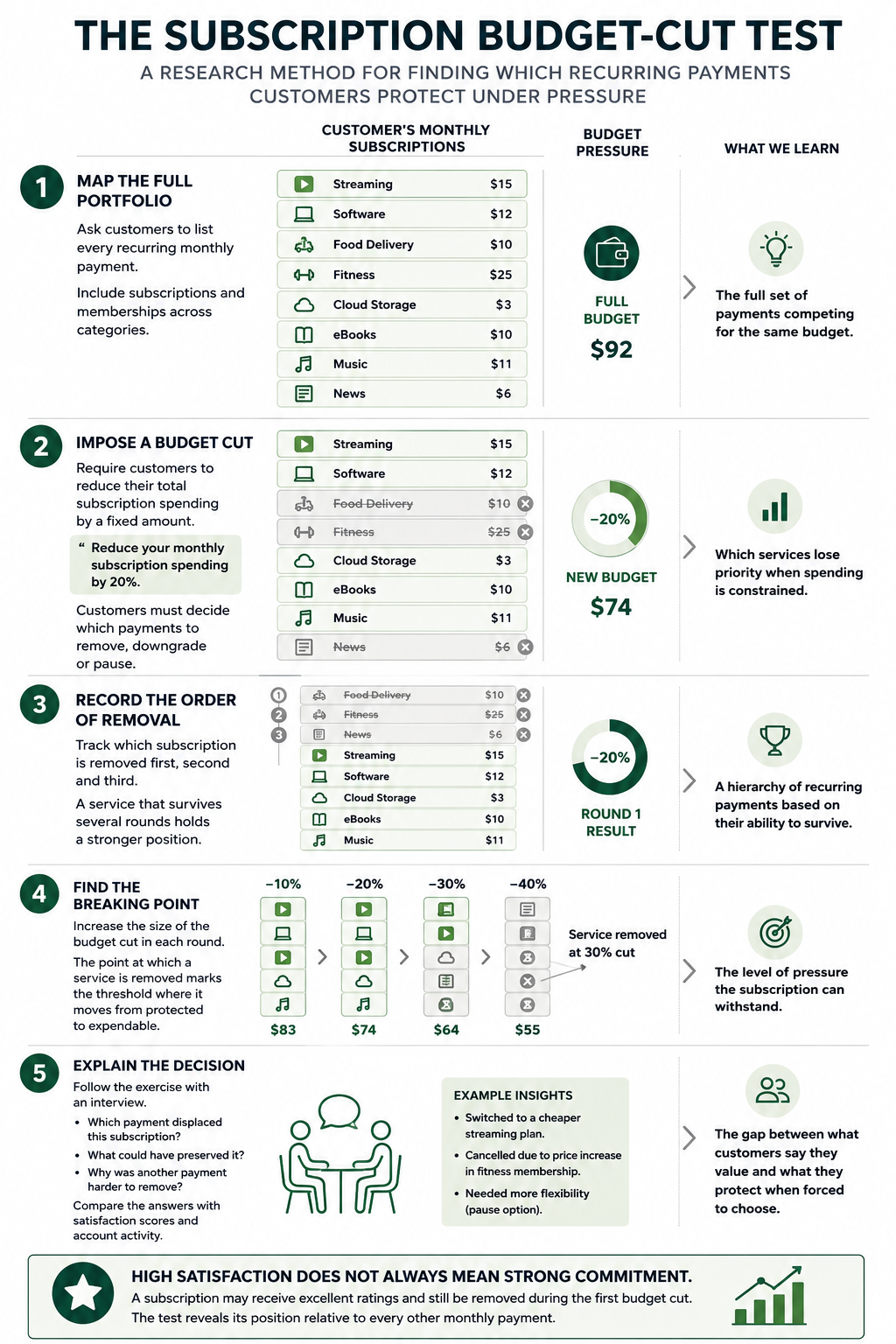
Image caption: Controlled research simulation, not a customer-facing retention campaign
Longitudinal research can also follow customers after several months of inactivity and through their next renewal or cancellation decision. It can test whether a clearer value, a lower-cost tier, or a pause of up to three months would have preserved the subscription. The findings should shape the response available at the decision point, not trigger a mass campaign to dormant accounts.
The order of removal provides a sharper measure than a single final choice. A service that survives several rounds of cuts holds a stronger position than one removed as soon as spending tightens. Pricing teams can track that threshold over time.
Track the service’s share of a customer’s subscription spending alongside its category share. It may beat direct competitors while taking a smaller share of the household budget.
Account data can expose the gap between stated satisfaction and actual commitment. A highly rated service may still be removed early under pressure. Repeating the exercise across markets shows how billing arrangements alter the result, including whether a subscription is paid directly or absorbed into a telecom package. Quarterly tracking can reveal a weakening position before it appears in revenue.
Recurring Revenue Needs a Confidence Measure
Recurring revenue is not equally dependable. Revenue that consistently renews and remains tied to a clear customer need carries more weight than revenue sustained solely by inactivity.
That distinction should shape how much future growth spending a business is willing to support with today’s subscription base.
Where Does Your Subscription Sit in the Customer’s Portfolio?
Kadence can help identify which subscriptions customers protect, where renewal risk is building, and which offer is most likely to preserve revenue. Get in touch to shape pricing, plan design, and retention around the decisions customers make under pressure.

FAQs
How can companies tell whether a cancellation is temporary or permanent?
Sustained inactivity can flag future risk internally, but intervention should wait for cancellation intent or an important renewal point. The reason given then can show whether the need has ended or temporarily paused.
Which subscription metrics matter beyond churn?
Track usage depth, downgrade behaviour, reactivation rates and the service’s share of the customer’s recurring spending. These measures reveal whether the subscription remains protected when budgets tighten.
Are pause and downgrade options better than retention discounts?
Full-price retention should come first. A lower tier can preserve most of the revenue when the full plan no longer fits, while a pause can protect the relationship when the need is temporary. Reactivation follows only after cancellation.
How do subscription bundles affect customer loyalty?
Bundles can expand reach and reduce cancellation, but the bundle provider may own the customer relationship. Companies need visibility into usage and permission to contact customers directly.