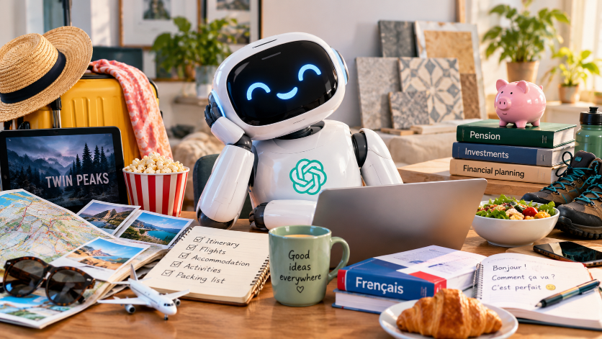

Ask someone how they think market researchers use AI, and they'll probably picture enormous datasets being uploaded, complex cross-segmentation analyses, and endless spreadsheets being interrogated for hidden patterns. And they'd have a point. We're naturally curious people who enjoy getting to the bottom of things, especially when there's data involved.
But what happens when we close our laptops at the end of the working day? Does that curiosity switch off, or does it follow us home?
We decided to find out by turning the research lens on ourselves, asking eight members of our Kadence UK team how AI has found its way into their personal lives.
We expected a few productivity hacks. What we discovered was a rather more entertaining glimpse into the personalities behind the research, along with some interesting clues about how our relationship with technology, information and everyday decision-making might be changing.
Getting the tedious stuff out of the way
Planning a family holiday sounds wonderful until you're trying to coordinate ten people's preferences, travel arrangements, budgets and activities. For Cindi Collett, Managing Director of Kadence UK, AI has become something of a personal travel coordinator. She used it to help build a day-by-day itinerary, estimate costs, calculate travel times and even prepare a packing list. The result was a shared plan everyone could access on their phones, saving hours of logistical juggling.
Mei Anne Hills, Insight Executive, has found a similarly practical use for ChatGPT, although her adventures involve hiking boots rather than family holidays. An enthusiastic hiker with a fondness for spreadsheets, she uses AI to help organise her gear inventory, develop formulas, and keep track of equipment. It makes packing easier and helps her offer recommendations when friends ask for advice.
Meanwhile, Bianca Abulafia, Head of Strategy and Client Services, has found a clever shortcut for her French lessons. Rather than laboriously copying exercises from photographs of textbook pages, she asks ChatGPT to turn them into Word worksheets. She can spend more time learning French and less time preparing homework, although Word's insistence on correcting her answers remains an occupational hazard.
There's a common thread here. None of them is trying to eliminate the enjoyable part of the experience. They're simply handing over the tedious bits so they can spend more time doing what they actually enjoy.

Making decisions feel less daunting
Choosing bathroom tiles shouldn't be quite so stressful, but when you're renovating an entire room, even a seemingly simple decision can become overwhelming. Hannah Turnbull, Insight Manager, knows the feeling. Faced with endless combinations of tiles, sinks and vanity units for her new home's en suite, she turned to ChatGPT. By uploading Pinterest inspiration and photographs of potential purchases, she could explore different designs and see how the pieces might work together. It helped her move beyond imagining the possibilities to actually seeing them.
For Cindi, AI has also become a useful shopping companion. She photographs food labels in the supermarket and asks it to explain ingredients, compare nutritional information, and examine claims such as "high protein" or "healthy." Rather than relying entirely on what's printed on the front of the packaging, she can explore what those claims mean for the portions she'd actually eat.
Rupert Sinclair, Head of Insight, has taken things further. He used AI to explore how his pension was invested, question some assumptions and investigate whether a similar investment mix could be achieved with lower fees. He subsequently restructured his portfolio, reducing his reliance on actively managed funds.
What's interesting about these examples is how AI enters the decision-making process. It's giving people another way to explore unfamiliar choices, weigh up alternatives and question the information they're given. For brands, it's worth considering what happens when customers arrive having already explored alternatives, questioned product claims and formed opinions with the help of an AI assistant.
Getting exactly the information you want
Ever watched a television adaptation of a book and found yourself wondering whether a particular storyline was in the original? James Hingley, Senior Insight Executive, had exactly that experience while watching The Shards, having previously read Bret Easton Ellis's novel. Rather than digging out the book, he asked ChatGPT to help him untangle which characters and plotlines belonged to which version. A passing curiosity became a conversation, with increasingly specific questions.
Ben Williams, Insight Manager, has developed a similar habit, although his approach comes with one very important condition: absolutely no spoilers. While watching Twin Peaks, he used AI as a companion to keep track of characters, relationships and mysterious symbols, specifying exactly which episode he'd reached. Having once Googled an actor from The Sopranos and accidentally learned far more about the character's fate than he wanted, Ben wasn't taking any chances.
What makes these examples interesting is the control people have over the information they receive. Neither James nor Ben wanted an encyclopedia of television trivia. They wanted answers to very particular questions, delivered with the right context and without unnecessary information. And unlike a conventional internet search, they could keep asking follow-up questions until they'd satisfied their curiosity, without having to wade through pages of information they never wanted in the first place.
Making sense of personal information
For Katrin Scheibert, Head of Design at Kadence UK, deciding whether to push harder in the gym or take a recovery day has become a little more scientific. Between CrossFit and Olympic weightlifting, she uses Bevel, an app connected to her Garmin smartwatch, to track everything from heart rate variability to sleep patterns. Rather than trying to interpret all those numbers herself, she can ask the app's AI assistant questions about her recovery, explore training trends, and even log meals by photographing her lunch.
She's also noticed independent gyms experimenting with similar technology, using AI tools alongside member information to help coaches develop more personalised training resources.
Rupert has found AI useful in an entirely different setting: medical appointments. With so much information to absorb during a consultation, remembering every detail can be difficult. He uses AI-assisted tools to capture discussions, summarise key points, and track next steps, allowing him to focus on the conversation rather than remembering everything afterward.
Both experiences show how AI can make complex personal information easier to manage. But when the information concerns someone's health or physical wellbeing, how much confidence should they place in an AI-generated interpretation? Understanding the information more easily is valuable, but knowing when to question it or seek professional advice is equally important.
What do these everyday experiences mean for brands?
Our UK team's experiences may be personal, but they raise some intriguing questions for businesses trying to understand their customers. Consider how much of a purchasing decision might now happen before someone visits a brand's website or speaks to a salesperson. Someone shopping for a new sofa could ask AI to compare materials, assess durability, suggest alternatives and narrow down their options before ever setting foot in a showroom.
For brands, this introduces a potential blind spot. Traditional customer journey research might reveal which websites people visited, whose recommendations they sought and what ultimately influenced their purchase. But what if an AI assistant has already helped them decide which brands are worth considering? A company could lose a potential customer without that person ever appearing in its website analytics or sales enquiries.
Understanding this influence requires looking beyond the usual touchpoints. Rather than relying solely on consumers recalling how they researched a purchase, researchers could ask participants to document their AI interactions as they happen, keeping diaries of the questions they ask, the recommendations they receive and which suggestions they pursue. With participants' consent, researchers could also observe AI-assisted shopping sessions to understand how people respond to recommendations in real time. Testing different product claims and information sources could also help establish whether consumers place greater trust in AI-generated explanations or information provided directly by brands.
There's an important distinction between using AI to make a decision easier and allowing it to make the decision for you. Understanding where consumers draw that line, and whether it differs across categories, could help businesses rethink how they communicate, support and engage with customers.
Eight personal stories aren't evidence of a universal change in consumer behaviour. But they offer a compelling reason to investigate what might be happening beyond the parts of the customer journey brands can currently see.
We're still figuring it out
Perhaps the most enjoyable discovery from asking our UK team about their AI habits is just how differently everyone uses it. From pension investments to television mysteries, bathroom renovations to French homework, there's no shortage of imagination when people find a tool that makes life a little easier.
We're still learning what AI does well, when its answers deserve a second look and when human judgment matters more. As researchers, we find that uncertainty is every bit as interesting as the possibilities.
As AI becomes part of how consumers research products, compare options, and make decisions, brands need to understand where it's influencing the customer journey. Kadence helps businesses uncover these changing behaviours, understand what drives consumer choices, and identify opportunities to stay relevant. Get in touch to explore what AI-assisted decision-making could mean for your customers and your brand.
FAQs
How are people using AI in everyday life?
People are using AI for much more than work-related tasks. Common applications include planning travel, comparing products, organising personal information, visualising home improvements, managing fitness data, and learning new skills. These everyday uses show how AI can help people save time, explore options, and make more informed decisions.
How is AI changing consumer behaviour?
AI gives consumers another way to research products, compare alternatives, and interpret information before making purchases. Instead of relying solely on search engines, reviews or brand websites, people can ask AI assistants for personalised explanations and recommendations. This may influence which brands they consider and how they evaluate their options.
How does AI influence the customer journey?
AI can influence the customer journey before someone visits a retailer or brand website. Consumers may use AI assistants to identify products, compare prices, understand features, and narrow down their choices. This creates additional touchpoints that brands may not capture through conventional website analytics.
How can market research measure the impact of AI on purchasing decisions?
Market researchers can use consumer interviews, digital diaries, and observed shopping sessions to understand when and how people consult AI. By examining the questions consumers ask, the recommendations they receive, and the choices they make afterward, researchers can investigate how AI influences brand consideration, trust, and purchase decisions.
Why should brands understand how consumers use AI?
As consumers incorporate AI into everyday decisions, brands risk overlooking influences beyond their own websites and marketing channels. Understanding AI-assisted behaviour can help businesses identify changes in product discovery, customer expectations, and brand trust, informing more effective marketing, communications, and customer experiences.