

What if some of your most valuable potential customers are people your brand has never considered targeting?
Consider the growing number of people living alone. According to BCG's 2026 consumer research, single-person households account for around 30% of households in mature markets. Their spending per person is two to three times that of households with multiple people. Yet between 50% and 70% of solo consumers surveyed say products and services aren't designed with their needs in mind.
That's a considerable amount of purchasing power potentially being overlooked.
Think about how many products and services are designed around families or couples. Family-sized packaging, bulk discounts, subscription plans, and delivery minimums all make perfect commercial sense when that's your target audience. They're considerably less appealing when you're shopping for one.
And these consumers span generations, income brackets, and life stages. They may have little in common demographically, yet share needs that could make them a valuable audience for the same product.
A brand tracker might show strong awareness and consideration among these consumers. Customer data might even reveal that some are already purchasing regularly. But neither necessarily tells you whether the company is overlooking a larger opportunity among people who sit outside its established target.
When was the last time your segmentation research challenged the definition of your target audience, rather than simply describing the people you'd already decided to pursue?

The Overlooked Solo Consumer
In Germany, Sweden, France and Italy, approximately 40% of households now contain just one person. Yet many products, services and promotional strategies still favour larger households.
The commercial implications extend beyond smaller food packages. A single-person household might have substantial disposable income but find little value in family subscriptions, bulk discounts or minimum purchase requirements. A consumer willing to pay more for convenience might instead be offered savings that depend on purchasing quantities they don't need.
There's also considerable diversity within this audience. Someone living alone in their thirties may have very different spending priorities from someone in their seventies. An affluent professional might value convenience above price, while a retired consumer on a fixed income could be particularly sensitive to waste. Their circumstances differ, but both may be poorly served by products designed for multi-person households.
The question is whether these shared needs translate into enough demand to justify changing what a company offers.
Household composition can identify consumers who might have been missed by traditional targeting. But needs-based segmentation can reveal what those consumers have in common, while purchase-occasion research can explain when their priorities change. Pricing studies and product testing can then establish whether alternative pack sizes, services or propositions would actually influence purchasing decisions.
A large population of single-person households doesn't automatically represent a viable market for every brand. The real opportunity depends on how many have an unmet need, are willing to pay for a solution, and can be reached profitably.
A company might discover an entirely new customer segment. Equally, it might find that customers already buying its products would purchase more frequently if the offer better suited their circumstances.
Age Doesn't Explain Everything
Two consumers can be the same age, shop on the same platforms, and have completely different attitudes toward buying online.
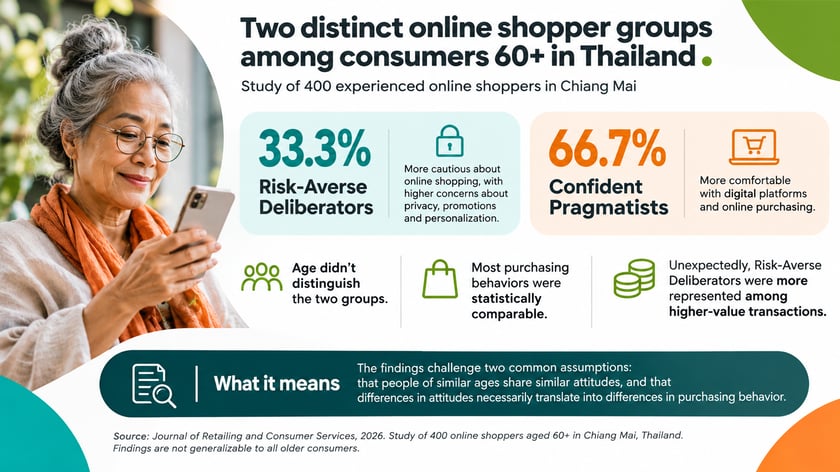
Researchers surveyed 400 consumers aged 60 and older in Chiang Mai who had previously purchased products online. They identified two distinct groups: Risk-Averse Deliberators, representing 33.3% of respondents, and Confident Pragmatists, accounting for 66.7%.
The groups had markedly different attitudes toward online shopping. Confident Pragmatists were more comfortable with digital platforms, while Risk-Averse Deliberators expressed greater concerns about issues including privacy, promotions, and personalisation.
Yet chronological age did not significantly distinguish the two groups. More interestingly, most of their observable purchasing behaviours were statistically comparable.
There was even an unexpected result. Despite their less favourable attitudes toward digital platforms, Risk-Averse Deliberators were relatively more represented among higher-value transactions.
The study, published in the Journal of Retailing and Consumer Services, challenges two common assumptions in consumer segmentation: that people of similar ages share similar attitudes, and that differences in attitudes necessarily translate into differences in purchasing behaviour.
The research was limited to experienced online shoppers in one Thai province, so its findings cannot be generalised to all older consumers. Nevertheless, it raises a useful question about how segmentation is validated.
A company could identify two groups with sharply contrasting attitudes, develop separate marketing strategies for each, and discover that their purchasing behaviour differs very little. Understanding what consumers think is valuable. Establishing whether those differences influence what they actually buy is another matter.
Sometimes Your Best Customers Were There All Along
The pressure to attract younger consumers can be considerable, particularly for established brands concerned about ageing customer bases. But pursuing a younger audience doesn't necessarily offer the strongest growth opportunity.
British breakfast cereal brand Weetabix discovered the value of reconsidering that assumption.
Facing declining penetration and sales volumes, the company examined its brand positioning and the customers most likely to respond to it. Its research suggested that Weetabix's heritage had become associated with being outdated, despite the brand retaining strong credentials among consumers aged 45 and older.
Rather than continuing to prioritise younger consumers, Weetabix developed its Grown-Up Growth strategy around its established audience. The company modernised its advertising, emphasised health benefits and taste, and invested in channels including television and radio to reach those consumers.
The results, documented in its 2026 IPA Effectiveness Awards case study, included a reported 5.3% increase in penetration, 2.38% revenue growth and a 12% improvement in pricing power.
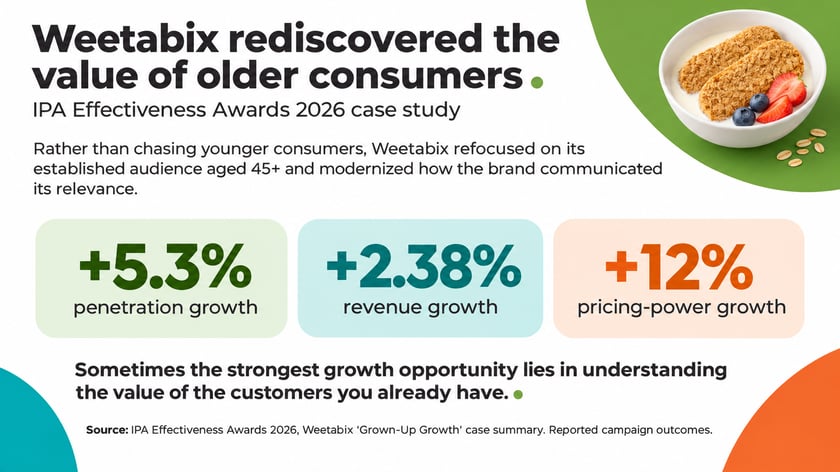
Sometimes the strongest opportunity lies in understanding why existing customers choose a brand, how their needs are changing, and whether the business has been underestimating their value.
Research can just as readily support a decision to concentrate investment on an established audience as it can justify pursuing a new one.
Why Segmentation Doesn't Always Change Strategy
Companies invest considerable time and money in understanding their customers. Yet the findings don't always influence as many business decisions as they could.
An October 2025 study by the American Marketing Association and Kantar surveyed 182 marketers about how their organisations use segmentation research. Some 72% considered segmentation pivotal to understanding customers. However, only 37% reported making specific design choices around how the research would be used, and just 36% said their segmentation was being used for all its intended purposes.
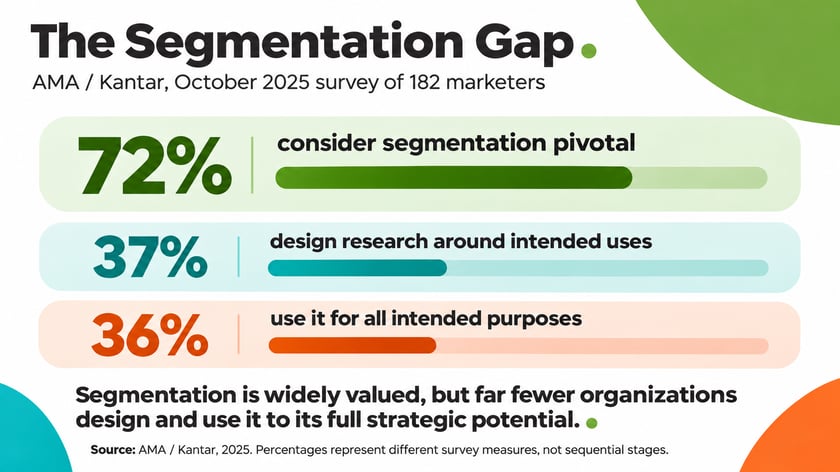
The study also found that only 8% of respondents reported improved decisions about expansion opportunities as a benefit of segmentation.
That is a surprisingly small proportion, given the potential influence of consumer segmentation on decisions about new markets, product portfolios and customer acquisition.
A segmentation study identifies several consumer groups, each with distinctive attitudes, motivations and purchasing preferences. The findings inform advertising briefs, media targeting and perhaps a revised customer persona. But the product development team may continue working to the same priorities, while investment decisions rely on market forecasts that barely reference the research.
The segmentation may be statistically sound and genuinely useful for communications. Its wider commercial potential remains largely unexplored.
There's also the question of how the research was designed in the first place. A study developed primarily to improve advertising effectiveness may not contain the behavioural, pricing or category data needed to support an investment decision.
If a company wants segmentation to identify future growth opportunities, it needs to investigate more than who its current customers are. It needs to understand which needs remain underserved, where purchasing behaviour is changing, and whether those differences justify doing something commercially different.
Otherwise, even sophisticated segmentation can leave a business with a much clearer picture of its customers and surprisingly little reason to change its strategy.
Finding the Customers Worth Pursuing
Discovering an unexpected group of customers can be exciting. But before redirecting millions of dollars in marketing or product development, a company needs to establish what those customers are actually worth.
Imagine a household appliance manufacturer discovering that consumers over 65 account for an increasing share of its premium product sales, despite its marketing being directed primarily at younger homeowners.
That might warrant a change in strategy. But first, the company needs to understand what's driving those purchases.
Are older consumers choosing premium appliances because they value durability, ease of use or specific features? Are they purchasing at higher price points, replacing products more frequently or simply more visible in the company's customer database?
Transaction data can help establish who's buying, what they're purchasing and how much they're spending. It cannot necessarily explain their motivations or identify potential customers who have never purchased the brand.
Consumer research can fill those gaps. Needs-based segmentation can identify shared priorities across demographic groups, while qualitative research can explore motivations that purchasing data alone may not reveal. Choice-based conjoint analysis can test whether different consumers value product features differently and how those preferences change when price enters the equation.
The findings might reveal a substantial underserved market. Equally, they could show that older customers have essentially the same purchasing priorities as the existing target audience, making a separate strategy unnecessary.

What Makes an Overlooked Segment Worth Pursuing?
|
Research question |
Commercial implication |
|
Who is buying outside the established target? |
Identifies unexpected sources of revenue |
|
What needs or occasions explain their purchases? |
Reveals opportunities for product or positioning changes |
|
How large is the potential audience beyond current customers? |
Establishes growth potential |
|
What do they spend, and how often do they return? |
Evaluates customer value |
|
Do they respond differently to products, prices or communications? |
Tests whether a distinct strategy is justified |
|
Can they be acquired and served profitably? |
Informs investment decisions |
Even a statistically distinct segment may offer limited commercial value if it's too small, expensive to reach or unlikely to respond differently to the brand's proposition.
The real opportunity emerges when research establishes that a group has identifiable needs, sufficient purchasing potential and a compelling reason to choose the brand. Only then does changing the target audience become a credible growth strategy.
What Changes When the Target Changes?
Identifying a commercially attractive customer segment is only useful if the business is prepared to act on what it discovers.
A food manufacturer might find that smaller households offer greater growth potential than its traditional family audience, prompting changes to packaging, pricing and distribution. A financial services company could discover that older consumers are more receptive to a new digital product than its existing targeting assumptions suggest.
But those decisions come with trade-offs. Developing new products, adapting communications, and expanding distribution all require investment. Pursuing an additional audience can also divert resources from customers who are already highly profitable.
Discovering an unexpected group of customers can be exciting. But before redirecting millions of dollars in marketing or product development, a company needs to establish what those customers are actually worth.
And sometimes the research will show that the existing strategy is working perfectly well.
Before changing who you're targeting, it's worth establishing whether the customers you're overlooking are actually worth more to the business than the ones you're trying so hard to attract.
Understand Where Your Next Customers Will Come From
Kadence International helps brands identify growth opportunities through consumer segmentation, behavioural research, customer analytics and product testing. Whether you're reassessing an established target audience or exploring new customer segments, our research teams can help establish where demand exists and which opportunities justify investment.
FAQs
How can brands identify customers outside their target audience?
Brands can analyse transaction data, purchasing frequency, customer lifetime value and demographic profiles to identify unexpected sources of revenue. Behavioural and needs-based segmentation can then reveal why these consumers purchase and whether similar opportunities exist among people who haven't yet bought the brand.
Why is demographic segmentation alone insufficient?
Consumers with similar demographic characteristics can have very different needs, attitudes and purchasing behaviours. Equally, people across different age groups or income brackets may share the same motivations. Combining demographic data with behavioural research, purchase-occasion analysis and needs-based segmentation provides a more complete understanding of demand.
How can market research reveal overlooked customer segments?
Market research can identify unmet needs, changing purchasing habits and consumer groups that existing targeting strategies may exclude. Methods such as qualitative research, customer segmentation, conjoint analysis and product testing help establish what motivates these consumers and whether their preferences represent commercially meaningful opportunities.
How can companies determine whether a new customer segment is profitable?
Companies need to assess segment size, purchase frequency, spending, retention, customer acquisition costs and potential margins. Research can also test whether consumers respond differently to products, pricing and communications. A segment may be distinctive or growing rapidly without generating sufficient incremental revenue to justify additional investment.
How often should brands review their target audience and segmentation strategy?
Brands should reassess their targeting assumptions when purchasing behaviour, customer demographics, category demand or market conditions change significantly. Regular analysis of customer data can identify emerging patterns, while periodic segmentation research can determine whether existing customer groups still reflect the market and support current business objectives.