

India has nearly 1.5 billion people, and its economy grew 7.8% in the April–June quarter of 2026. Household consumption rose 7.1% over the same period. It's easy to see why the country features prominently in the expansion plans of international brands.
But here's a number that might give some of those companies pause.
An October 2026 analysis by BNP Paribas estimated that just 1.6% of India's population, fewer than 24 million people, meets its definition of a financially secure middle class. It's a particularly strict definition, and India has a substantial consumer market beyond that group. Still, the difference between nearly 1.5 billion people and 24 million is worth examining when you're sizing up an opportunity.
Indonesia presents another interesting picture. Its economy grew by 5.47% in the third quarter of 2026, yet its middle class contracted from 47.9 million in 2024 to 46.7 million in 2025. Meanwhile, Vietnam's economy expanded 9.01% during the first nine months of 2026, with consumer spending also growing strongly.
All three economies are expanding, but a company selling premium skincare, packaged foods, or household appliances could reach three very different conclusions about where to invest.
A country might have millions of consumers who fit your target demographic. How many want your product, can afford to buy it regularly, and can realistically be reached through the channels available? That's a much harder number to establish.

The Market Isn't as Large as It Looks
National averages can conceal enormous differences in purchasing power. Two countries might have similar GDP per capita, yet offer very different opportunities for a company selling premium cosmetics, packaged foods, or consumer electronics.
India's Household Consumption Expenditure Survey found that average monthly spending per person was ₹6,996 (approximately US$74) in urban areas, compared with ₹ 4,122 (approximately US$44) in rural areas. Among the wealthiest 5% of urban consumers, that figure reached ₹20,310 (approximately US$216).
The survey was conducted in 2023–24, but its findings remain important to the October 2026 BNP Paribas analysis. That report also estimated that India's per capita consumption, adjusted for purchasing power, was around 30% lower than in Indonesia, Vietnam and the Philippines.
Consider what that means for a manufacturer planning a national launch. The target audience for a premium product could be concentrated in a relatively small number of cities, while a more affordable version might appeal to a much broader customer base. Both could represent substantial opportunities, but the pricing, distribution, and investment required would look very different.
Even identifying the right income group doesn't settle the question. Consumers with similar spending power may have quite different priorities. A household might spend heavily on education and technology while being extremely price-conscious when it comes to groceries. Another might regularly purchase premium personal care products but have little interest in upgrading household appliances.
A market-sizing exercise based primarily on population and income can miss those differences. Category penetration, purchase frequency and the amount consumers are willing to spend all influence how large the opportunity really is.
And a million consumers who might buy your product once are not necessarily as valuable as half a million who will buy it every month.
The Middle-Class Assumption
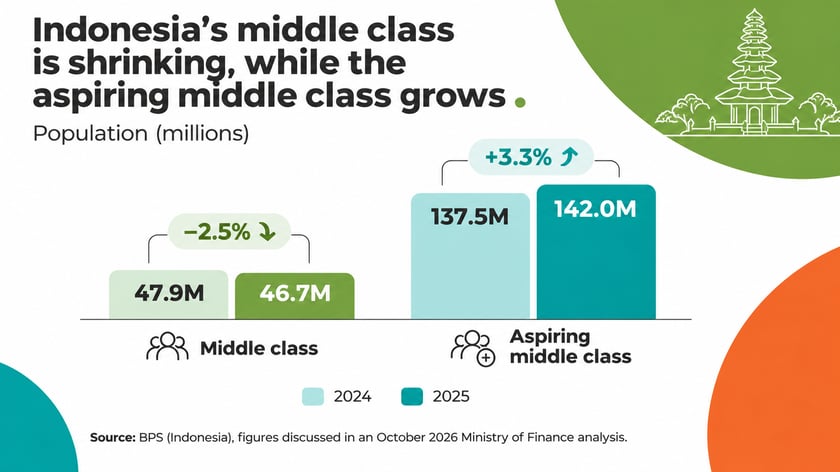
Indonesia's middle class is shrinking, despite continued economic growth. According to government statistical data, the population declined from 47.9 million in 2024 to 46.7 million in 2025. Meanwhile, the aspiring middle class grew from 137.5 million to 142 million.
That's a considerable number of consumers sitting just below the country's middle-class threshold, in an economy that continues to grow.
Someone might comfortably afford a premium shampoo but buy it only when there's a promotion. Another consumer could have the same income and happily pay full price, while spending considerably less on other personal care products. Neither pattern is particularly surprising, but they produce very different sales forecasts.
Pack sizes can also change the equation. A smaller, more affordable format may attract consumers who would never purchase the full-sized product. Whether those smaller packs generate sufficient volume and margin is another question.
Indonesia's expanding aspiring middle class could represent a substantial opportunity for companies that understand these purchasing decisions. But assuming that rising incomes will automatically translate into greater demand for premium products is a risky basis for an investment forecast.
A manufacturer might identify millions of consumers with the means and interest to purchase its products. How often they buy, how much they spend on each occasion and where they shop will determine how much of that potential translates into sales.
Reaching Consumers Is Another Matter
A company could identify a promising consumer segment, establish an attractive price point and still struggle to reach the people most likely to buy its products.
NielsenIQ's 2026 reporting found that e-commerce accounted for just 6% of FMCG sales across urban India, rising to 14% across metropolitan markets and 18% in the country's eight largest metros.
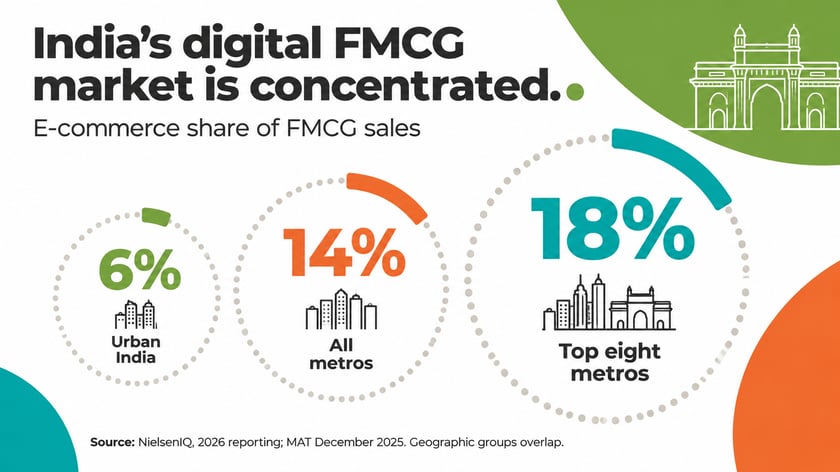
A digital-first launch aimed at affluent urban shoppers could make commercial sense in Mumbai or Bengaluru. Reaching consumers elsewhere might require an entirely different distribution strategy, with different costs, retail partners and promotional requirements.
Indonesia has its own retail realities. An early-2026 Snapcart survey found that 53% of respondents who regularly purchased daily essentials offline used traditional neighbourhood shops, known as warungs. Alfamart and Indomaret were also widely used, at 48% and 47% respectively.
A distribution agreement with a major supermarket chain might look impressive in a market-entry presentation. It may be considerably less useful if the consumers you're targeting do most of their shopping elsewhere.
Shopper research and retail audits can reveal where consumers discover unfamiliar brands, compare products and make repeat purchases. They can also expose gaps between the distribution a manufacturer intends to build and the shopping habits of its target audience.
Those findings could change the cities selected for launch, the retail partners approached, the pack sizes offered and the marketing budget required to acquire customers.
A smaller launch concentrated in a few well-understood locations may deliver more useful commercial evidence than a national rollout built around optimistic assumptions about distribution.
Vietnam's Digital Boom Has a Catch
Vietnam's retail sales of goods and consumer services grew 7.7% in real terms during the first ten months of 2026. Its e-commerce market is expected to reach US$32 billion this year, up 22% from 2025, according to Google, Temasek and Bain.
But much of that online activity is concentrated on two platforms.
YouNet ECI's Q3 2026 analysis found that Shopee and TikTok Shop accounted for nearly 98% of gross merchandise value across the four major marketplaces it tracked.
That gives these platforms considerable influence over how brands reach Vietnamese consumers. Marketplace visibility, promotional spending, commissions and competition from established sellers can all affect the economics of entering the market.
A brand might find plenty of demand for its products but discover that acquiring customers costs considerably more than expected. Another could benefit from the platforms' existing audiences without investing heavily in its own distribution.
The difference could determine whether Vietnam is an attractive expansion opportunity or simply an attractive-looking market.

When Market Research Changes the Investment Decision
A company might rank Vietnam ahead of Indonesia based on economic growth, then reverse that decision after researching category demand, local competitors and the cost of acquiring customers.
Or it might discover that entering India through five major cities offers a better initial return than attempting a national launch.
Yet market-entry forecasts can give considerable weight to population, income growth and projected market share before anyone has established how consumers will respond to the product itself.
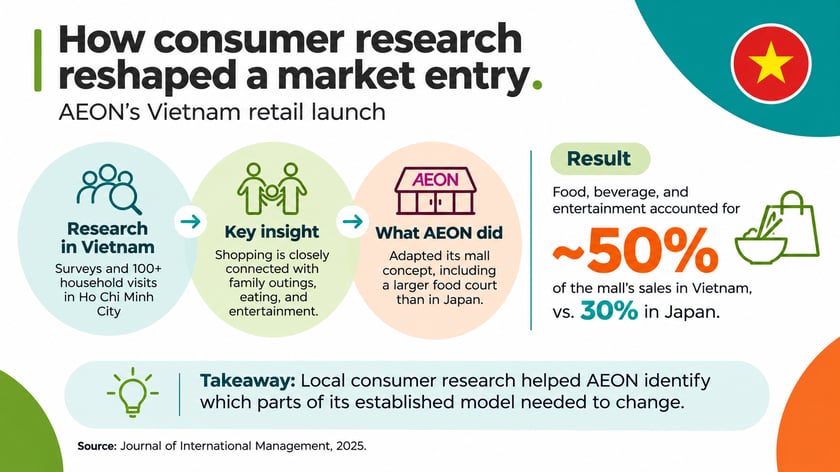
Japanese retailer AEON provides a useful example. Before entering the Vietnamese market, the company surveyed consumers and visited more than 100 households in Ho Chi Minh City. The research found that shopping was closely connected with family outings, eating and entertainment.
AEON adapted its mall concept accordingly, including a larger food court than it typically offered in Japan. By March 2015, food, beverage, and entertainment accounted for approximately half the mall's sales, compared with an average of 30% in Japan.
The case, documented in a 2025 study published in the Journal of International Management, shows how local consumer research influenced the retail experience AEON developed for a new market.
The same principle applies to product launches. Consider a premium personal care brand entering Southeast Asia. Consumers might express strong interest in its ingredients and benefits during concept testing. But what happens when they're shown the actual price alongside familiar local products? Would they purchase it regularly, occasionally or only when discounted?
Choice-based conjoint research can test those trade-offs. Local product testing can reveal whether the proposition meets expectations, while shopper research can establish where consumers would expect to find it.
The findings might support a smaller pack size, a different product range or a launch through specialist retailers rather than mass distribution.
What Market-Entry Research Should Establish
|
Research question |
Commercial decision |
|
How many consumers currently buy the category? |
Realistic market sizing |
|
What needs are existing brands failing to meet? |
Product positioning and differentiation |
|
What will consumers pay against local alternatives? |
Pricing and pack architecture |
|
Where do target consumers discover and buy products? |
Channel selection and launch geography |
|
What drives repeat purchase? |
Revenue and retention assumptions |
|
What will it cost to reach and serve them? |
Commercial viability and investment scale |
There are limits to what research can predict. Purchase intent expressed in a survey is not a sales forecast, and even sophisticated choice experiments cannot fully reproduce the competitive pressures of a live market.
A controlled launch can help test the assumptions against actual purchasing behaviour before committing to a larger rollout.
Sometimes the research will confirm the original investment case. Sometimes it will suggest entering a different market, targeting fewer cities or changing the product. Occasionally, the sensible decision will be not to enter at all.
Know Your Market Before You Enter It
Kadence helps global brands evaluate market opportunities through consumer research, competitive intelligence, pricing studies, and local market expertise. If you're considering expansion into India, Southeast Asia, or other international markets, talk to our team about building a stronger business case.
FAQs
How do companies choose which emerging market to enter?
Companies evaluate population, GDP growth, consumer purchasing power, category demand, competition and market accessibility. Market research helps establish how many consumers are likely to purchase a specific product, what they're willing to pay and whether the business can reach them profitably. The largest or fastest-growing economy isn't necessarily the most attractive opportunity.
Why is consumer research important when entering emerging markets?
Consumer research reveals purchasing habits, unmet needs, brand preferences and price sensitivity that national economic indicators cannot capture. It helps international companies assess product-market fit, identify promising customer segments and adapt their pricing, products and distribution strategies before committing significant investment.
What are the biggest challenges of entering India, Indonesia and Vietnam?
Challenges vary considerably. India has substantial differences in purchasing power and retail access across regions. Indonesia's middle class faces affordability pressures, while traditional retail remains important. Vietnam's rapidly expanding e-commerce market presents opportunities, but competition and dependence on major marketplaces can affect customer acquisition costs.
How can businesses estimate the real market size for a new product?
Effective market sizing combines population and income data with category penetration, purchase frequency, willingness to pay and distribution accessibility. Consumer segmentation, concept testing and pricing research can help estimate commercially relevant demand. These findings should be tested against local competition, channel costs and realistic sales assumptions.
How can market research reduce the risk of international market entry?
Market research helps companies test assumptions about consumer demand, pricing, product preferences and purchasing behaviour before launching. Methods such as choice-based conjoint analysis, shopper research, competitive analysis and controlled market pilots can identify potential barriers and inform decisions about launch locations, product adaptations and investment levels.