
Japan has started building products for a country that is chronically short on rest. Capsule hotels are using sensors to monitor guests’ breathing, movement and snoring; workplaces are testing nap pods for employees trying to recover between meetings; furniture makers are selling beds that adjust temperature, angle and airflow; and developers are marketing apartments around lighting, sound and humidity control. Even clothing is being designed around the 20-minute power nap, a small act of recovery now treated as something that can be engineered, packaged and sold.
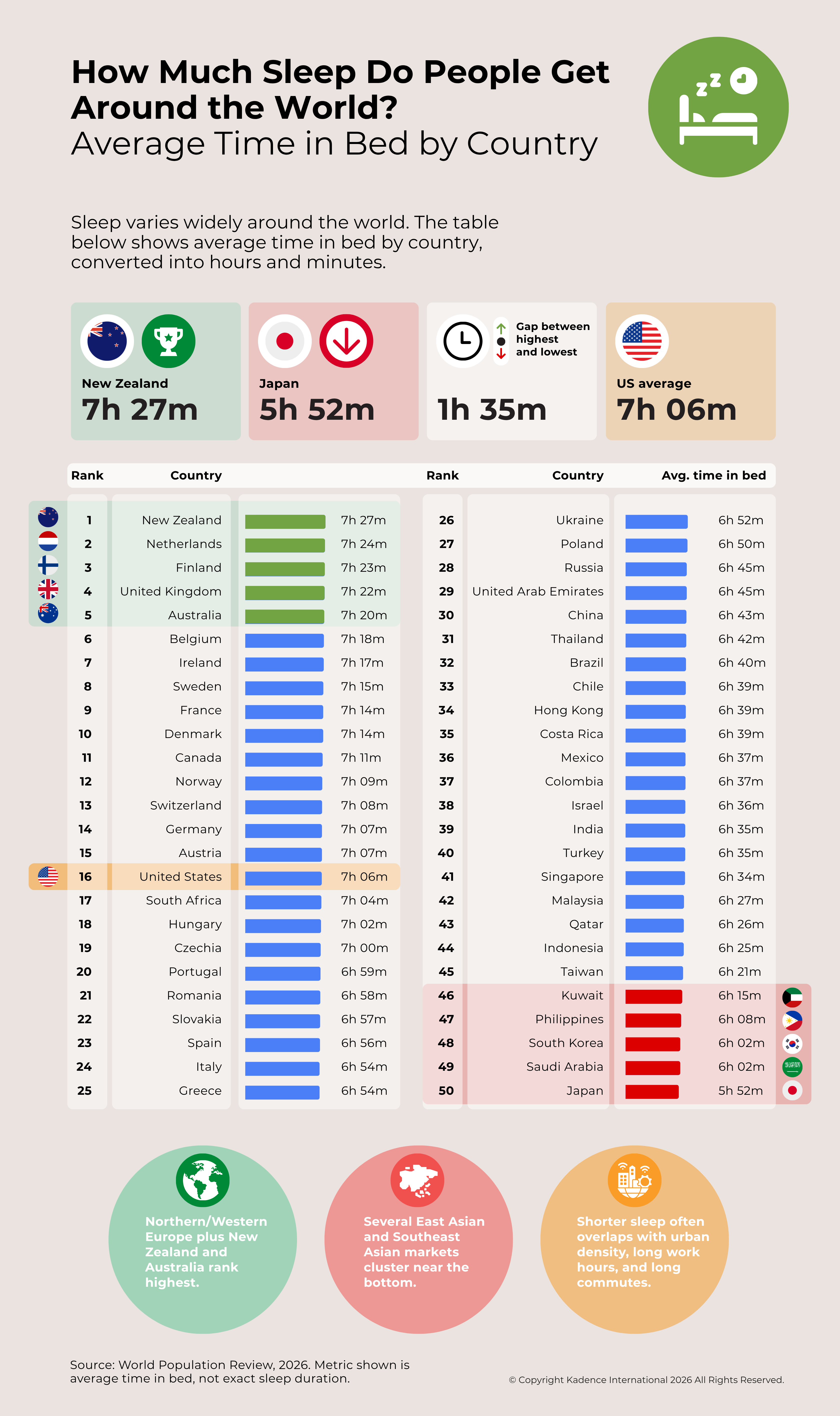
The products can look niche, but they are better understood as market responses to a much larger problem. Japan sits at the bottom of a global ranking of average time in bed, at 5 hours and 52 minutes. New Zealand leads at 7 hours and 27 minutes. The US comes in at 7 hours and 6 minutes. These figures measure time in bed rather than clinically verified sleep, but the gap is still commercially useful: sleep opportunity varies sharply by country, and where rest is under pressure, new categories tend to appear.
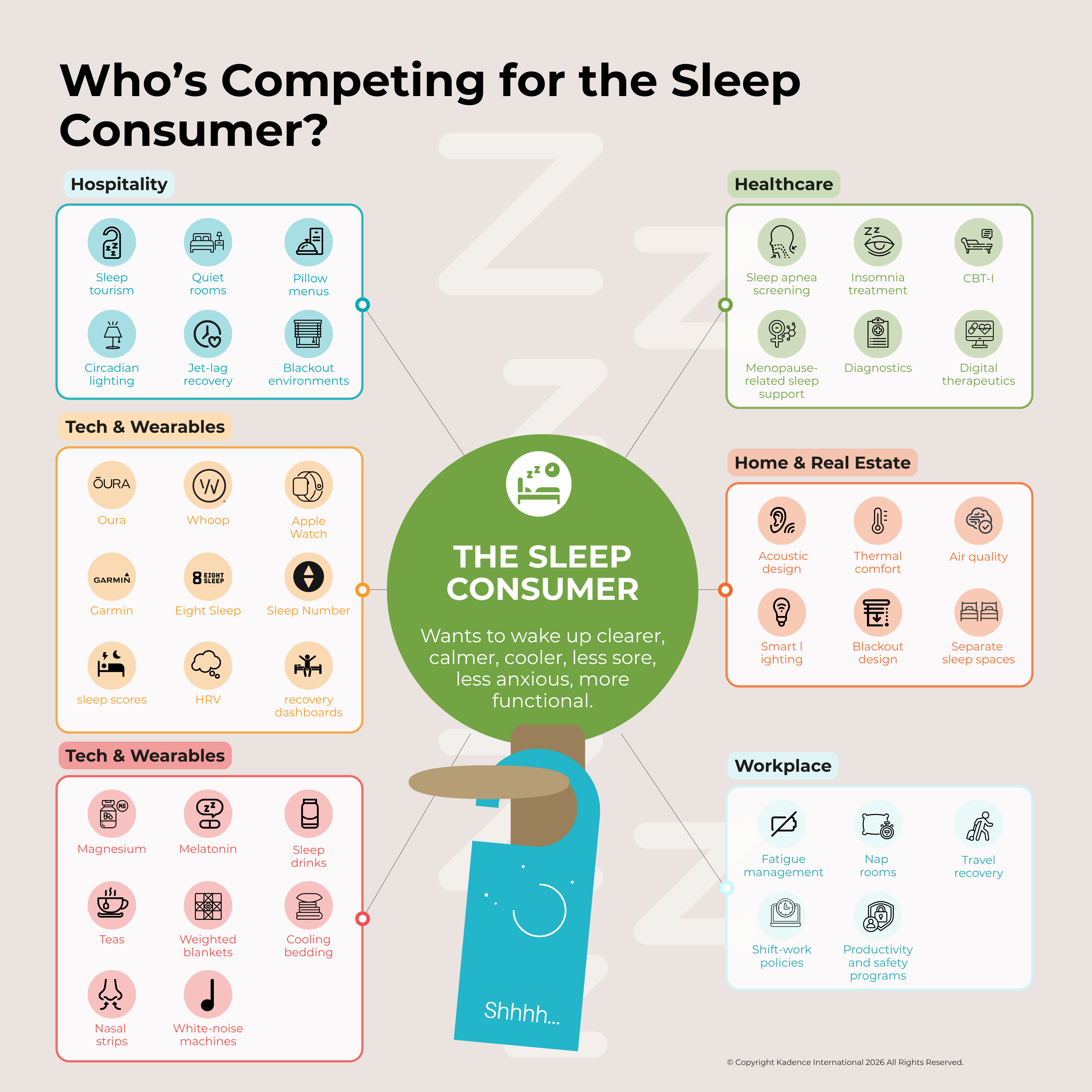
The same pattern is visible well beyond Japan. In the US, sleep has become part of the performance economy, tracked through Oura rings, Whoop bands, Apple Watches, and mattress systems that turn rest into a nightly score. In hospitality, hotels are moving past thread count into pillow menus, blackout environments, soundproof rooms, circadian lighting, and “sleep tourism” packages. In retail, the sleep category now stretches from mattresses and pillows into magnesium powders, melatonin gummies, weighted blankets, cooling sheets, sunrise lamps, white-noise machines, nasal strips, and mouth tape. In the workplace, fatigue is increasingly discussed as a productivity and safety issue, though the fixes often take the form of benefits and interventions rather than changes to the conditions that cause exhaustion.
Sleep has become a useful commercial signal because it sits at the intersection of several pressures executives already track: ageing populations, stress, urban density, climate discomfort, screen saturation, hybrid work, business travel, women’s health, mental well-being, and the broader shift toward self-optimisation. Consumers are not simply looking for “better sleep,” they are buying temperature control, noise control, light control, breathing support, recovery data, evening rituals, and permission to disconnect.
For companies in health, hospitality, technology, retail, real estate, and workplace services, sleep is becoming one of the more revealing frontiers in consumer behaviour. It shows what people lack, what they are willing to measure, what they are willing to pay to improve, and how quickly a basic human need can become a premium market when everyday life stops reliably protecting it.
Sleep Is Shaped by Systems, Not Just Habits
The global sleep gap is often discussed as a matter of personal discipline: go to bed earlier, put the phone away, drink less caffeine, build a better routine. Those things matter, but they only explain so much. Sleep is also shaped by the systems people live inside — when work starts, how long it takes to get home, how crowded the home is, how noisy the street is, how hot the bedroom gets, whether school and work reward late nights, and whether rest is treated as a necessity or a weakness.
That is why country-level sleep data is useful, even with the usual caveats. Average time in bed is not the same as clinically measured sleep, and different datasets use different methods, but the pattern still reveals something important: sleep opportunity is unevenly distributed. Some markets appear to give people more room for rest. Others seem to compress it.
The differences are not only cultural. They are economic and infrastructural. A knowledge worker with flexible hours, a quiet bedroom and control over temperature has a very different sleep environment from a shift worker, a young parent, a student preparing for competitive exams, a service worker with a late commute or a household sharing limited space across generations. The consumer may experience sleep loss as a private problem, but the conditions that produce it are often public: labour markets, transport systems, housing costs, climate, school expectations and social norms around availability.
This is what makes sleep so commercially interesting. When people cannot easily change the systems around them, they start looking for smaller points of control. They buy products that make the bedroom darker, cooler or quieter. They seek rituals that create a hard stop at the end of the day. They track their bodies for evidence of recovery. They pay for environments — hotels, retreats, premium homes, wellness spaces — that promise rest by design.
The more sleep becomes constrained by modern life, the more valuable those points of control become.

From Sleep Aid to Sleep System
The sleep market used to be easier to see because it sat in obvious places: mattresses, pillows, bedding, prescription sleep aids, and over-the-counter remedies. That structure no longer captures how the category behaves. Sleep now appears in travel, consumer electronics, supplements, lighting, air quality, beauty, workplace benefits, diagnostics, real estate, and luxury hospitality, making the market harder to size but more important to understand.
The numbers vary depending on what gets counted. Grand View Research estimates that the global sleep tourism market will reach $148.98 billion by 2030. Sleep-tracking devices are another fast-growing segment, estimated at $26.6 billion in 2023 and projected to reach $58.21 billion by 2030. Global Market Insights puts the broader sleep tech devices market at $24.9 billion in 2024 and forecasts it could reach $134.7 billion by 2034. Those estimates overlap, use different definitions, and reflect a category that is still being carved up rather than one that fits neatly inside a single industry report.
That fragmentation is what makes the market commercially interesting. Hotels can package sleep as recovery; wearable companies can turn it into a nightly data relationship; supplement brands can build it into a nightly routine; mattress companies can attach it to temperature and comfort; employers can discuss it through productivity; and health insurers can connect it to risk reduction. The same consumer need is being translated into different commercial languages depending on who is selling the solution.
The business case would not exist if there was not cost associated with poor sleep. Researchers have estimated that insufficient sleep costs the US economy up to $411 billion a year, or 2.28% of GDP, largely through lost productivity. Japan’s total loss was smaller in dollar terms, but significant when measured against the size of its economy. For business leaders, that is the more useful comparison: fatigue matters not only because people buy products to feel better, but because poor sleep creates measurable drag on productivity and economic output.
The productivity numbers help explain why sleep is attracting attention well beyond wellness brands. Poor sleep shows up in the places executives already measure: absenteeism, safety risk, decision quality, healthcare costs, business-travel recovery, and customer satisfaction. It also creates a consumer who is unusually motivated. When people are tired enough, they do not need to be convinced that rest has value; they are already looking for something that might make tomorrow feel easier.

The New Sleep Consumer Is Focused on How Tomorrow Feels
A growing share of the sleep economy is being built around consumers who are awake enough to function, but not rested enough to feel well. They wake up tired, foggy, anxious, sore, hot, puffy, short-tempered, or unconvinced by the seven hours their phone or watch says they got. That gap between being technically asleep and feeling recovered is where much of the new demand is coming from.
The behaviour is easy to see in the products people now pull into the bedroom and the routines they build around them. Wearables track sleep stages, heart rate variability, and recovery scores, giving consumers a nightly readout on whether their bodies are ready for the day. Temperature-controlled mattress systems aim to address overheating. Sunrise lamps and smart lighting aim to make waking feel less abrupt. Magnesium powders, melatonin gummies, herbal drinks, and functional beverages turn the wind-down period into a consumable ritual. Meditation apps, sleep stories, and breathing exercises give structure to the last stretch of the day, especially for people who struggle to come down from work, screens, or stress.
The appeal changes by generation and life stage. Younger consumers often talk about sleep through the language of anxiety, overstimulation, and mental health, which helps explain the popularity of sleep sounds, weighted blankets, bedroom “reset” routines, and phone boundaries.
Millennials are more likely to fold sleep into the logistics of overload: hybrid work, parenting, debt, household admin, and the feeling that the day never quite ends. Gen X brings a different set of pressures, including leadership roles, business travel, caregiving, snoring partners, perimenopause, menopause, and the first real sense that one bad night can affect weight, mood, focus, and patience almost immediately. For older consumers, the category often becomes more practical and health-linked, shaped by pain, apnea, medication, nocturia, mobility, and the need to stay functional and independent.
What Comes Next: Sleep Moves From Product to Platform
The next phase of the sleep market is likely to be less about adding more products to the bedside table and more about connecting the ones consumers already use. The consumer who wears a ring, runs a smart thermostat, uses a meditation app, buys magnesium, travels for work, and books hotels based on noise, bedding, and blackout quality is already creating the outline of a sleep platform. The industry has not fully caught up to that behaviour yet.
Personalisation will be the clearest shift. Sleep advice today is still often generic: go to bed earlier, keep the room cool, avoid screens, and reduce caffeine. The market is moving toward a more individualised model, where products respond to a person’s actual patterns: temperature changes through the night, travel schedules, hormonal shifts, snoring, stress load, workout recovery, alcohol use, medication, glucose response, and partner disturbance. The winning products will not simply say they support sleep. They will learn what disrupts it for a specific person and adjust around that.
Hotels are likely to become one of the first places where this becomes visible at scale. A guest profile could eventually include preferred room temperature, pillow type, light exposure, sound environment, wake-up style, and recovery needs after travel. A business traveller landing from a long-haul flight may be offered a different room setup from a family on vacation or a guest booking a wellness weekend. Sleep becomes part of personalisation in the same way dining preferences and loyalty status already are.
The home is moving in the same direction. Bedrooms are likely to become more responsive: cooling systems that adjust before the user wakes, lighting that follows circadian rhythms, air quality that changes with the seasons, sound masking that adapts to street noise, and beds that treat two sleepers as separate users rather than a single shared environment. This matters because many of the fastest-growing sleep problems are relational and environmental. One person runs hot, another snores, one wakes early, one scrolls late, one travels, one is in menopause, one works shifts. The traditional bedroom was not designed for such a significant difference.
Retail will also change. The sleep aisle is likely to become less product-led and more occasion-led, organised around needs such as cooling, calming, recovery, jet lag, partner disturbance, teen sleep, menopause, shift work, and Sunday-night anxiety. That creates new opportunities for bundles, subscriptions, and guided routines, but also raises the bar for credibility. Consumers may be willing to experiment, but they are also becoming more aware of overclaiming.
The most valuable territory may sit at the intersection of consumer tech and healthcare. Sleep data is already one of the stickiest features of wearables because people check it daily and understand it intuitively. The next step is connecting that data to more useful action: when to seek apnea screening, when insomnia needs clinical support, how sleep changes across perimenopause, how recovery interacts with stress, glucose, pain, or medication, and when a pattern is meaningful rather than just a bad night.
For brands, the signal is clear; the sleep category is moving away from single-item fixes and toward connected environments, personalised routines, and measurable outcomes. Consumers are not waiting for one industry to solve the problem - they are assembling their own systems from whatever is available. The companies that understand that behaviour will stop treating sleep as a product claim and start treating it as a relationship that runs from evening to morning, across home, travel, health, and work.
For brands, the sleep economy raises a practical question: how does your product fit into the way tired consumers are already trying to feel better? Kadence International helps companies answer that through concept testing, product and packaging research, claims evaluation, and cross-market consumer understanding. From wellness and hospitality to retail, technology, healthcare, and home, we help brands understand what sleep-deprived consumers value, what they believe, what they reject, and what would make them buy. Get in touch to discuss how we can help.
FAQs
Why is sleep becoming an important area for consumer research?
Sleep is no longer a narrow category defined by mattresses, pillows or insomnia remedies. Consumers now connect sleep with energy, mental health, recovery, productivity, aging, stress, travel, beauty, and overall quality of life. That makes it a valuable lens for understanding broader consumer priorities. Market research helps brands identify what people are really trying to solve when they buy sleep-related products: difficulty falling asleep, waking up tired, overheating, anxiety, partner disturbance, travel fatigue, or the need to feel more functional the next day.
How can market research help brands understand sleep-deprived consumers?
Sleep-deprived consumers are not one group. A student, a frequent business traveler, a new parent, a menopausal woman, a shift worker, and an older adult managing health issues may all want better rest, but their needs, language, triggers, and purchase barriers are very different. Research helps uncover those differences, from the emotional drivers behind a purchase to the specific product features, claims, formats, and price points that feel credible in each market.
Why is cross-market research important in the sleep economy?
Sleep is shaped by culture, work patterns, housing, climate, family structure, commuting, technology use, and attitudes toward rest. A product positioned around performance in one market may need to be positioned around calm, comfort, health, or family well-being in another. Cross-market research helps brands avoid assuming that consumers everywhere define “better sleep” the same way, while identifying which needs are universal and which are highly local.
What types of research are useful for sleep-related products and services?
Brands can use concept testing to understand whether a new sleep proposition is relevant and differentiated, product testing to assess performance and usability, packaging research to evaluate shelf impact and comprehension, and claims testing to identify which messages feel motivating without overpromising. Qualitative research can also reveal the routines, frustrations, and trade-offs that shape sleep behavior, while quantitative research can segment markets, prioritize features, and measure purchase intent.
How can research help brands find opportunity in the sleep economy?
The biggest opportunities often sit between categories. A consumer may not be looking for a “sleep product” in the traditional sense; they may be looking for a quieter hotel room, a cooler bedroom, a supplement that fits an evening routine, a wearable that explains their fatigue or packaging that makes a product feel trustworthy. Market research helps brands understand where their product fits in the consumer’s wider sleep system, how to position it clearly, and which audiences are most likely to see value in it.