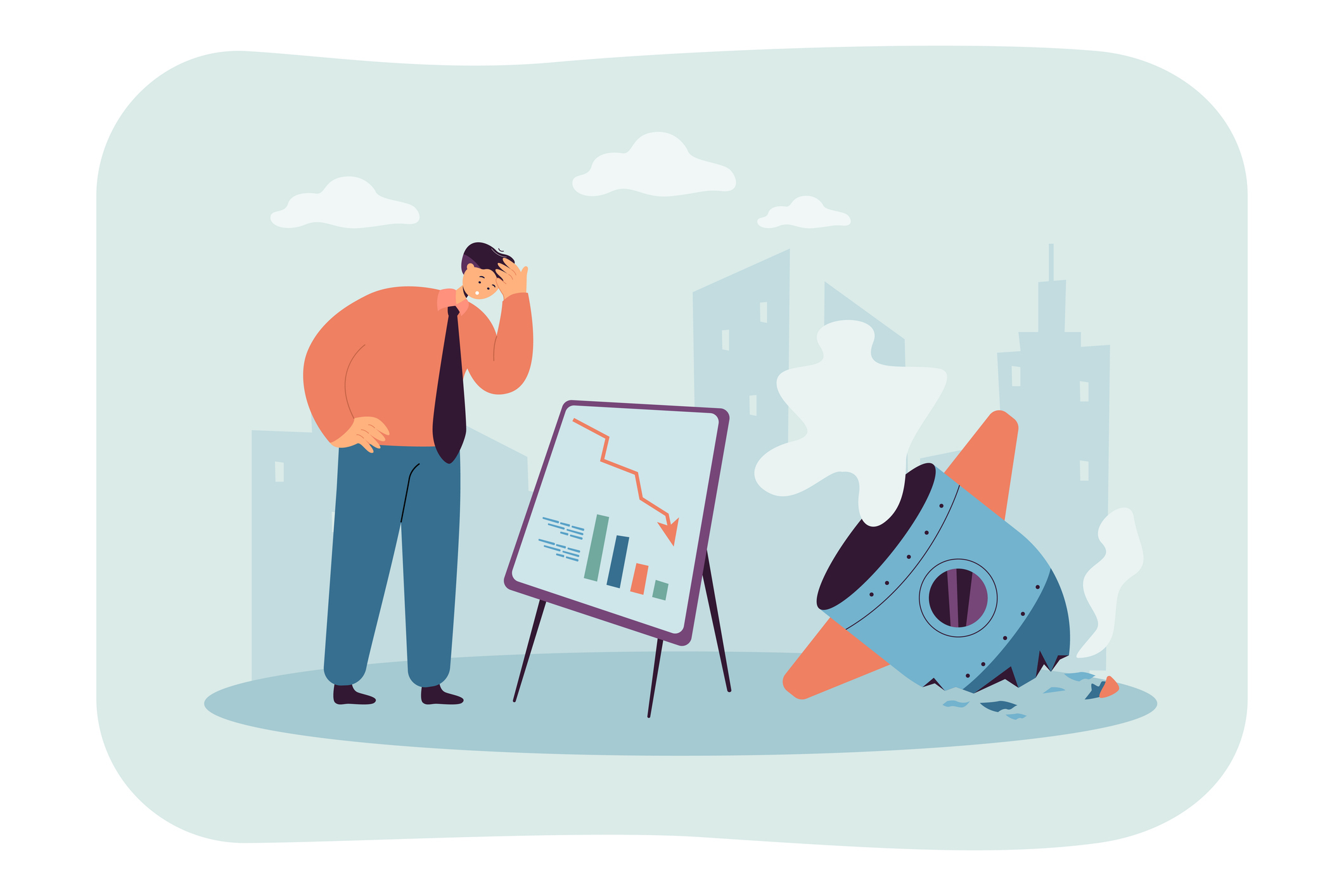

A product can launch cleanly, win distribution, reach more shelves, and still fail to grow in any meaningful way.
Sure, the units move and the dashboards populate. None of that changes the underlying problem. Repeat purchase never builds at the rate the business assumed it would, and without repeat there is no expansion, only a more expensive version of a trial.
Because repeat purchase is the only signal that compounds. Everything else is front-loaded and decays quickly if behaviour does not change.
Inside the company, the failed launch is usually explained as execution. Sometimes that is true. Execution determines whether a product is present, visible, and easy to choose. But execution cannot compensate for a product that does not displace anything once encountered.
To compensate, price gets adjusted and media gets pushed harder. The issue is framed as visibility, or support, or timing, because that is easier to fix than the possibility that the product was approved on the wrong test in the first place.
And that approval usually starts with purchase intent. Consumers say they would consider buying the product, and that signal is treated as evidence of future demand.
But the truth is purchase intent does not equal future demand. It shows the product is acceptable in theory. It does not test whether anyone will replace what they already buy, which is the only decision that matters once the product enters a category governed by routine.

The Market Is Already Decided
Panel data consistently shows that in mature FMCG categories, only a minority of purchase occasions, often in the 10 to 20% range, reflect brand switching, while the majority repeat prior choices.
The Ehrenberg-Bass Institute has documented the same pattern over decades. Brand growth is driven by penetration and light buyers, but those buyers still operate within stable repertoires once a purchase is made, returning to familiar options rather than reopening the entire category each time.
That’s because a new product is not competing with the whole category. It is competing with a much smaller set of options the buyer already uses, already recognises, and already trusts enough not to think about. Bain & Company has shown that consumers typically consider fewer than three brands at the point of purchase in many categories, a set that has narrowed in recent years.
The problem is ingrained in human behaviour. The product has to interrupt a pattern that is already in motion and replace something that is known, available, and good enough. The incumbent choice carries no uncertainty, asks for no extra time, and rarely creates a problem large enough to force reconsideration.
In low-involvement categories, that is usually enough to win. The gain from switching has to be clear, immediate, and worth the inconvenience of doing something different once.
Sure, trials can be bought with a discount, a display, or a moment of curiosity. Second purchase is where the story usually ends. Product switching because it is in front of the buyer, temporarily discounted, or easier to reach in the moment is usually unstable. It creates trial without commitment and disappears as soon as the context resets.
What Research Removes
Concept testing isolates the idea and asks for a reaction without consequence. It overstates rational evaluation, ignores repetition over time, and removes the need to maintain or break a habit, producing agreement that would not survive a second or third purchase decision.
But in the actual market, the buyer is not evaluating a concept; they are deciding whether to replace something they already use, already trust, and can access without friction, often in a rushed moment with no reward for careful consideration. The incumbent product benefits from familiarity, availability, and habit, which together lower the perceived risk of doing nothing while raising the burden of trying something new, even once.
Purchase intent captures a softer signal. It records that the idea is coherent, relevant, and plausible within the category when presented cleanly and without competition. It does not force the respondent to give anything up, and it does not measure whether they will interrupt an existing pattern to make room for the new option. That gap is where most launches fail.
In their study on status quo bias, William Samuelson and Richard Zeckhauser found that individuals disproportionately stick with default options even when alternatives are objectively superior. That tendency compounds in consumer settings, where decisions are repeated, low attention, and shaped by habit rather than active comparison. A recent McKinsey analysis of consumer decision journeys found that a majority of purchases occur within an initial consideration set, with limited switching unless a disruption forces reevaluation.
Traditional concept testing removes the very condition that determines outcome in the market: the need to replace. It strips away habit, compresses risk, and presents the product in a vacuum where agreement is cheap and consequences are absent, producing a signal that confirms the idea can be accepted when nothing is at stake but says nothing about whether it can displace anything when something is.
Why “Strong Concepts” Mislead
A concept tests well for reasons that are usually obvious. It is clear enough to understand on first read, it fits the category people already know, the benefit is legible, and the use case lines up with behaviour that already exists. None of that asks the buyer to rethink anything. It only asks whether the product makes sense.
Purchase intent is often a measure of coherence, not commitment. People can recognise a sensible offer without having any real intention to change what they do on a Tuesday afternoon when they are tired, in a rush, and standing in front of a shelf full of things they have already decided are good enough.
The concept did its job. It showed the product was intelligible, but it did not show the product could replace anything. Many products follow the same pattern: high concept scores, initial trial driven by promotion or curiosity, and rapid reversion to prior behaviour once the context normalizes.
That gap matters more than most teams want to admit. Agreement requires nothing. Replacement requires forfeiting something that already works.
A favorable concept response does not require someone to drop a habit, give up a familiar brand, accept even a minor switching cost, or justify one more small decision in a day already crowded with them. Real buying behaviour is not a classroom exercise. It is a routine under constraint, and the old product is not removed from the shelf just because the new one tested well in a survey.
Nielsen has documented for years that strong concept scores do not reliably translate into durable in-market performance, with many launches showing early interest and trial but weak repeat over time. Consumers say the product sounds good, some try it, and then behaviour slides back into what it was before.
Humans are creatures of habit. A new offer does not arrive in an empty field where preference can be cleanly expressed. It arrives inside an existing system of habit, memory, availability, and friction, where being noticed is difficult and being repeated is harder.
That is the part traditional concept testing does not solve. The concept can be right and the launch can still fail, because the market is not grading comprehension. It is sorting for replacement. And replacement is where coherent ideas discover they were never strong enough to interrupt anything.
The Only Decision That Matters
Adoption is not about preference. It is about displacement. And that displacement is rarely clean. Most products do not fully replace an incumbent; they enter unevenly, take a share of occasions, and compete inside a small repertoire of acceptable choices, which still requires interrupting what was already being bought without thought.
Displacement also requires presence. A product cannot replace what it is not consistently available to compete against, which makes physical distribution and mental availability preconditions rather than supporting factors. If the product is not encountered at the moment of decision, it is not part of the decision at all.
A new product does not win because it is liked in isolation; it wins when it takes enough share from something already being purchased, used, and trusted without friction to justify being chosen again.
Concept testing asks whether the product is acceptable on its own terms, in a controlled setting, without forcing the buyer to give anything up, and then treats that answer as a proxy for real behaviour in a market that runs on replacement decisions.
But in the real world, replacing an existing choice carries a cost, even when the category is routine and low involvement, because the current option is known, easy, and requires no reconsideration, while the new one introduces even a small amount of uncertainty and asks the buyer to change behaviour. And that is often enough to stop the second purchase.
People do not switch because something is better. They switch when staying becomes harder than leaving.
What Better Validation Actually Looks Like
If validation fails, it is not because testing is useless. It is because it is pointed at the wrong question.
The question is not whether someone would buy the product. It is what they would stop buying to do it, and under what conditions that trade actually happens in a real environment with real constraints.
That shift breaks most research designs.
Typical testing isolates the concept and asks for a reaction, which produces clean data and false confidence, because it removes the one condition that determines behavior: competition with what already exists and works well enough.
A more predictive approach forces a decision inside that constraint.
Not a rating. A tradeoff. Not whether the product is appealing, but whether it is chosen over the current default when both are present and the cost of switching is real.
Methods like discrete choice modeling and simulated shelf tests attempt this, but they still overstate deliberate tradeoffs and underweight habit, repetition, and context, which means they improve the signal without fully resolving the gap.
That threshold is not abstract. It is a combination of relative advantage, ease of adoption, consistent availability, and reinforcement across occasions, all of which must be strong enough to overcome doing nothing.
Fewer concepts pass when they are forced to compete directly against existing behaviour instead of hypothetical openness, and many ideas that look viable in isolation collapse when asked to earn replacement.
That is not a flaw in the method. It is THE point. Validation that does not survive contact with real decisions is not validation.
The Solution
The problem is not that purchase intent is slightly inaccurate. It is used to approve decisions it cannot predict, which turns early agreement into a substitute for evidence and allows products to move forward without ever proving they can change what people actually do.
A product should not be approved because it is acceptable in isolation. It should be approved only if it demonstrates the ability to take share from an existing choice under conditions that resemble how decisions are actually made: in the presence of current options, with real tradeoffs, and with the friction of switching intact.
The question is no longer “would you buy this?” It is “what would you buy less often if this existed?” If there is no clear answer, there is no basis for repeat. If the product does not take volume from something specific, it does not have a path to growth.
If no observable substitution emerges when the product is tested against current behaviour, it should not proceed, regardless of stated intent or concept strength.
In practice, that means forcing concepts into competitive contexts early, measuring choice against current behaviour, and setting a minimum bar for displacement—however imperfect—before capital is committed. Not directional interest. Not stated intent. Observable substitution.
Market research is still central to that process, but its role shifts from validating ideas in isolation to testing whether they can change behaviour under real conditions.
Yes, fewer ideas will pass, and the ones that do will have a clearer path to repeat because they have already demonstrated the ability to take share under realistic conditions. Others will require stronger distribution, sharper positioning, or a more meaningful advantage before they are viable.
The cost is earlier constraint, fewer approvals, and a higher bar before launch. But the alternative is predictable failure.
The system persists because it serves internal needs. Purchase intent produces early agreement, supports business cases, and allows decisions to move forward with apparent evidence. Harder tests delay that process and eliminate more ideas, which conflicts with how most organisations are structured to operate.
It also filters out products that require explanation or behaviour change early, favoring those that are immediately agreeable even if they are less capable of changing what people actually do.
Concepts that are easy to agree with will no longer be enough. Products will have to demonstrate that they can interrupt existing behaviour, take share from something specific, and justify being chosen again under real conditions.
Most will not meet that bar. But that is the point. Consumers are not rejecting these products. They are continuing with what already works, and the only way to change that is to approve fewer things that never had a chance of replacing anything in the first place.
Kadence works with teams facing this exact problem: strong concepts that clear testing but fail to build repeat once they reach the market. Concept testing still has a role, but only when it is designed to reflect how decisions are actually made. That means testing in a competitive context, forcing real tradeoffs, and identifying whether a product can take share from what people already buy—not just whether it is acceptable in isolation.
If your current approach is generating agreement but not growth, it is worth reassessing what your testing is actually measuring. Explore how Kadence approaches concept testing with a focus on real-world choice, displacement, and repeat behaviour.
FAQs
Why doesn’t purchase intent predict actual buying behaviour?
Because it measures whether a product is acceptable in isolation, not whether it can replace something people already buy. In real conditions, consumers default to existing choices, and purchase intent does not test the cost or friction of switching.
What is the difference between purchase intent and real demand?
Purchase intent reflects stated interest under no consequence. Real demand shows up when a product is chosen over an existing option repeatedly. The gap is whether the product can displace current behavior, not just be liked.
Why do products with strong concept testing still fail?
Because concept testing removes competition, habit, and tradeoffs. Products can test well when evaluated alone, but fail when placed alongside familiar options that require no change in behaviour.
What actually drives repeat purchase behaviour?
Repeat is driven by a product’s ability to fit into existing routines or replace something already being used. If switching is not easier, better, or more accessible than the current option, repeat does not build.
How should concept testing be improved to predict success?
Testing should force real choices, not just reactions. That means placing concepts in competitive contexts, measuring what consumers would buy less often, and identifying whether the product can take share from existing behaviour.