

Many business decisions now move before the evidence is fully in place.
Market research has the greatest influence while the brand is still able to change course. Campaigns can win approval before the customer is fully understood. Pricing moves can reach the model before the trade-offs are visible. Product routes can build support before the riskiest assumptions have been tested.
This is the insight lag problem. Organisations now see customer behaviour unfold much earlier than they once did. Sales patterns shift, media performance updates, and customers leave digital traces that can push teams toward action before a formal research question has even been framed.
Those signals can show that something is changing before they show what it means. Research brings discipline to that uncertainty, especially when confidence begins to form around evidence that is still incomplete.
The answer is not to strip research down to fit every internal deadline. Fast evidence is valuable when it supports the right decision. It becomes risky when treated as proof for choices with lasting commercial consequences. The issue isn’t the speed of research, but using evidence to support decisions it wasn’t designed to validate.
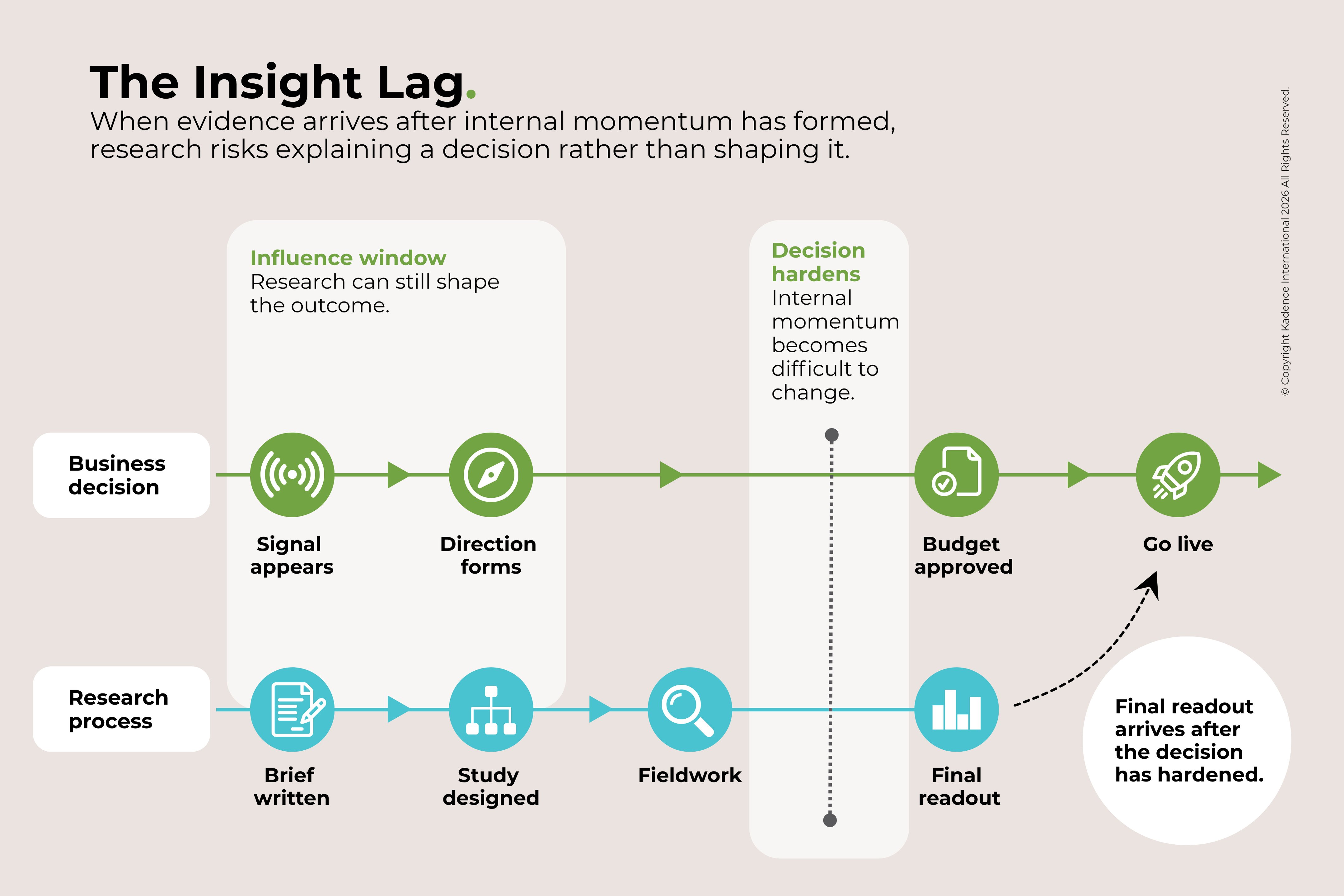
Decision-making has moved closer to live data
Modern business decisions often rely on immediate evidence, like search trends, customer data, and commercial dashboards, that emerges before formal research even begins. These real-time signals highlight market shifts while teams are still deciding how to respond.
McKinsey found that organisations gain an advantage when speed is matched by quality, yet only 37% of respondents said their decisions were both high-quality and fast. The advantage comes when organisations can move quickly without compromising judgment quality.
Available data often becomes the easiest evidence to act on. A rise in conversion may show that an offer worked in the moment, while leaving the harder question unanswered: did it strengthen demand, or simply buy temporary volume? A drop in engagement may suggest fatigue, but it cannot explain whether the problem is strategic, creative, channel-led, or category-wide.

More data does not always create better judgment
Marketing teams have more data than ever before, yet confidence in what that proves remains uneven. Forrester’s 2024 Marketing Survey found that 64% of B2B marketing leaders do not trust their organisation’s marketing measurement for decision-making. The problem is the gap between what measurement records and what leaders need to understand before committing to budget or growth targets.
Most measurement systems are built to show visible movement. They can tell a team what changed and where performance gained or lost momentum. That makes them useful for monitoring the market, but weaker when the business needs to understand what made customers hesitate, switch, repeat, or disengage.
Metrics such as declining acquisition costs, rising volumes, or high stated intent can make campaigns and promotions appear successful. However, without proper interpretation, brands risk optimising surface-level results while overlooking the underlying conditions that actually drove them.
Performance data becomes more useful when it is tested against the reasons customers behave as they do. It can show when growth reflects real relevance and when it has been bought through short-term incentives. It can also reveal when strong results are hiding weak attachment to the brand.
In retail media, for instance, a promotion can make the campaign appear successful in a dashboard. The harder question is whether the shopper chose the brand because preference strengthened or because the offer was temporarily cheaper. Without that distinction, the brand may fund the next campaign with confidence while training customers to wait for incentives.
Synthetic data can sharpen the first question, not answer the final one
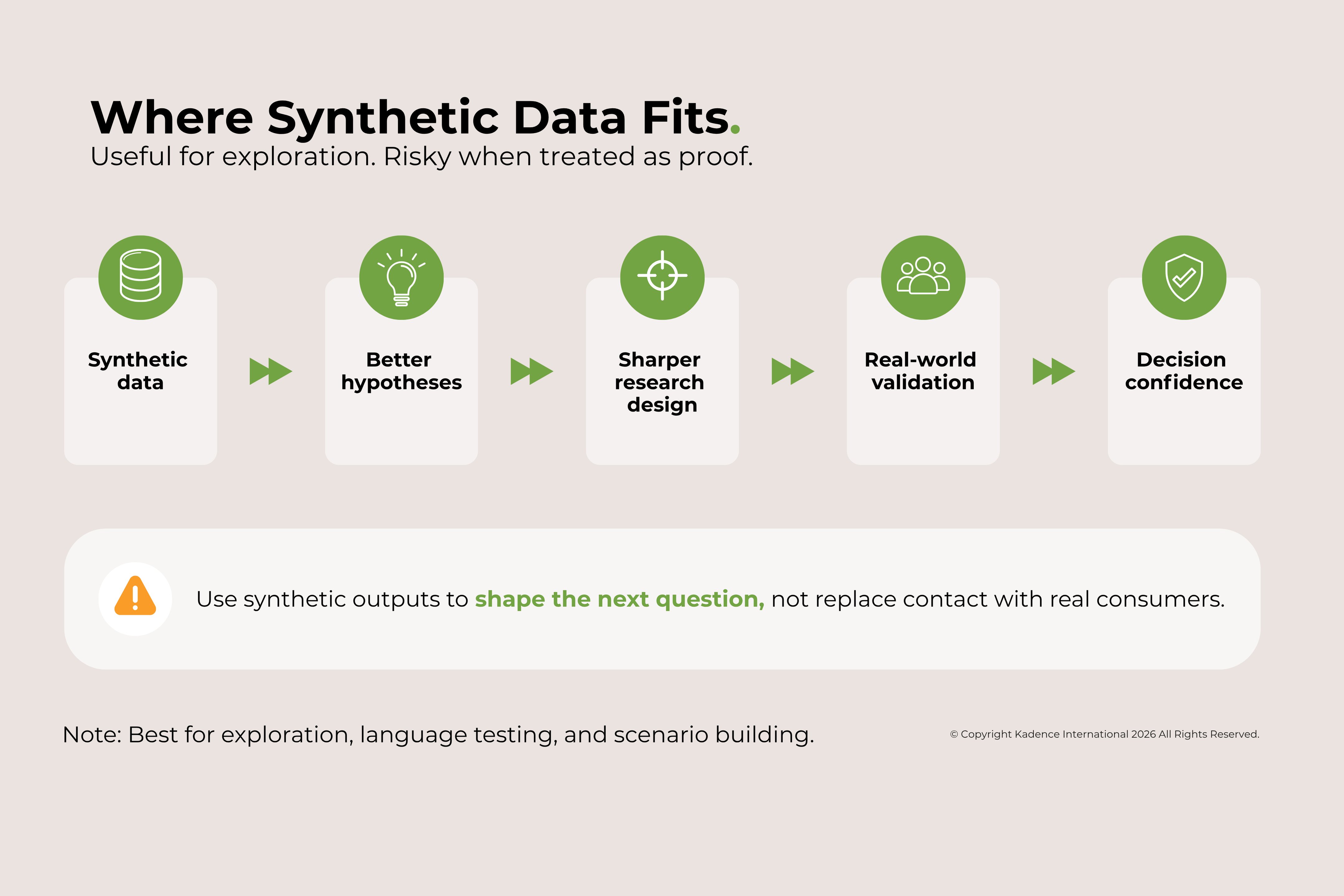
Synthetic data appeals to organisations because it offers an answer before the market has been asked. Used carefully, it helps teams explore hypotheses, test language, and model responses.
However, synthetic data has limitations as it is generated from existing data, models, prompts, and assumptions. It can reproduce patterns, but it cannot fully replace the lived context, incentives, and trade-offs that shape real consumer behaviour. When used beyond its proper role, it can make a weak assumption appear more stable than it is.
Recent academic work on synthetic data makes the same distinction, noting its value for research design and experimentation while warning that its quality must be judged by use case, validation standards, and the risk of treating simulated outputs as real-world representation.
The danger begins when a synthetic read is treated as permission to fund a high-stakes decision. A synthetic read may be fast enough for exploration and cheap enough for early pressure-testing, but that does not make it strong enough for a pricing move, market entry decision, brand repositioning, product launch, or investment case.
Synthetic data is most useful when it sharpens what needs to be tested with real people.
The evidence standard should match the cost of being wrong
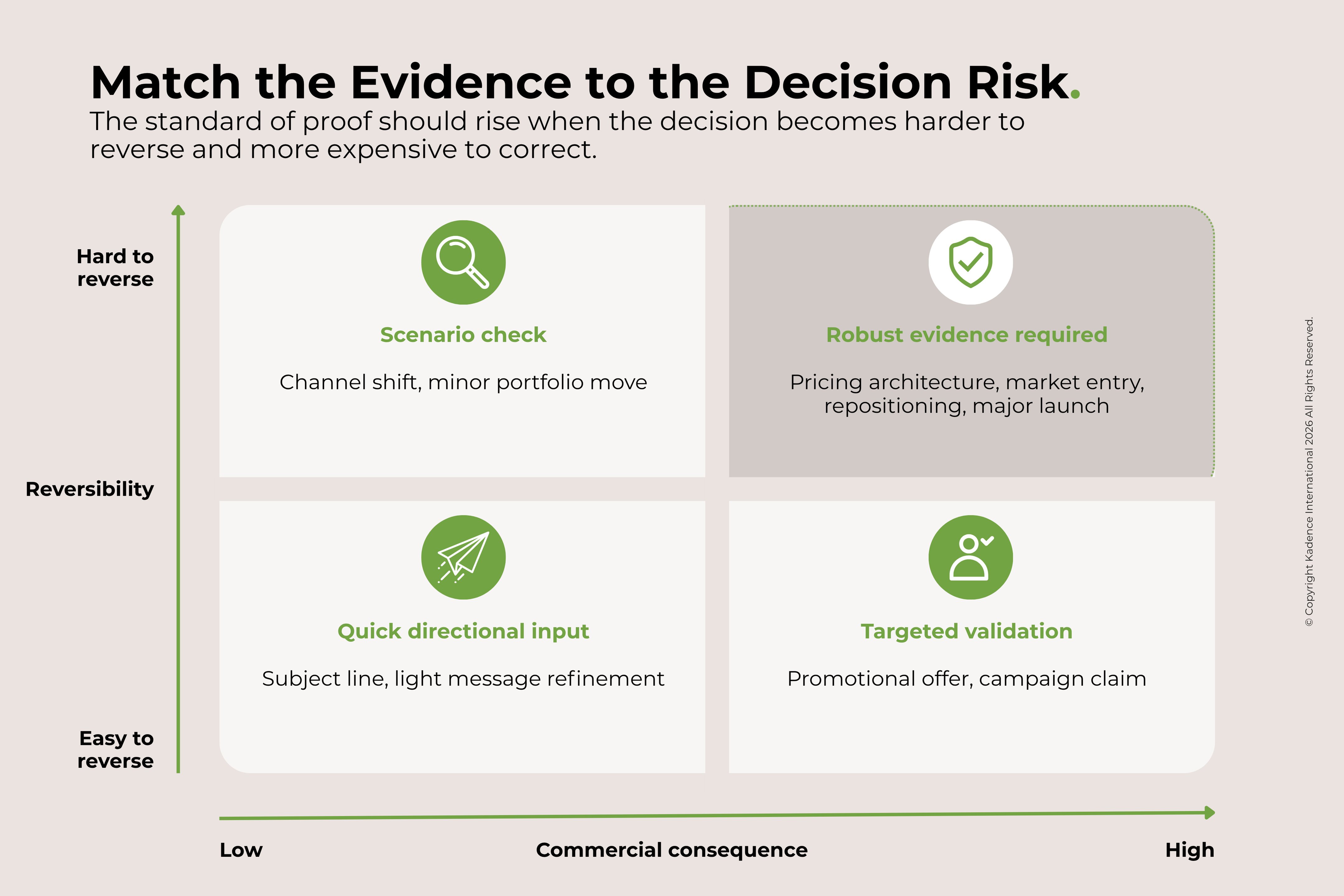
Not every decision deserves the same evidence standard. A subject line test does not carry the same consequences as a pricing shift. A packaging refinement does not require the same level of proof as a market entry plan. Applying the same research design to each creates waste in one direction and exposure in the other.
The sharper approach is to judge the decision before choosing the method. Some questions need a quick read because the decision is reversible and the investment is contained. Others need deeper validation because the cost of being wrong may show up in lost margin, damaged trust, or years of misallocated spend.
The standard should rise when a decision changes the economics of the business, not just the wording of the offer. Pricing, positioning, market entry, and portfolio choices need stronger proof because they are harder to reverse and more expensive to correct.
This is where modular research has value. The first stage should clarify the real decision behind the brief. The next step should test the assumption most likely to break the plan. Later stages can validate the strongest route with more robust evidence. The work should deepen as the level of commitment increases.
For a new product launch, concept scores matter only after the business has tested whether the audience recognises the problem, sees the occasion, and accepts the value exchange. If those foundations are weak, a later concept score may only identify the best version of a flawed idea.
Every significant decision also needs a clear burden of proof. Brands should know what evidence would confirm the route, what would weaken it, and what would force a change. Without that threshold, almost any finding can be absorbed into the existing direction.
Research needs authority before the brief becomes fixed
Briefs often arrive with the core strategy already narrowed. The audience has been chosen, the benefit has been defined, and the pricing logic may already be assumed. At that point, research can still improve the work, but it may have less room to challenge the thinking behind it.
A well-written brief can still point the business in the wrong direction. A brand can spend heavily on awareness, while the real weakness lies in relevance. A sharper message cannot rescue an offer that customers do not value. A company may pursue a younger audience when the category economics sit elsewhere.
Research needs enough authority to test the foundations of the brief before they become operating assumptions. It should be able to question whether the business is solving the right problem, whether the audience has been defined correctly, and whether the commercial case rests on evidence strong enough to support approval.
In more mature organisations, research helps decide whether the evidence is strong enough for approval.
Findings should be written around choices, not observations
Research loses force when it stops at what people said, what people preferred, or which option scored highest. Those findings may be accurate, but they do not always tell the business what should change.
Reporting that “consumers responded positively” is insufficient, as such feedback often masks factors like novelty or social desirability. Meaningful insights must detail the nature of the response, the conditions that shaped it, and the resulting business limitations.
The same applies when results are weak. A low score does not always mean the idea has no value. It may mean the audience is wrong, the benefit is unclear, the price feels disconnected from the promise, or the route needs a different market-entry sequence.
Research outputs should show what the evidence means for investment, execution, and accountability while staying clear about the limits of certainty.

Post-launch learning should test the original assumptions
The final measure of research quality is whether the decision survives market testing.
Too many organisations treat launch as the end of the evidence cycle. Performance is monitored, but the assumptions behind the decision are rarely examined with the same discipline. If sales rise, the strategy is often credited. If sales disappoint, execution is often blamed. Both reactions can miss the more useful question: which assumption proved true, which one weakened, and which one was never properly tested?
Post-launch learning should connect market performance back to the decision logic. If a new product underperforms, the issue may sit in the problem definition rather than the campaign. If a campaign performs well, the brand still needs to know whether it built durable preference or only captured temporary attention.
A launch can reveal whether stated intent translated into trial, whether early buyers matched the expected audience, or whether price sensitivity was underestimated. The strongest companies use post-launch learning to improve the next decision, not to defend the last one.
The future of insight is influence at the point of decision
The value of research is measured by the quality of the decisions it improves before the business commits.
That requires research to speak directly to commercial risk. It must show when evidence is strong enough to support action and when confidence outruns proof.
In a business culture that rewards speed, the advantage will go to organisations that know when to move quickly, when to test more precisely, and when to change course.
Need stronger evidence before a major pricing, launch, or market decision? Kadence can help design research that matches the risk of the decision.
FAQs
Why do insights often arrive too late to influence business decisions?
Insights often arrive too late when research is brought in after the business has already narrowed the options, built internal support, or committed budget. The issue is usually not the quality of research, but when it enters the decision process.
How can brands reduce insight lag?
Brands can reduce insight lag by building research into earlier decision points. This means testing key assumptions before campaigns, pricing moves, launches, or market entry plans become difficult to change.
What is the difference between fast research and weak evidence?
Fast research can be valuable when it is designed for the right decision. Weak evidence appears when quick signals, synthetic outputs, or early data are treated as proof for decisions that carry major commercial risk.
When should a business use deeper research instead of quick directional input?
Deeper research is needed when a decision is expensive, hard to reverse, or likely to affect brand trust, pricing, positioning, market entry, or long-term growth. The evidence standard should rise with the cost of being wrong.
Can synthetic data replace consumer research?
Synthetic data can help shape hypotheses, test language, and improve research design, but it should not replace real consumer evidence for high-stakes decisions. Its strongest role is to sharpen what needs to be tested with real people.