
Brand loyalty is proving to be a curious thing. Consumers still have their favourites, but that doesn't necessarily mean they're buying them.
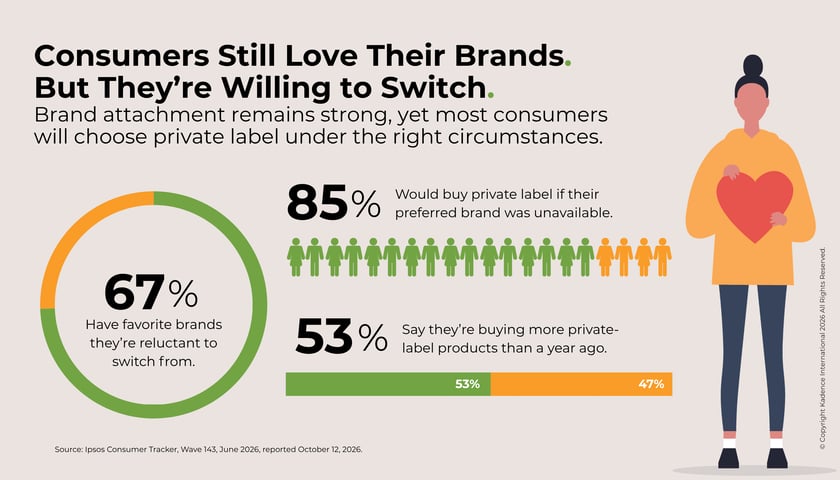
An October 2026 Ipsos study found that 67% of American consumers have favourite brands they're reluctant to give up. Yet 85% say they're willing to buy private label when their preferred brand is unavailable. More than half (53%) report buying more private-label products than they did a year ago.
And increasingly, they're not doing so reluctantly.
McKinsey's 2026 grocery research found that 85% of North American consumers believe private-label products match or exceed the quality of national brands. Across Europe, private label now accounts for nearly 40% of grocery sales value. In the US, store brands reached a record 23.7% share of units sold in the first ten months of 2026.
So what happens when consumers still like your brand, trust its quality and recognise its packaging, but no longer see a compelling reason to pay more for it?
Price has always influenced what people buy. But retailers have spent years improving their own-label products, investing in better ingredients, packaging, innovation and premium ranges. Shoppers have noticed. In many categories, choosing the cheaper product no longer feels like a compromise.
And that's where things get interesting. A brand can score well on awareness, consideration, and even preference while quietly losing customers at the shelf. The numbers in a brand tracker might look perfectly healthy, even as the sales figures tell a different story.
Private Label Has Outgrown Its Budget Reputation
Retailers have become serious competitors in product development. Premium ingredients, distinctive packaging and exclusive ranges are now part of their private-label strategies, often with a price advantage that's difficult to ignore.
McKinsey's 2026 research found that 69% of North American grocery consumers believe private labels are as innovative as national brands. The same proportion believe major retailers offer private-label products they cannot buy elsewhere.
That's quite a shift. Manufacturers have spent decades developing products and innovations that give consumers a reason to seek out their brands. Now retailers are doing much the same thing, building ranges that shoppers can only find in their stores.
NIQ's Consumer Outlook: Guide to 2027 found that 34% of global consumers consider quality and performance the most influential factors in determining whether a household or grocery purchase is worthwhile, compared with 31% who prioritise affordability.
Consider the choice facing someone who sees two products of comparable quality on the shelf. One costs considerably less, and the retailer has given them little reason to doubt its performance. They might still prefer the national brand. Whether they're willing to pay more for it is another question.
How Much Is Brand Loyalty Really Worth?
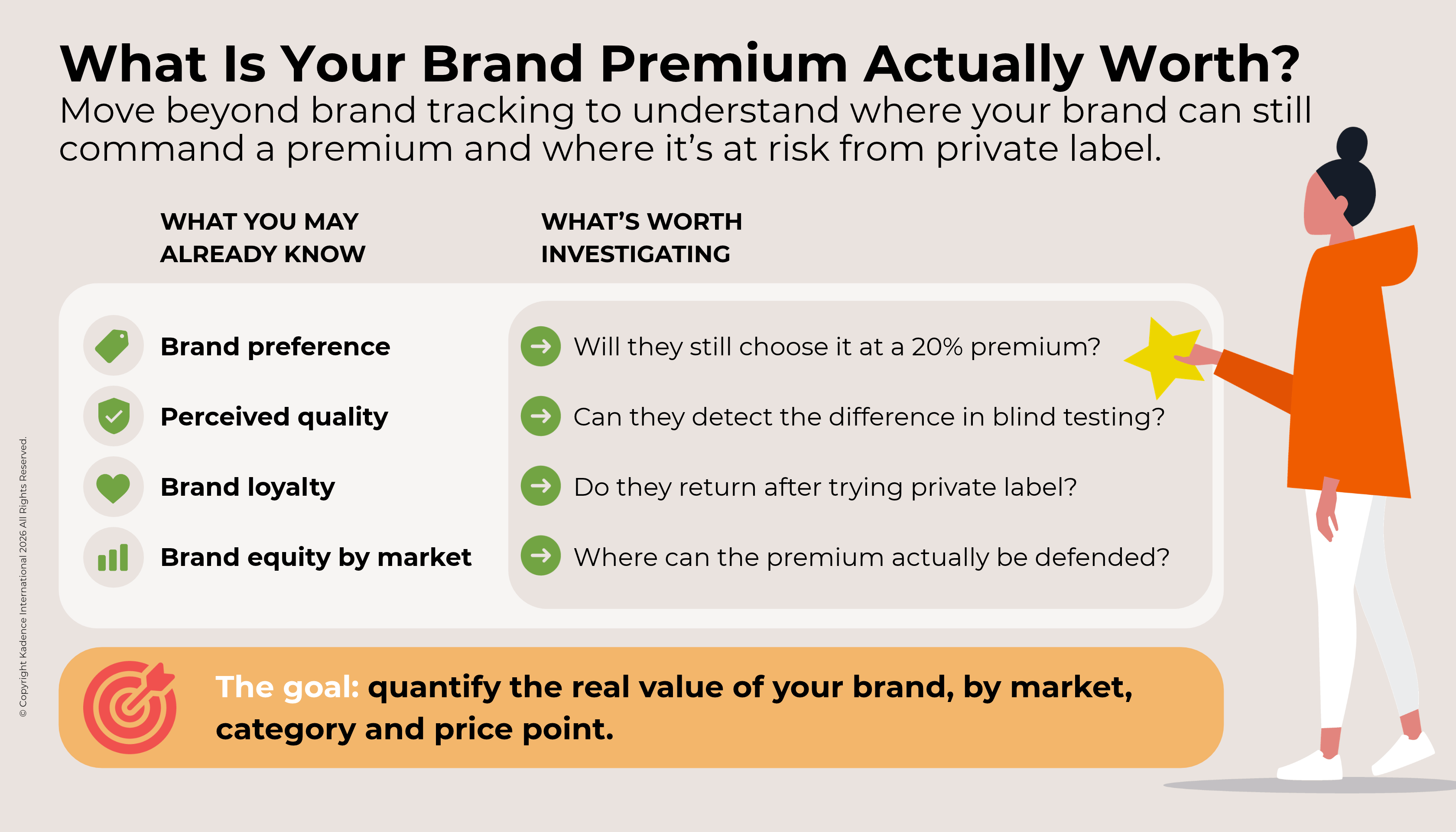
Here's something worth examining in your next brand tracker. How many consumers who say they prefer your brand would actually buy it if the private-label equivalent were sitting beside it at 20% less?
And how many would still choose it at 30% less?
Brand trackers are very good at telling us what people think about brands. They're less useful at telling us what people are prepared to pay for those opinions.
Someone who has bought the same laundry detergent for twenty years might have no complaints about it whatsoever. They simply discover that the store brand does the job for several dollars less. After a few purchases, the old brand starts to look rather expensive.
That shopper could still tell a researcher they prefer the national brand. They might even recommend it. But their purchasing behaviour has changed.
The more revealing question is what happened after that first purchase. Did they buy private label because their usual brand was out of stock? Was there a promotion? Or had the price difference finally become too difficult to justify?
And once they'd tried it, did they go back?
A consumer who switches temporarily during a promotion presents a different problem from someone who tries private label, finds it perfectly acceptable and never returns. Yet both may continue to express favourable opinions about the original brand.
Shopper-panel and transaction data can help distinguish between occasional switching and sustained changes in purchasing behaviour. Examining those patterns alongside brand tracking offers a clearer picture of how much loyalty survives when consumers have other options.
Even then, knowing that someone has switched doesn't tell us what would persuade them to come back. The answer may have surprisingly little to do with how much they like the brand.

Where the Brand Premium Still Holds
Think about the products you buy without giving much thought to the brand, then consider the ones you wouldn't dream of switching. Most consumers have a mixture of both in their shopping baskets.
The difference often comes down to what they believe is at stake.
A disappointing packet of pasta is a minor inconvenience. A skincare product that irritates your face is another matter. When the consequences of a poor purchase feel greater, familiarity and previous experience can become worth paying for. The same applies when consumers have strong preferences around taste, performance or reliability.
Then there's the occasion. Someone might buy private-label coffee for the office but spend considerably more on beans for their espresso machine at home. A household that routinely buys store-brand groceries may choose recognised brands when entertaining guests. The product category hasn't changed, but the expectations surrounding the purchase have.
The interesting question is how much of that premium comes from a genuine difference in performance and how much comes from habit, familiarity, or the reassurance of knowing what to expect.
The Private-Label Challenge Looks Different Around the World
Europe offers a glimpse of how far retailer-owned brands can go. According to NielsenIQ data published by PLMA, private label accounted for 39.5% of sales value across 17 European markets in 2026. In Switzerland, that figure reached 53%, while the Netherlands stood at 51.3%.
But some of the more surprising findings are coming from Asia.
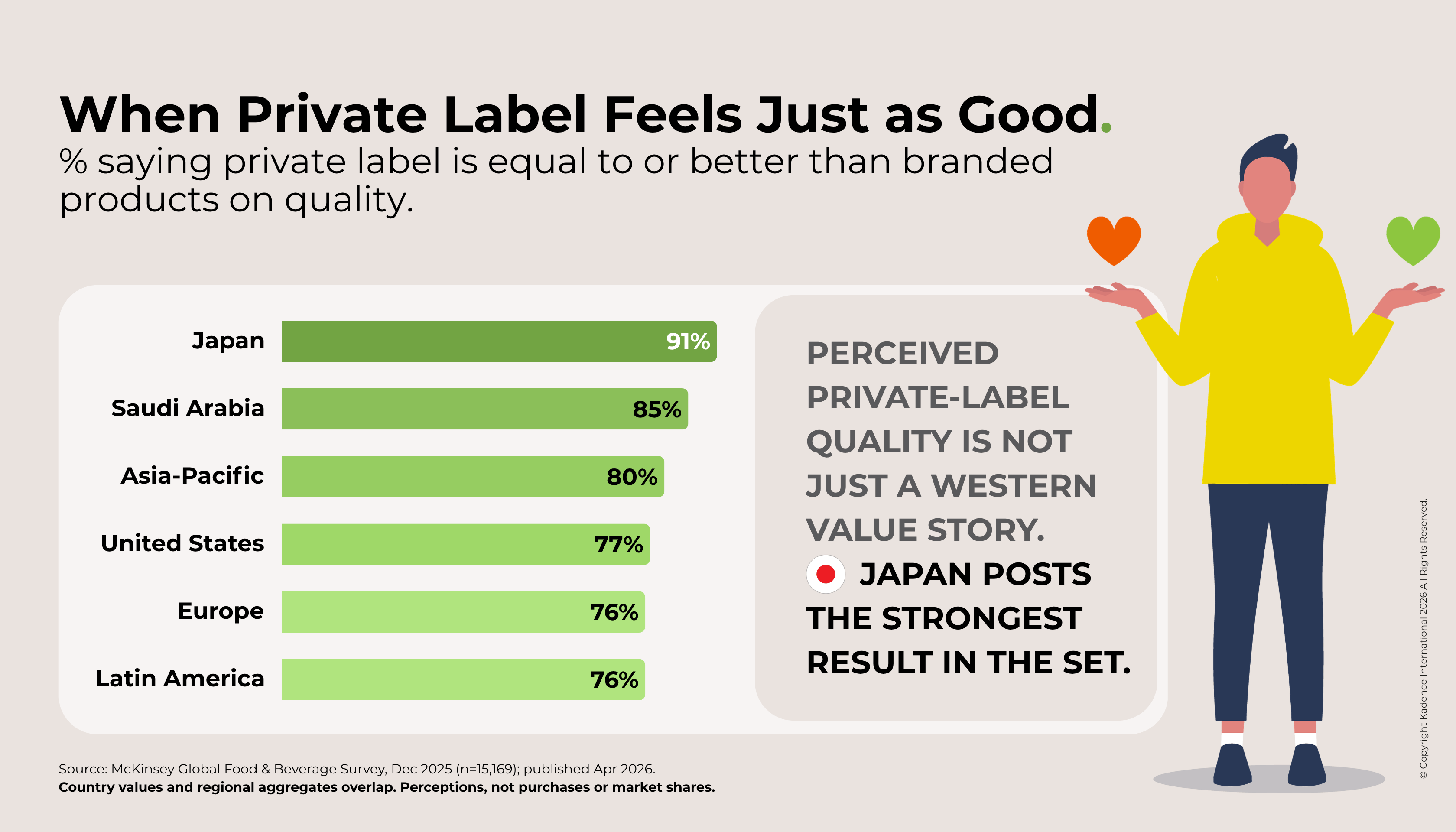
McKinsey's April 2026 State of Food & Beverage report found that 91% of Japanese consumers considered private-label products equal to or better than national brands in terms of quality. That compares with 77% in the US and 76% across Europe.
Singapore provides another interesting example. FairPrice has developed more than 3,500 own-brand products across 70 categories, with nearly half its shoppers purchasing at least one. According to McKinsey, the retailer requires its private-label products to outperform established competitors in blind testing while maintaining a meaningful price advantage.
The Japanese finding is particularly revealing. Consumer perceptions of quality don't necessarily follow the same pattern as private-label market penetration. A country where shoppers rate retailer-owned products highly may present a very different competitive environment from one where private label is primarily associated with savings.
A global brand might enjoy considerable pricing power in one market and discover that consumers elsewhere see little reason to pay more. Even where the product is identical, the competition surrounding it rarely is.
Finding Out What Your Brand Is Really Worth
Imagine discovering that your brand commands a healthy premium among loyal customers, but that the advantage disappears almost entirely among shoppers who have tried the retailer's alternative. Would you spend more on advertising, reduce your price or reconsider what you're offering?
It's the sort of question that becomes difficult to answer with brand tracking alone.
Choice-based conjoint research can help establish how much consumers are willing to pay for a brand when its price and product benefits are weighed against private label. Combine that with blind and branded product testing, and you can start to distinguish genuine performance advantages from the value consumers place on the name itself.
The findings might be uncomfortable. Perhaps consumers can barely distinguish your product from the cheaper alternative. Or perhaps they consistently prefer yours in blind testing, yet fail to recognise its advantages when shopping. One suggests a need to improve the product. The other raises questions about packaging, claims, and communication.
The picture can become even more complicated across markets. Germany has a well-established private-label sector, while Japan's high consumer ratings for private-label quality suggest that retailer-owned products are credible competitors there too. But neither market's quality perceptions tell us how much extra consumers will pay for a national brand. That depends on the category, the alternatives available and what shoppers believe they're getting for their money. A pricing strategy that works in the US shouldn't automatically be rolled out elsewhere.
There are also limits to what consumers say they're willing to pay. Choice experiments provide useful estimates, but actual purchasing data, promotions, and competitor activity help establish whether those preferences translate into sales.
A premium worth defending in one market may be holding back volume in another. The sensible investment could be in product development, pricing, communication, or a different mix of products altogether.
Understand What Makes Consumers Choose Your Brand
Kadence helps global brands understand consumer choice, competitive switching and willingness to pay across markets. If you're questioning how well your brand premium is holding up against private label, talk to our team.
FAQs
Why are consumers switching from national brands to private label?
Consumers are increasingly finding private-label products that offer comparable quality at lower prices. Improved ingredients, packaging and product innovation have made retailer-owned brands more credible alternatives. Inflation and household budget pressures can encourage shoppers to try these products, while satisfactory experiences may lead to repeat purchases.
How does private label affect brand loyalty?
Private label challenges the relationship between brand preference and actual purchasing behaviour. Consumers may continue to trust and prefer a national brand while choosing a cheaper alternative. Measuring brand loyalty therefore requires looking beyond stated preferences to switching behaviour, repeat purchases and willingness to pay.
What makes consumers willing to pay more for branded products?
Consumers may pay a premium for superior performance, familiar quality, reliability, emotional attachment or reduced purchase risk. Willingness to pay can also vary by category and purchase occasion. Brands are better positioned to defend higher prices when consumers recognise a meaningful benefit over cheaper alternatives.
How can market research measure a brand's price premium?
Choice-based conjoint analysis can estimate how much consumers are willing to pay for a brand relative to competing products. Blind and branded product testing helps separate functional quality from brand perceptions, while shopper-panel and transaction data reveal whether stated preferences translate into actual purchases.
Does private-label competition differ across global markets?
Yes. Private-label penetration, retailer credibility and consumer expectations vary considerably across countries. European markets such as Switzerland have high private-label market shares, while research in Japan shows strong consumer perceptions of private-label quality. Global manufacturers need local consumer research to understand where their brand premiums remain competitive.