
By the time most people read this, the Winter Olympics will already be underway. Early results will be circulating, and a handful of performances will already be shaping headlines and conversations.
But the most durable viewing behaviour was decided before any of that happened.
We conducted a study in Japan just ahead of the opening of the Milan–Cortina 2026 Winter Olympics, when expectations were still forming, and attention had not yet been pulled by medals, upsets, or storylines. The research captured who planned to watch, what they intended to watch, and how they expected to engage once the Games began.
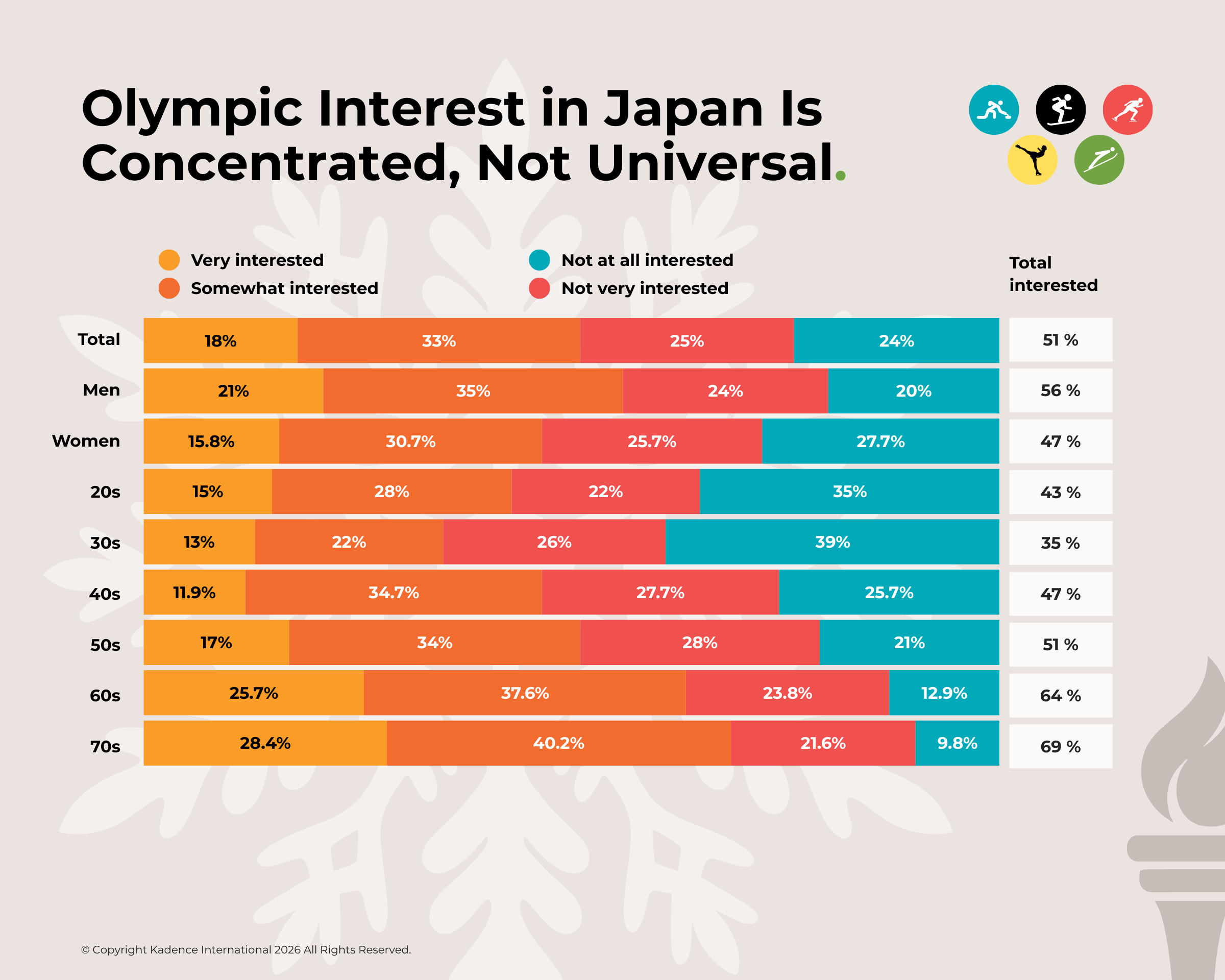
What emerges from the data is not indifference. Interest exists, but it is narrow and shaped by habit rather than anticipation. Just 51% of Japanese adults expressed interest in the Games before they began.
In Japan, the Olympics no longer operate as a single national moment. Instead, they sit alongside everyday media, approached selectively, often quietly, and usually alone.
What Japanese Viewers Planned to Watch Matters More Than What They Skipped
When interest narrows, attention becomes deliberate.
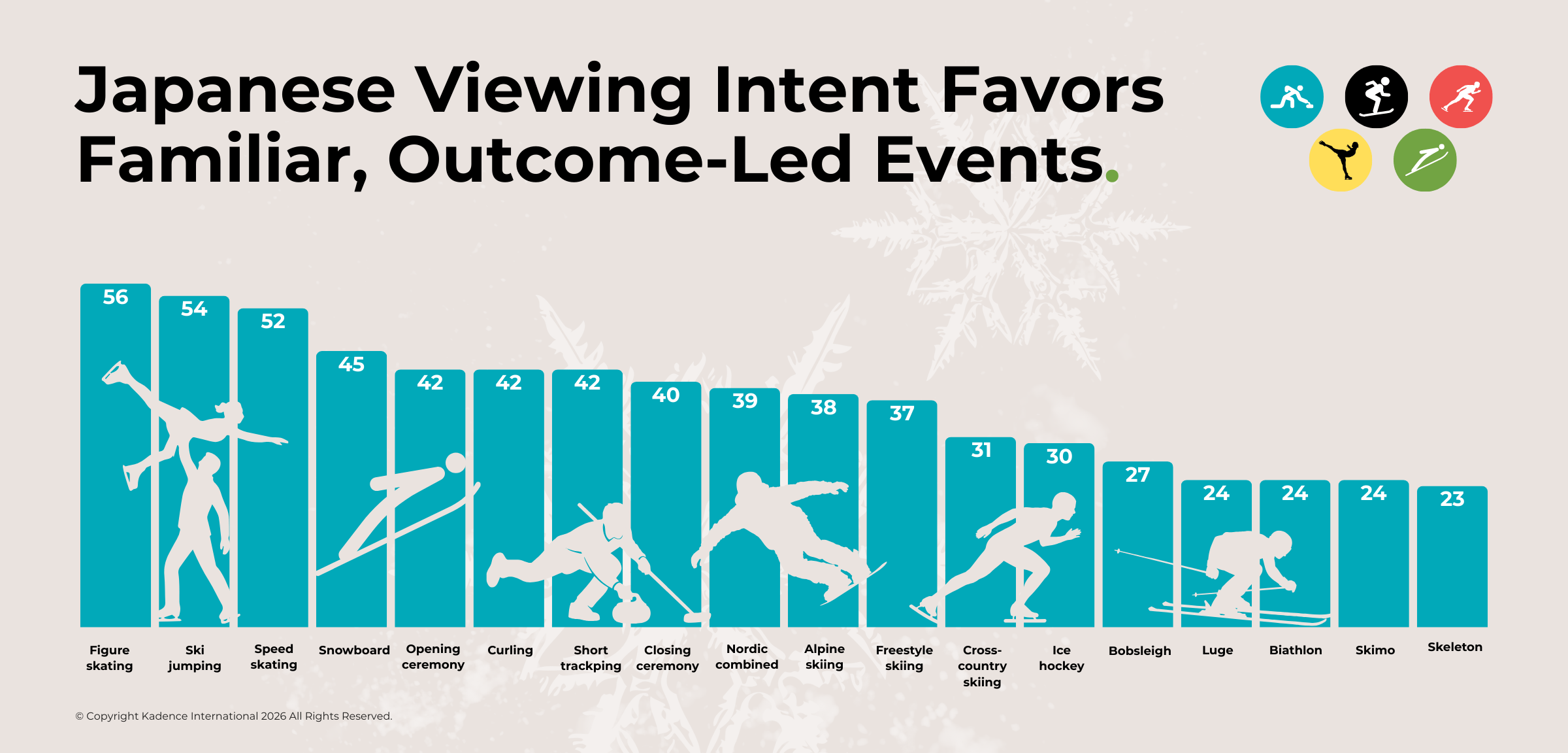
Ahead of the opening ceremony, Japanese viewers did not distribute their intent evenly across the Winter Games. Instead, interest concentrated around a narrow set of events, with figure skating (56%), ski jumping (54%), and speed skating (52%) outpacing all others before the Games began.
This is expectation-driven viewing, rather than curiosity-driven.
Even with ceremonies, people don’t treat the Olympics as a unified event. Opening and closing ceremonies get attention, but not enough to function as collective rituals.
Japanese audiences generally know what to expect from the Olympics. Their focus is on events where meaning can be quickly assigned, and outcomes are easily understood.
Age sharpens this pattern rather than reversing it. Older viewers express interest across a broader range of events, but the hierarchy remains intact.
What people chose not to watch is as instructive as what they did. The Olympic Games are filtered in advance, with attention reserved for moments that promise clarity rather than surprise.
This is how large cultural events persist in Japan now, not by pulling everyone in, but by allowing viewers to opt into the parts that already make sense to them.

For Japanese Viewers, the Olympics Are Quiet, Casual, and Individual
How people expect to watch the Olympics matters more than how much they plan to watch.
Before the Olympic Games began, Japanese viewers described an Olympic experience defined by ease rather than immersion. Seven in ten said they expected to watch alone. A similar share said they wanted to enjoy the Games casually rather than follow them closely.
There is little appetite for mastery or obligation. Viewers are not looking to decode complex formats or commit to extended schedules. They want moments that fit cleanly into existing routines and can be exited without consequence.
This style of engagement mirrors broader media behavior in Japan, where solitary viewing and low-friction consumption have become the norm across television, streaming, and mobile platforms. And the Olympic Games are no exception.
What stands out is not disengagement, but restraint. Viewers are choosing enjoyment without intensity, interest without investment. While the Olympic Games are present in their lives, they are not commanding.
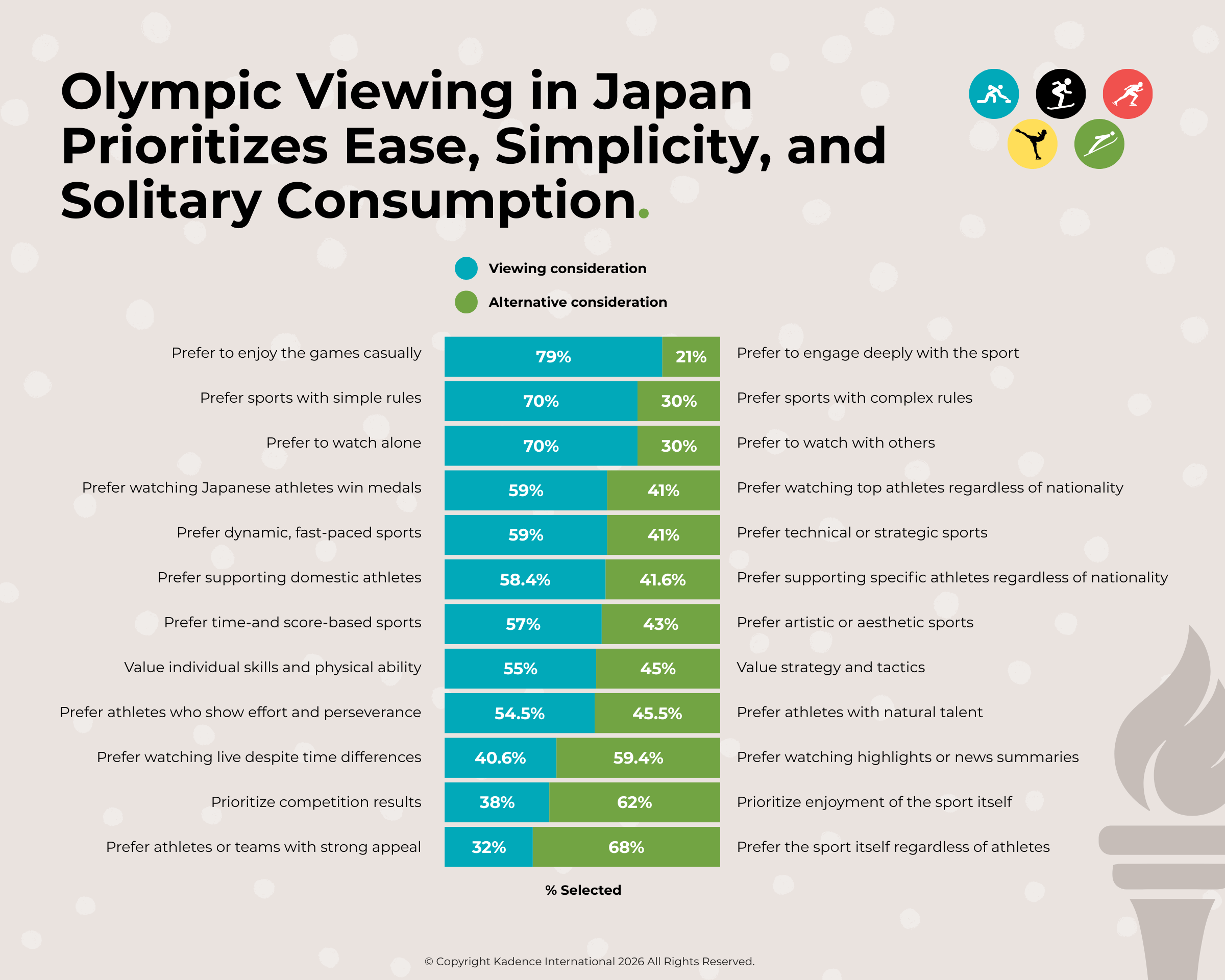
Taken together, these preferences explain why attention concentrates where it does. When viewing is casual and individual, complexity becomes a barrier, and familiarity becomes an advantage. The Olympics endure not as a shared national experience, but as a series of quiet, optional moments.
What These Patterns Reveal About Olympic Engagement in Japan
When placed side by side, the overall behaviour becomes clear.
Interest in Japan is genuine but focused. People gravitate toward events where outcomes can be understood in advance. Engagement is quiet, individual, and intentionally low-effort.
This is not a country losing interest in the Olympics. It is a country engaging with them on tighter terms.
The Olympic Games arrive as familiar content that must earn its place alongside everyday media. Viewers decide in advance what is worth watching, how much energy to invest, and when to step away.
That accommodation reflects experience. Viewers in their 60s and 70s show the strongest interest, while people in their 30s register the weakest. What survives is what fits.
This is the environment in which the Winter Olympics operate in Japan, not as a spectacle demanding attention but as a known quantity integrated selectively and without obligation.

What This Means for Brands While the Games Are Underway
With the Winter Olympics already underway, the risk for brands is misreading attention.
Early medal moments and breakout performances will produce visible spikes. They always do. But our research shows those reactions sit atop a viewing structure that was already narrow before the Games began. Treating short-term lifts as signs of renewed mass engagement risks drawing the wrong conclusions.
Familiarity is doing more work than novelty. Japanese viewers are gravitating toward events they already understand and can interpret quickly. Messages that rely on immediate legibility align more closely with how attention is being allocated than those that demand learning, decoding, or sustained focus.
The tone of engagement also matters. Olympic viewing tends to be low-friction and solitary, absorbed into existing routines rather than treated as a shared moment. Efforts that blend into those routines are more likely to feel natural than those that assume heightened emotional intensity.
Perhaps most importantly, the Olympic association no longer guarantees attention. The Games are being evaluated alongside streaming, social, and mobile content, not elevated above them. Visibility must earn its place rather than assume it.
Muted response, then, should not be read as disengagement. It reflects a reassessment of how large events fit into daily life. The value lies in understanding that structure.
Once the Games Begin, Outcomes Shift Attention — Not Expectations
As medals are awarded and narratives form, attention will move. A breakout performance can widen the audience. A familiar name can pull viewers back. Results create emotion, and emotion creates spikes.
Our research examined Japanese viewing expectations prior to any performance outcomes, before successes or disappointments altered public discourse. What it reveals is not a lack of interest, but a shift in perspective. The Olympics hold cultural significance in Japan, but they no longer require immersion by default. Instead, they are integrated into everyday media consumption and experienced more selectively.
As the Olympic Games continue, outcomes will matter. They always do. But once the noise fades, this is the pattern that remains — selective interest, familiar focus, and viewing shaped less by spectacle than by fit.