

For more than a decade, enterprise content strategy followed a clear exchange: publish useful content, rank well, earn traffic, and convert attention into future demand.
That exchange is now weakening. A growing share of search journeys no longer reach brand-owned environments. Bain estimates that 80% of consumers rely on zero-click results for at least 40% of searches, contributing to a 15% to 25% decline in organic traffic. SparkToro’s data shows that in the US and Europe, fewer than 40% of Google searches result in a click to the open web.
Answers are delivered inside search interfaces, AI summaries, and closed platforms. In many cases, the interaction ends there, with users finding what they need without visiting a site or comparing sources.
Performance frameworks still treat traffic as evidence of reach and influence. The problem is that traffic now reflects decisions shaped elsewhere. Buyers form impressions and narrow options in spaces that leave little trace in traditional analytics, creating a gap between what brands measure and what drives choice.
This raises a more fundamental question: Does traffic still reflect influence?
Traffic and Influence
Traffic became the standard signal because it was easy to see, compare, and report. It represented something harder to measure: whether a brand was on a buyer's shortlist and influenced how they viewed their options. As long as people discovered and assessed products on the open web, this substitution worked.
A visit now reflects only a fraction of the user journey, sometimes the final step rather than the formative one. By the time a user clicks, most of the evaluation is already complete.
This leads to wrong decisions. More budget is allocated to SEO content production, ranking optimisation, and conversion rate improvements that capture demand after it has already formed. Traffic, engagement, and conversion remain within expected ranges. These metrics capture the outcome, not the process that produced it.
That gap creates false confidence. Brands optimise for visible signals, while the factors shaping preference lie outside this measurement. A campaign can appear effective without increasing consideration. Similarly, a product page can convert without influencing the decision.
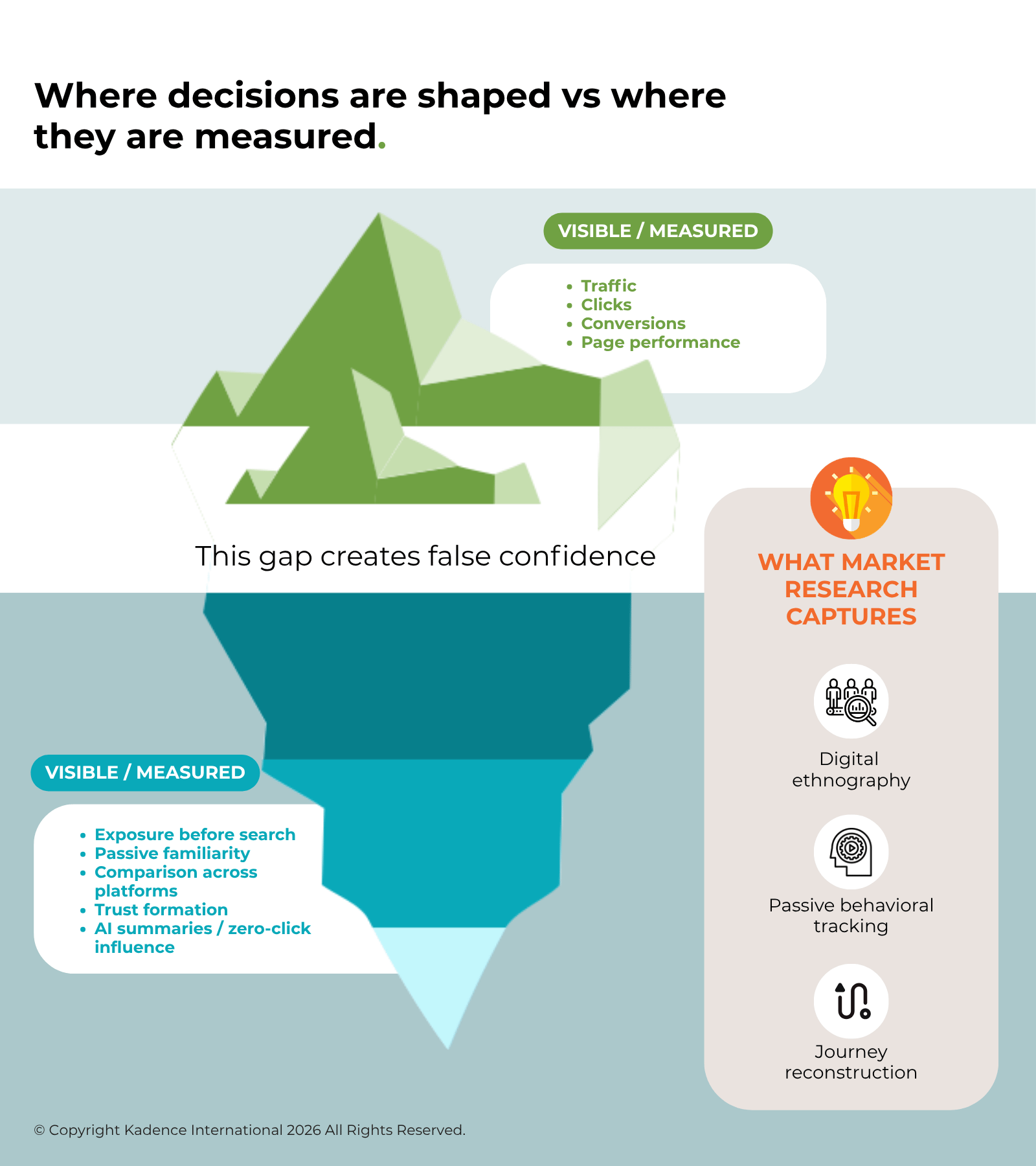
Market research is the only way to see what is shaping the decision before it appears in data. Techniques such as digital ethnography, passive behavioural tracking, and journey reconstruction make it possible to map how decisions are actually formed, not just where they end. They reveal the sequence of exposure, comparison, and validation that no analytics platform can fully capture.

Where Platforms Eliminate Options Early
Search has moved from directing users elsewhere to keeping them within its own interface. AI-generated summaries formalise this shift, collapsing multiple sources into a single answer and reducing the need to visit comparison sites or review pages. This direction was already underway before AI summaries became prominent. Featured snippets, product carousels, and comparison modules had already begun reducing the need to explore further, turning search into a destination rather than a pathway. The interaction often ends at the point of first exposure.
A similar pattern applies across platforms, where the set of options is shaped before a user evaluates them. On Amazon, ranking, reviews, and “best seller” badges determine which products are seen and trusted before product detail is considered. More than 60% of product searches now begin on Amazon, shifting discovery into an environment where visibility is already filtered.
On TikTok, the mechanism is different, but the outcome is the same. Products gain traction through creator content and repeated exposure in feeds, building familiarity before users actively search for them. By the time the search occurs, the decision has already narrowed.
Evaluation shifts from active comparison to acceptance of what surfaces. Summarised answers, ranked outputs, and repeated exposure reduce the need to seek additional sources.
With fewer sources, the path to a decision becomes shorter, more curated, and less transparent. By the time a user takes action, the outcome reflects a set of options that has already been defined.
Case Study: e.l.f. Cosmetics and Pre-Search Discovery on TikTok

Background
e.l.f. Cosmetics, a US-based beauty brand, built its growth strategy around reaching younger consumers through digital-first channels. As social platforms began shaping discovery, the brand focused on TikTok as its primary engagement platform rather than relying only on search-led traffic.
Approach
The brand launched the “Eyes. Lips. Face.” campaign on TikTok, designed to encourage user participation rather than passive viewing. Instead of directing users to product pages or external sites, the campaign centred on creator-led content, music, and repeatable formats that could scale organically across the platform.
Scale and Reach
The campaign generated more than 7 billion views, becoming one of the most widely participated in branded challenges on TikTok. Hundreds of thousands of users and creators contributed content, extending reach far beyond paid distribution.
Impact on Consumer Behaviour
Products such as the e.l.f. Camo Concealer and Power Grip Primer gained traction through repeated exposure in tutorials, reviews, and everyday content. Consumers encountered the brand multiple times within their feed before actively searching for it. By the time the search occurred, much of the evaluation had already taken place.
Strategic Implication
If e.l.f. had relied on search-led discovery, its products would have entered comparison pages alongside dozens of similar options, where ranking, price, and reviews determine visibility. Without repeated exposure on TikTok, the brand would not have been familiar before evaluation began. It would have competed as one of many, rather than being selected early.

Why Market Research Is the Only Way to See What Is Happening
When preferences are shaped in environments that do not produce observable signals, measurement breaks down. Analytics can report what happened, but not how or why. The inputs that shaped the decision remain outside the dataset.
Market research fills that gap by reconstructing the user journey rather than relying on recorded interactions. Digital ethnography captures how consumers move across platforms, what they notice, and how they interpret what they see. Passive behavioural tracking observes real patterns over time, beyond what consumers report. Journey reconstruction studies map the sequence of exposure, comparison, and validation that leads to a decision.
This allows you to see whether a brand entered consideration, how it was evaluated, and where it was filtered out.
Without that visibility, strategy operates on incomplete information. With it, brands can see where decisions are formed and adjust how they show up within those moments.
What This Requires from Brands
A strategy built on capturing demand at the point of click selects for decisions that have already been made. By the time traffic appears, the outcome is largely fixed.
Optimising for traffic misallocates budget. It rewards what is easy to measure after preference has formed, while ignoring what determines whether the brand was considered at all.
The tradeoff is not additive. Budget for SEO content production and conversion optimisation has to be reduced to fund influence before the click.
The consequence is exclusion, and no amount of downstream optimisation recovers that loss. If a brand is not present when options are narrowed, it does not enter consideration. No amount of traffic or conversion work recovers that loss later.
Traffic is no longer the primary indicator of influence. It reflects intent that has already been shaped elsewhere. Optimising for it alone selects for late-stage wins while forfeiting the stage where choice is decided.
The decision is immediate: reduce investment in traffic capture and reallocate it to the environments and signals that shape inclusion before search. If that shift is delayed, the brand competes only after the outcome is already determined.
Understanding where influence is formed now requires a different approach to research.
Kadence helps brands map the full decision journey, including the moments that analytics cannot capture, through market research methodologies.
If traffic is declining but demand patterns remain unclear, the issue may not be performance. It may be happening before your measurement begins.
FAQs
What are AI summaries in search, and how do they work?
AI summaries are generated responses that combine information from multiple sources into a single answer within the search interface. Instead of directing users to individual websites, search engines analyse and aggregate content across the web to present a consolidated view. This reduces the need to click through to external pages and changes how users evaluate information.
Do AI summaries reduce website traffic?
AI summaries can reduce website traffic by answering queries directly within the search results. When users find what they need without clicking, fewer visits reach brand-owned sites. This shifts the role of content from driving traffic to shaping how a brand appears within aggregated answers.
Does search traffic still matter for brands?
Search traffic still matters, but it no longer reflects the full picture of influence. Many decisions are now shaped before a user clicks, inside AI summaries, social platforms, and marketplaces. Traffic captures the outcome of demand, not how that demand was created or which brands were considered earlier.
How can brands measure influence without relying on traffic?
Brands need to look beyond analytics and reconstruct how decisions are formed. Methods such as digital ethnography, passive behavioural tracking, and journey reconstruction help identify where consumers first encounter a brand, how options are narrowed, and which signals shape final choice.