
For most of the year, households operate with a stable internal spending hierarchy. Some money is protected, some is conditional, and some is off-limits. That hierarchy is rarely stated directly, but it affects daily spending through budgets, habits, and common beliefs about what needs a reason.
Then the Lunar New Year arrives, and that logic flies out the window.
The most common explanation for festive spending spikes is consumer impulsivity. But the spending pattern before, during, and after the festival suggests otherwise. If judgment had weakened, hesitation or regret would follow. Instead, spending rises, settles, and discipline resumes without friction.
What changes during Lunar New Year is not whether people exercise judgment, but which justifications take precedence. Purchases tied to obligation, reunion, and shared meaning temporarily outrank everyday priorities. When the season passes, that ranking collapses, and the old order resumes.
What looks like indulgence is a reallocation of spend.

Why Chinese New Year Spending Is Misread as Impulse
Impulse spending assumes relaxed constraints. Consumerism during the Lunar New Year suggests otherwise.
Money is often set aside in advance. Categories are prioritised long before the first purchase is made. Limits stretch only where spending can be justified without apology. Consumers do not experience this as rule-breaking. They experience it as following the right rules for this moment.
This is why the Lunar New Year spending rarely produces regret. The purchases do not compete with long-term goals. They temporarily outrank them. When the season ends, discipline returns without resistance because nothing feels misjudged.
Where Permission Expands, and Where It Holds
The reordering of priorities during the Lunar New Year is selective.
Food and gifting provide the clearest example. Abundance is interpreted as care rather than excess. Larger quantities and premium ingredients signal preparedness and respect. Efficiency gives way to sufficiency, while waste remains unacceptable. The same spending would feel irresponsible at another time of year. During the festival, it feels correct.
Gifting follows a similar logic. The primary risk is not overspending, but rather misjudging what is appropriate for the relationship or hierarchy. Spending is adjusted instead of optimised.
Travel operates differently. It is framed as a duty rather than leisure. Prices rise, and tolerance expands. Absence carries greater consequences than cost, allowing consumers to accept conditions they would normally reject without any internal conflict.
Other categories do not receive this latitude. Personal upgrades, discretionary electronics, and everyday apparel are often browsed and deferred. Interest does not automatically convert simply because spending is higher elsewhere. Permission applies only where the meaning outweighs the ownership.
Lunar New Year is not a niche retail moment, but a synchronised commercial event across multiple economies where the holiday is officially recognised. That geographic scale is precisely what tempts brands to overextend.
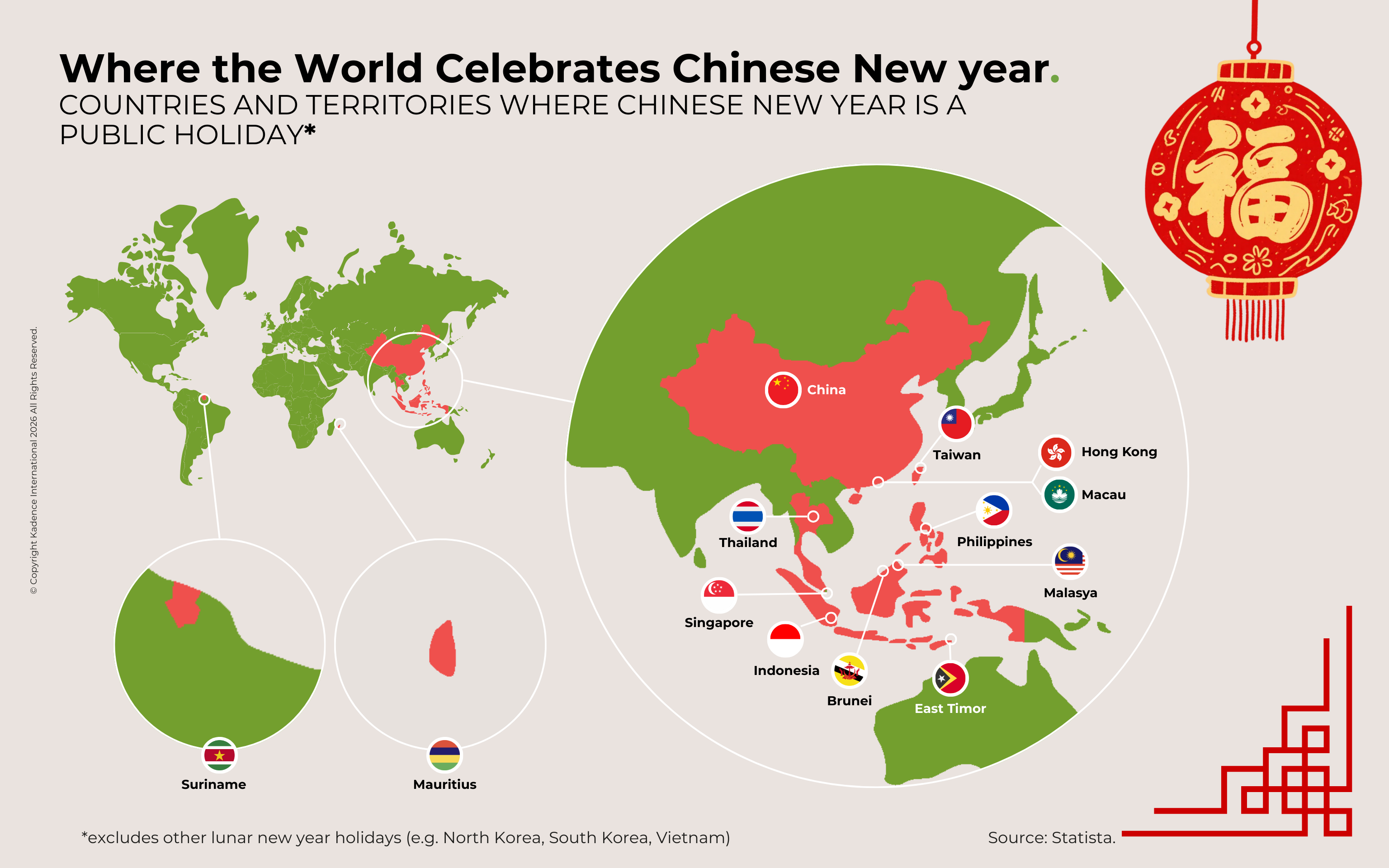
Lunar New Year is a public holiday across major Asian markets and parts of the global diaspora, creating a concentrated but time-bound commercial window.
Source: Statista.
Festival-Specific FMCG and Gifting Products
Across China and Southeast Asia, FMCG and food brands routinely launch Chinese New Year–specific products designed for gifting and reunion meals. These lines are typically premium-priced, symbolically packaged, and available only during the festival window.
What matters strategically is not just the creative execution, but the constraint. These products sit in categories already sanctioned for festive spending, are framed around social obligation rather than personal indulgence, and are withdrawn once the season ends.
Even when Lunar New Year products perform well, brands rarely extend them beyond the festival. Success is treated as situational rather than as evidence of ongoing demand. This implies that festive permission does not transfer. Attempting to carry it forward would weaken the very logic that made it work.
Travel Around the Lunar New Year
Travel during the Lunar New Year shows how far consumers will stretch on price without relaxing their rules.
China is bracing for record travel volumes this Lunar New Year, even as broader economic pressure continues to weigh on consumer sentiment. Officials expect roughly 9.5 billion passenger trips during the 40-day holiday travel period, including around 540 million rail journeys and 95 million air journeys. That would exceed the 9.02 billion trips recorded last year.
Travel demand is rising alongside weak retail momentum, slowing sales growth, and visible consumer stress. Retail sales growth slowed sharply toward the end of last year, rising just 0.9 percent year on year in December and 1.3 percent in November, despite aggressive promotions. Discounting has lost its ability to unlock discretionary demand.
Consumers are absorbing higher prices, reduced convenience, and logistical friction because travel during this time is categorised as reunion and obligation rather than discretionary leisure. Absence carries a greater social cost than price in this moment.
What happens immediately afterwards is just as important. Once the festival window closes, demand collapses. Price sensitivity reasserts itself. The willingness to absorb cost does not spill into adjacent periods.
This remains true even as policymakers extend the Lunar New Year holiday to nine days to stimulate broader consumption. Longer promotional and holiday windows have already failed to meaningfully shift behaviour. Consumers responded tepidly to extended Singles’ Day and 618 campaigns. Time alone does not convert restraint into openness.
Travel strength, then, is not a signal of renewed confidence. It is evidence of how narrowly permission is granted under pressure.
Why Brands Misinterpret Seasonal Demand
Many brands still treat the Lunar New Year as a broad release valve. Higher volume is taken as proof of slacked judgment. The macro data argues otherwise.
Record travel volumes are occurring alongside weak retail demand and slowing sales growth. Heavy discounting has failed to unlock discretionary spending outside narrowly sanctioned categories. Consumers are not opening their wallets more freely. They are opening them more selectively.
This distinction changes how seasonal performance should be interpreted. Strong results in travel, food, or gifting do not imply a rising tide that will lift adjacent categories. They indicate that permission is being granted under strain, not because strain has eased.
When brands assume that holiday demand signals broader interest, they often fail quickly. Promotions outside sanctioned categories underperform. Volume-led tactics create short-lived spikes followed by sharper retrenchment. Consumers who were pushed to justify purchases during a period that was supposed to feel self-evident reassert control aggressively once the season ends.
Why Policy Optimism Does Not Translate Into Consumer Permission
Policy optimism tends to focus on duration and stimulus. Longer holidays, extended promotions, and calendar expansion are expected to loosen restraint.
Recent evidence suggests otherwise.
Extended Singles’ Day and 618 periods did not materially change consumer behaviour. Aggressive discounting late last year failed to prevent retail sales growth from slowing further. The expansion of the Lunar New Year holiday may increase movement, but movement is not the same as discretionary openness.
Travel demonstrates the limit clearly. Consumers tolerate cost and inconvenience when spending can be categorised as an obligation. That tolerance disappears the moment the justification expires. More days do not create more permission. They only stretch the same one.
This undermines a common planning assumption for brands. Macro support does not broaden acceptable spending. Under pressure, consumers narrow their definitions of what is worth spending on.
A common counterargument is that record travel volumes and seasonal spending resilience point to a consumer turning point. On this view, constrained categories are simply leading indicators, and extended holidays or supportive policy will eventually convert movement into momentum.
That interpretation fails because it confuses capacity to spend with permission to spend. The same consumers absorbing high travel costs are rejecting discounts in discretionary retail. There is no spillover, no post-festival persistence, no experimentation beyond obligation-led categories. What appears to be recovery is containment. This should not be read as a sign of confidence returning.
The Strategic Lesson Brands Cannot Afford to Miss
The Lunar New Year does not reveal a consumer who has regained confidence. It reveals a consumer who has become more exacting.
Spending rises not because judgment weakens, but because justification tightens. Permission is narrow, deliberate, and temporary. Categories that mistake this for momentum overreach, while those that respect its limits earn credibility.
The brands that perform best are not the loudest during the festival, nor the ones that assume success can be carried forward unchanged. They recognise that some demand exists only under specific conditions, and that misreading those conditions damages what follows.
Growth built on misunderstood permission is fragile. Growth built on constraint endures.
That is the difference the Lunar New Year exposes, and the one brands must act on before the calendar turns again.
The next phase of growth in Asia will not come from louder incentives or longer calendars. It will come from understanding when consumers allow their rules to bend, and when they do not. With deep, on-the-ground research across Asian markets, we help brands distinguish momentary permission from real momentum before costly decisions are locked in.