
Meals once gave the day its shape. Morning began with breakfast. Lunch marked the midpoint. Dinner signalled an ending. Those rhythms aligned time, appetite, and social life, and for a long stretch, they were treated as natural facts rather than social agreements.
The assumption that food consumption follows a stable morning–midday–evening sequence no longer matches observed behaviour. Meals still exist, but they no longer govern when eating happens, how often it happens, or what role it plays.
That shift matters because mealtimes were doing more than organising habits. They functioned as infrastructure. They made demand predictable. They gave brands clear occasions around which to plan production, portions, messaging, and placement. As meals lose their authority, that scaffolding weakens.
What replaces it isn’t disorder. It’s something more adaptive.
Eating becomes continuous. Consumption happens in pieces, driven by energy drops, short breaks, stress, boredom, convenience, or reward. Choices that once took place around a table now happen in transit, at desks, between meetings, or late at night with food decisions responding to circumstances rather than schedules.
Across markets, the same signals repeat. Snacking frequency increases. Meal replacement becomes ordinary. Afternoon and late-night eating expands. Discovery moves closer to consumption, often mediated by mobile or social platforms. These patterns are evident even where traditional food culture remains strong.
The erosion of mealtime isn’t a rejection of food culture. It’s a response to how time, work, and attention now function. When days lose clear boundaries, meals follow.
For brands, this isn’t a dietary narrative. It’s a behavioural one. Consumption no longer waits for the clock’s permission. It happens when friction is lowest, and payoff is immediate. That reality reshapes what relevance looks like.

Why the Meal System Is Breaking
The decline of mealtime is often explained as a byproduct of busier lives. That explanation is tidy but insufficient. What’s actually failing is a system that depended on synchronised schedules, shared routines, and predictable availability.
Work is the first stress point. The standard workday once created reliable pauses for eating. Even long days had legible edges. Today, work expands and contracts throughout the day. Hybrid arrangements blur home and office. Shift work, contract work, and global teams stretch attention across time zones. The day no longer moves in blocks. It pulses. Eating mirrors that irregularity.
Households add another layer. Fewer people live in synchronised units with shared schedules and shared responsibility for meals. Dual-income households, single-person homes, and multigenerational caregiving reduce the chance that everyone is hungry at the same time. Food becomes individualised. One person eats between calls. Another eats after a late commute. Another grazes while managing care. Coordination gives way to accommodation.
Access completes the shift. Food is no longer tied to kitchens or advanced planning. Dense convenience retail, delivery platforms, and ready-to-eat formats make food constantly available. Hunger no longer triggers preparation. It triggers acquisition.
Cognitive load compounds everything. Decision capacity is under steady pressure. In that state, people don’t seek novelty. They seek resolution. Familiar options win because they close the loop quickly.
These forces don’t act alone. Fragmented workdays collide with desynchronised households, which collide with frictionless access and mental fatigue. The result isn’t a sudden break with tradition, it’s a gradual loss of structural support.
Meals required alignment—time, people, preparation, and appetite. Continuous consumption doesn’t. It works precisely because it tolerates misalignment. That resilience explains both its spread and why attempts to “restore” mealtime rarely hold.
What Global Consumption Patterns Reveal
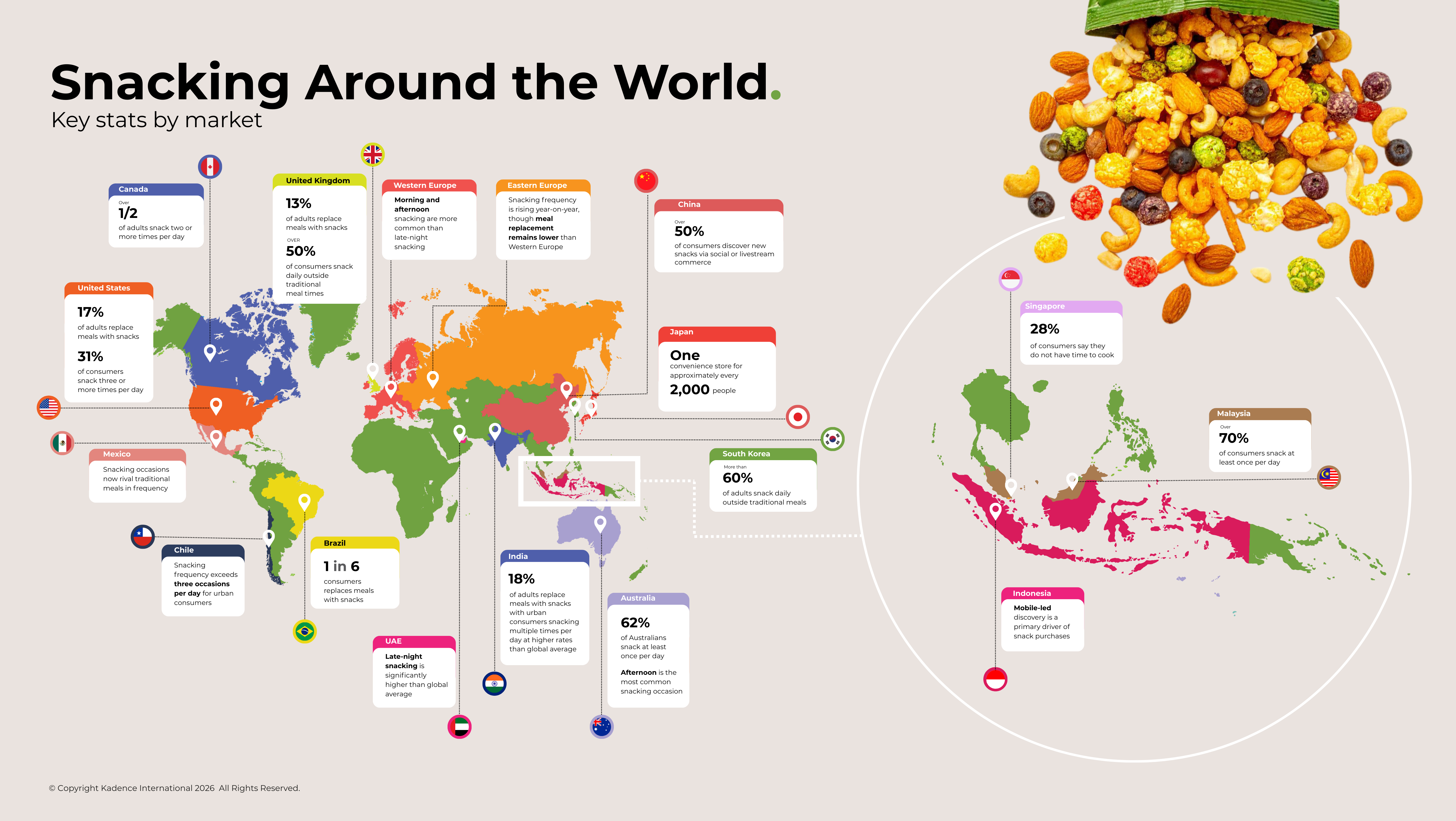
When meals stop organising behaviour, patterns that once looked marginal become visible at scale. This is where global data matters—not as cultural trivia, but as evidence of structural change.
Across regions with very different food traditions, the same adjustments appear. People eat more frequently, but in smaller, less formal increments. Snacking no longer just fills gaps. It increasingly performs the function of meals once served: maintaining energy, stabilising mood, marking pauses. In some markets, snacks openly replace meals. In others, they quietly supplement them until the distinction erodes.
Timing shifts are telling. Afternoon eating grows as lunch loses its central role. Late-night consumption rises as evenings stretch and shared dinners become harder to coordinate. These aren’t indulgent exceptions. They’re practical responses to days that no longer reset cleanly.
Discovery patterns reinforce the shift. In markets where mobile and social platforms drive exposure, decisions move closer to consumption. People encounter options while scrolling or waiting and act immediately. The distance between seeing, choosing, and eating collapses.
What matters isn’t which country is ahead. It’s that the direction is consistent. Even where traditional meals retain cultural weight, behaviour bends around them. Occasions multiply. Structure loosens. Flexibility becomes the defining trait.
Treating this as a “snacking trend” misses the point. The data doesn’t show a change in taste. It shows a reconfiguration of how eating fits into daily life. Consumption adapts to the shape of the day, rather than the day bending around consumption.
The map doesn’t tell you what people eat. It shows where structure fails—and how people compensate.
Eating Becomes Responsive, Not Ritualised
As structure weakens, eating shifts from something scheduled to something reactive. Food decisions answer immediate conditions rather than planned occasions. Hunger is only one trigger, and often not the strongest.
Energy dips prompt intake. Stress creates permission. Boredom invites grazing. Convenience resolves delay. These cues operate independently of time of day, which is why the same product can plausibly serve morning, afternoon, or late-night roles. The idea of an “appropriate” eating time loses force, replaced by situational logic.
Eating also becomes more solitary. Without shared schedules, consumption fits around individual constraints. People eat while working or scrolling, not because they reject shared meals, but because shared time is harder to secure.
This doesn’t make consumers careless. It narrows their consideration set. Familiar brands reduce decision effort. Novelty still plays a role, but it has to justify itself immediately. Anything that adds friction is easy to discard.
This is the behavioural bridge between collapsing meal structures and continuous consumption, and for brands, the implication is clear. Competition shifts away from owning categories and toward fitting seamlessly into moments already under pressure. Relevance is earned through solving a need.
What Continuous Consumption Forces Brands to Rethink
In those moments, consumers aren’t weighing options. They’re resolving tension. The brand that wins feels obvious and low risk. Recognition matters more than persuasion. Ease matters more than novelty. Consistency matters more than excitement.
This helps explain why strong brand metrics don’t always translate into choice. Awareness doesn’t guarantee selection when decisions are fast and repetitive. What matters is whether the brand fits the moment without explanation. Products that require context, preparation, or justification struggle under opportunistic consumption.
Continuous consumption also collapses the distance between exposure and action. Discovery happens near use, whether through mobile screens, convenience retail, or social influence. The traditional funnel thins. There’s little time to educate and limited tolerance for friction.
As a result, portioning, format, and availability become strategic. Smaller units lower commitment. Portable formats remove situational barriers. Presence in high-frequency environments matters more than presence in ceremonial ones.
Loyalty in this context is quiet. It shows up as repetition, not attachment. Consumers return to brands because they work without effort. That trust is fragile. When failure occurs, frequency amplifies it.
The decline of mealtime doesn’t mean food has lost meaning. It signals a reordering of priorities. Food now competes with everything else demanding attention.