
People usually notice a decline in physical fitness in fairly ordinary ways: stairs feel harder, fatigue lasts longer, sleep becomes less restorative, or everyday tasks start taking a little more effort than they used to.
Our latest study of 1,100 adults across Japan shows just how widespread that sense of declining physical capacity has become.
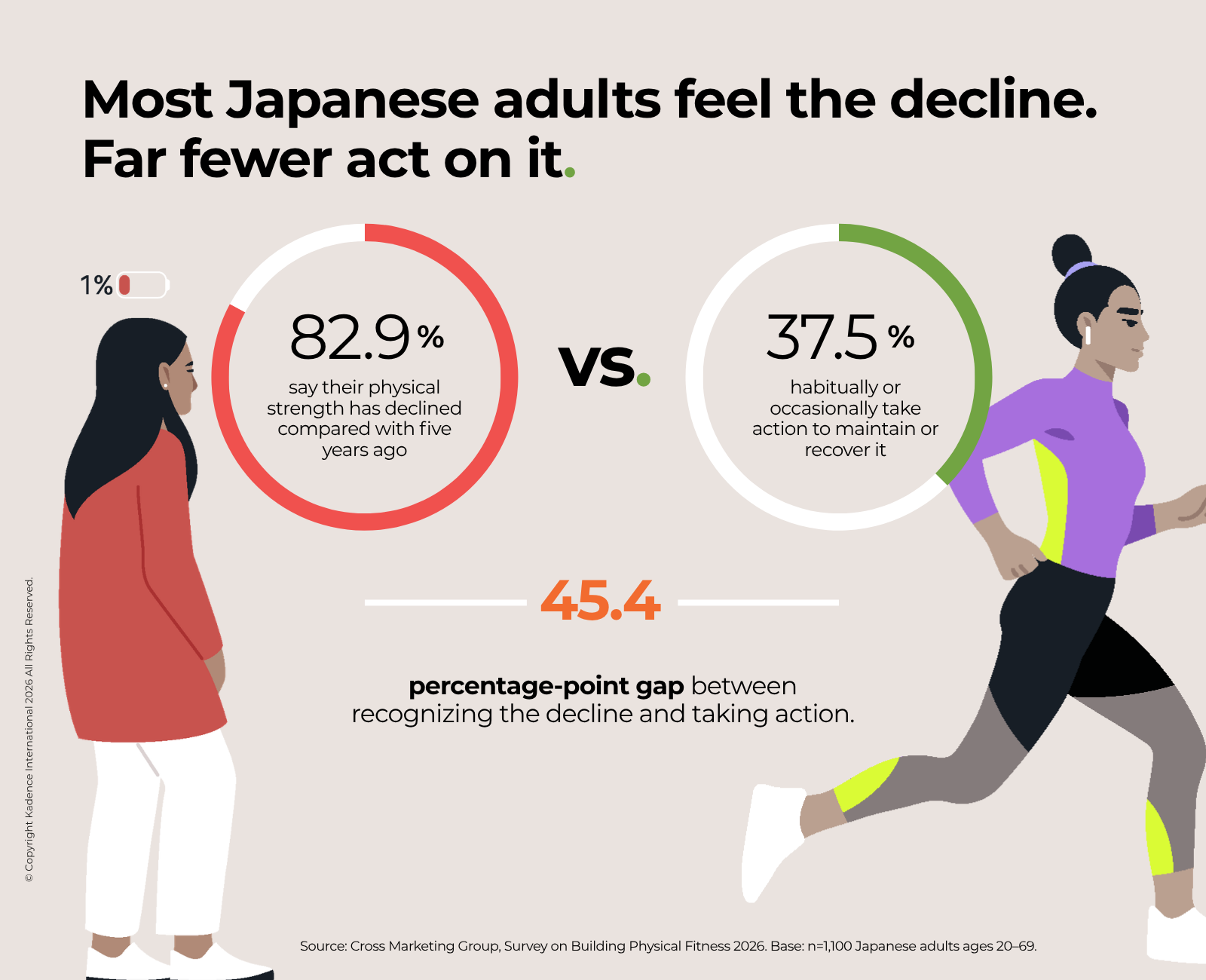
More than 8 in 10 respondents (82.9%) say their physical strength has fallen compared with five years ago. Asked to rate their current physical strength with their level five years ago set at 100, the average falls to just 73.
Only 37.5% say they habitually or occasionally do something to maintain or recover their physical strength. So while declining stamina is widely recognized, most Japanese people are not responding with regular action.
In Japan, fitness is not just about exercise
For many people outside Japan, “fitness” immediately brings to mind gyms, running, strength training, or sports.
When Japanese respondents were asked when they notice a decline in their physical condition, the answers were much more everyday. The most common was fatigue that lasts into the next day or even several days later, cited by 26%. Another 20.5% say they notice it because they can no longer sleep for as long as they once could, while 19.4% feel it when climbing stairs leaves them out of breath. Difficulty concentrating was cited by 16.5%, and 16.6% say they notice it when they can no longer manage oily food or a large meal as easily.
The survey uses the Japanese term tairyoku (体力), which can mean physical strength, stamina, or overall physical capacity. In Japan, it is commonly used much more broadly than “fitness” is in English. Someone may talk about losing tairyoku because they tire more easily, recover more slowly, or simply find daily life more physically demanding than it used to be.
That helps explain why sleep, recovery, diet, and everyday movement appear so prominently in the findings. For health and wellness brands, the outcomes worth communicating in Japan may extend well beyond improved fitness performance to better sleep, more energy, faster recovery, and greater ease in daily life.

Feeling the decline starts surprisingly young
It would be easy to read this as a story about Japan’s older population. After all, 90.9% of people in their 60s say their physical strength has declined over the past five years.
That sense of decline starts much earlier than might be expected. Among people in their 20s, 70.5% say their physical strength has also declined, and their average score falls to 77 when their level five years ago is set at 100.
There is a clear gender difference within this younger group. Japanese men in their 20s are much more likely to feel they have maintained or improved their physical capacity: 27.3% say it is unchanged, and 11.8% say it has increased. Among Japanese women in their 20s, however, 80% say their physical strength has declined.
For a group still in early adulthood, that is notable. Concerns about stamina, energy, and recovery are clearly not confined to middle age or later life.
It also complicates the usual assumption that younger consumers are primarily motivated by improvement or peak performance. For some, maintaining how they feel now (or regaining energy they feel they have already lost) may be just as relevant.
Midlife women stand out
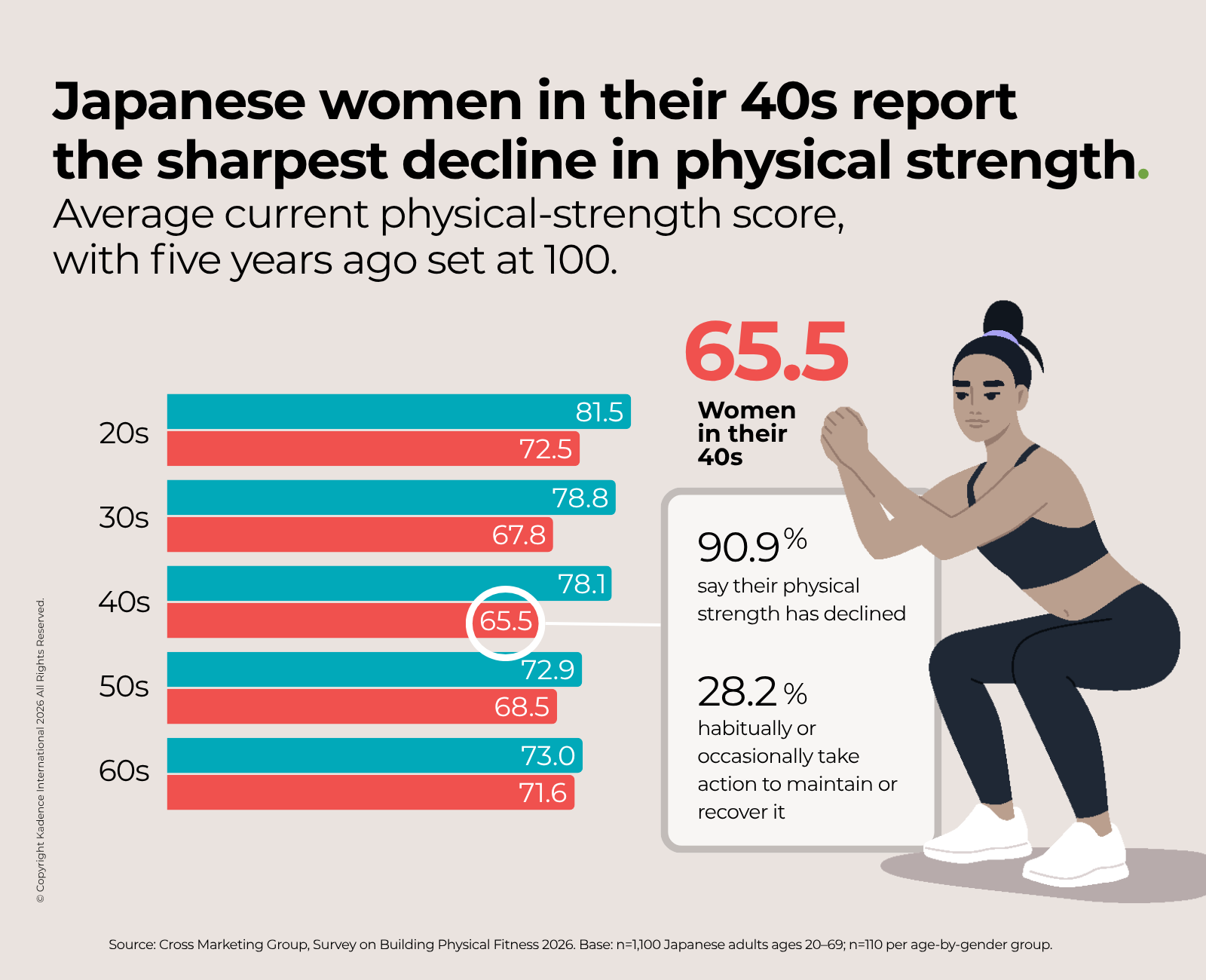
Japanese women in their 40s report the lowest physical-strength score of any age-and-gender group in the study. With their level five years ago set at 100, their current average is just 65.5.
More than 9 in 10 (90.9%) say their physical strength has declined over the past five years, and 27.3% rate themselves at less than half of their former level.
Among women in their 40s:
- 36.4% say fatigue now lingers into the next day or several days later.
- 33.6% say they can no longer sleep for long periods.
- 25.5% report more difficulty concentrating.
- 23.6% notice breathlessness after climbing stairs.
- 21.8% sometimes want to rest while carrying shopping home.
- 21.8% say they are more likely to avoid difficult shoes or heavy bags.
Despite that, only 28.2% say they habitually or occasionally take action to maintain or recover their physical strength, the lowest figure of any age-and-gender group.
So the group reporting the greatest deterioration is also the least likely to say it is actively doing something about it. For companies serving midlife women in Japan, the more useful question is what makes staying active, recovering well, or maintaining energy difficult to fit into everyday life.
Older Japanese consumers feel the decline most — and do the most about it
Japanese people in their 60s report the greatest decline in physical strength, but they are also the most likely to take steps to maintain it.
More than a quarter (25.5%) say they habitually take action to maintain or recover their physical strength, around twice the proportion seen among people in their 20s.
Among consumers in their 60s:
- 26.8% run, jog, or walk.
- 26.4% deliberately use the stairs.
- 19.5% walk faster.
- 19.5% stretch or have a massage.
- 17.7% deliberately walk with a longer stride.
- 14.5% pay attention to maintaining good posture.
These are mostly simple, everyday ways of staying mobile and maintaining stamina rather than formal fitness routines.
With more than 36 million people aged 65 and over, older consumers are not a niche audience in Japan. They are a fundamental part of the market.
That makes the way fitness is framed particularly important. Messaging built around intensity, youth, and athletic performance may have little connection to what many older Japanese consumers are trying to preserve: the ability to walk comfortably, take the stairs, remain independent, and recover well enough to do the same again tomorrow.
The most popular workout may be the staircase
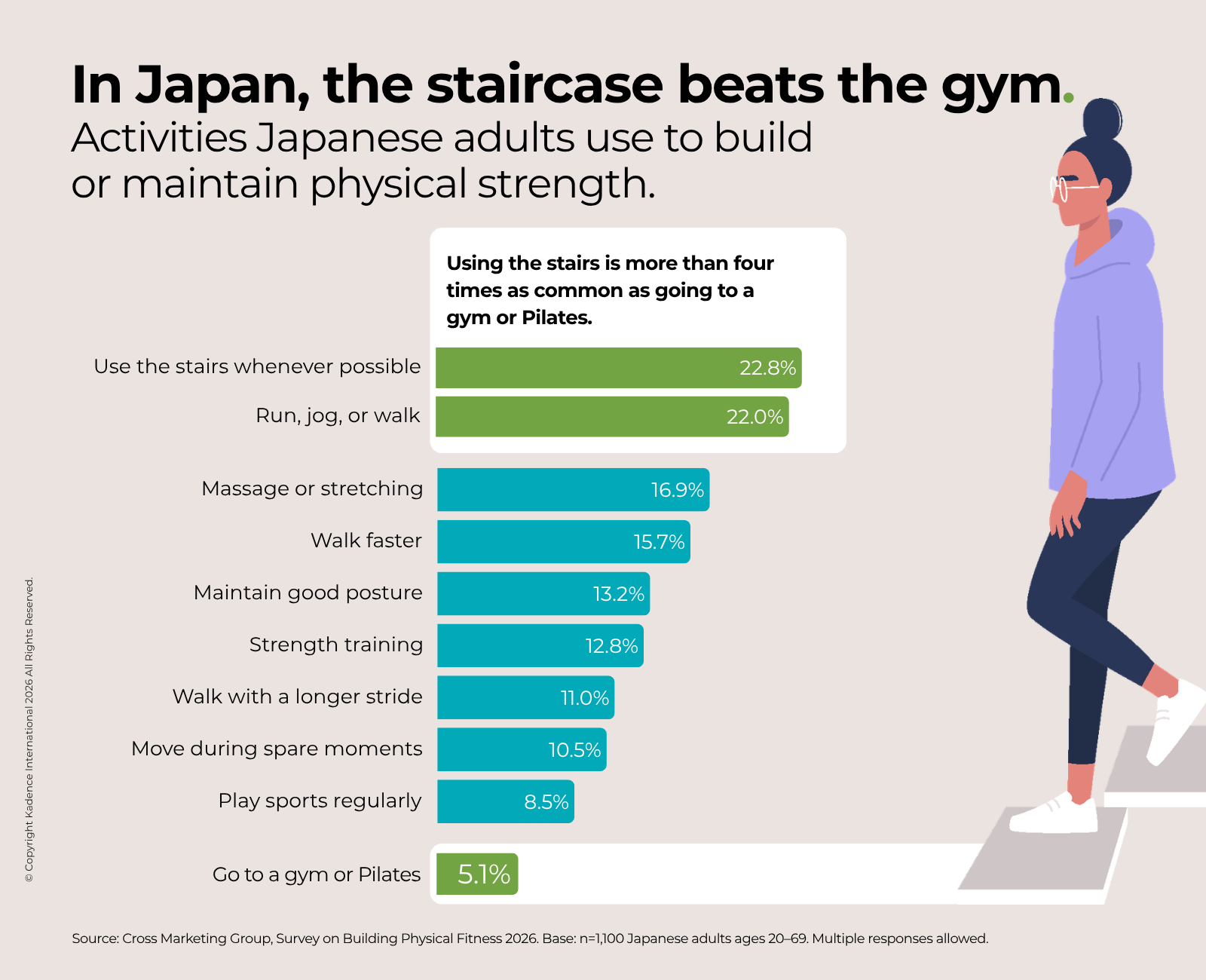
Formal exercise is only a small part of how people in Japan are trying to stay physically capable. Just 5.1% of respondents say they go to a gym or do Pilates, compared with 22.8% who make a point of using the stairs and 22% who run, jog, or walk.
Other common habits are similarly low-key: 16.9% stretch or have a massage, 15.7% try to walk faster, 13.2% pay attention to their posture, and 11% consciously take longer strides. At the same time, 34% say they are doing none of the exercise-related activities listed in the survey.
This is happening against a wider decline in everyday movement in Japan. The Ministry of Health, Labour and Welfare has reported falling step counts over the past decade, with the 2023 National Health and Nutrition Survey recording daily averages of 6,628 steps for men and 5,659 for women.
Most of the behaviors people report here require no membership, equipment, or major change in routine. They are things that can be folded into an ordinary day — taking the stairs, walking faster, stretching, or simply moving more. That may be a more realistic route into greater activity for many Japanese consumers than asking them to adopt a formal fitness program.
Women and men maintain their physical well-being differently
Japanese men and women also differ in how they approach maintaining their physical strength. Men are more likely to participate in conventional exercise, with 27.8% reporting running, jogging, or walking compared with 16.2% of women. Strength training is also more common among men (16% vs. 9.6%), as is playing sports regularly (11.5% vs. 5.5%).
Women, meanwhile, are more likely to report stretching or massage, paying attention to posture, and finding opportunities to move throughout the day.
The differences extend beyond physical activity. Women are more likely than men to report:
- Frequent hydration: 28% vs. 19.5%
- Eating a balanced diet: 24.5% vs. 18%
- Making a point of consuming protein: 22.2% vs. 15.1%
- Soaking in the bath: 17.3% vs. 12%
- Keeping the body warm: 19.1% vs. 6.2%
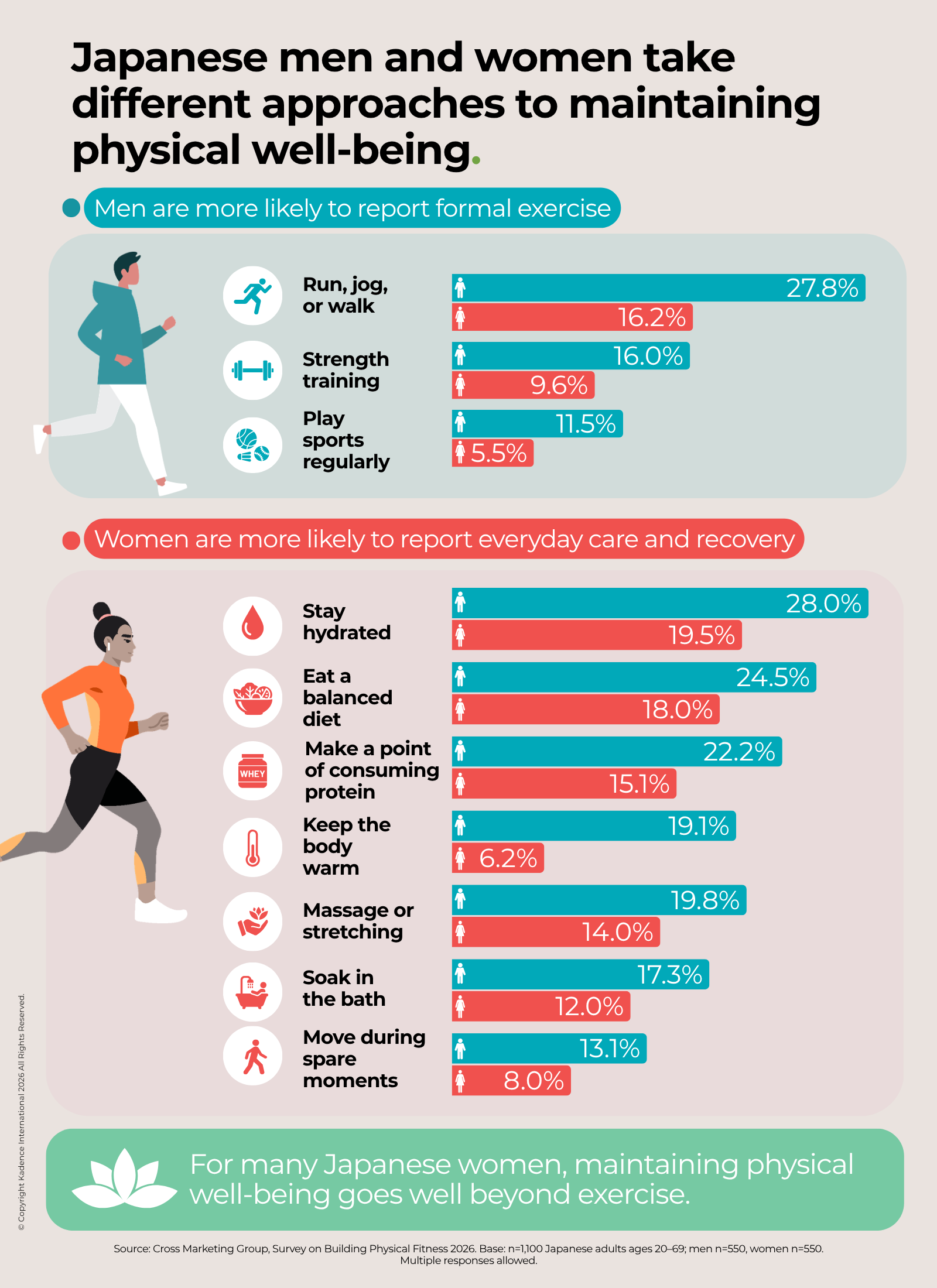
The emphasis on warmth and bathing is especially relevant in Japan, where soaking in a hot bath is an established part of daily life. Nearly one in five women consciously tries to keep her body warm, more than three times the proportion of men.
So lower participation in conventional exercise should not be read as lower engagement with physical well-being. Women are simply more likely to express that engagement through nutrition, hydration, recovery, and everyday care.
For researchers, this is an important distinction. A study that measures fitness only through workouts or sports participation could significantly understate how Japanese women are already managing their physical health.
The Japanese bath belongs in the well-being conversation
Some of the survey findings are very specific to daily life in Japan. Nearly 15% of respondents say they soak in a bath to maintain their physical strength. Among women in their 60s, that rises to 26.4%.
Keeping the body warm also comes through strongly. Around 1 in 8 respondents overall say they consciously try not to let their body get cold. Among women, that rises to 19.1%, and among women in their 60s, 29.1%.
Bathing, warmth, and recovery may sit outside the way fitness is typically marketed in Western markets, but in Japan, they are familiar parts of looking after the body.
This is one of the places where simply importing a global wellness proposition can go wrong. Japanese consumers are not starting with a blank sheet. They already have established routines and ideas about recovery and physical care, and new products have to find a credible place within them.
The gap between concern and action
The biggest unanswered commercial question sits in the gap between the 82.9% who feel their physical strength has declined and the 37.5% who say they regularly or occasionally do something about it.
Awareness is clearly not the barrier. The more useful questions are what prevents action, what people are willing to change, and which outcomes are compelling enough to motivate them. Those answers are likely to look very different for someone in their 20s, a woman in her 40s, and someone approaching or already in retirement.
The age differences in this study are more than demographic variation. They point to different needs, motivations, and definitions of what it means to maintain physical strength.
Rethinking what fitness looks like in Japan
The study offers a much broader view of what fitness means in Japan. Consumers are noticing changes in sleep, stamina, concentration, recovery, and mobility, and responding through everything from walking and stretching to diet, hydration, bathing, and keeping warm.
The important idea running through all of this is physical capability. For many Japanese consumers, the goal is not necessarily to become fitter in the athletic sense. It is about having enough energy for the day, recovering well, remaining mobile, and continuing to do ordinary things comfortably.
That broader definition brings more categories into play. It brings food and beverage, health tech, mobility, personal care, recovery, and other wellness categories into the same conversation because they may all address different parts of the same underlying need.
For international companies looking at Japan, that is the point I would take from this research: do not assume the category starts with exercise. Start by understanding what consumers are trying to preserve in their everyday lives.
Source: Cross Marketing Group, Kadence International’s parent company, Survey on Building Physical Fitness 2026. Online survey of 1,100 Japanese adults ages 20–69 across all 47 prefectures, conducted October 2–3, 2026. Each age group from the 20s through 60s included 220 respondents.
Understanding Japanese consumers takes more than translating a global strategy. It means understanding the cultural context, everyday behaviors, and motivations behind the numbers.
Kadence has teams on the ground in Japan and deep experience helping international brands understand how Japanese consumers think, choose, and behave.
Talk to us about your next research project in Japan.
FAQs
How physically active are Japanese people?
Physical activity in Japan often extends beyond formal exercise. In our study, 22.8% of Japanese adults said they deliberately use the stairs, 22% run, jog, or walk, and 16.9% stretch or have a massage. By comparison, just 5.1% said they go to a gym or do Pilates.
How do Japanese consumers think about fitness and physical health?
The Japanese concept of tairyoku (体力) is broader than fitness in the athletic sense. It can refer to stamina, physical strength, energy, recovery, and the ability to manage everyday physical demands. This helps explain why Japanese consumers associate physical well-being with sleep, diet, walking, bathing, hydration, and recovery as well as exercise.
Do younger Japanese adults worry about declining fitness?
Yes. In our study, 70.5% of Japanese adults in their 20s said their physical strength had declined compared with five years earlier. Among women in their 20s, that figure rose to 80%, showing that concerns about stamina and physical capacity begin much earlier than might be expected.
How do Japanese men and women approach physical well-being differently?
Japanese men are more likely to report conventional exercise such as running, strength training, and sports. Women are more likely to report behaviors including hydration, a balanced diet, protein intake, stretching, bathing, and keeping the body warm. This suggests that exercise participation alone gives an incomplete picture of physical well-being among Japanese women.
What should health and wellness brands understand about Japanese consumers?
Health and wellness in Japan is not defined only by exercise or athletic performance. Many consumers are focused on maintaining everyday physical capability: having enough energy, recovering well, remaining mobile, and continuing normal activities comfortably. Products and messaging that fit existing Japanese habits and routines may therefore resonate more strongly than propositions built solely around “getting fit.”