

A global manufacturer tests a new product across six countries. The results look promising. Consumers in three markets rate it highly, one market delivers an exceptional score, and two appear considerably less enthusiastic.
The obvious next step might be to prioritize the markets where the product performed best. After all, the same product was tested using the same methodology, so the results should be comparable.
Except they might not be.
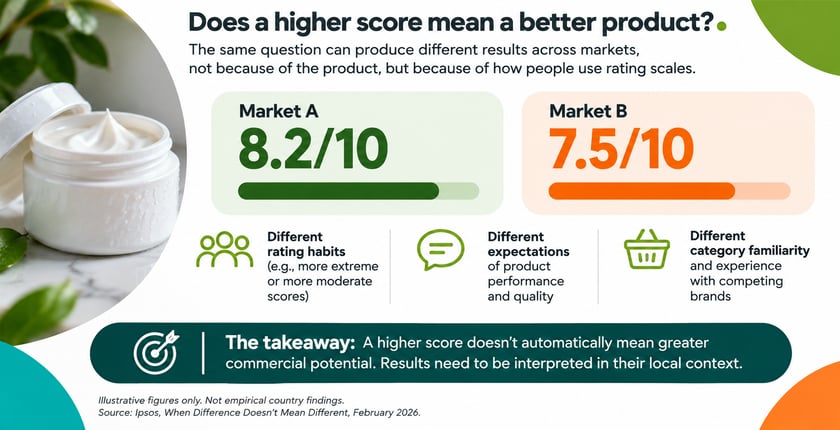
Consumers in different countries don't necessarily use rating scales in the same way. Some are more comfortable giving extreme scores, while others tend toward the middle. Their expectations of product quality, familiarity with the category and experience of competing brands can also influence how they evaluate what they're testing.
A product rated 8 out of 10 in one market might not have greater commercial potential than one rated 7 in another.
It's a problem with significant consequences when product development, manufacturing and international launch budgets depend on relatively small differences in consumer research findings.
In June 2026, ASTM International published new guidance specifically addressing cross-cultural consumer product testing, including the challenges of language, response scales, recruitment and testing conditions.
The question for global brands is whether the differences appearing in their research reflect genuine differences in consumer preference, or differences in how that preference has been measured.

When the Same Score Means Something Different
Imagine you're reviewing the results of a new skincare product tested in Japan, Brazil and Germany. The Brazilian consumers give it the highest satisfaction score, Germany comes second, and Japan finishes third.
Would you recommend launching in Brazil first?
You might. But before making that decision, you'd want to know whether consumers in all three countries were using the rating scale in the same way.
Research published by Ipsos in February 2026 examined how cultural response patterns can influence international survey results. Some populations are more inclined to use the extremes of a rating scale, while others favor more moderate responses. Differences in how readily people agree with statements can also affect the findings.
A seven out of ten may represent genuine enthusiasm in one market, while an eight elsewhere could be a fairly ordinary response.
Consistent questions and testing conditions are essential, but they don't guarantee that results are directly comparable across countries. Local research teams still need to establish whether differences in scores reflect genuine differences in preference, particularly when those scores could influence investment decisions.
That could mean examining how rating scales are used in each country, testing whether translated questions carry the same meaning, and looking beyond overall liking scores to purchase preference, product performance, and willingness to pay.
A company might ultimately discover that its product genuinely performs better in Brazil. It might also find that the apparent difference narrows considerably once cultural response patterns are taken into account.
Either finding would be more useful than treating the highest average score as the strongest commercial opportunity.
This is where working with a global research partner with established local teams becomes valuable. Researchers who understand the cultural context can identify when differences in scores reflect genuine consumer preferences and when they may be influenced by how people interpret questions, use rating scales, or evaluate competing products. That local knowledge gives global product teams a more reliable basis for deciding which differences warrant action.
Different Markets, Different Reasons to Buy
Taste, nutrition, convenience and price all influence what consumers choose to eat. How much weight people give each of those factors can vary considerably between countries.
An October 2025 study published in Foods examined the relationship between health and pleasure in food choices among 6,300 adults across ten countries. The findings revealed some interesting contrasts.
Respondents in Peru and China placed relatively high importance on both health and enjoyment. Mexico and Russia showed a stronger orientation toward pleasure than health, while Thailand and Spain displayed a more balanced pattern. Japanese respondents were more polarized across the two dimensions.
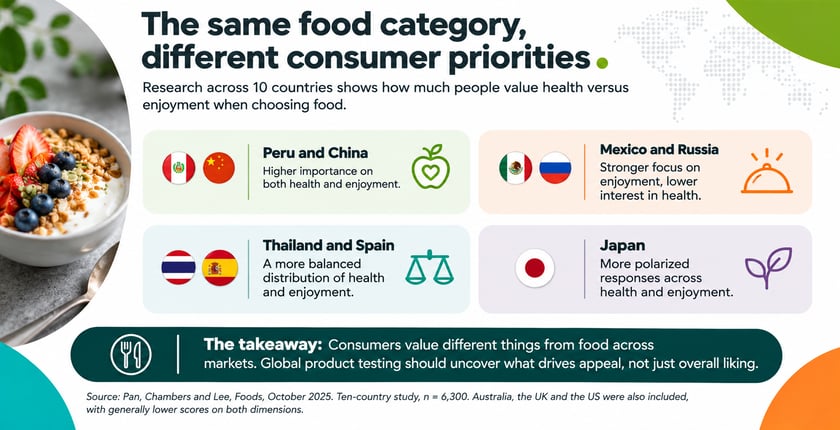
These are population-level patterns, not descriptions of every consumer in each country. Nor does a stronger interest in health necessarily translate into greater demand for products marketed as healthy.
A snack developed around its nutritional credentials may have broad international appeal, yet the reasons consumers choose it could differ substantially. In some markets, the health proposition may attract attention. Elsewhere, flavor and enjoyment may carry more weight in the purchase decision.
A manufacturer could spend millions developing different formulations when the existing product simply needs a different proposition. Or it could invest heavily in marketing a promising concept, only to discover during product testing that consumers don't particularly like the taste or texture.
Deciding which elements to standardize requires understanding the attributes consumers value, the compromises they're prepared to make, and how the product performs against familiar local alternatives.
When the Product Itself Gets Lost in Translation
Even trained sensory experts can disagree on how to describe the same product.
A recent study published in Food Quality and Preference examined sensory evaluation across six markets: China, India, Singapore, the Netherlands, the UK and the US. Researchers investigated how differences in sensory vocabulary and cultural reference points affected the comparability of assessments.
Consider something as seemingly straightforward as a fruity aroma. One panel might associate it with blackcurrant, another with raspberry or blueberry candy. The underlying sensory characteristic may be similar, but the references used to describe it differ.
Without consistent sensory references, R&D teams could mistake differences in terminology for differences in product performance. The same problem can arise when evaluating texture, sweetness, and mouthfeel.
There are two separate questions to resolve:
- Is the product being assessed consistently? Trained panels need comparable definitions, reference materials and evaluation protocols.
- Do consumers actually prefer different things? Consumer testing needs to establish which sensory characteristics influence liking, preference and purchase decisions locally.

When Local Research Changes the Launch
Zespri sells kiwifruit in more than 50 countries. The fruit itself is recognizable, but persuading consumers to try it requires an understanding of what appeals to shoppers in each market.
The company tested product claims and brand messages across Thailand, India, Malaysia, Indonesia, Brazil and Mexico. Working within its established global brand positioning, Zespri evaluated which messages motivated consumers to try its products.
Some performed consistently well across all six countries. Others generated little interest in particular markets.
The findings allowed Zespri to retain messages with broad appeal while adapting those that weren't working locally. The research concerned product claims and communications rather than physical product formulation, but the commercial lesson is relevant to both: don't assume that every difference between markets requires changing the product.
Adidas offers a more substantial example of local product adaptation.
In China, the company moved away from relying so heavily on products developed for its global range. According to Reuters reporting in early 2026, locally designed products had increased from approximately 10% to 60% of Adidas' Chinese assortment.
By 2025, Adidas had recorded ten consecutive quarters of growth in China, following five quarters of decline in 2023.
Its recovery involved faster development cycles and designs responding to local demand. Those results cannot be attributed to product testing alone, but they demonstrate the commercial importance of making decisions closer to the consumers a company wants to reach.
The two cases point to different investment decisions:
- Zespri: Retain the underlying product and global positioning, but adapt the messages that motivate trial.
- Adidas: Give local teams greater influence over product development when consumer preferences justify a different offering.
A Favorable Product Test Isn't a Sales Forecast
Here's a statistic worth taking into the next global innovation review: 76% of consumers who try a new product say they would buy it again. Actual repeat purchasing is typically considerably lower.
That finding comes from NielsenIQ's 2026 Launch Fast, Learn Faster research, drawing on 15 years of new-product data and more than 54,000 interviews with verified buyers across Britain, Germany, France, Italy and Spain.
The research found that:
- 76% of trialists said they would purchase the product again, although observed repeat rates were typically much lower.
- 17% of new launches achieved both strong trial and repeat purchasing.
- Only one in three launches reached 1% household penetration.
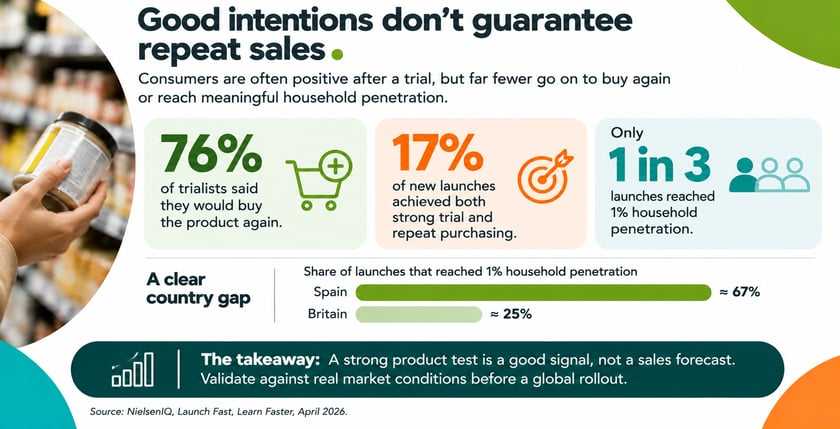
The figures also hide considerable differences between countries. In Spain, roughly two-thirds of launches reached 1% household penetration. In Britain, just one in four did.
Those aren't differences that can be explained by consumer liking scores alone.
Retail distribution, competitive intensity, promotional support, and the frequency with which consumers buy the category all affect whether a promising innovation gains traction. A product that performs well in controlled testing may face a very different set of choices once it reaches the shelf.
Prelaunch testing should reflect the choices consumers will face in the market. That means evaluating the product against familiar local alternatives, at the intended retail price, rather than relying on liking scores alone. Repeat purchasing then provides a much stronger indication of whether the product can sustain demand.
Deciding What Should Stay Global
The biggest risk in global product testing may be the decisions companies make with the results.
A higher score doesn't necessarily identify a better market. Different consumer preferences don't automatically justify different formulations. And strong purchase intent tells a manufacturer relatively little about whether consumers will return once the product reaches the shelf.
Yet these findings can influence multimillion-dollar decisions about manufacturing, product portfolios and international expansion.
The real value of global research is knowing which differences are worth acting on.
What Global Product Testing Should Establish
|
Research question |
Commercial decision |
|
Are product ratings genuinely comparable across countries? |
Which market results can inform investment priorities |
|
Do consumers understand and value the same benefits? |
Global versus locally adapted positioning |
|
Which sensory characteristics influence preference? |
Whether formulations need changing |
|
How do local purchasing occasions affect demand? |
Product formats, packaging and usage positioning |
|
Will consumers choose the product over local alternatives? |
Pricing and competitive strategy |
|
Does initial interest translate into repeat purchasing? |
Launch validation and investment scale |
Every local adaptation introduces complexity. Different formulations, packaging and product ranges can increase production costs, complicate supply chains and dilute the efficiencies of a global portfolio.
But standardizing a product that fails to meet local expectations can be considerably more expensive.
A global manufacturer could spend millions developing regional formulations when a change in positioning would have been enough. Or it could protect the efficiencies of a global product range while losing sales to local competitors that better understand what consumers want.
Both mistakes are expensive, and good research should help prevent them.
Before approving the next international launch, the question worth asking is whether the research has identified what consumers genuinely prefer, what they're prepared to pay for, and which differences are significant enough to justify changing the product.
Make Better Global Product Decisions
Kadence International helps global brands evaluate product opportunities through consumer testing, sensory research, pricing studies and local market expertise. With research teams across Asia, Europe and the Americas, we help companies understand which consumer preferences matter, where products need adapting and how to make confident international innovation decisions.
FAQs
Why do product testing results differ between countries?
Product testing results can vary because consumers have different cultural expectations, product preferences, purchasing habits and experiences with competing brands. Differences in how respondents interpret questions and use rating scales can also affect scores. Cross-cultural product testing helps distinguish genuine differences in consumer preference from variations caused by research methodology.
How can companies ensure global product testing results are comparable?
Companies should use consistent testing protocols, appropriate sample recruitment and carefully translated research materials. They also need to evaluate cultural response biases, local product familiarity and differences in testing conditions. International standards such as ASTM E3436-26 provide guidance on conducting cross-cultural consumer product testing and improving the comparability of results.
What is the difference between sensory testing and consumer product testing?
Sensory testing evaluates product characteristics such as taste, aroma, texture, appearance and mouthfeel, often using trained assessors. Consumer product testing examines how target customers perceive, prefer and respond to a product. Combining both approaches helps manufacturers understand a product's sensory performance and whether those characteristics influence consumer acceptance and purchasing decisions.
When should global brands adapt products for local markets?
Product adaptation may be justified when research identifies meaningful differences in consumer needs, sensory preferences, usage occasions or willingness to pay. However, not every market difference requires a new formulation. Consumer testing, competitive benchmarking and pricing research can help determine whether changes to the product, packaging, positioning or marketing are commercially worthwhile.
Can positive consumer product testing predict a successful product launch?
Positive product testing can indicate consumer interest, but it cannot guarantee commercial success. Actual performance also depends on pricing, distribution, competition, product availability and repeat purchasing. Concept testing, product trials, choice-based research and controlled market launches can help brands evaluate demand before committing to a wider rollout.