
Marketers have become remarkably good at measuring attention. We know how many people see an advertisement, watch a video, engage with an influencer, or click through to a website. But knowing that someone has encountered a message tells us surprisingly little about whether they believe it, and even less about whose opinion they would trust when making a decision.
Our latest research among 3,000 adults in Japan reveals a striking difference between the sources consumers encounter and those they consider credible. Family recommendations top the trust rankings at 63%, while just 17% trust celebrity and influencer social media posts. Even official company websites and social media accounts, trusted by 56%, perform considerably better than the individual voices that often dominate online conversations.
What's particularly interesting is how actively Japanese consumers question the information they receive. Nearly 77% distrust information when they cannot identify its source, and 70% compare multiple sources when something raises doubts. They're not simply consuming information; they're making judgments about who deserves their confidence.
For brands investing heavily in digital marketing, these findings invite a closer look at what their performance measures actually tell them. Reach and engagement remain useful, but how much do they reveal about trust? And if some of the most credible information comes from conversations between family members or sources outside a brand's paid media activity, how well do marketers understand what ultimately shapes consumer confidence?
Japanese consumers are taking credibility into their own hands
Japanese consumers are doing more than simply choosing which sources to believe. Many are actively checking what they read, comparing different accounts and deciding for themselves whether the information is reliable. Our research found that 79% take an active interest in finding information about subjects that matter to them, while nearly 70% consult multiple sources when something raises doubts.
Even expert opinions are approached with a degree of caution. Seven in ten respondents prefer to treat the views of specialists as one perspective to consider rather than something to accept unconditionally. That doesn't necessarily reflect a rejection of expertise, but a desire to weigh different opinions before reaching a conclusion.
What's equally revealing is how consumers feel about the volume of information they encounter. Two-thirds would prefer to eliminate unnecessary information, while 59% find the constant arrival of messages and updates bothersome. There is a difference between wanting to be informed and wanting to be continually interrupted, something that can easily get lost in a marketing environment built around frequent communication.
Taken together, the findings suggest that Japanese consumers want more control over the information they receive, not simply more of it. Their willingness to investigate a subject shouldn't be mistaken for an appetite for endless content, particularly when much of that content may offer little that helps them make up their minds.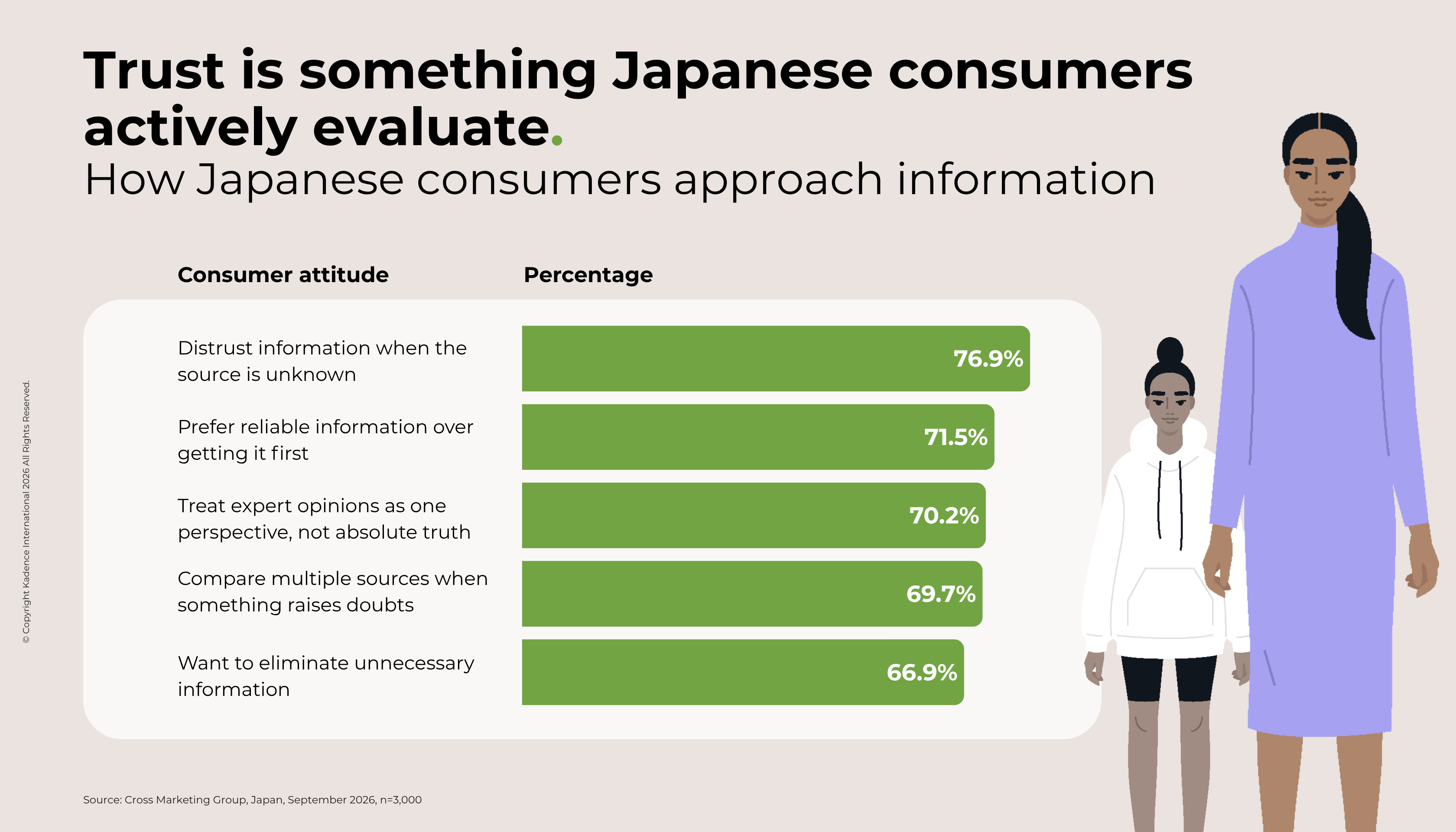
The people and institutions Japan trusts most
For all the changes in how people find information, the sources Japanese consumers trust most remain surprisingly familiar. Recommendations from family rank highest at 63%, followed by NHK, Japan's public broadcaster, at 61%, and official government websites and social media accounts at 60%. Newspapers retain the confidence of 58%, while recommendations from friends and information published through companies' official channels are both trusted by around 56%.
Only 34% trust online review sites, while celebrity and influencer social media posts earn the confidence of just 17%. Posts from ordinary individuals on social media fare slightly worse at 16%. Generative AI sits somewhere in between, trusted by 37% of respondents.
That challenges the assumption that consumers are inherently more receptive to information from individuals than from brands themselves. A personal recommendation may carry considerable weight when it comes from someone you know, but the same confidence doesn't necessarily extend to a stranger posting online.
Family recommendations occupying the top position also deserves attention. Unlike advertising or influencer campaigns, conversations between relatives are largely invisible to the brands being discussed. Companies may know how many people have seen their campaigns or visited their websites, but they have far less insight into the private conversations that might reinforce or challenge what consumers believe about their products.
The research doesn't tell us how often these conversations lead to purchases, but it does suggest that some of the most trusted information exists beyond the channels marketers can easily monitor. That distinction becomes particularly relevant when we examine how trust differs across generations.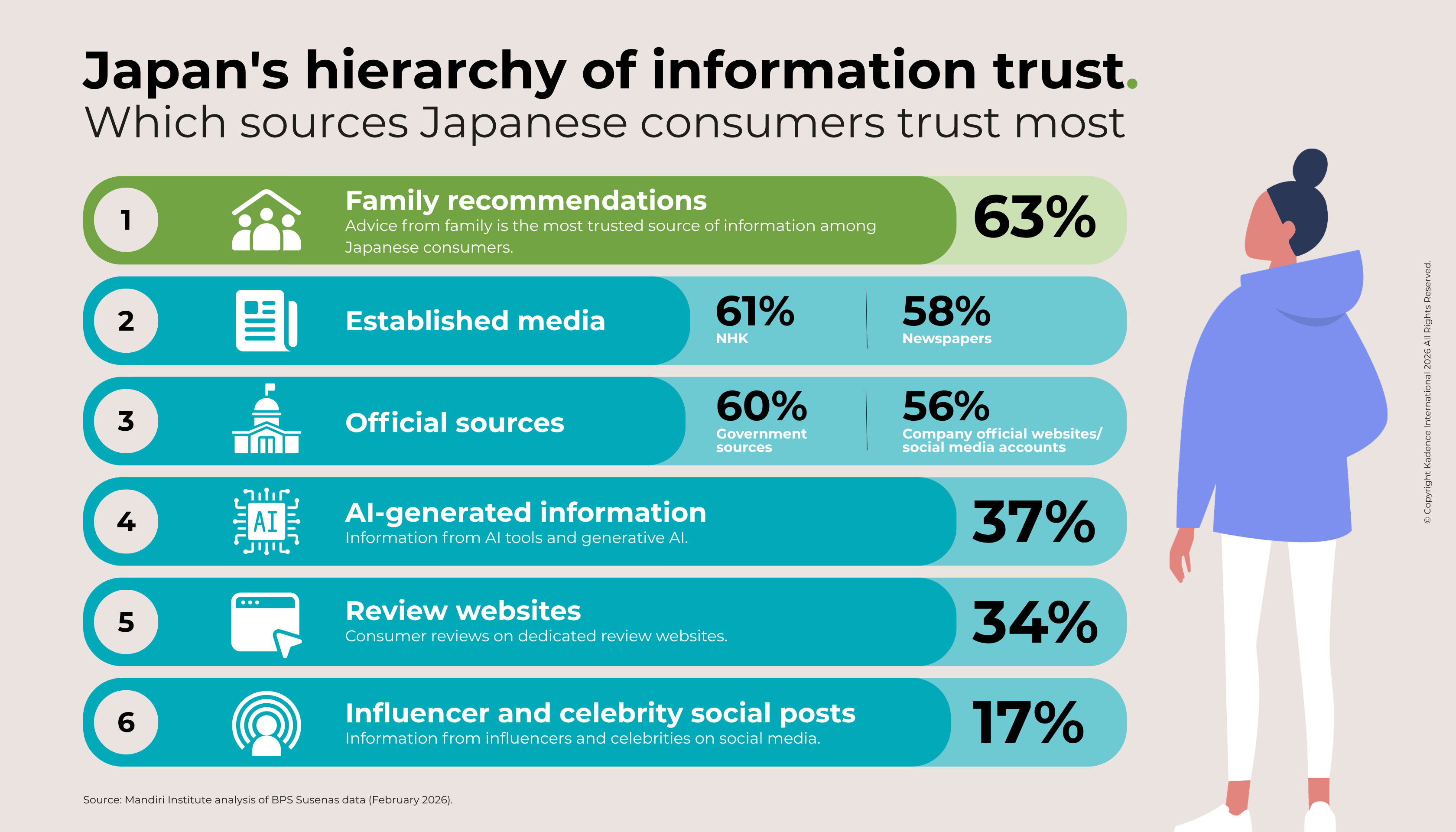
Younger Japanese consumers have a different hierarchy of trust
Age makes a considerable difference to which information sources Japanese consumers trust, although the results challenge some familiar assumptions about younger audiences and their relationship with digital media.
Among 18–29-year-olds, family recommendations remain the most trusted source at 61%, followed by friends and acquaintances at 59%. Official company websites and social media accounts also perform strongly at 56%, suggesting that younger consumers haven't abandoned established sources simply because they have grown up with more digital options.
The generational divide becomes much clearer when we look at traditional media and influencers. NHK is trusted by 79% of those aged 70–79, compared with 50% of younger adults. Influencer and celebrity social media posts show the opposite pattern, earning the trust of 29% of 18–29-year-olds but just 9% of the oldest group.
Even among 18–29-year-olds, fewer than three in ten trust influencer content. Their greater openness to social media personalities is evident when compared with older generations, but the figures also suggest that familiarity with these platforms shouldn't be confused with confidence in the people using them.
There is also an interesting point of consistency across generations. Official company information is trusted by approximately 56% of both the youngest and oldest age groups, despite their very different attitudes toward traditional media and influencers. For international brands accustomed to tailoring communications around generational media preferences, this suggests that some sources of credibility may have much broader appeal than expected.
The differences are worth considering when developing campaigns aimed at younger Japanese audiences. Reaching consumers through the platforms they use is important, but understanding whose opinions they respect offers a more complete picture of how those audiences engage with information.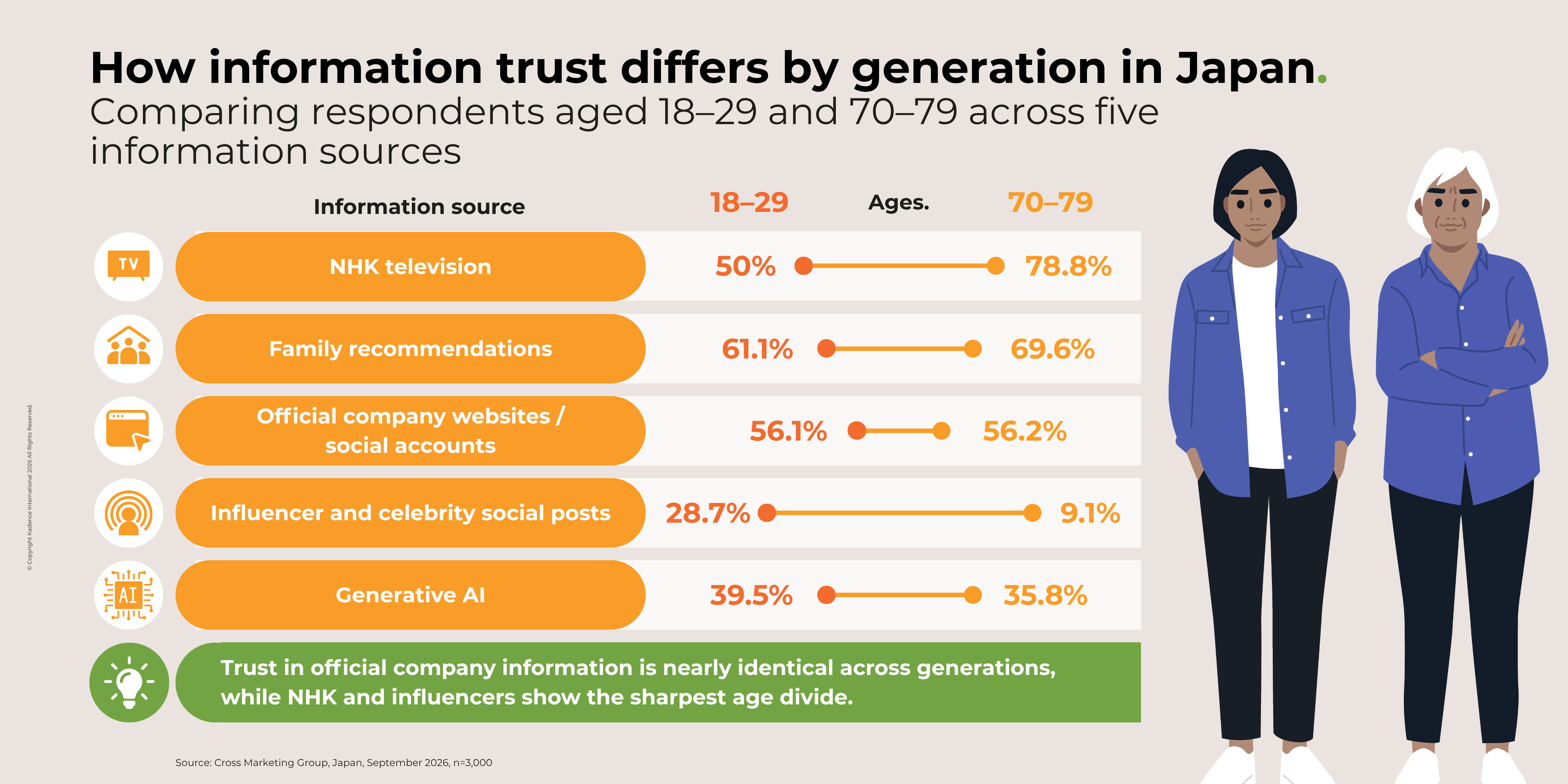
Social influence doesn't necessarily translate into trust
The findings also challenge how we think about influence itself. Social media has made it possible for almost anyone to share opinions, recommend products and potentially reach thousands of people, yet most Japanese consumers don't consider themselves influential. Our research found that 47% say they don't share information or influence others, while a further 30% believe they have little influence.
That perception is worth examining alongside the relatively low trust placed in social media posts. A recommendation doesn't necessarily become more credible because the person sharing it has a large following, and someone who considers themselves to have no influence might still be the person a friend or family member turns to for advice.
None of this means influencer partnerships lack value. They can introduce unfamiliar brands, demonstrate products, and generate interest among audiences that might otherwise be difficult to reach. The question is what happens beyond that initial exposure, particularly when consumers are willing to investigate claims and compare information from several sources.
Someone with thousands of followers may attract considerable attention, while a person with no public audience at all may be the one whose advice a consumer values most. Understanding who people listen to, and why, could reveal forms of influence that conventional social media metrics were never designed to capture.

AI is changing access to information faster than it is changing trust
Generative AI introduces a different challenge to the question of consumer trust. Where social media gives people access to an enormous range of opinions, AI can bring information together and present it as a single, seemingly authoritative answer. For consumers accustomed to checking sources and comparing different accounts, the convenience is obvious, although it may not always be clear where the information originated or how reliable it is.
Its adoption in Japan is moving quickly. Our research found that 58% of respondents now use generative AI to gather information, compared with 47% in 2025. Among those using it, 27% say it has primarily made information gathering faster, while 22% report improvements in the quality of what they receive. Another 12% believe both efficiency and quality have improved substantially.
The experience is far from universally positive, however. A third of AI users report little improvement in either efficiency or quality, while 6% feel that using the technology has actually made things worse. Only 37% of all respondents trust AI-generated information, considerably below the 56% who trust official company websites and social media accounts.
There is something revealing about this combination of rising usage and relatively modest trust. People are finding reasons to use AI even when they are not entirely convinced by the information it provides. Speed and convenience clearly have value, but they don't necessarily resolve the questions consumers have about accuracy or the origins of an answer.
This could become increasingly important as AI takes on more of the work consumers previously did themselves, from comparing products to researching unfamiliar brands. A company might have detailed, accurate information available on its website, but what happens when a consumer encounters that information through an AI-generated summary instead? The original source may become less visible, and the consumer may have fewer opportunities to judge the evidence behind a claim.
The research cannot tell us how Japanese consumers verify AI-generated answers or whether they trust brands differently after encountering them through AI. What it does reveal is that adoption is moving ahead of confidence, making the relationship between convenience, credibility and information sources an important area to watch.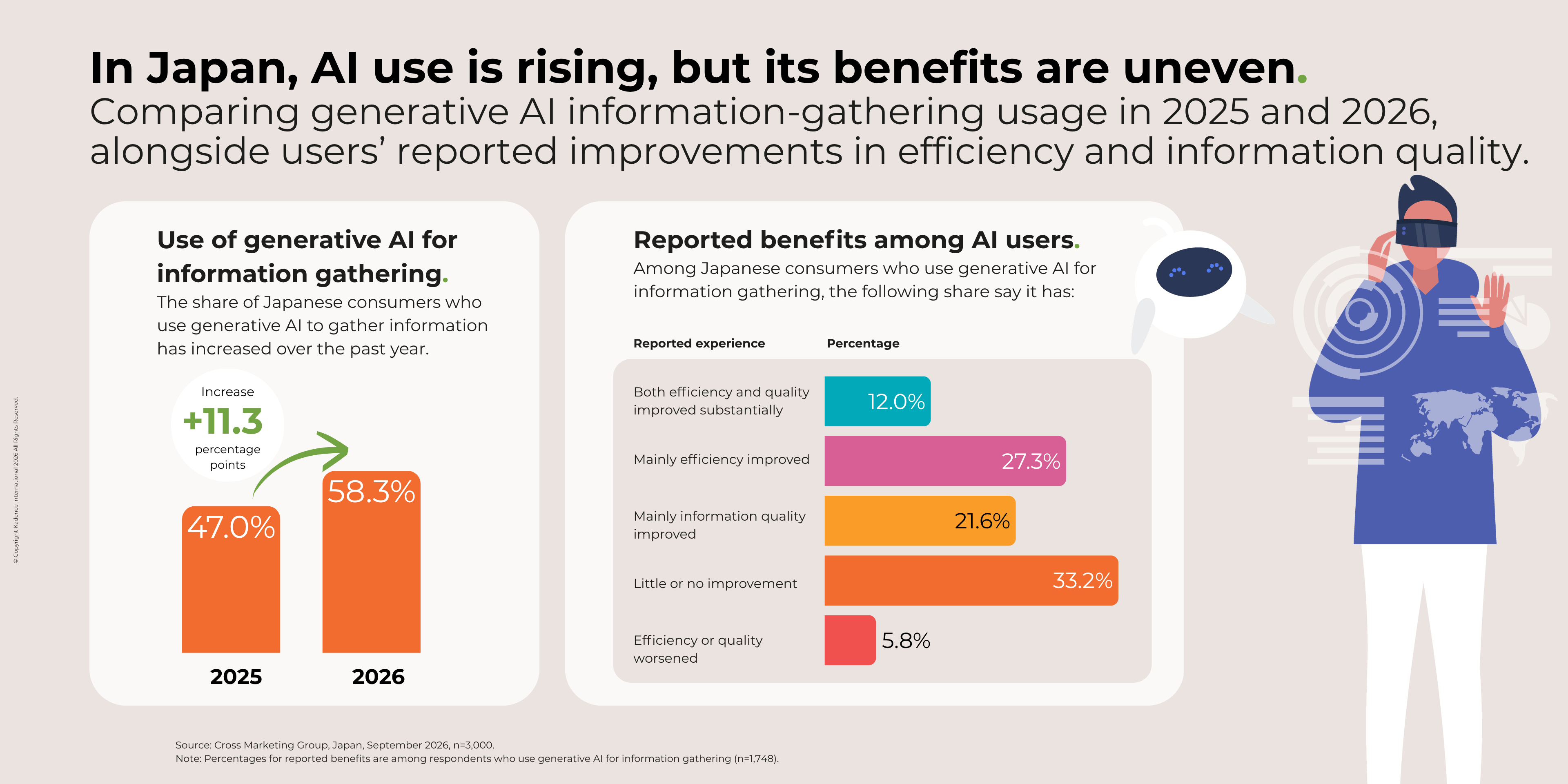
What this means for brands trying to earn consumer trust
There is a temptation to look at these findings and conclude that brands should invest less in influencers and more in traditional media or their own communications. But the research doesn't support such a straightforward conclusion. A source can be useful for introducing consumers to a product without necessarily being the one they trust most when deciding whether to buy it.
The more interesting question is whether brands understand what happens between those two moments. A consumer might discover a skincare product through an influencer, investigate its ingredients on the manufacturer's website, compare independent reviews, and eventually ask a friend who has used it. Each source contributes something different, yet much of that activity may be difficult to connect to the campaign that first generated interest.
This matters when marketing budgets are scrutinized, and channels are expected to demonstrate a return. Reach, clicks, and engagement are valuable measures, but they provide an incomplete picture of how people make decisions. Equally, investing in a highly trusted source won't necessarily deliver results if consumers rarely encounter it or don't consider it relevant to what they're buying.
The research also leaves an important question unanswered: does Japan's overall ranking of trusted sources hold when consumers are making particular purchases? Someone researching a financial product may have very different expectations from someone choosing cosmetics or deciding where to eat. Understanding those differences could reveal which information matters at each stage of a decision, where doubts arise, and what helps consumers resolve them.
Rather than treating trust as another metric to add to a marketing dashboard, brands have an opportunity to examine how it develops through real purchasing decisions. That may offer a more useful basis for deciding where to invest, what information to provide, and how to judge whether their communications are doing more than attracting attention.
What brands may be overlooking about consumer trust
Japan's findings offer a useful reminder that consumers don't experience marketing in the neat sequence that campaign reports often suggest. They encounter information from different sources, question some of it, disregard plenty of it, and form opinions through experiences and conversations that brands may never see.
The more valuable question for businesses is what happens when those different sources disagree. If an influencer recommends a product but a friend advises against it, whose opinion carries more weight? Does an official company explanation resolve a consumer's doubts, or would they rather hear from someone who has used the product themselves? The answers are likely to vary by category, audience and the importance of the purchase, which is precisely why they deserve investigation.
Brands have invested heavily in understanding how consumers encounter their marketing. Japan's research suggests there is just as much to learn about how consumers use that information afterward, particularly when deciding what to believe and whom to trust.
Understand what builds consumer trust in Japan
Knowing where consumers encounter information is only part of the picture. Understanding what makes them believe it, which sources influence their decisions and where confidence breaks down can reveal opportunities that traditional measures of reach and engagement overlook.
At Kadence International, we help brands understand the attitudes, behaviors and decision-making processes shaping consumer markets. Through tailored research in Japan and across global markets, we uncover the insights businesses need to build stronger connections with their audiences.
Looking to understand what drives consumer trust in Japan? Get in touch with our team.
Research conducted in September 2026 by Cross Marketing Group, a sister company of Kadence International, among 3,000 adults aged 18–79 across Japan.
FAQs
What sources of information do Japanese consumers trust most?
Our September 2026 research found that family recommendations are the most trusted information source in Japan, at 63%, followed by NHK television at 61% and official government websites and social media accounts at 60%. Newspapers, recommendations from friends and official company information also perform strongly, suggesting that personal relationships and identifiable, established sources remain important to consumer trust.
How do Japanese consumers decide whether information is trustworthy?
Japanese consumers demonstrate a strong preference for information they can verify. Nearly 77% say they distrust information when they cannot identify its source, while 70% compare multiple sources when something raises doubts. Another 72% prefer receiving reliable information later rather than being first to hear something, highlighting the importance of credibility over speed.
Do Japanese consumers trust social media influencers?
Trust in social media influencers is relatively low compared with other information sources. Just 17% of Japanese consumers trust celebrity and influencer social media posts, according to our research. Younger consumers are more receptive, with 29% of 18–29-year-olds expressing trust, compared with only 9% of those aged 70–79. However, low reported trust does not necessarily mean influencer marketing is ineffective at generating awareness or interest.
How is generative AI changing information gathering in Japan?
Generative AI is becoming a more widely used information source. In 2026, 58% of surveyed Japanese consumers reported using AI for information gathering, compared with 47% in 2025. Among AI users, 27% said it primarily improved efficiency, while 22% reported improvements in information quality. However, only 37% of all respondents trusted AI-generated information, highlighting a gap between adoption and credibility.
How can international brands build consumer trust in Japan?
Brands can strengthen their approach to consumer trust in Japan by providing accurate, transparent and easily verifiable information. Research suggests that Japanese consumers value identifiable sources, compare information when uncertain and place considerable confidence in official company communications and personal recommendations. Understanding which sources consumers trust within a specific product category, and how they use those sources throughout their decision-making journey, can help international brands develop more effective marketing and communications strategies.