
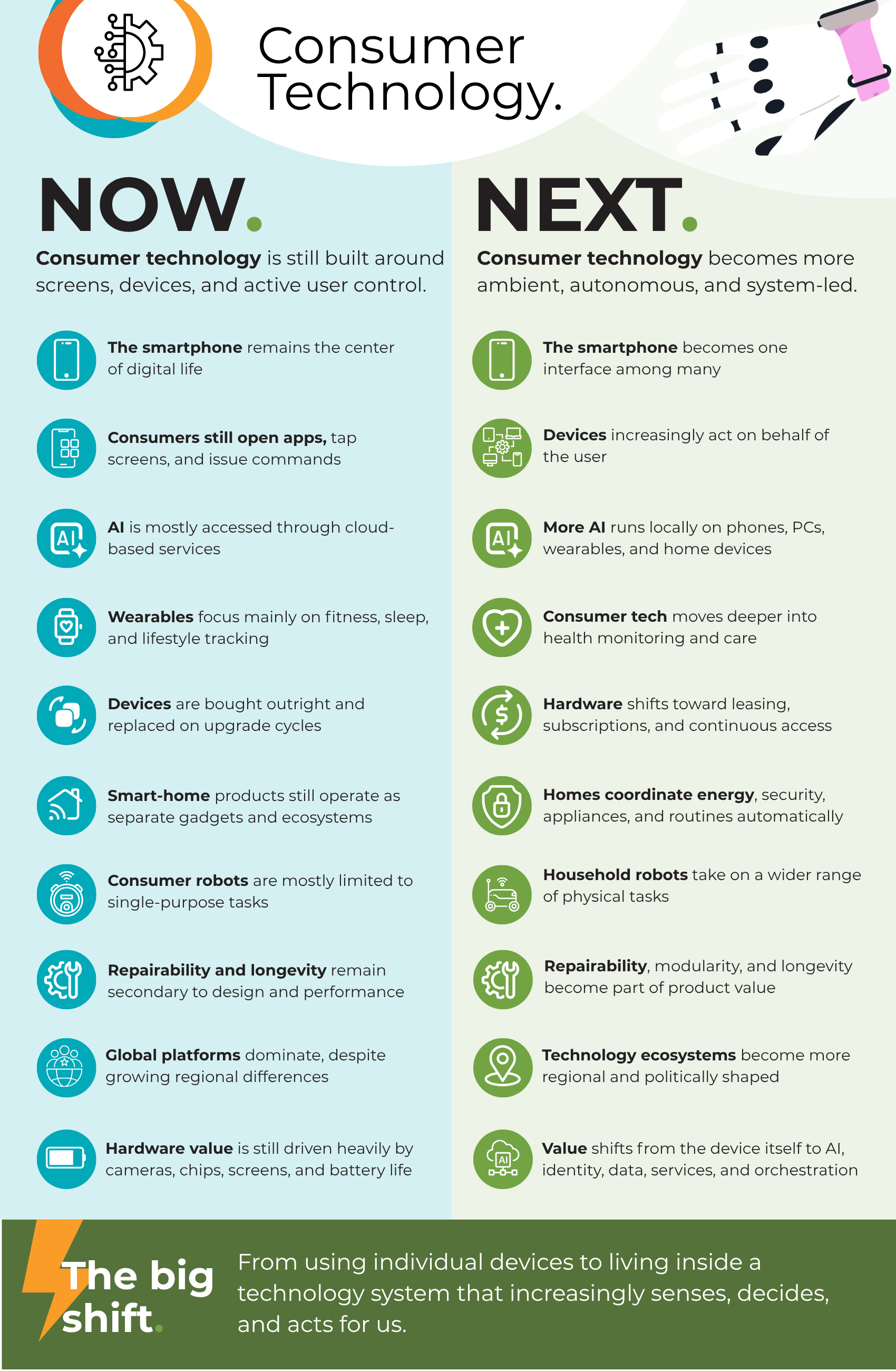
For years, consumer technology has revolved around a familiar promise: the next device would be faster, thinner, smarter, or more capable than the one before it. Being feature-rich still matters, but it no longer explains where the most interesting changes are happening.
The smartphone is a good example. In 2026, IDC expects global shipments to fall sharply even as the market grows in value and average prices rise. At the same time, more computing is moving into glasses, watches, rings, cars, and the home. The result could be a future in which people spend less time looking at a single screen while relying on more technology throughout the day.
There are early signs of that shift already. Smart glasses are becoming a real consumer category rather than a recurring prototype. Wearables are moving beyond fitness into more serious health applications. AI is starting to run locally on devices, and connected homes are slowly getting better at coordinating products from different brands.
A decade or two from now, the biggest change may be less about the arrival of one breakthrough gadget and more about how quietly technology slips into the background. Devices may become less visible, more persistent, and more capable of making decisions for us. For consumer tech companies, that raises a bigger question than what the next hit product will be: who owns the relationship when the technology itself becomes almost invisible?
11 shifts that could reshape consumer tech
1. The smartphone stops being the center of consumer tech
The phone is unlikely to disappear, but it may no longer be the place where every digital interaction begins. Smart glasses, watches, earbuds, cars, and other connected devices are starting to take on tasks that once required pulling out a phone.
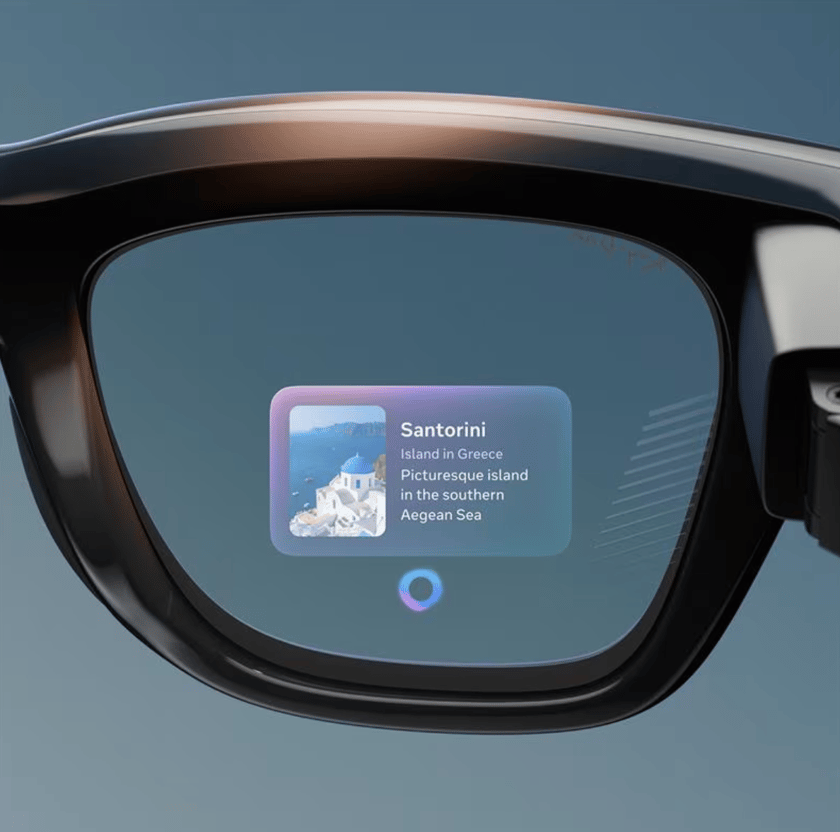
Image credit: EssilorLuxottica
Meta is one of the clearest signals. Its smart-glasses push with EssilorLuxottica has helped make the category more commercially serious, and the company is now reportedly preparing a camera-free version in response to growing privacy concerns.
The phone may increasingly sit in the background, powering a wider network of glasses, watches, earbuds, cars, and other interfaces. Consumers could still depend on it while spending far less time actually looking at it.
2. Screens start disappearing into everyday objects
More technology does not necessarily mean more screens. Glasses, earbuds, vehicles, appliances, and even rooms can already deliver information through voice, audio, sensors, and contextual prompts without asking consumers to look at another display.
If that continues, screen time could fall while technology use keeps rising. For brands, that changes the fight for attention. The interface may become less visual, less deliberate, and more embedded in the background of everyday life.
3. Devices start acting on our behalf
On-device agentic systems are already being developed to handle multi-step workflows locally, with Qualcomm demonstrating AI that can run continuous, proactive tasks on PCs rather than relying on isolated prompts.
A consumer version could compare prices, manage subscriptions, reorder household products, coordinate travel, or negotiate between services. That would change more than convenience. If software increasingly decides which options a consumer sees, brands may have to influence both an automated agent and the person using it.

4. AI moves from the cloud onto the device
AI has largely been delivered via remote servers, but hardware companies are investing heavily in running more of the intelligence locally.
MediaTek’s 2026 Dimensity 9600 Pro, for example, claims a 51% improvement in on-device generative AI performance over its predecessor. Qualcomm is making the same bet in PCs, where local processing is being pitched around speed, privacy, and continuous use.
That could make AI capability a hardware feature in its own right. Consumers may increasingly compare devices not just on battery, camera, or processing speed, but on what they can understand and do without sending everything to the cloud.
5. Consumer tech becomes part of the health system
Wearables are already moving beyond counting steps and tracking workouts. Watches, rings, and earbuds are becoming more useful for sleep, heart health, hearing, recovery, and early warning.
Apple has steadily added regulated health functions to Apple Watch, while Oura has built much of its growth around preventive health rather than fitness alone. The important shift is not simply that devices collect more health data. It is that this data starts sitting between consumers, clinicians, insurers, and other parts of the healthcare system.

Image credit: Oura
That creates new value, but also new problems. Who is responsible when a device flags a risk? Who monitors continuous data? Which readings are useful enough to act on? Consumer tech may move closer to healthcare faster than healthcare systems are ready to absorb it.
6. The device business shifts from ownership to access
Apple’s Upgrade program already gives consumers the option to lease iPhones, Apple Watches, Macs, and iPads, then upgrade, return, or buy them later.
If that model spreads, hardware starts to look less like a one-off purchase and more like an ongoing service. A monthly payment could eventually cover the device, AI features, storage, protection, upgrades, and support, keeping manufacturers in the customer relationship long after the initial sale.
7. Repairability becomes part of product design
For years, consumer electronics became thinner, more sealed, and harder to repair. Regulation and economics are now pushing in the opposite direction.
New EU right-to-repair rules require easier access to repair and spare parts, and the European Commission estimates they could generate €4.8 billion in growth and investment. Brands such as Fairphone and Framework have already built products around replaceable and upgradeable components.
The economics may end up pushing repairability further than sustainability messaging ever did. As devices become more expensive and some components become harder to source, keeping hardware in use longer starts to make financial sense. Repair becomes less of an ethical choice and more of a practical one.
8. The smart home starts running itself
The smart home still asks consumers to do a surprising amount of work. Devices have to be installed, linked, configured, and told what to do.
Matter is slowly reducing some of that fragmentation. Version 1.5 added support for more device categories and new energy-management capabilities, allowing connected products to respond to information such as electricity pricing, tariffs, and grid conditions.
The next step is a home that starts coordinating those systems on its own. Heating, cooling, EV charging, irrigation, security, and appliances could all be managed in the background, based on cost, routine, and context. If that happens, more of the value may sit with the platform that orchestrates the home rather than with any one device maker.
9. Household robots move from one job to many
Consumer robotics has succeeded by being narrow. A robotic vacuum does one thing reasonably well. A pool cleaner does another.
1X is testing whether consumers will pay for something much broader. Its NEO home robot is being offered at $20,000 for early ownership or $499 a month, with initial consumer deliveries planned from 2026.
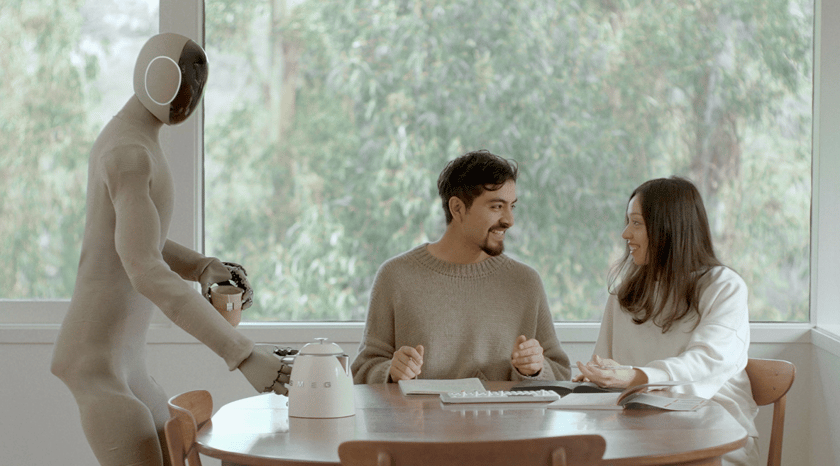
Image credit: Neo Home Robot
The technology is still early, and current systems do not prove that general-purpose household robotics is solved. But the economics become much more interesting once one machine can spread its cost across several chores. Household labor could eventually become a subscription-based technology category, much as software did.
10. Consumer tech becomes more geographically fragmented
Consumer technology has spent decades becoming more global. The same operating systems, device categories, and major platforms reached consumers across very different markets.
Geopolitics is starting to push the other way. Huawei is accelerating its own chips and broader technology stack as China works to reduce dependence on foreign suppliers. Similar pressures are appearing around AI models, data rules, privacy, and infrastructure elsewhere.
A single “global product” may become harder to build. The same device could sit inside very different AI, software, data, and regulatory systems in China, Europe, India, and the US, forcing companies to make more market-specific choices in how products are designed, launched, and supported.
11. Scarcity starts deciding what gets built
Consumer technology companies have long designed products around what people want and are willing to pay for. Access to components is becoming a bigger part of that calculation.
AI infrastructure is competing with consumer electronics for advanced chips, memory, and other constrained components. MediaTek’s latest flagship chip shows how aggressively the mobile industry is chasing access to cutting-edge manufacturing capacity.
If supply remains tight, companies may have to make harder choices about which devices, price tiers, and markets deserve scarce components. That could reinforce premiumization, lengthen product lifecycles, and make repairability more valuable. The future of consumer tech may be shaped not only by what consumers want but also by what manufacturers can afford to build.
Which trends deserve investment?
Consumer tech is full of ideas that work technically but never become part of everyday life. The real test is whether people will adopt them, pay for them, trust them, and keep using them once the novelty wears off.
The answer will vary sharply by category. Smart glasses depend on comfort, social acceptability, and privacy. Household robots depend on reliability and whether the time saved justifies the cost. Health wearables have to prove they are useful enough to influence real decisions, not simply generate more data. AI agents face an even higher bar because consumers are being asked to hand over judgment, purchasing, and access to personal information.
This is where market research matters most: testing not just interest, but willingness to change behavior, pay, delegate, share data, and tolerate trade-offs. It also needs to identify where those answers differ across markets, generations, income levels, and use cases.
The strongest opportunities will not necessarily be the most futuristic. They will be the ones where the technology solves a problem consumers already feel strongly enough to change what they do.
Consumer technology will continue to produce impressive demos. The commercial challenge is knowing which ones will change behavior.
That means understanding where consumers are genuinely ready to hand over control, share data, pay for convenience, adopt a new interface, or bring an unfamiliar technology into everyday life. Those answers will differ by market, category, age, income, and context.
Kadence helps companies test those questions before they become expensive bets: identifying real demand, adoption barriers, acceptable trade-offs, and where an idea is ready now, later, or perhaps not at all.
Talk to Kadence about where consumer tech is heading NEXT.
FAQs
What are the biggest consumer technology trends shaping the future?
Some of the most important shifts include AI moving onto devices, smart glasses becoming more practical, wearables expanding into health, smarter home systems, household robotics, longer-lasting hardware, and more regional technology ecosystems. Smart glasses and AI-enabled devices are already among the faster-growing areas of consumer electronics.
Will smartphones still be important in the future?
Most likely, yes, but their role may change. The smartphone could become more of a computing hub behind glasses, watches, earbuds, cars, and other connected devices rather than the screen people use for every interaction.
How will AI change consumer electronics?
AI could change both what devices do and how people interact with them. More processing is moving onto devices themselves, while agentic AI could allow products to complete tasks, coordinate services, and respond to context rather than simply waiting for individual commands. Current industry analysis still suggests edge AI adoption will vary widely by device and use case.
Are smart glasses likely to replace smartphones?
There is not enough evidence to say that they will. Smart glasses are gaining momentum as a consumer category, but privacy, comfort, price, battery life, and social acceptance remain important barriers. A more plausible near-term future is that glasses take over some interactions while smartphones remain part of the wider device ecosystem.
What will consumers expect from future technology products?
Convenience alone may not be enough. As devices become more embedded in health, homes, and everyday decision-making, consumers are likely to weigh privacy, trust, repairability, interoperability, price, and how much control they are comfortable handing over alongside performance and features.