

Ask someone why they bought a particular product, and they can usually tell you. Perhaps a friend mentioned it, they had seen good reviews, or it was simply a brand they already knew and felt comfortable buying. Whatever the reason, most of us have a fairly coherent story about how we arrived at the choices we make.
The problem is that the story we remember may not include everything that shaped the decision.
Long before someone reaches the point of purchase, they may have encountered a brand in dozens of different places. It might have appeared in a social feed, turned up in a search, been mentioned by a creator, recommended by a retailer, or simply become familiar through repeated exposure over time. Much of this happens without us paying particularly close attention to it.
Then something prompts us to act. A friend recommends the product, we come across a persuasive review, or the price drops at exactly the right moment. When someone later asks what influenced the purchase, that is often the part we remember.
But was it really where the influence began?
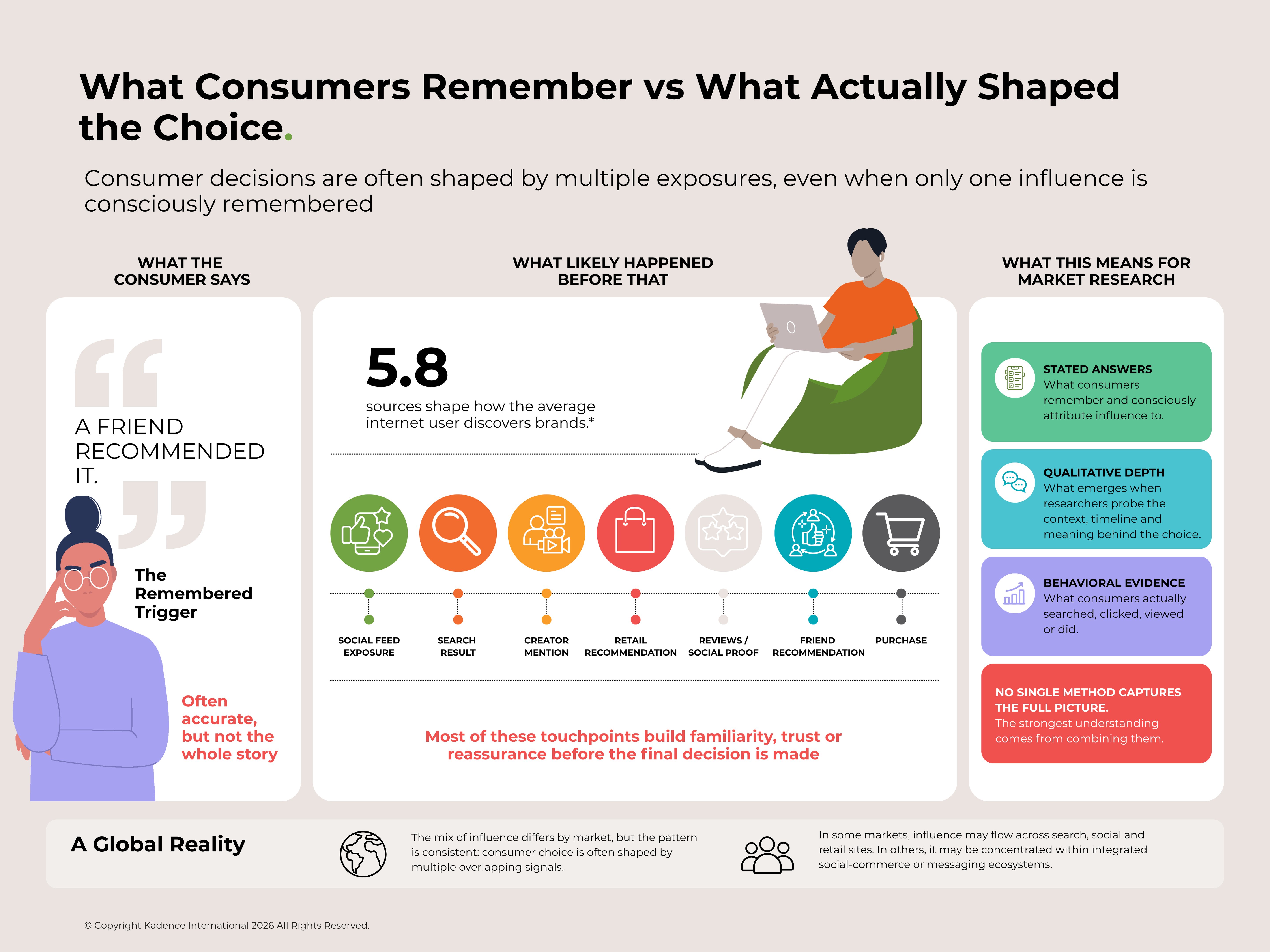
According to GWI data reported by DataReportal, the average internet user now discovers brands through around 5.8 different sources. Search engines, television, word of mouth, and social advertising all continue to play a significant role, often overlapping rather than operating independently.
For anyone trying to understand consumer behavior, this creates an increasingly difficult problem. We ask people to tell us what influenced them as though influence were a discrete event they can easily identify. In reality, a purchase may be the outcome of weeks, months, or even years of accumulated exposure, much of which the consumer has long since forgotten … or never consciously registered in the first place.
Consumers are not necessarily giving researchers the wrong answer when they explain why they chose something. They may simply be giving us the part of the story they can still see.

Consumers Are Not Lying. They Are Reconstructing.
One of the more useful findings in behavioral research is that people can be remarkably confident about decisions they do not fully understand.
A well-known series of experiments on “choice blindness” demonstrated this in a surprisingly simple way. Participants were asked to choose between two options, including consumer products such as jam and tea. In some cases, researchers secretly switched the selected item and then asked participants to explain why they had chosen it.
Many did not notice. More strikingly, they were still able to give plausible reasons for preferring the option they had originally rejected.
The point is not that people are foolish or that every explanation consumers give should be treated with suspicion. It is that introspection has limits. We are often better at producing a coherent explanation for a decision than we are at identifying every influence that produced it.
That has obvious implications for market research.
When someone tells us they chose a brand because it felt more trustworthy, offered better value, or seemed like a better fit, that explanation may be entirely sincere. But it may also be partly retrospective: a way of making sense of a decision after the fact.
Human memory does not work like a recording. It is reconstructive. We retain fragments, cues, and impressions, then rebuild the story later.
That means the reasons people give us are often meaningful, but they are not always complete accounts of causation.
For researchers, the challenge is to treat stated reasoning as one layer of evidence rather than the entire decision process. Because sometimes the story a consumer tells is less a transcript of what happened than the best explanation available to them now.
So, Should We Trust What Consumers Tell Us?
Yes. But perhaps not in the way we always have.
If someone tells a researcher that a friend's recommendation influenced their purchase, that answer is still valuable. It tells us what the consumer remembers, what they are willing to attribute influence to, and, often, what felt most important at the point of decision. What it does not necessarily tell us is everything that happened before that moment.
This is where relying on a single research method becomes risky.
Quantitative research is excellent at showing us patterns at scale. We can ask thousands of consumers which sources they used, what they considered, and what ultimately drove their choice. But a survey depends heavily on recall and on the respondent's ability to understand their own behavior. If the influence was subtle, cumulative, or barely noticed at the time, it may never appear in the data.
Qualitative research can get closer to the messiness of the decision. In an interview, a researcher can probe what happened before the purchase, when the brand first became familiar, what other options were considered, and why one recommendation carried more weight than another. A consumer who initially says, "My sister told me to buy it," may, ten minutes later, remember that they had also been seeing the product repeatedly on social media for months.
Neither method gives us the whole truth on its own.
This is why hybrid research becomes more valuable as consumer journeys become more complex. Quantitative data can tell us how common a behavior is. Qualitative work can help us understand how that behavior actually unfolded. Add observational or behavioral data, where appropriate, and the picture becomes richer still: what consumers searched for, what they clicked, what they encountered, and what they actually did can be compared with what they remember doing.
The gaps between those sources may be as revealing as the areas where they agree.
For market researchers, the lesson is not to stop asking consumers why they made a choice. It is to stop assuming that a single answer to a single question can fully explain it.
The better question may be: what combination of evidence gets us closest to understanding how the decision was really made?
The Same Psychology, Different Influence Systems
The underlying psychology of influence may be broadly human, but the systems through which influence travels are anything but universal.
A consumer in the US or UK might discover a product on TikTok, validate it on Reddit, compare it on Google, check reviews on Amazon and finally buy it from a retailer. In China, discovery, recommendation, social proof and purchase may happen within a far more integrated ecosystem, where platforms such as Douyin, Xiaohongshu and WeChat compress what would be several separate stages elsewhere. Across India and Southeast Asia, messaging, creator commerce and mobile-first behavior can play a larger role in shaping what enters consideration and what feels trustworthy.
That means global research cannot simply export a Western model of influence and translate the questionnaire.
The same question can produce very different answers depending on how people in that market actually discover, evaluate and discuss brands. “Word of mouth” in one country may mean a family recommendation. In another, it may be a creator whose content feels more personal than advertising. In another, it may be a community conversation unfolding inside a messaging app.
For multinational brands, this creates a more demanding standard. Understanding influence requires more than identifying touchpoints. It means understanding the cultural weight of those touchpoints, the platforms that connect them and the social norms that determine which sources people trust enough to act on.
This is where I think the future of market research becomes much more interesting.
The best research will not be purely declarative, behavioral or observational. It will combine them. We will still ask consumers what they think and why, but we will place those answers alongside what they actually did, what they were exposed to and the context in which the decision unfolded.
That does not diminish the respondent's role. It gives their answer more meaning.
The future is not about deciding whether stated data or behavioral data is more “truthful.” It is about recognizing that each captures a different part of reality.
As consumer journeys become more fragmented, personalized, and algorithmically shaped, the research approaches that rely on a single lens will become less adequate. The advantage will go to organizations that can connect the layers: what people say, what they do, what they see, and what they remember.
Consumers may never be able to tell us every force that shaped a choice.
The job of market research is to get closer to the answer than any one source can take us.
At Kadence International, we help brands understand the full context behind consumer decisions by combining quantitative, qualitative and behavioral approaches across markets. From identifying what consumers say influences them to uncovering the cultural, digital and contextual forces shaping behavior, our research is designed to get closer to how choices are really made.
Talk to us about building a research approach that gives you a more complete view of your customers, your category and the influences driving growth.
FAQs
What influences consumer buying decisions?
Consumer decisions are typically shaped by a mix of prior brand familiarity, reviews, recommendations, advertising, social media, search, price, convenience and personal experience. The challenge is that consumers may only remember the influence closest to the final decision, rather than the full set of exposures that shaped their preference over time.
Can consumers accurately explain why they bought something?
Consumers can usually give a meaningful explanation, but that does not always capture the complete decision process. Research on memory, introspection and choice blindness suggests people can reconstruct plausible reasons for decisions without being fully aware of every factor that influenced them.
Why is self-reported consumer data still valuable?
Self-reported data remains important because it reveals what consumers remember, believe, and consciously attribute importance to. Its value increases when combined with qualitative research, behavioral data or observational methods that can uncover influences people may not recall or recognize.
Is hybrid market research better for understanding consumer behavior?
Hybrid research can provide a more complete view because different methods answer different questions. Quantitative research identifies patterns at scale, qualitative research explores context and motivation, while behavioral or observational data can show what people actually did. Comparing these sources can reveal important gaps between stated and observed behavior.
How should global brands research consumer influence across different markets?
Global brands should avoid assuming that the same channels carry the same meaning everywhere. Social platforms, family influence, creators, search, messaging and e-commerce ecosystems vary widely by market, so research should account for local culture, digital behavior and the specific ways consumers discover and evaluate brands.