

Japanese households hold one of the world’s largest pools of household savings. At the end of 2025, they held ¥1,140 trillion in currency and deposits, according to the Bank of Japan, equal to 48.5% of total household financial assets. For decades, that money faced little pressure to move. Deflation helped cash retain its value, low interest rates made returns modest across much of the financial system, and uncertainty reinforced a preference for deposits over market risk.
Inflation and falling real wages have started to erode the value of idle cash, pushing investing out of the margins of financial life and into the mainstream conversation for younger consumers. At the same time, the expansion of NISA, Japan’s tax-free investment program, has lowered the psychological and financial barrier to investing.
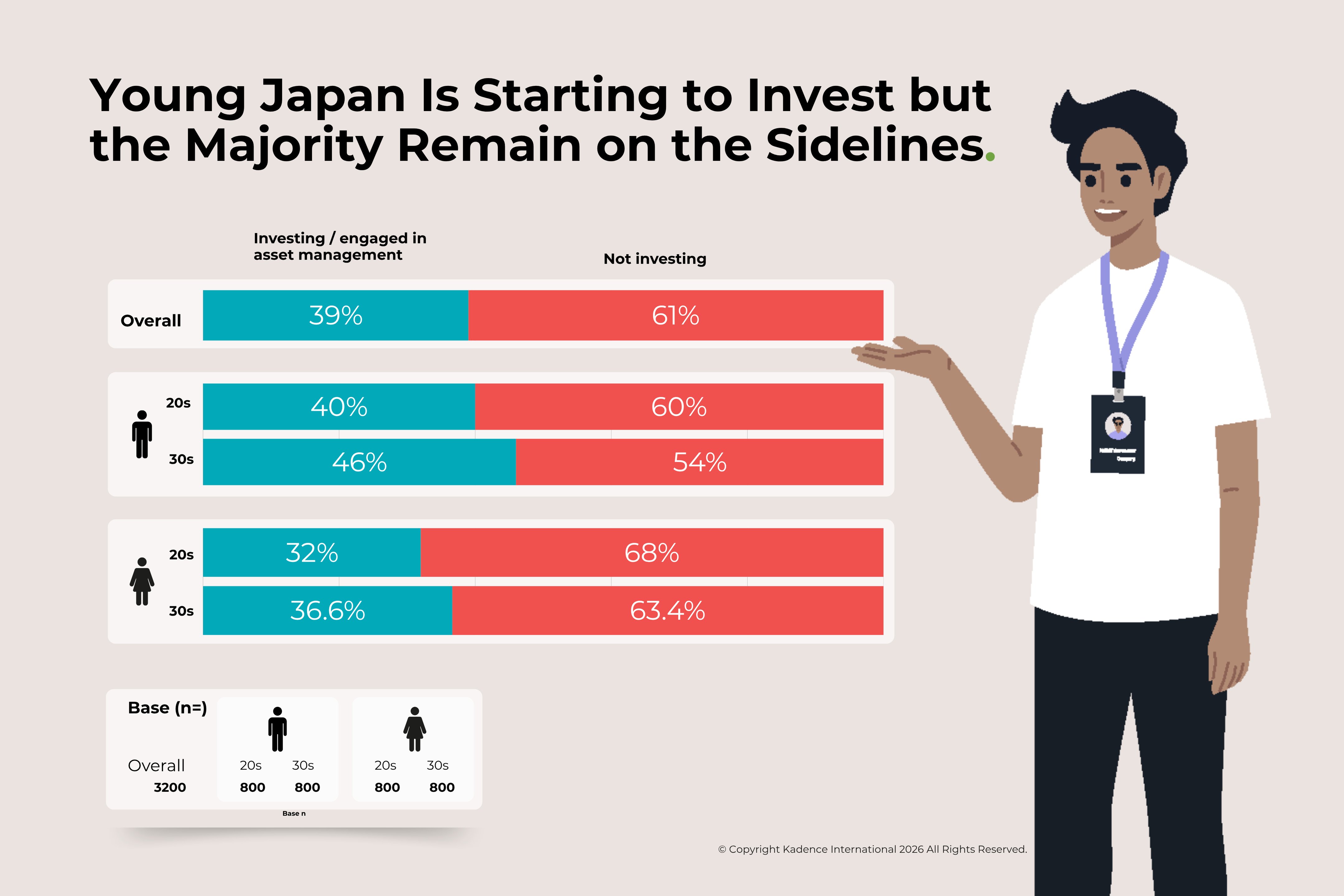
Our latest research in Japan shows the shift is already underway. Among 3,200 Japanese adults aged 20 to 39, nearly four in 10 are already engaged in asset management, with investment trusts and NISA products emerging as the dominant entry point into investing.
Most young non-investors in Japan are not actively rejecting asset management; they have simply never mentally entered the category. In our research, many are not yet comparing platforms, fees, or portfolio strategies because investing still feels distant from everyday life rather than part of it.
That creates a narrow but important opening. The battle for younger investors may be won before they ever search for a brokerage platform or speak with a financial adviser. It is happening while they hear about NISA from family members, watch investment explainers on YouTube, or begin questioning whether cash savings alone can keep pace with rising living costs.
NISA investment trusts are becoming the starting point into asset management
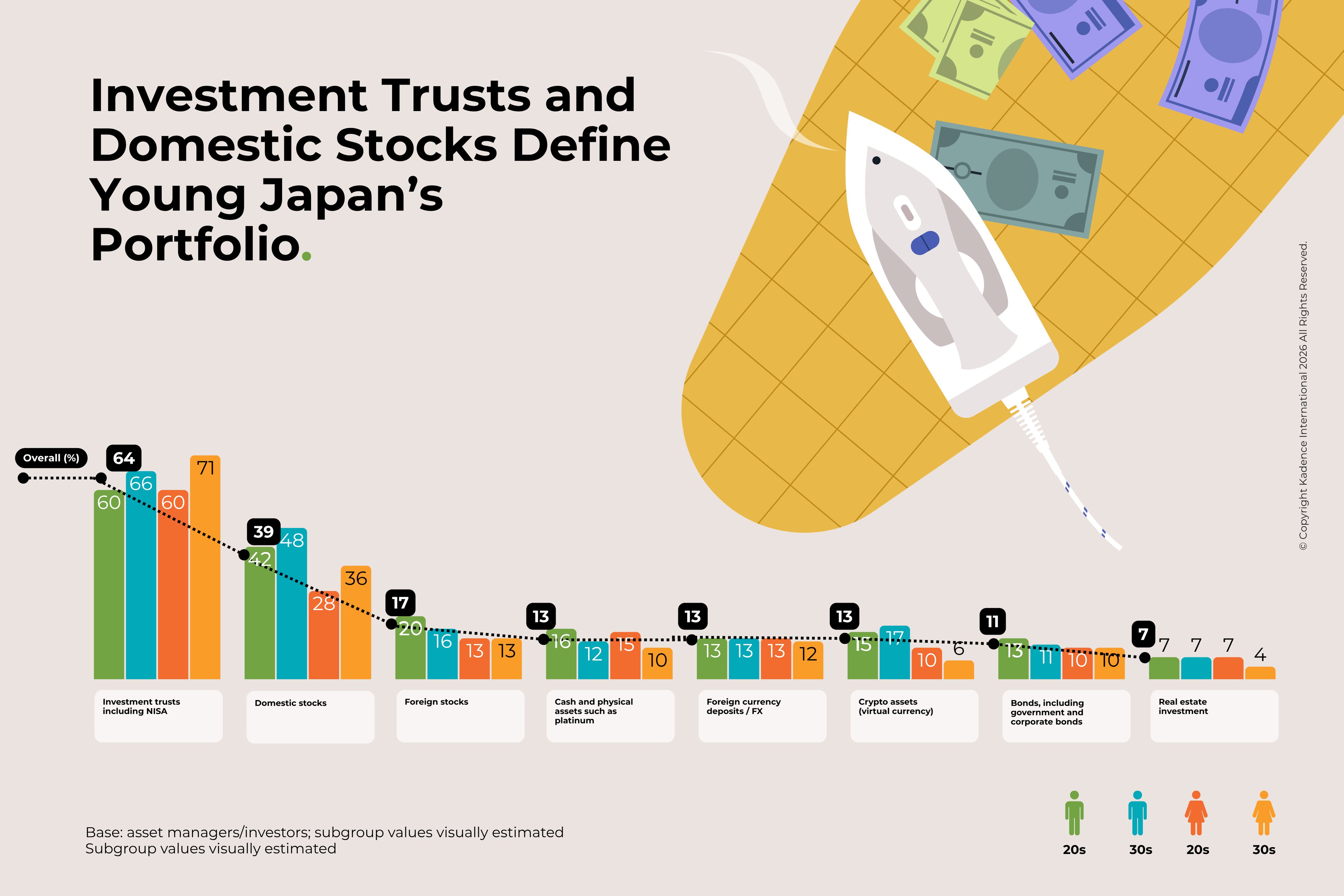
For many young Japanese investors, asset management begins with products that reduce complexity rather than maximize choice. Investment trusts linked to NISA have become the dominant entry point in our research, well ahead of direct investment into foreign equities.
Japan has spent years trying to shift household wealth from dormant cash savings into long-term investment products. NISA lowered some of the barriers that historically kept ordinary consumers away from investing by making gains tax-exempt, expanding annual limits, and allowing indefinite holding periods. For first-time investors, the structure offers a more controlled entry point than direct stock picking.
The product split also shows how uneven confidence remains within the same generation. Women in their 30s lean more toward investment trusts, while men in their 20s and 30s are more active in domestic stocks. Age alone doesn't explain this behavior. Some young investors want reassurance and simplicity. Others want control and a more direct relationship with the market.
Financial brands should pay close attention to the first product a young consumer chooses. It often signals how they want to learn, how much risk they are willing to carry, and what kind of relationship they expect from a provider. A NISA-linked investment trust may need clear comparisons and calm guidance. A domestic stock investor may respond better to sharper market information and tools that support independent decisions.

The first investing influence is no longer a banker
In Japan, the first step into asset management is increasingly happening before a consumer reaches a bank, brokerage, or financial adviser. In our research, the leading triggers are social, digital, and policy-led.
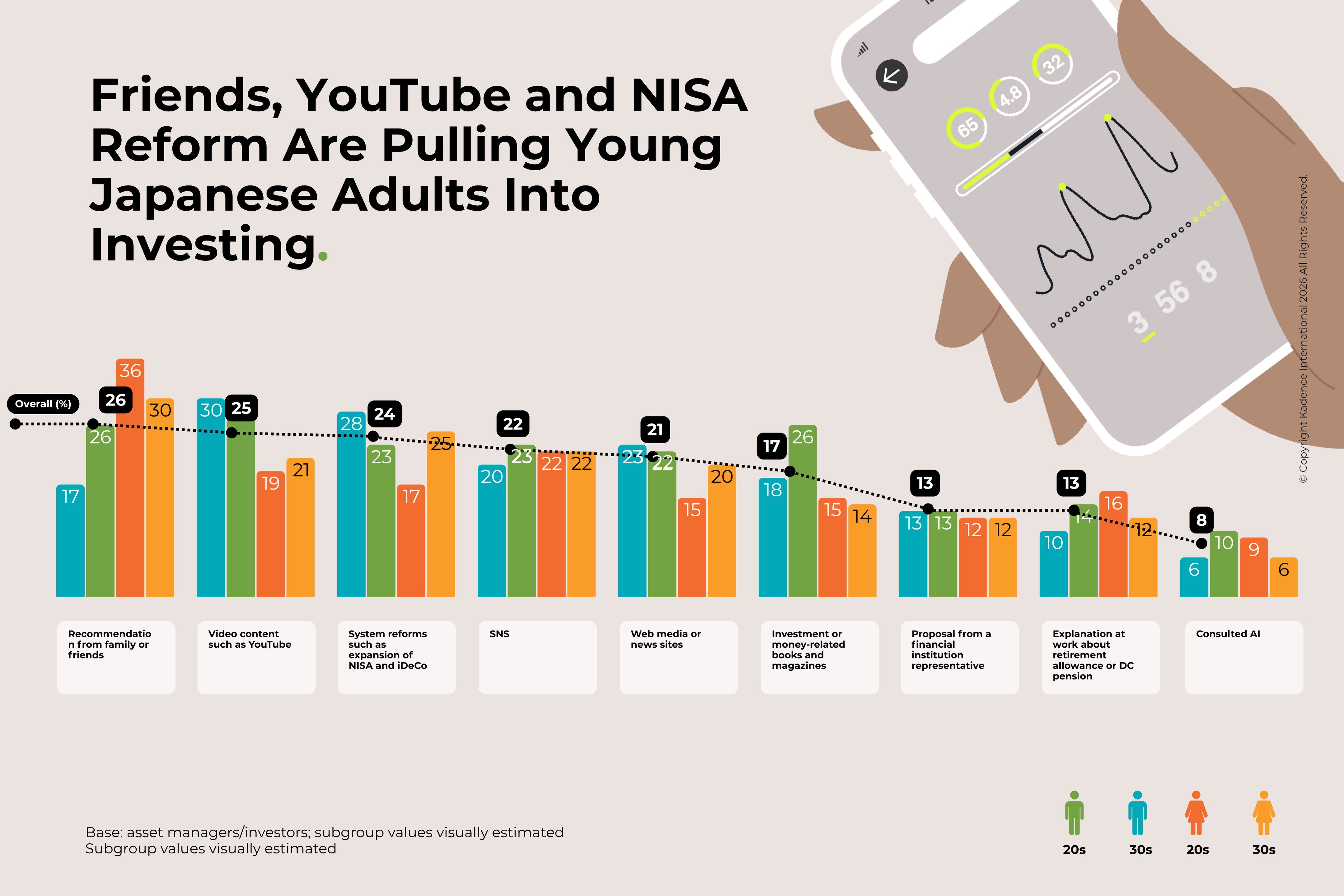
For women, family and friends are the largest influence. For men, video content is a stronger trigger. Among people in their 30s, policy reform carries more weight, suggesting that tax advantages and retirement planning become more relevant as financial responsibilities grow.
Our research shows there is no single route into investing. One consumer said they were prompted by a family conversation, while another said they started with a YouTube explainer or a policy change that made the timing feel right. For finance brands, this means influence has to be planned across trusted people, searchable content, and moments when policy creates urgency.
Financial providers cannot assume education begins on their own websites or apps. Much of the early influence now happens elsewhere, especially through people and content consumers already trust. That puts pressure on brands to create explanations clear enough to be shared, not just found.
Financial literacy content has to do more than explain terms; it has to help people discuss investing with someone they trust, check what they heard online, and understand how policy changes apply to their own money.
Young investors are looking for financial resilience
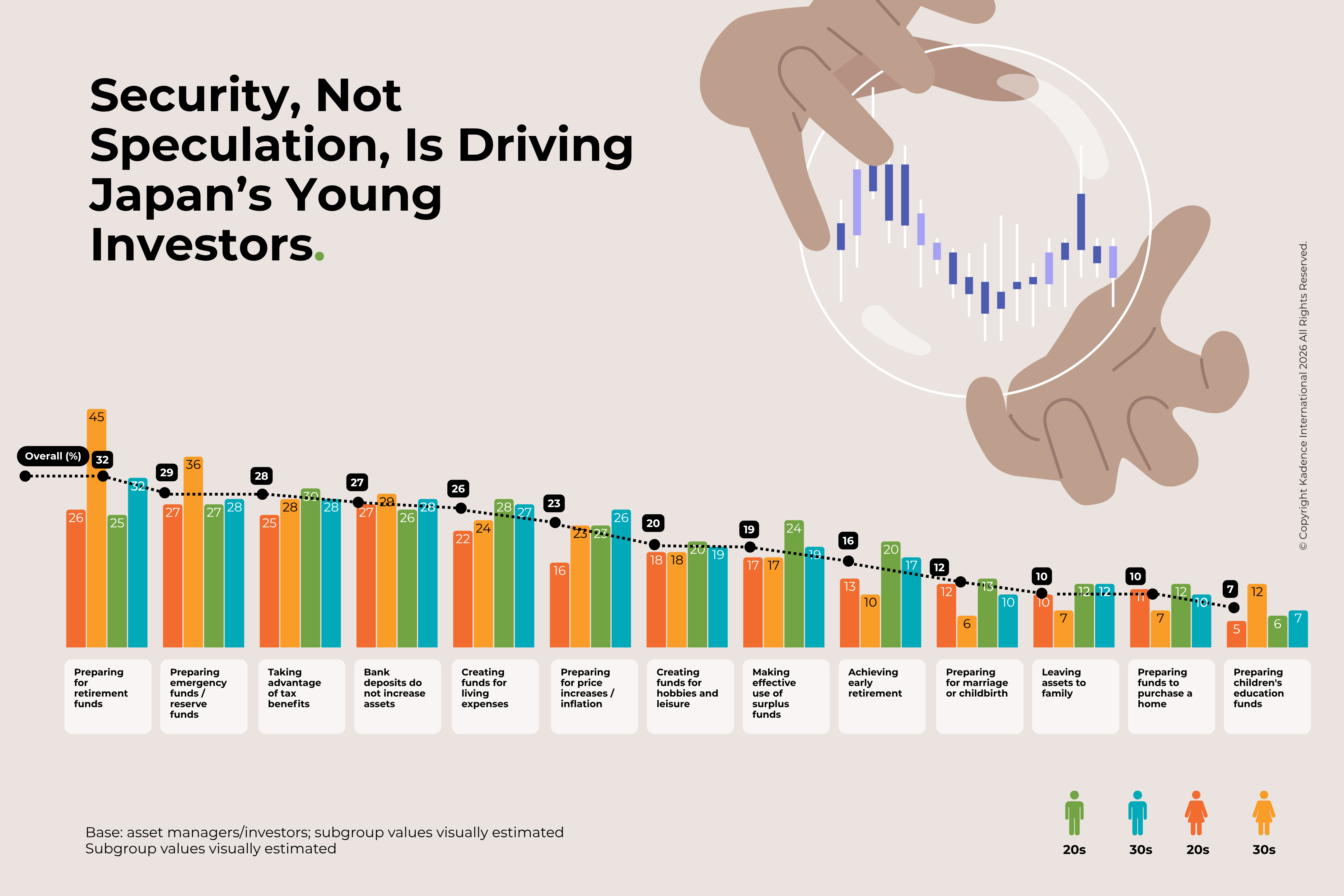
The motivations in our survey point more to preparedness than to speculation. Retirement, emergency funds, tax benefits, and inflation all rank near the top of the list, suggesting that young investors are using asset management to build a broader financial buffer.
In Japan, the meaning of financial security is changing. For older consumers, holding cash in the bank could feel like prudence. For younger generations facing higher prices, security increasingly depends on whether money can hold its value over time.
Women in their 30s show this most clearly. Their responses lean heavily toward retirement planning and emergency funds, pointing to an investing approach rooted in protection rather than aspiration. The appeal is practical: having enough set aside to handle a longer future and a less predictable present.
Financial brands should be careful with language focused only on ambition or market performance. For many young millennials and Gen Z, the stronger message is preparedness: what the money is for, how long it needs to last, and how much risk feels acceptable. A retirement calculator should show what a small monthly contribution could mean over time. An inflation explainer should show how cash savings may lose purchasing power. Emergency fund content should help people decide what to keep liquid and what to invest. The strongest content answers a practical question before asking the consumer to open an account.
Stock investors want returns they can see
The stock-investing segment has a different character. These young investors are not only looking for broad market exposure. They are paying attention to the ways listed companies return value, from price growth to dividends and shareholder benefits.
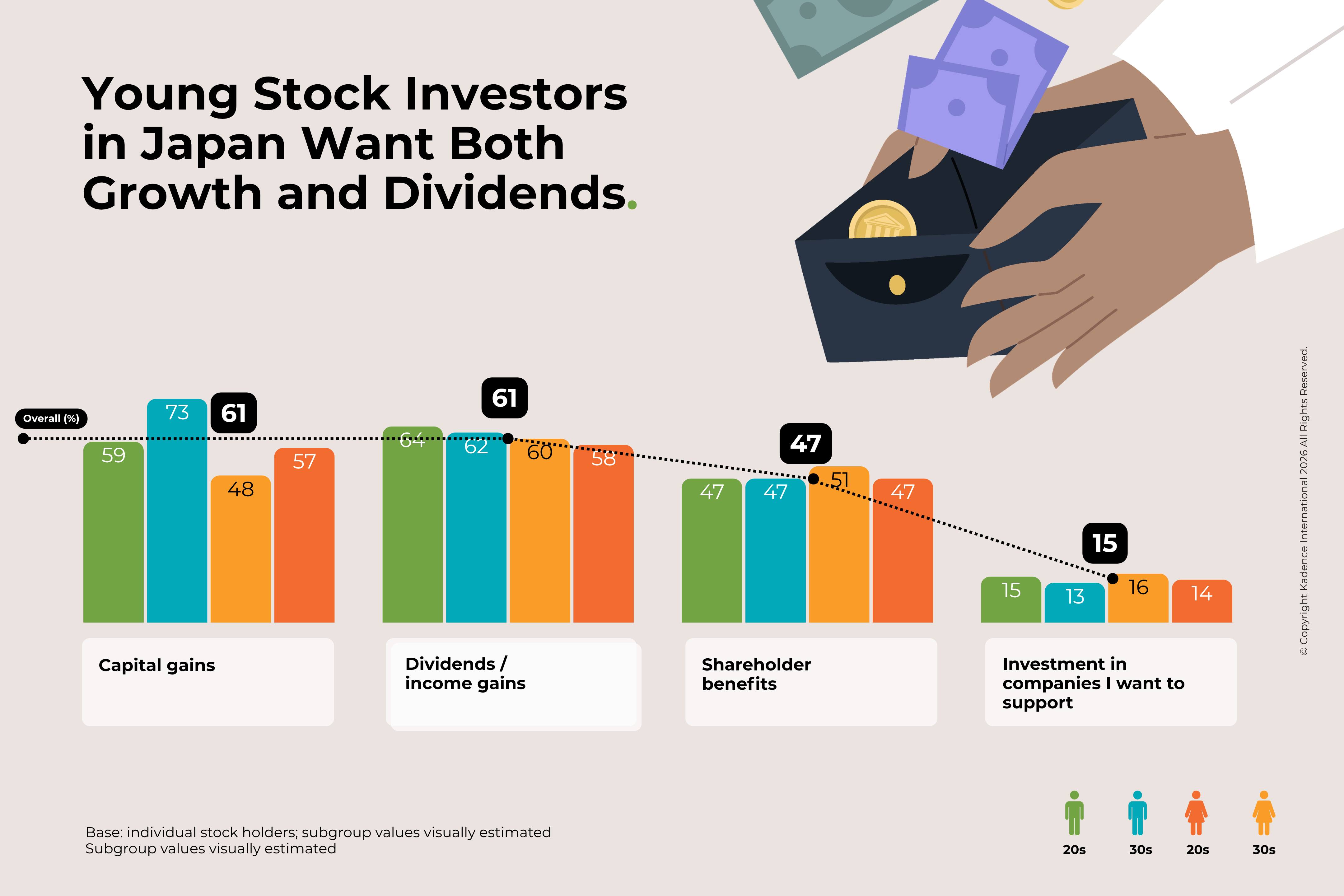
Growth still carries weight, especially among men in their 30s, but income matters almost as much. That balance is important because it shows a more disciplined approach to investing than the stereotype of young investors chasing quick gains. Many are looking for visible reward, not only future potential.
.png?width=4320&height=2880&name=Fig-5b-Selection-Criteria-for-young-japanese-investors%20(1).png)
In Japan, shareholder benefits give stock ownership a consumer dimension. Vouchers, discounts, loyalty-style rewards, or product-linked benefits can make the value of a holding easier to understand beyond the share price. For younger people, that can make a company feel less abstract. Dividends offer recurring value, while company performance and valuation still matter to those judging whether a stock has room to grow.
Listed consumer brands should treat young retail shareholders as more than a capital markets audience. Shareholder benefits, dividend communication, and investor updates can shape how these consumers judge the company as a brand. A benefit that feels useful, a clear explanation of performance, or a credible dividend story can strengthen the relationship in ways ordinary advertising may not.
Most non-investors have never considered asset management
The largest opening in the market lies with people who have not entered the category at all. In our research, most non-investors say they have simply never thought about asset management, while lack of money, lack of knowledge, and fear of losing money sit much lower as barriers.
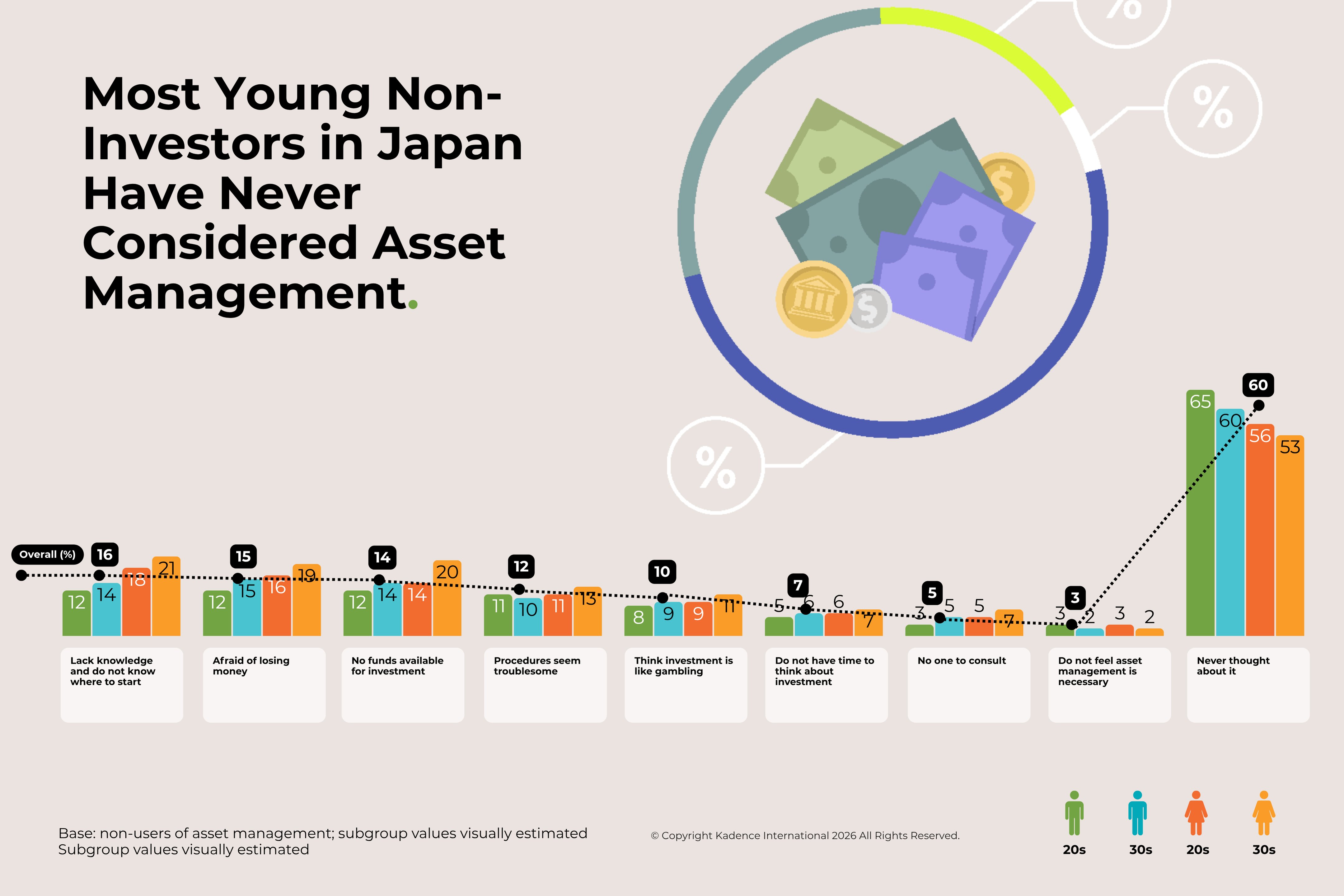
Someone who has never considered investing needs a different message from someone already comparing fees and risk levels. The first needs a reason to care. The second needs a reason to switch position.
Many financial campaigns assume the consumer is already standing at the edge of a decision. The language often moves quickly into fees and product features. For many young adults, that may be too late in the conversation. The more important task is to connect asset management to moments they already recognize, such as starting work, managing higher costs, or taking on family responsibilities.
PayPay Securities shows how that early-entry strategy can work in Japan. In 2024, PayPay and PayPay Securities launched PayPay Invest Easy inside the PayPay app, allowing users to choose from two mutual funds curated by PayPay Securities. The service brought investing into a familiar payment environment rather than asking consumers to begin with a brokerage platform.
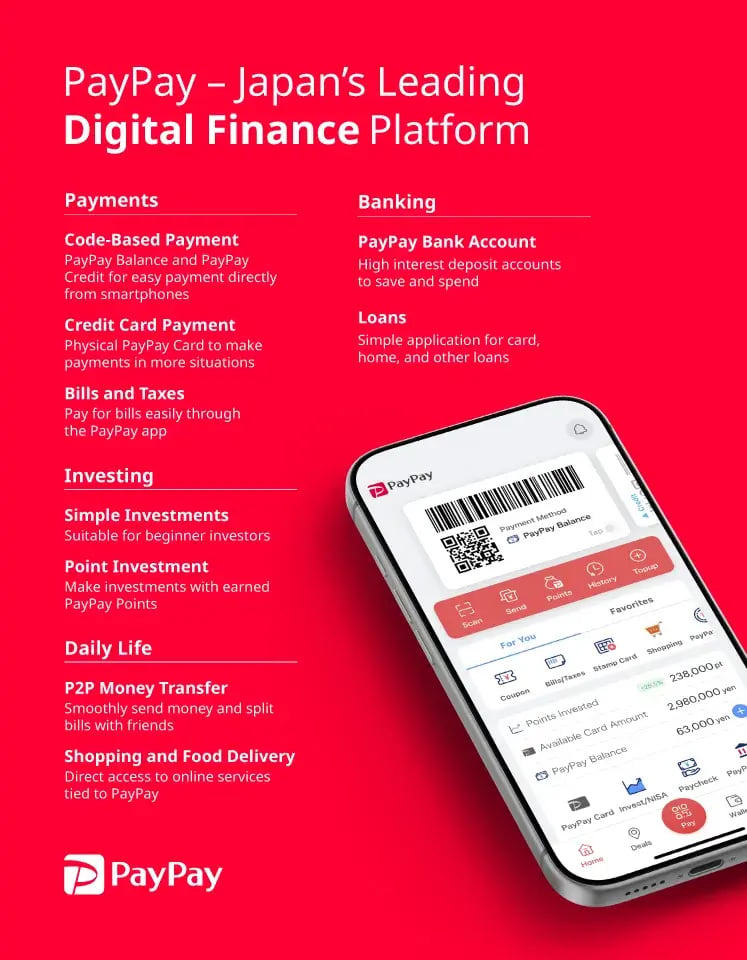
Image Credit: Type-F Capital
PayPay’s model gives financial brands a practical lesson: placement can do some of the work that advertising usually has to do. Putting investment options inside a familiar money app reduces the need to persuade consumers to visit a separate brokerage environment before they are ready.
What financial brands need to understand about Japan’s next investor
Japan’s young investment market is split by how people enter the category: reassurance, independent learning, tax reform, and no prior consideration. Each route calls for a different message, media choice, and first step.
A NISA-led message should make the first decision feel simple and structured, while a non-investor message should start with familiar life moments rather than product features.
Media choices should follow how the idea first reaches the consumer. A self-directed learner may start with YouTube. Someone checking a family recommendation may need a clear, searchable guide. A consumer already managing money through an app may respond better to a timely prompt than a broad awareness campaign.
SMBC’s Olive points to how the product environment is also changing. Sumitomo Mitsui Financial Group describes Olive as an integrated retail financial service that brings bank accounts, card payments, online securities, and online insurance together in one app. SMBC also promotes Olive as a service that allows accounts, cards, securities, and points to be managed together. The commercial lesson is practical: investing may work better when it sits beside the money tools consumers already use.

Image Credit: Medium
The first account may be small, but the first experience carries weight. Onboarding should show the minimum decision a new investor needs to make, the risk they are taking, the fees they will pay, and what happens next. Providers that make the early experience clear, useful, and easy to continue will be better placed when that customer later needs banking, insurance, credit, advice, or retirement planning.

Japan’s next investor may start before they search
Japan’s young investment market is moving through small, practical shifts rather than a dramatic break from the past. A tax-free account, a family recommendation, a YouTube explanation, or an investment option inside a familiar app can each make asset management feel closer to daily life.
The strongest providers will act before those signals turn into active product searches. In Japan, the next investor may not begin with a search for returns. They may begin with a moment when investing finally feels understandable enough to consider.
Understand how Japan’s younger consumers are reshaping financial decisions. Contact Kadence to uncover the attitudes, triggers, and barriers shaping your next growth opportunity.
FAQs
Why are young adults in Japan starting to invest?
Young adults in Japan are investing to prepare for retirement, build emergency funds, manage inflation, and take advantage of tax-efficient systems such as NISA.
What is the most popular investment product among young Japanese investors?
Kadence’s Financial Survey 2026 found investment trusts, including NISA, are the leading asset management product among young adults already investing.
How does NISA influence young investors in Japan?
NISA gives young consumers a tax-exempt and more structured route into investing, making asset management feel more accessible for first-time investors.
Why are many young adults in Japan not investing?
The biggest barrier is not always fear or lack of money. Kadence’s research found that many non-investors have simply never considered asset management.
How can financial brands reach young investors in Japan?
Financial brands need to reach young consumers earlier through trusted content, simple tools, app-based journeys, and messaging tied to real financial needs.