

Japanese breakfast looks stable until you examine who actually shows up.
In our survey of 1,100 consumers, more than 60% report eating breakfast almost every day, which reads as continuity until you separate the consistent from the conditional and see how wide that gap has become in practice. What holds at the category level is carried by older, regular participants; the rest move in and out depending on whether the morning lasts long enough to support the habit.
The change is not in the menu choice. Younger consumers skip more often, not because they have revised their views on health, but because mornings have become structurally unreliable: variable start times, longer commutes, fragmented schedules, and less tolerance for anything that requires preparation before leaving the house.
Older cohorts still anchor the occasion, but they are not setting the pace of change. When time compresses, the first thing to go is the task that requires setup and cleanup on a clock that is already tight.
Food choice reflects the same constraint. Quick, portable options gain share when breakfast happens at all, while more traditional, preparation-heavy meals hold where time is predictable and the household structure supports them.
Spending follows frequency: fewer occasions reduce total spend, even if unit prices hold or rise, which makes the category look resilient until you track visits rather than baskets.
“Morning services” in cafes and restaurants sit alongside this shift rather than replacing at-home breakfast. They capture the days when routines break, like late starts, early departures, missed trains, and convert them into a structured, fixed-price stop that fits inside a compressed window.
In Japan, longer average commute times and higher rates of dual-income households are associated with shorter weekday meal preparation time, particularly among younger segments (Statistics Bureau of Japan, 2024). The mechanism is plain: less time at the margin reduces participation first, then variety.
That leaves two groups occupying the same category with different rules. One plans for breakfast and executes it with minimal variance. The other treats breakfast as contingent, filling it when the schedule allows and dropping it when it doesn’t.
The category average hides that split, with the consequence not just fewer breakfasts. It is a market that becomes harder to predict because decisions are made upstream, and when the occasion disappears, everything attached to it goes with it.

How Often People Eat Breakfast in Japan and How It Varies by Age
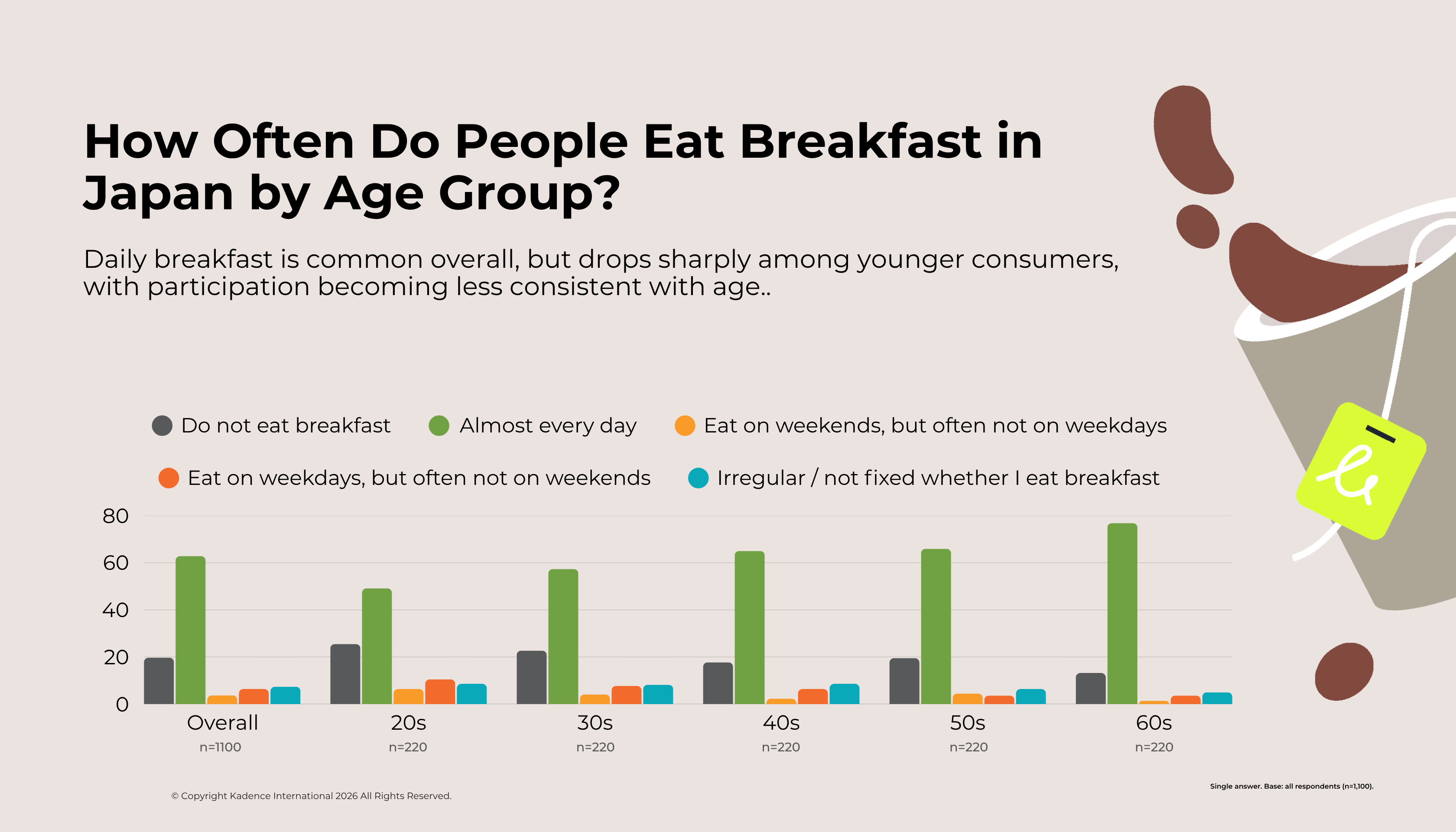
In Japan, most people eat breakfast regularly, and frequency increases with age. This difference is most visible across age groups. Among consumers aged 60+, roughly three-quarters eat breakfast every day. In their 20s, that drops to about half. At the other end of the spectrum, around one in five say they never eat breakfast at all.
The difference is visible in frequency rather than preference. The data do not suggest that younger consumers are systematically replacing breakfast with something else. Instead, participation itself becomes less consistent: some days include it, others do not. The change is less about what people prefer and more about whether they participate at all.
What this means
- Growth depends on recovering occasions that would otherwise be lost, rather than competing within those that remain.
- Solutions must be designed for mornings that may not include breakfast at all
- Availability and ease of access matter more than brand preference at the point of decision
- The opportunity lies in capturing occasions that would otherwise be skipped. These missed opportunities represent incremental demand, not a redistribution of share.
Japanese Breakfast Foods Show a Split Between Bread and Rice
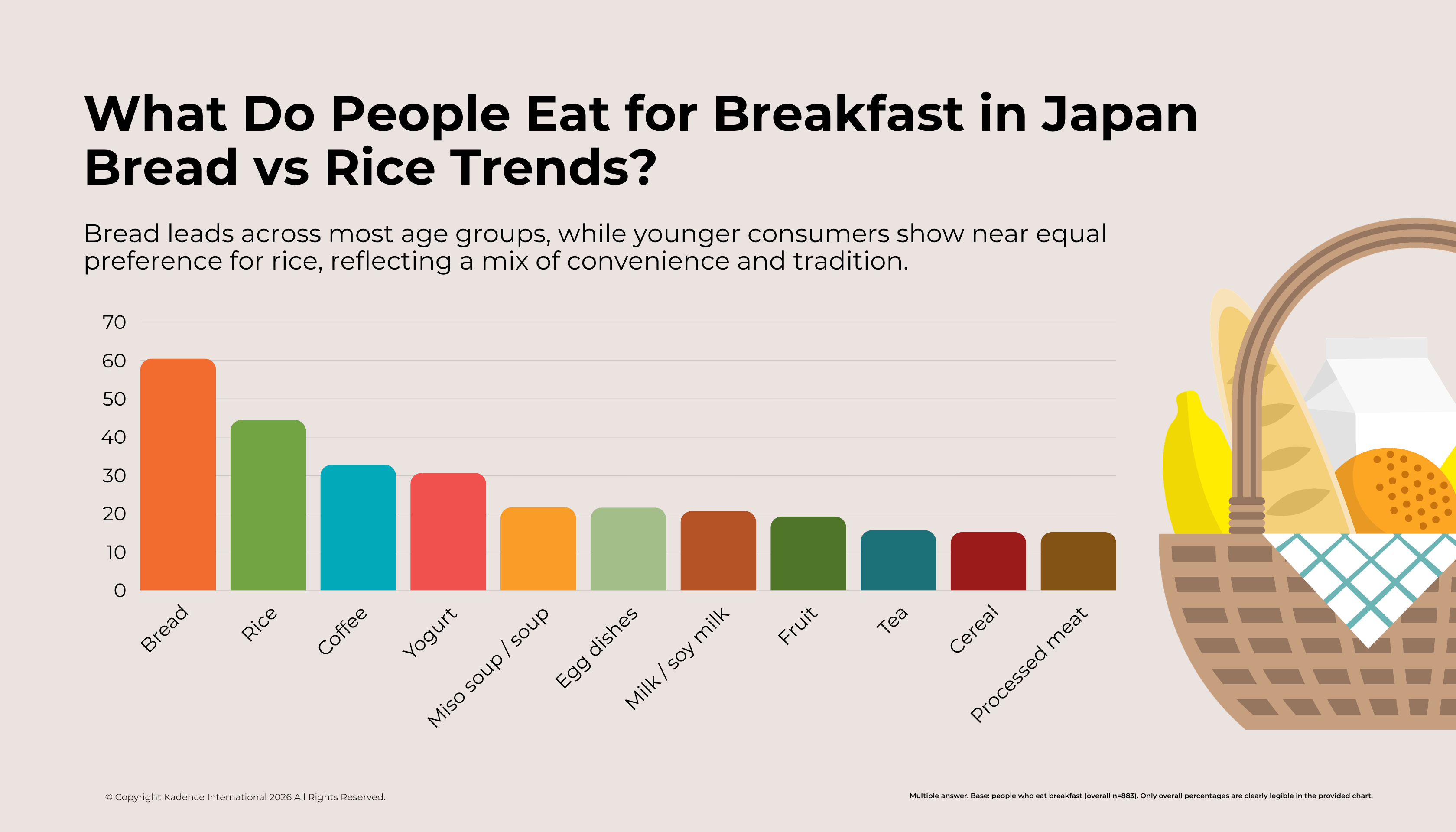
The most common breakfast foods in Japan are bread and rice, with bread slightly more common overall, reflecting broader breakfast trends.
The gap between the two is not uniform across age groups. Among consumers aged 40 to 60, bread is firmly embedded, with well over half selecting it. In contrast, among those in their 20s, the difference narrows to the point where bread and rice are chosen at almost equal levels.
This does not reflect a replacement of traditional foods. Rice remains a central part of the breakfast mix. What changes is how often it appears and in what context. Bread is more consistently part of everyday routines, while rice sits alongside it rather than being displaced.
The pattern points to a dual structure in which one format aligns with ease and repeatability, while the other aligns with familiarity and continuity. Categories like ready-to-eat cereals have grown by fitting into limited morning windows, rather than replacing existing formats.
What this means
- Single-format breakfast brands will lose relevance among younger consumers unless they provide a solution for mornings when the occasion does not occur.
- Offerings should adapt to different morning contexts, not assume a fixed preference
- Younger consumers require flexible options that can shift between convenience and familiarity
- Growth comes from ensuring availability across formats that match different morning contexts
Under time pressure, formats that require preparation are the first to lose. Portable, ready-to-eat options capture the mornings that remain, while more traditional formats hold where time and structure allow them to be maintained.
Japanese Breakfast Habits Show Strong Preference for Routine and Repetition
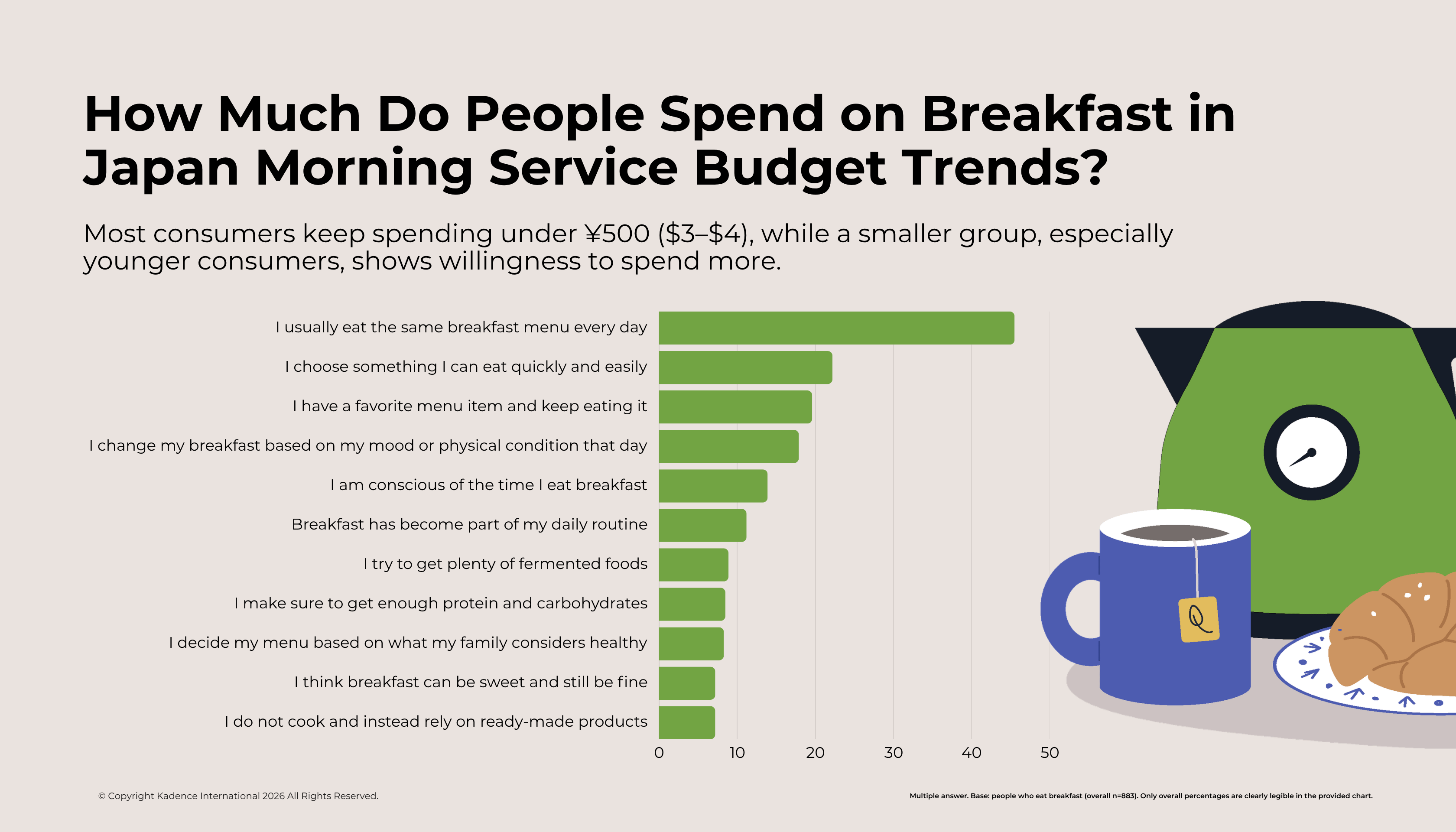
Breakfast habits in Japan are shaped by routine, with nearly half of respondents reporting that they eat the same menu every day. A smaller but meaningful share prioritizes ease, choosing options that can be prepared or consumed quickly.
The pattern becomes more pronounced with age. Among consumers in their 50s and 60s, responses tied to routine rise further, with many describing breakfast as part of how the day begins rather than a decision made each morning.
This pattern shapes how the category functions. Breakfast is not a space where consumers actively seek change. It is one where predictability reduces effort.
The presence of “easy to eat quickly” alongside “same menu every day” also points to how decisions are made. Once established, these patterns are rarely revisited, making breakfast one of the least actively decided meals of the day. This is reflected in how newer formats have entered the category. Products like Calbee’s Frugra gained traction not by replacing traditional breakfasts, but by offering a convenient option that could fit into existing routines, particularly among time-constrained consumers. Without fitting into existing routines, new formats fail to be adopted consistently, regardless of how well they perform in terms of taste or health.
What this means
- Winning depends on becoming part of an existing routine, not introducing new choices
- Products need to reduce effort while maintaining familiarity to be adopted daily
- Differentiation comes from fitting seamlessly into the routine, not disrupting it
Japanese Breakfast Spending Shows Strong Value Limits with Select Premium Uptake
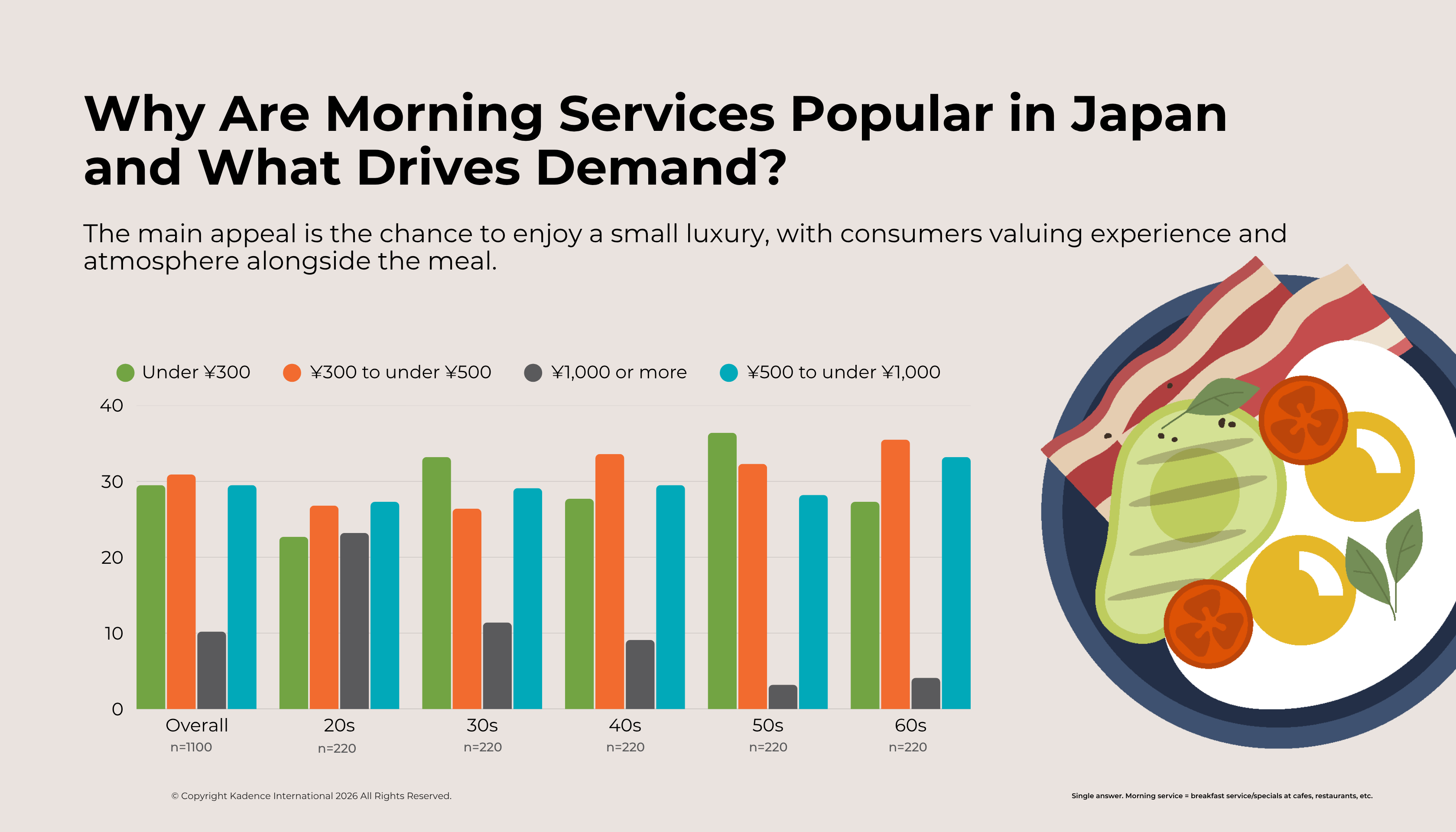
Most consumers in Japan spend under ¥500 (around $3–$4) on breakfast, keeping the category tightly value-driven.
The pattern shifts slightly by age. Older consumers are more likely to stay within lower price bands. Among younger consumers, the distribution widens, with a noticeable share willing to spend more than ¥1,000 (about $7).
This creates a layered market. The core remains price-sensitive, with clear boundaries on what is considered acceptable for a morning purchase. Alongside it, a smaller segment is open to paying more. This reflects two distinct roles for breakfast: either a routine cost to be managed or a moment that can justify spending more. For most Japanese consumers, breakfast remains a low-involvement decision, limiting how far premium can expand beyond specific moments.
What this means
- Pricing operates within a narrow band because the decision itself carries low involvement, limiting how far premium can scale beyond specific moments.
- Premium offers should be targeted and clearly differentiated, not broadly positioned
- Value must be communicated quickly and simply at the point of decision
- Growth comes from structuring tiers around defined price bands, not stretching the core offer
Why Japanese Morning Services Appeal Through Small Luxury and Experience
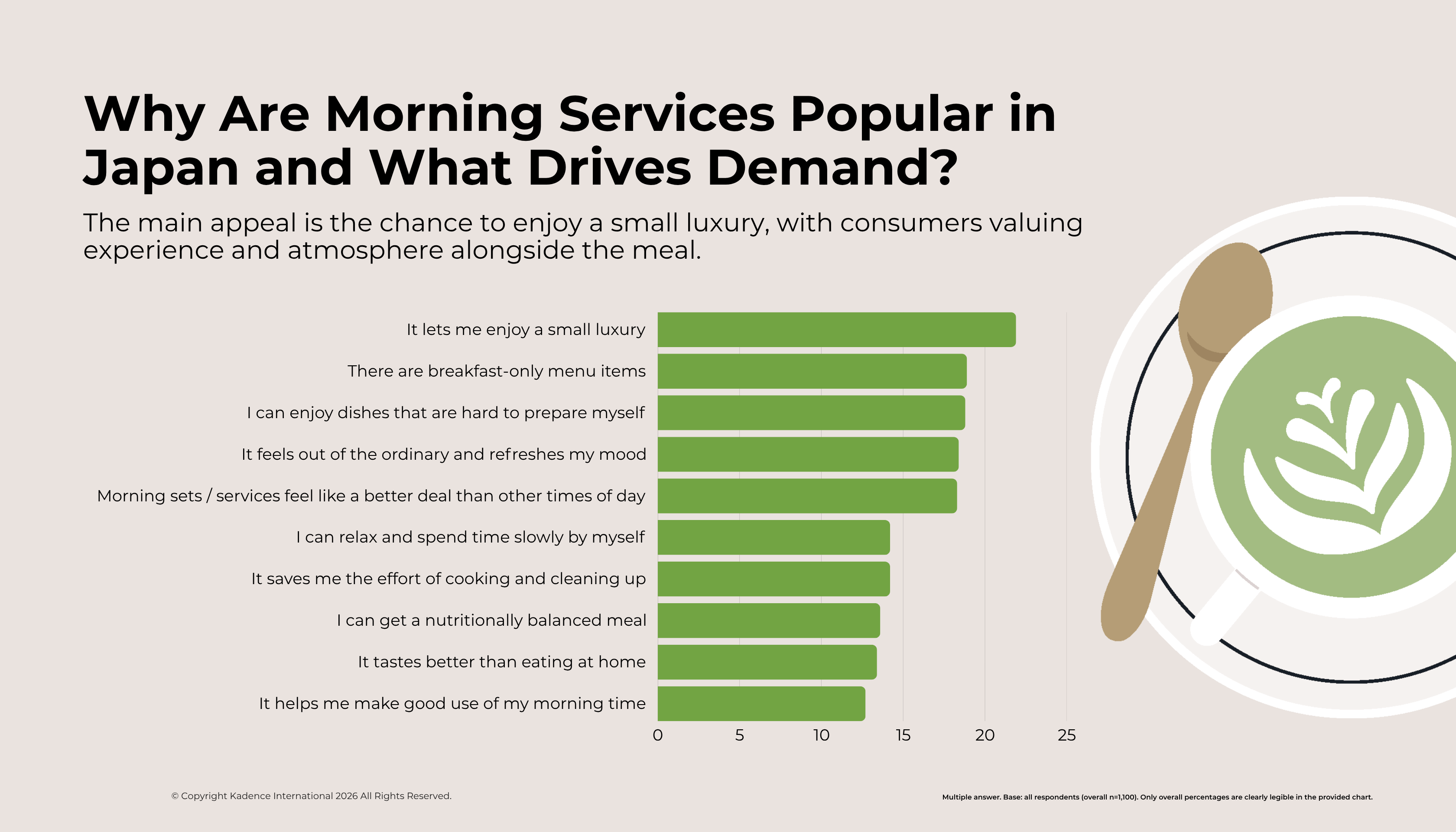
Morning services in Japan are popular because they offer a sense of small luxury rather than just convenience.
Other reasons point in the same direction. Consumers value access to breakfast-specific menu items, dishes that are difficult to prepare at home, and the chance to experience something slightly out of the ordinary.
There is also a clear gender difference. Women index higher across many of these appeal factors, particularly those tied to enjoyment and mood.
What stands out is the role of contrast. Breakfast at home is defined by repetition and efficiency. Morning services introduce variation and a sense of occasion within a structured part of the day. This is reflected in the broader growth of Japan’s breakfast market, where operators are using the morning as a strategic entry point, combining affordability with a sense of occasion to attract time-constrained consumers. Convenience chains and quick-service brands have expanded breakfast sets to capture early-day traffic, with players like MOS Burger and KFC focusing on portable morning offerings.
What this means
- Morning offers need to deliver a clear sense of occasion, not just a meal
- Experience should be designed into the product, not treated as an add-on
- Premium is earned through atmosphere, presentation, and context
- Out-of-home offerings must create a reason to step outside routine, not replicate it
Out-of-home formats benefit from this shift by capturing the days when routines break. They do not compete with at-home breakfast directly; they convert missed occasions into structured ones.

What Japan’s Breakfast Patterns Signal for the Next Phase of Growth
Breakfast in Japan is becoming more selective in how it occurs. Frequency varies by age, formats are used with less attachment, and spending sits within clearly defined limits. What appears stable at a distance is being reshaped by how mornings are structured.
The most consistent behavior now sits with older consumers, where repetition and predictability continue to define the category. Among younger consumers, participation is less reliable. The difference is not driven by experimentation, but by whether the occasion happens in the first place.
At the same time, out-of-home breakfast serves a different role. It does not replace what happens at home. It creates a separate moment, where setting, menu, and experience carry weight alongside the meal itself.
Participation, format, and spending no longer move together. Each is shaped by a different constraint. Time determines whether breakfast happens, routine shapes what is eaten, and context determines how much is spent.
A category once defined by habit is now defined by how well it fits into constrained, segmented mornings. The first opportunity sits with consumers who are not consistently in the market. This shifts focus from optimizing existing occasions to ensuring presence at the point where participation is decided.
Brands competing for breakfast share are optimizing the wrong problem. The category is not constrained by preference, but by participation, and growth depends on how often the occasion happens in the first place.
Many current strategies assume breakfast remains a consistent daily occasion, but the data suggest that this no longer holds across all consumers.
These changes reflect a broader shift in how daily consumption decisions are made, where time, structure, and context increasingly determine participation. These patterns reflect broader shifts in food and beverage consumption trends in Japan. Breakfast remains one of the most frequent consumer touchpoints in food. What is changing is how that moment is secured, and which brands are present when it happens.
The advantage will not come from offering more choice, but from being present when the decision to participate is made.
Breakfast behavior in Japan is changing in ways that standard metrics often miss. Frequency, routine, and spend are being shaped by constraints that are not always visible in sales data alone.
At Kadence International, we combine behavioral insights, digital ethnography, and decision-journey mapping to uncover how food and beverage consumption trends in Japan are evolving and why they matter for growth.
Get in touch to explore how these shifts are shaping your category and where new opportunities are emerging.
FAQs
How often do people eat breakfast in Japan?
Most people in Japan eat breakfast regularly, with over half doing so every day. However, frequency varies significantly by age, with younger consumers less consistent than older groups.
What do Japanese people typically eat for breakfast?
Breakfast in Japan is most commonly centered around bread or rice. Bread is slightly more frequent overall, while rice remains a strong traditional option, particularly among older consumers.