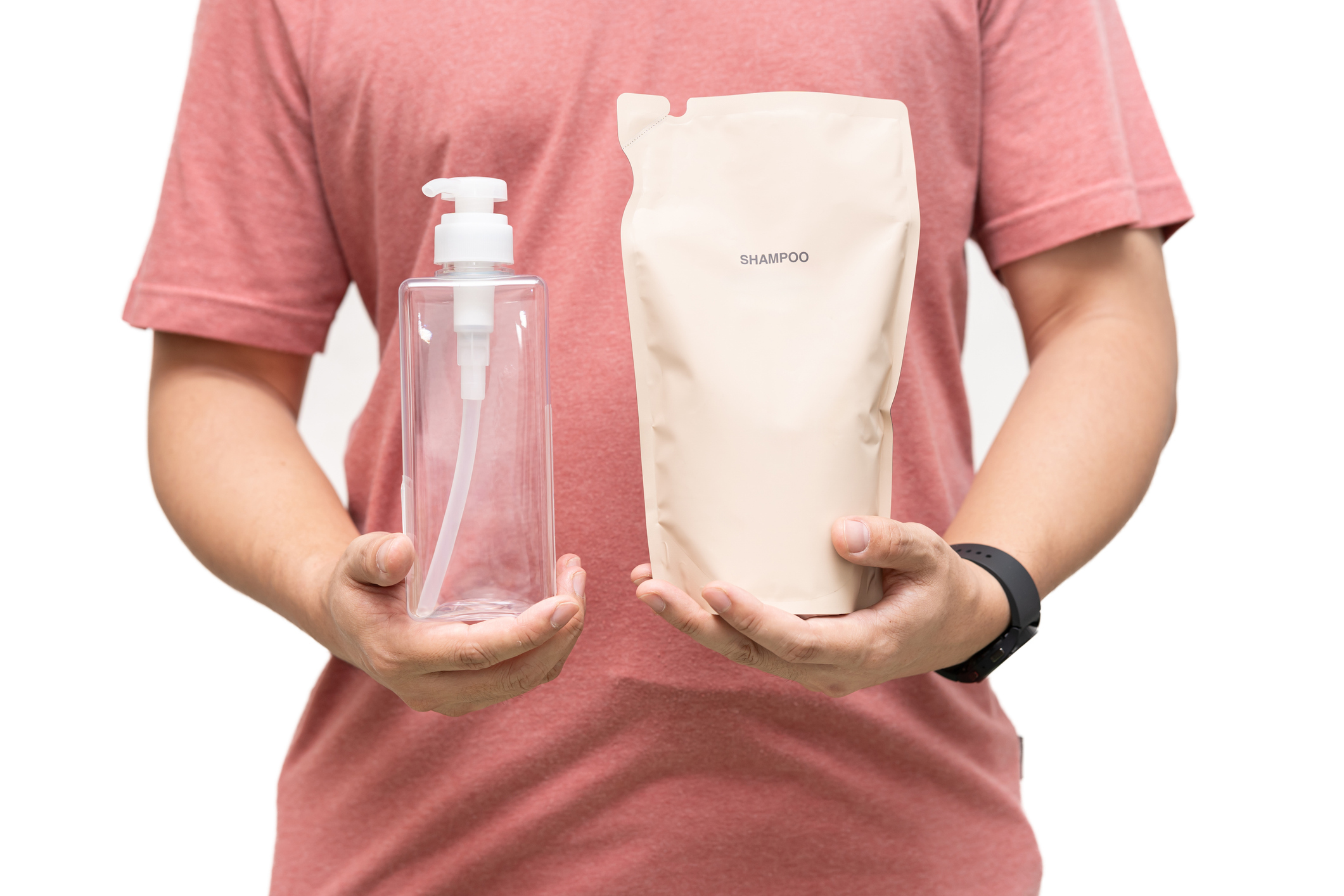

At a Jakarta warung (a small neighborhood shop selling everyday essentials), a household can buy enough detergent, dishwashing liquid, or shampoo for the next few days without committing to a larger pack, finding room to store it, or tying up cash needed elsewhere.
That creates a demanding test for refill brands in Indonesia. A refill offer must compete with low upfront prices, small quantities, familiar products, and the convenience of neighborhood retail. It must also give shoppers confidence that they are getting the same product quality they expect from a sealed pack.
Unilever has tested refill machines, kiosks, and manual points throughout Indonesia. In its 2025 report, Unilever said consumers placed particular value on affordability, convenience, and dosage control during those trials. Those priorities reflect the choices made at the point of purchase: how much money is available, how much product is needed, and whether the refill process feels reliable enough to use again.
Shoppers immediately assess if refill is cheaper, offers flexible amounts, is convenient, and is as reliable as a sealed sachet.
A refill model may draw interest when it comes with a discount or reward. Its value is proven only when shoppers choose it again without a fresh discount or reminder.
To gain traction in Indonesia, refill models must fit existing household budgets and retail habits without adding cost, effort, or uncertainty. And "household budget" is not one thing: how a family manages money depends heavily on where that money comes from.

Refill has to work within the household budget
Small packs give shoppers control over when and how much they spend. NielsenIQ has reported that Indonesian consumers have turned to smaller packs as they manage pressure on household spending.
This regulation varies based on how income is structured. Indonesian families generally rely on three primary earning cycles: daily wages, typical for construction laborers, ride-hailing drivers, marketplace traders, and additional informal workers receiving pay when their day ends; weekly pay, standard across agriculture, plantations, and segments of manufacturing; and monthly compensation, common in formal jobs. According to BPS's Survei Angkatan Kerja Nasional (Sakernas), or the National Labor Force Survey, the informal sector in Indonesia reached 87.7 million individuals, representing roughly 60% of the 147.7 million employed population by February 2026. This reflects an absolute increase in informal labor from the previous year, despite overall employment expansion, maintaining a ratio of nearly six out of ten workers. Consequently, the majority of Indonesian buyers continue to manage their spending based on immediate cash availability rather than on a structured monthly budget.
Monthly income patterns offer less flexibility than they appear. With the average national net wage at just Rp 3.29 million in 2026, most monthly earners see their pay committed to essentials within days. This force-reverts their spending to the same cash-metered, small-quantity habits as daily earners for the rest of the cycle. Daily earners face the tightest constraints, as morning income must immediately cover that day’s meals and transport, leaving no cushion for larger purchases.
Refill pricing has to align with how small-pack purchases are made. A lower unit price may have little appeal when the shopper must spend more cash upfront, pay a deposit for a container, or buy more product than the household needs that week. The savings have to be visible in the amount paid at the counter, not buried in a calculation about cost per gram or milliliter.
Unilever’s Indonesian trials showed how closely refill is judged against the timing and size of an ordinary household purchase. Those findings suggest that consumers were judging refill through ordinary household decisions: whether they could afford the purchase that day, choose the amount they wanted, and complete the transaction without adding time or uncertainty.
For brands, the pricing issue extends beyond whether refill is cheaper than a standard bottle. The offer has to work for the customer who needs a small quantity today, as well as for the customer who can buy in bulk. A refill program that favors only larger purchases, or that assumes a monthly budgeting habit, risks excluding the majority who are paid daily or weekly, for whom sachets remain the more reliable option.
Prices also carry more weight in this setting. Shoppers need to see the full amount they will pay, the quantity they will receive, and any deposit they must recover later — and for a cash-constrained daily earner, that deposit needs to be small enough, or refundable quickly enough, not to compete with the same day's other essential spending.
Refill asks consumers to trust the whole system
Not all refill models ask the same thing of consumers. A sealed refill pouch still gives shoppers many of the signals they expect from packaged goods: a visible brand, a fixed quantity, and a product that has not been opened before purchase. In-store dispensing asks for a different level of trust.
A sachet makes several things clear without requiring the shopper to think about them. The product is branded, the quantity is fixed, and the sealed pack indicates it has not undergone store-level handling. With a dispensed refill, some of that reassurance moves from the pack to the equipment, retailer, and container.
The shopper must be confident that the dispenser is clean, the product is genuine, and the amount received is correct. Confidence is built through visible care. Consumers notice whether the dispensing point looks clean, whether the product is clearly identified, and whether the retailer can explain what happens if something goes wrong.
Indonesia’s rules for refillable cosmetics show how formal that responsibility can become. BPOM requirements introduced in 2023 include product information such as the batch number, expiry date, notification number, refill date, and the identity of the refill facility. These requirements recognize that a refill purchase needs a visible record of where the product came from and how it entered the consumer’s hands.
That has wider implications for home care and personal care brands testing dispensed refill. The refill station, the retailer, and the container all become part of the branded experience. A familiar logo alone may not carry the same reassurance once the product is dispensed in-store. Brands need to make quality control visible enough that consumers can judge the refill with the same confidence they bring to a sealed pack.
The store determines whether refill can spread
Traditional trade accounted for nearly 70% of Indonesia’s FMCG sales in the second quarter of 2024, according to Worldpanel data. Formats built for large stores or specialist outlets face a practical problem in a market led by neighborhood trade. Household products are often bought alongside food, drinks, and other essentials during short local trips. A model that requires shoppers to travel elsewhere, wait for assistance, or carry a container back later adds effort to a purchase that is usually quick and familiar, and that effort falls hardest on shoppers who are already making several small, cash-based trips a day rather than one planned monthly shop.
Unilever has tested lower-tech refill stations through warungs, waste banks, and other community locations after experimenting with more equipment-heavy formats. The company says its Indonesia network now includes more than 1,000 refill stations, showing how closely the model depends on local retail access.
The challenge lies as much with the retailer as with the consumer. A shopkeeper has to see enough return from a refill to justify the space and attention it requires. In a busy store, even a well-priced product can lose appeal if the process interrupts the pace of ordinary transactions.
This is where consumer testing can miss part of the picture. A shopper may welcome the idea, while the store owner decides the process takes too much space, time, or attention. Brands also need to watch what happens behind the counter. Refill can fail when stock is difficult to manage or when the retailer sees little reason to keep promoting it after launch support fades.
Refill also changes the economics of the wider portfolio. A lower-priced refill can divert volume from bottles and sachets that carry higher margins, while collection, cleaning, and retailer support add costs that do not appear in the shelf price. Brands need to judge the model across the full category, rather than treating refill sales as an isolated sustainability metric.

What Happens After the First Refill
A discount can bring shoppers to a refill station once. The challenge is whether they come back when the offer has gone.
The next purchase depends on a chain of small actions. The container has to be kept, brought back at the right time, and the return point has to be nearby. The process also must feel familiar enough that it does not require another explanation from a store worker. For a daily earner, that chain has to fit into a routine already built around several small purchases a day — not a single planned monthly trip.
Unilever says its community refill stations in Indonesia sold 91,000 liters of product in 2023 and reached more than 6,000 customers. The figures show that local outlets can generate use, but they do not reveal how often customers returned, whether containers remained in circulation, or how much support stores needed to keep the system running.
Launch figures can be deceptive; repeat purchases often falter when containers aren't returned, retailers withdraw support, or consumers find the extra effort outweighs the savings.
Alner, the Indonesian reuse company formerly known as Koinpack, has built its model around collection, cleaning, refilling, and consumer incentives. Its experience reflects the wider challenge: the package has value only when it completes the loop. A return system that works in one neighborhood may struggle in another if collection points, retailer participation, or consumer routines differ.
The most useful measures show up after the first transaction. Brands need to identify where the loop breaks: whether containers disappear, stores stop participating, or customers fail to make a second or third purchase. Those patterns reveal whether the program can continue after the launch offer fades.
The larger lesson lies beyond refill
Indonesia’s refill experiments show that a lower-waste format does not travel equally well across every category. Refillable water gallons offer a familiar comparison in Indonesia, where consumers already understand the exchange process and the reason for returning the container. Home care and personal care products present a different challenge because consumers are being asked to accept a new way of buying familiar brands.
Brands should start with categories where refill fits the way people already buy and use the product. Water gallons offer a familiar model because the container is part of the purchase routine. Personal care and home care products face a higher bar, with consumers likely to expect clearer proof of hygiene, product quality, and consistency.
The first question is whether a category is suitable for refill at all. Brands need to consider how the product is used at home, how often it is replaced, and what consumers expect from the pack itself. In some cases, refill may be appropriate. In others, lighter packaging, concentrated formulas, or another route to reuse may fit the category better.
The Next Test for Packaging Is Everyday Use
Indonesia’s refill market offers an early glimpse of a future where purchasing goes beyond the checkout, requiring consumers to manage containers throughout the product's entire lifecycle.
That will change the standard by which new formats are judged. A refill system will have to work throughout the product's life, from the moment a household chooses a quantity to the point at which the container is returned for reuse. A new container will not solve the problem if the return process fails in the shop or at home.
Indonesia raises the stakes because consumers already have efficient ways to buy what they need when they need it, and this is calibrated, for most households, to a daily or weekly income rhythm rather than a monthly one.
The brands that succeed will build around the way products are actually bought and used. Their formats will have to earn a place in everyday life before they can deliver broader environmental gains.
Want to understand whether refill can become a habit rather than a one-time trial? Kadence helps brands examine the household economics, retail realities, and trust signals that shape repeat behavior.
FAQs
Why are sachets still so important in Indonesia?
Sachets help shoppers manage day-to-day spending. They offer familiar brands in small quantities, require little storage space, and are widely available through warungs and neighborhood stores. With roughly six in ten employed Indonesians (87.7 million people as of February 2026) in informal work and paid daily or weekly rather than monthly (BPS Sakernas, Feb 2026), sachets match the rhythm most households actually get paid in. Any refill model has to match those practical advantages before consumers will change their buying habits.
What would make consumers choose refill over sachets?
The refill option needs to offer a clear benefit at the point of purchase. Shoppers need to see what they will pay, how much product they will receive, and whether the process fits into an ordinary shopping trip. Savings that only appear over time may be less persuasive than an immediate, visible price difference — particularly for shoppers spending against a single day's cash rather than a monthly budget.
Why does trust matter so much in refill models?
A sealed sachet gives consumers a visible signal that the product is genuine and has not been opened. Refill shifts that reassurance to the dispenser, retailer, and container. Consumers need confidence that the product is clean, correctly handled, and consistent with the brand they know.
Can discounts and loyalty rewards make refill a long-term habit?
They can encourage people to try the format, but they do not guarantee repeat use. The more telling measure is whether shoppers return once the promotion has ended and whether retailers continue to support the program without extra launch assistance.
Which product categories are best suited to refill?
Products bought frequently, used in predictable quantities, and already associated with container returns may offer the clearest starting point. The right answer will vary by category. A refill model that works for one product may not suit another if consumers have different expectations around hygiene, convenience, or pack size.