

AI has moved brand trust into the everyday customer experience. A recommendation, alert, chatbot answer, or automated decision now does more than complete a task. It reveals whether the brand understands the moment or is simply acting because it can.
Until recently, innovation was judged by capability: smarter products, faster systems, deeper integrations, and more personalized experiences. Now those promises are judged through the customer experience. Whether it appears as a recommendation, chatbot answer, health alert, banking notification, or loyalty offer, AI now shapes how customers experience a brand in moments that feel personal. It can decide what they see, how quickly a problem is resolved, whether a health signal feels useful or alarming, and whether a tailored offer feels helpful or uncomfortably precise.
Salesforce’s State of the AI Connected Customer shows how narrow that margin has become. Sixty-one percent of customers believe advances in AI make it even more important for companies to be trustworthy, while 64% believe companies are reckless with customer data. The same research found 72% say it is important to know when they are communicating with an AI agent. The message is clear: customers may accept automation, personalization, and faster service, but not if the exchange feels unclear or careless.
AI is becoming part of the commercial relationship
The commercial risk is not that customers reject AI outright. It is that they engage with it once, feel unsure about the motive or outcome, and become less willing to let the brand play a larger role next time.
A customer who doubts how a brand uses data will be less likely to accept personalization when it matters. A client who cannot tell whether they are speaking to a person or an AI agent may leave the interaction feeling misled, even if the issue is resolved. A prospect who receives a recommendation without understanding why may question the motive behind it.
A recent example is Klarna. In 2024, the company said its AI assistant handled two-thirds of customer service chats in its first month and performed work equivalent to 700 full-time agents. Reuters reported Klarna expected the assistant to improve profits by $40 million in 2024. The efficiency case was obvious. The brand lesson is that an AI service cannot be judged solely by cost savings. Once AI becomes the service experience, it has to be clear, fair, and helpful enough to represent the brand.

AI needs to help people make sense of the moment
In categories that touch health, money, family, travel, and the home, people want support they can understand. A fast answer is useful only when it feels right for the situation.
Customers are more likely to trust AI when it explains enough for them to act. A recommendation needs to show why it appeared. A health alert needs to explain what changed, not simply issue a warning. The strongest AI-led moments translate a signal into meaning quickly enough for the person to know what to do next.
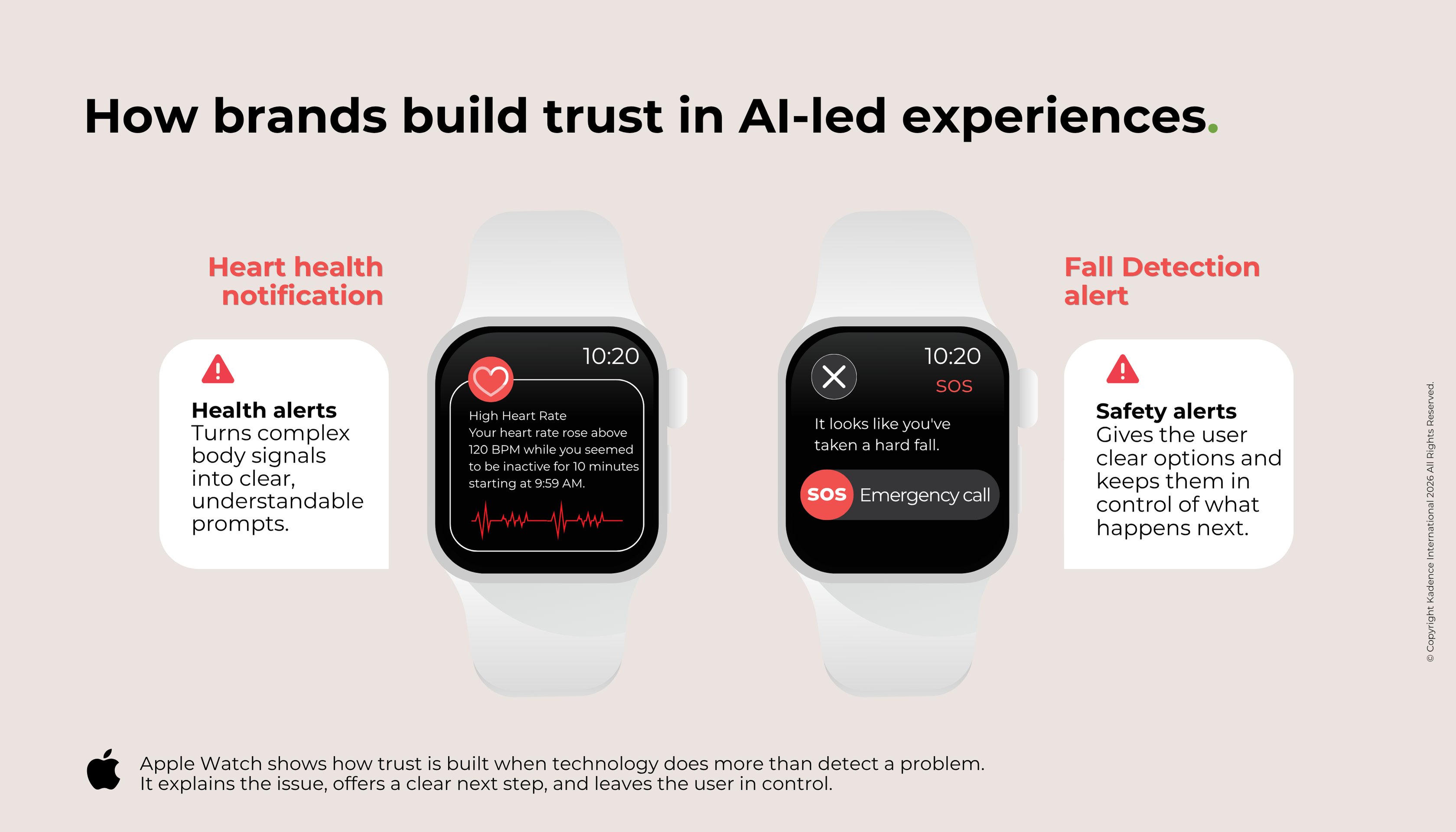
Apple Watch shows how this works when the alert is clear, and the next step is visible. The device can notify users of high or low heart rates and irregular rhythms. Its Fall Detection feature shows the same principle in a higher-stakes moment: when the device detects a hard fall, it alerts the wearer with a tap and an alarm, then displays an option to contact emergency services or dismiss the alert by confirming, “I’m OK.”
The real competition is life impact
The same standard applies beyond health. AI earns a place in the customer relationship when it solves a problem people already recognize.
Bank of America’s AI assistant Erica shows how this works at scale. In April 2024, the company said Erica had handled more than 2 billion interactions since launch, helping more than 42 million clients with account questions, personalized insights, financial guidance, payments, transfers, trading, and investment tracking.
Banking brands often compete on reassurance, guidance, and ease. Erica makes those claims tangible inside the product experience, from account details and card management to recurring-charge monitoring, refund tracking, and specialist connection.
This does not mean every brand needs a virtual assistant. It shows why AI has to be tied to a problem the brand is already expected to solve. Otherwise, it becomes another feature competing for attention.
The question for any AI investment should be direct: what customer problem does this solve often enough to change behavior? If the answer is clear, AI earns a place in the habit. If the answer is vague, it becomes another feature customers try once and forget.
Personalization is judged by what it suggests about the customer
Spotify and Netflix helped make personalization feel ordinary because the benefits were obvious and the risks were low.
Personalization can move beyond past clicks, purchases, or viewing habits. It can infer mood, intent, life stage, urgency, income, health interests, family needs, and likely next purchase. Consumers are not only judging whether the recommendation is relevant. They are judging what the brand must have assumed to make it.
The same data logic can feel helpful or invasive depending on the context. A grocery offer for school snacks in August may feel timely, while targeting that follows a search about children’s health, fertility, dieting, debt, or anxiety can feel far too personal. A travel site that remembers a preferred hotel style can reduce effort, but repeated urgency messages after several searches may make the customer wonder whether the brand is reading intent or exploiting vulnerability. In banking, a recurring-subscription alert may feel useful, while a credit offer triggered by a shift in spending can make the customer feel exposed.
That changes how personalization has to be written and delivered. A message can be technically relevant and still feel wrong if the timing, channel, category, or tone makes the customer feel judged. Entertainment can be highly tailored because the stakes are low and the benefit is immediate. Finance, health, insurance, parenting, and travel require more restraint because the brand may be touching a private worry, a major expense, or a sensitive life moment. A health brand, for example, may choose to show general sleep-support content after someone browses related products, rather than serving a pointed message that suggests stress, menopause, fertility concerns, or a specific condition. The discipline is knowing when precision helps and when restraint protects the relationship.
Proactive AI needs better judgment
Samsung’s partnership with Instacart shows the appeal of proactive AI when the intervention is tied to a familiar, low-risk household problem. Samsung’s AI Vision Inside technology can recognize certain food items as they are placed in or removed from the fridge, update shopping lists, and suggest low-stock groceries that can be ordered through Instacart. The value lies in addressing a practical question: what is missing, what is running low, and what needs to be replaced.
Other moments require a higher threshold. A weather delay, a low-stock item, or a possible fraud alert provides an obvious reason to interrupt. A softer behavioral signal, especially one tied to anxiety, money, or health, may not. The practical challenge is deciding which signals deserve action, which deserve a softer message, and which should be left alone. Predicted intent is not enough; category, likely state of mind, cost of error, and seriousness of the moment all matter. The higher the emotional or financial stakes, the stronger the reason for intervention needs to be.

AI needs a stop rule
A chatbot can handle delivery updates, reset passwords, summarize a policy, or point someone to the right form. The same interface can cause harm when it gives a confident answer on a refund, claim, health concern, financial decision, or travel problem, even when the customer has no reason to doubt it.
Air Canada’s chatbot case shows why the limit matters. In 2024, the British Columbia Civil Resolution Tribunal found Air Canada liable after its chatbot gave a customer incorrect information about bereavement fare refunds. The airline argued the chatbot was responsible for its own response, but the tribunal found Air Canada remained responsible for information provided on its website, whether it came from a static page or an interactive tool.
AI needs a clearly defined role before it becomes the first answer a customer receives. If the system is reliable for simple account questions, delivery updates, or basic policy lookup, that role should be clear. If the answer affects money, eligibility, safety, health, travel disruption, or a formal decision, the system should know when to stop, escalate, or point to a verified source.
A well-designed AI service should know when a routine issue has become something else. Delivery updates, password resets, and basic policy questions can move quickly through automation. A disputed charge, delayed refund, missed flight, rejected claim, or health concern needs a clear route to human judgment.
A delivery window, store location, product availability, return status, or loyalty balance carries little risk. A rejected insurance claim, fraud review, health recommendation, credit decision, refund denial, or account restriction does not. In those moments, speed is not enough. The customer needs evidence that the decision was considered carefully and can be challenged.
AI trust needs measures that capture real impact
AI performance dashboards can make a weak experience look successful. Adoption, engagement, conversion, satisfaction, and resolution time can indicate whether the system is functioning properly. They do not show whether the experience changed what the customer will do next.
The better measurement question is whether AI changes future behavior. Do customers return to the tool voluntarily? Do they share better data over time? Do they accept recommendations in higher-stakes moments? Do they escalate less because the answer was clearer?
Market research needs to show how people interpret AI in the moments where the brand is asking for trust. That means testing the language of recommendations, the point at which human help is offered, the service areas where automation feels acceptable, and the moments where customers expect more care.
Brands that manage AI well will not rely only on system dashboards. They will measure whether AI improves the behaviors the brand depends on: repeat use, better data sharing, fewer avoidable escalations, greater confidence in recommendations, and stronger returns after a service issue.
Trust will come from AI that makes a decision clearer, a service moment less stressful, or a high-stakes interaction safer to navigate. That is the standard brands now have to meet.
To understand where AI strengthens trust and where it creates risk, brands need to see how customers respond to AI-led interactions in real moments. Kadence helps brands identify what customers need, accept, and trust, so AI investments are grounded in evidence rather than assumptions.
FAQs
How is AI changing brand trust?
AI is changing brand trust by moving more brand interactions into automated recommendations, alerts, chatbots, service journeys, and personalized experiences. Customers now judge whether those interactions feel useful, clear, fair, and worth relying on.
Why does AI trust matter for brands?
AI trust matters because it affects whether customers share data, accept personalization, use self-service tools, believe recommendations, return after a service issue, and stay loyal to the brand.
What makes consumers trust AI-enabled experiences?
Consumers are more likely to trust AI-enabled experiences when they solve a real problem, explain enough for the customer to act, avoid overreaching in sensitive moments, and offer a clear path when automation is not enough.
How should brands measure AI trust?
Brands should measure AI trust beyond usage and efficiency. Stronger measures include repeat use, willingness to share data, confidence in recommendations, lower avoidable escalation, and stronger return after a service issue.
What is the biggest risk of using AI in customer experience?
The biggest risk is using AI to move faster without considering whether the experience still feels fair, clear, and appropriate. Poorly timed personalization, overconfident chatbot answers, or fully automated decisions in high-stakes moments can weaken trust.