

The wristwatch should have faded once the smartphone became the screen people check first.
Yet our latest study on wristwatch habits in Japan shows that the category still has a place in daily life. Among Japanese consumers ages 20 to 69, nearly two-thirds own a wristwatch or smartwatch, and almost half wear one regularly.
The finding is striking because Japan is a highly connected market with deep mobile habits. Japan had 109 million internet users at the start of 2025, with nearly 9 in 10 people online, according to DataReportal’s Digital 2025 Japan report. A watch no longer needs to be the main way people tell time.
Its continued use suggests something more durable: consumers still give the wrist a role when it feels faster, easier, more familiar, or more personally meaningful than reaching for a phone.
That role changes by generation. Older consumers are more likely to use a watch as a reliable everyday tool. Younger consumers show more interest in smartwatches, especially where the device connects to notifications and health tracking.
Japan’s wristwatch behavior shows that the next phase of wearable growth will not come from adding more features alone, but from identifying the moments when consumers are willing to use a device because it saves effort, builds confidence, or carries personal meaning. Traditional watches endure for a related reason: they keep emotional and practical value.
Japan’s wristwatch market is fragmenting by age
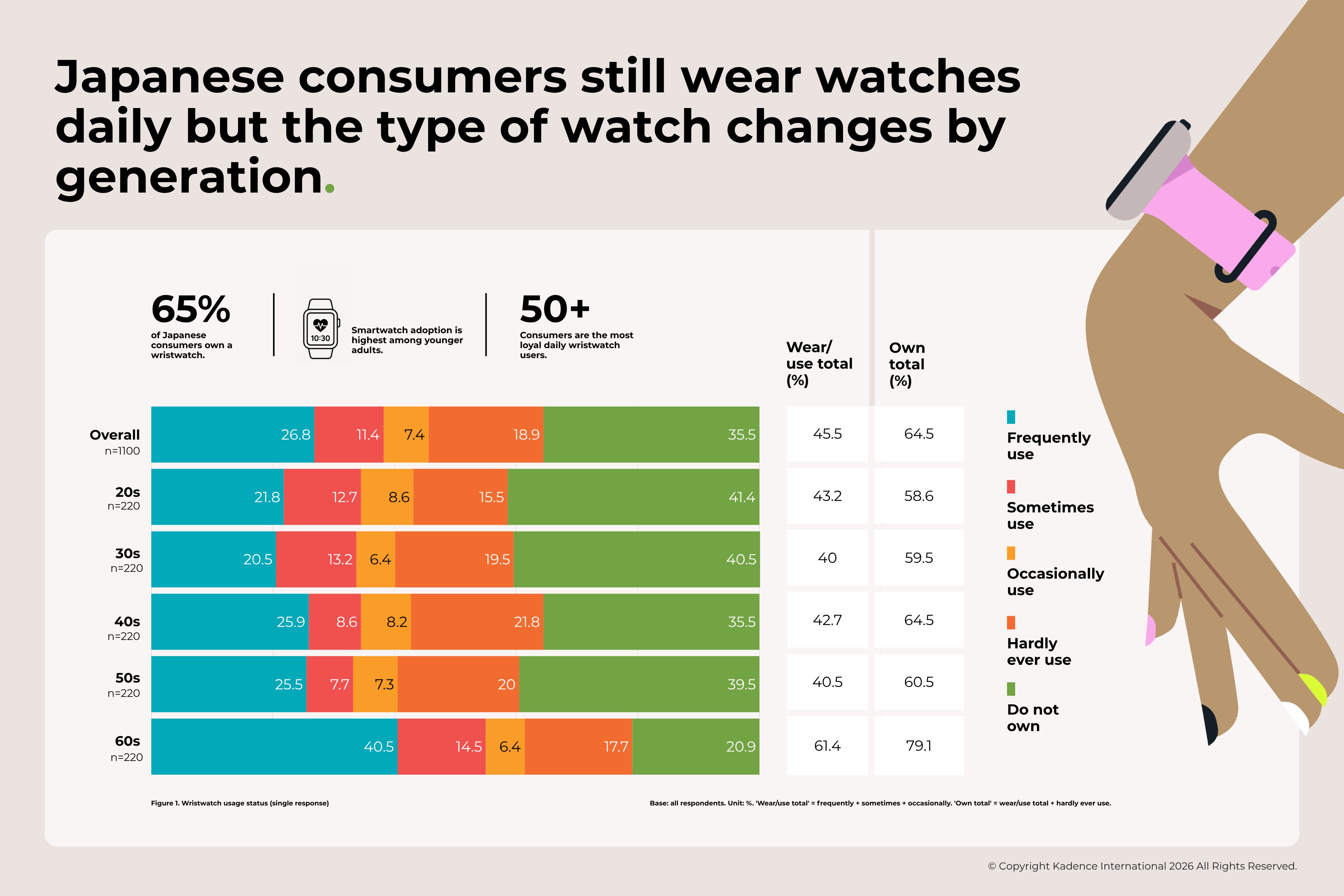
The strongest pattern in the study is generational. Wristwatch use rises with age, while non-ownership is more common among younger adults. Among people in their 60s, regular use reaches about 6 in 10. Among people in their 20s and 30s, about 4 in 10 do not own a wristwatch or smartwatch.
Older consumers appear to have a settled relationship with the wristwatch. It remains part of the daily routine because it is familiar and easy to use without having to pull out a phone.
Younger consumers show a more conditional relationship. The smartphone already handles most everyday tasks, so a watch needs a clearer use case.
For marketers, the more useful segmentation is behavioral: consumers who wear out of habit, consumers who wear for utility, and consumers who need a stronger reason to wear anything at all.
Analog still carries the category
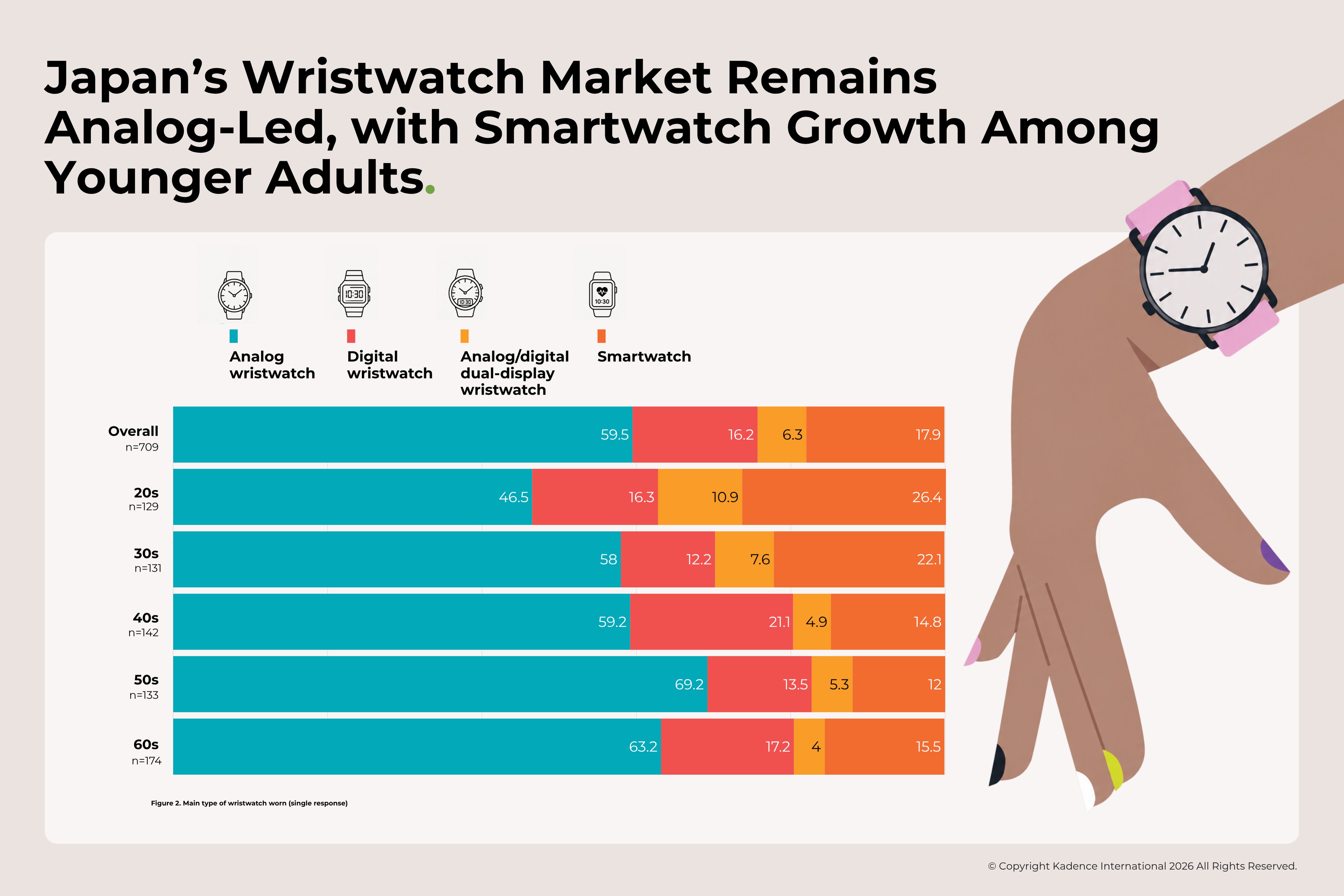
Analog watches remain the main format among regular watch users in Japan. The study finds that about 6 in 10 mainly wear an analog wristwatch, compared with nearly 1 in 5 who mainly wear a smartwatch. Analog is especially strong among older consumers, accounting for 70% of the main watches worn by those in their 50s and 63% among those in their 60s.
For many consumers, the appeal is straightforward. An analog watch is familiar, reliable, and easy to understand. It asks little of the wearer and fits into established routines.
Brands building around the wrist in Japan need to account for both behaviors. Digital features create new reasons to wear a watch. Analog watches keep their place through familiarity, reliability, and personal meaning. For luxury and premium watch brands, that emotional role matters: the product is not competing only on function, but on identity, taste, and the meaning attached to wearing it.
This has implications for brand positioning. Analog watches should not be treated as the past. For many consumers, they are still the benchmark for ease, reliability, and emotional value.

The reason for wearing a watch changes by generation
The primary reason for wearing a wristwatch in Japan remains practicality. About 4 in 10 say they wear one to quickly check the time. Among consumers in their 60s, that reason rises to around 6 in 10, making the watch a simple daily tool for fast access to time.
Among people in their 20s, smartphone notifications, health management, and exercise tracking appear more often as reasons for wearing a watch. The device becomes part of how they manage the day, beyond checking the time.
A watch worn by a 60-year-old and a smartwatch worn by a 25-year-old may sit in the same place on the body, but they answer different needs. One is anchored in ease and routine. The other is more closely tied to the phone and the personal data around it.
Smartwatch pricing reveals two different entry points in Japan
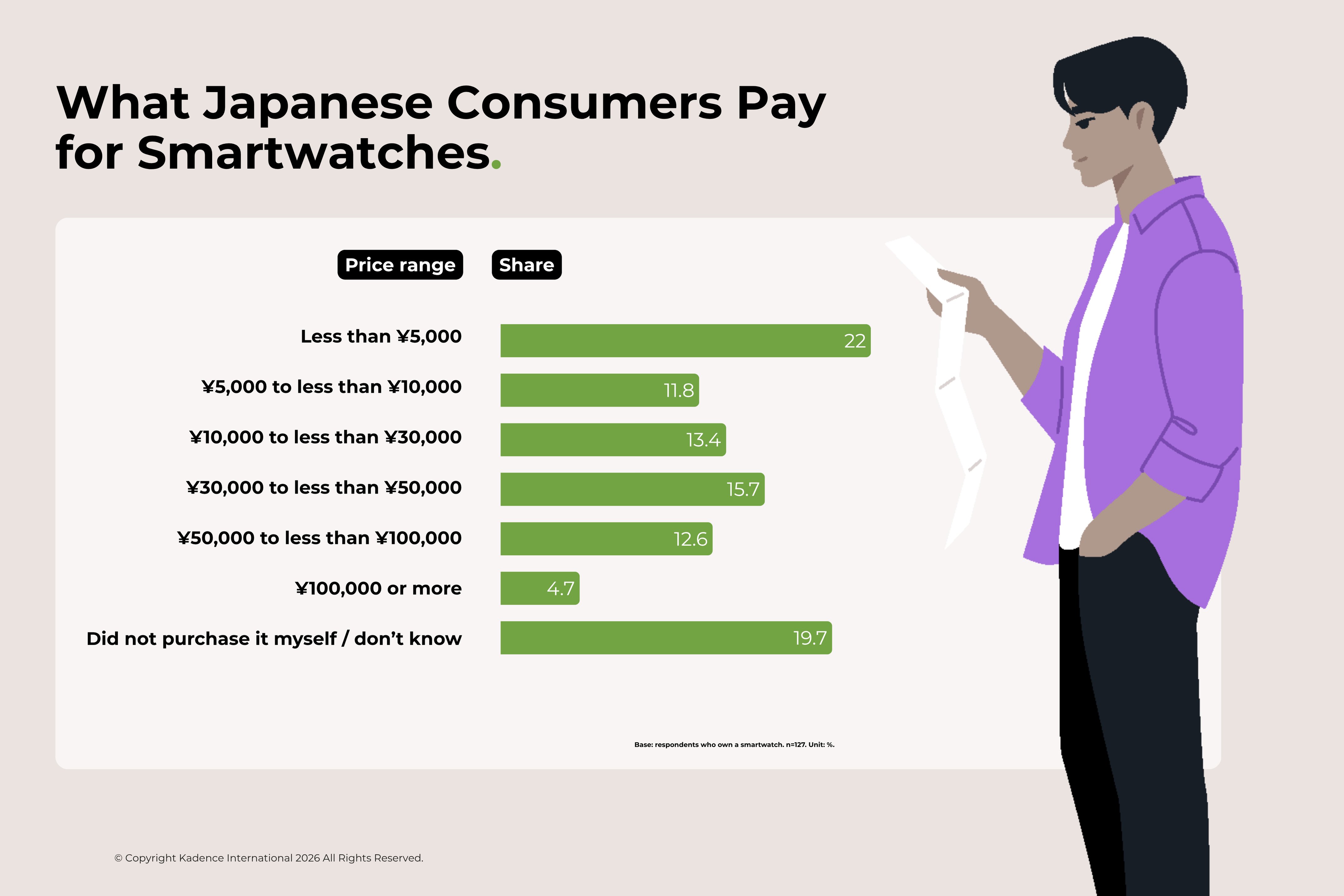
Smartwatch pricing in the study indicates varying levels of consumer confidence. The most common purchase range is under ¥5,000, (about US$31), chosen by just over 1 in 5 respondents who had purchased a smartwatch. The next-highest range is ¥30,000 to under ¥50,000, (about US$185 to under US$309), accounting for about 16%
With Japan’s wearable market projected at nearly $5 billion in 2025, growth will depend on whether devices fit into routines consumers already value.
The lower range suggests experimentation. Some consumers may want to see whether a smartwatch fits their life before paying for a more advanced device.
The higher range points to a more committed buyer, as these consumers already see enough value in the category to invest.
Wearable brands in Japan need to account for both behaviors. Entry-level devices can bring consumers into the category, but the next step has to feel worth the additional cost. Once the consumer moves beyond trial, the decision becomes less about curiosity and more about confidence.
Pricing should therefore reflect the stage of adoption. Low-cost devices can reduce the risk of trial, while premium devices need to prove why they deserve daily use, not just why they have better specifications.
In Japan, the smartwatch has to fit the routine
Smartwatch use becomes more compelling when it fits into routines people already repeat. In Japan, Apple Watch users can add Suica, PASMO, ICOCA, or TOICA cards to Apple Wallet and use them for public transit and store purchases, according to Apple’s Japan transit card guidance. The device saves effort at moments when speed and ease matter.
Adoption becomes easier when the device removes friction from a behavior people already have, rather than asking them to create a new one.
Younger Japanese consumers show where smartwatches can gain ground
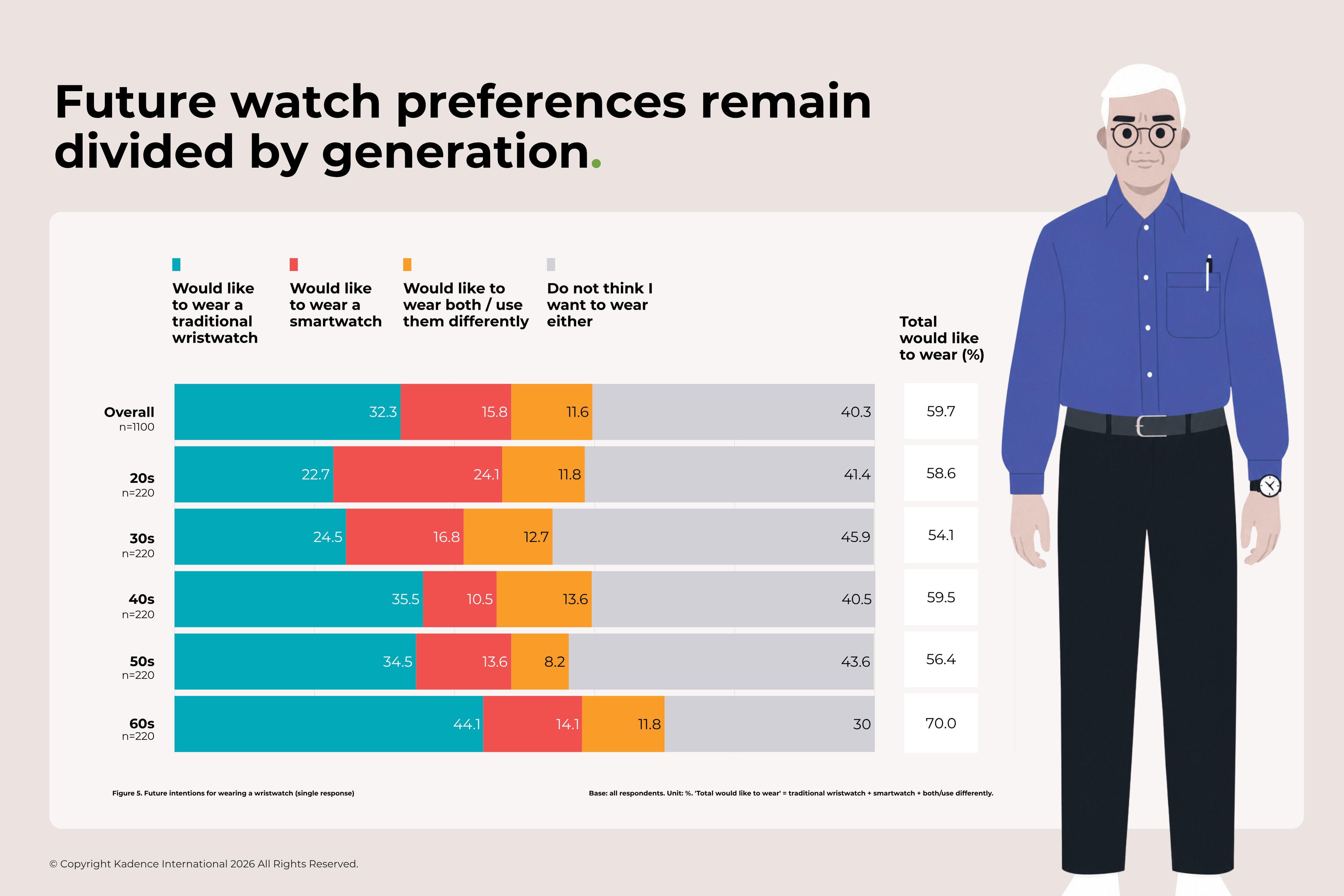
The study’s future intention data is strongest among younger adults. Overall, about 6 in 10 respondents say they want to continue wearing some form of wristwatch, while roughly 1 in 3 specifically want to wear a traditional wristwatch. Among people in their 20s, about 1 in 4 say they want to wear a smartwatch in the future, a higher share than in any other age group.
The opportunity will depend on whether the device supports routines they already value, from quick notifications to health tracking.
What Japan’s wristwatch behavior means for brands
Japan’s wristwatch habits show how easily personal devices can be misread. The value of the wrist depends on the role it plays in someone’s day.
Wearable adoption in Japan appears to depend on three forms of permission. The first is practical permission: does the device make a repeated task easier? The second is emotional permission: does it feel personal, familiar, or worth being seen with? The third is data permission: does the consumer trust the device enough to share health, payment, or behavioral information? Brands need all three, but the balance changes by category and age group.
A wearable health feature will mean little if the user does not trust the data or understand what action to take from it. Health data is more sensitive than a notification or a payment tap. If the wrist becomes a health interface, clarity around accuracy, privacy, and action will matter as much as the feature itself.
Age-based targeting can only go so far. The sharper question is why someone gives the wrist permission to sit close to the body and hold personal data. Brands that answer that question will be better placed to design products people keep using after the novelty fades.
For brands, the lesson is not simply whether consumers prefer analog watches or smartwatches. It is the amount of value a device must create before people allow it into their daily routine. Product teams need to know which moments justify wrist-based interaction. Marketing teams need to understand which benefits are credible enough to change behavior. Retail and pricing teams need to distinguish between trial buyers and committed users.
The implication is different by brand type. Consumer electronics brands need to prove sustained usefulness. Health and wellness brands need to make data understandable and actionable. Payment and mobility brands need to make wrist-based access faster than using a phone. Fashion and premium brands need to protect the emotional value that makes the object worth wearing. The same wrist can serve each of these roles, but not for the same reason.
The same logic applies beyond watches, from smart rings to other body-adjacent devices: the closer technology sits to the body, the more clearly it has to justify its place.

Why the wrist still matters in Japan
The next phase of the wrist in Japan will be shaped by trust.
A phone can carry almost every function, but it does not have the same relationship with the body. The wrist is more visible, more intimate, and harder to ignore. Consumers will only give that space to devices and brands that feel genuinely useful.
Japan gives that shift a distinct shape, with nearly 3 in 10 people aged 65 and older, creating long-term demand for health tools that feel clear and reassuring. The country’s commuting culture gives wrist-based payments a practical role in repeated daily moments. Its analog watch culture shows how personal objects can keep value even after their original function becomes less essential.
As devices move closer to the body, the consumer decision becomes more selective. The wrist is becoming a permission space for health signals, payment access, and daily prompts.
The commercial challenge is not only getting consumers to buy a wearable. It is getting them to keep wearing it. Trial can be driven by novelty, discounts, or health curiosity. Retention depends on whether the device becomes part of a repeated behavior. That is where many connected products succeed or fail.
Japan’s wristwatch habits show that proximity raises the standard for brands. The closer a device sits to the body, the more it has to earn trust, usefulness, and meaning. That is the real lesson for the future of wearables.
Kadence helps brands uncover what drives consumer confidence in health, fitness, retail, and technology. Download our latest report, Feeling Good: Powering the Next Gen of Fitness and MedTech, or get in touch to explore how research can sharpen your wearable, health, retail, or technology strategy.
FAQs
What does the Japan Wristwatch Survey 2026 reveal about wearable adoption?
The survey shows that wristwatches still hold a meaningful place in Japan, even in a highly connected market. Nearly two-thirds of consumers ages 20 to 69 own a wristwatch or smartwatch, and almost half wear one regularly. The findings suggest that wearables succeed when they fit into daily routines and solve repeated needs.
Why do Japanese consumers still wear wristwatches?
According to our survey, the top reason is still practical: many consumers wear a wristwatch to quickly check the time. Older consumers are more likely to see the watch as a familiar daily tool, while younger consumers show more interest in smartwatches for notifications, health management, and exercise tracking.
What can wearable brands learn from Japan’s wristwatch habits?
Wearable brands need to earn space on the body by creating practical, emotional, and data-related value. Devices must make repeated tasks easier, feel personally meaningful, and build trust when handling health, payment, or behavioral data. The challenge is not only getting consumers to buy a wearable, but getting them to keep wearing it.