
Valentine’s Day in Japan has never been a straightforward import. It was shaped by postwar confectionery marketing, formalized through workplace customs, and sustained for decades by a social logic that tied gifting to obligation as much as affection.
Today, modern Japanese consumers spend much differently.
Unlike Western markets, Valentine’s Day in Japan traditionally placed the burden of giving on women, with chocolate serving as both currency and signal — romantic for partners, obligatory for colleagues, and transactional in the workplace.
Known as giri choco, this obligation-driven gifting once required women to give chocolate to male colleagues and acquaintances as a matter of workplace etiquette. Over time, the practice has steadily declined, increasingly criticised as an unnecessary financial burden and, in some cases, as socially coercive rather than celebratory.
White Day, observed a month later, traditionally marked the return gift from men to women who gave chocolate on Valentine’s Day.
The system worked because it was predictable.
Our latest study shows that predictability no longer holds. Six in ten Japanese consumers say they don’t plan to give a Valentine’s gift this year. Participation hasn’t fallen abruptly. Instead, it has thinned steadily over time, suggesting consumers are stepping back rather than revolting.
Valentine’s Day participation in Japan is thinning, not because the holiday has lost relevance, but because the spending it requires has become harder to justify.
.png?width=2400&height=1920&name=Fig1_Gift_Plan%20(1).png)
Gifting during Valentine’s Day in 2026 closely mirrors levels seen in 2023, despite inflation, cocoa supply pressures, and growing discussions about alternative chocolates. The issue is not awareness, but willingness.
Valentine’s Day hasn’t become unpopular; it has just become optional.
Across Japan’s seasonal consumption calendar, this pattern is familiar. Ritualized occasions that once relied on social pressure increasingly depend on personal relevance. People engage when the moment feels appropriate, but step back when it doesn’t.
The role of White Day has narrowed. With fewer people initiating exchanges on Valentine’s Day, fewer returns are required at all. The loop tightens naturally, not because the tradition has disappeared, but because the motivation to reciprocate happens less often.
And once an obligation loses authority, everything downstream begins to shift.

Why Chocolate Still Dominates Valentine’s Day Gifting in Japan
If participation is narrowing, the next question is what happens inside the group that still opts in.
We found the answer is not radical.
Chocolate remains the most common Valentine’s gift among Japanese consumers, across both men and women. That hasn’t changed. What has changed is how narrowly chocolate is now framed, less as an expression, more as a safeguard.
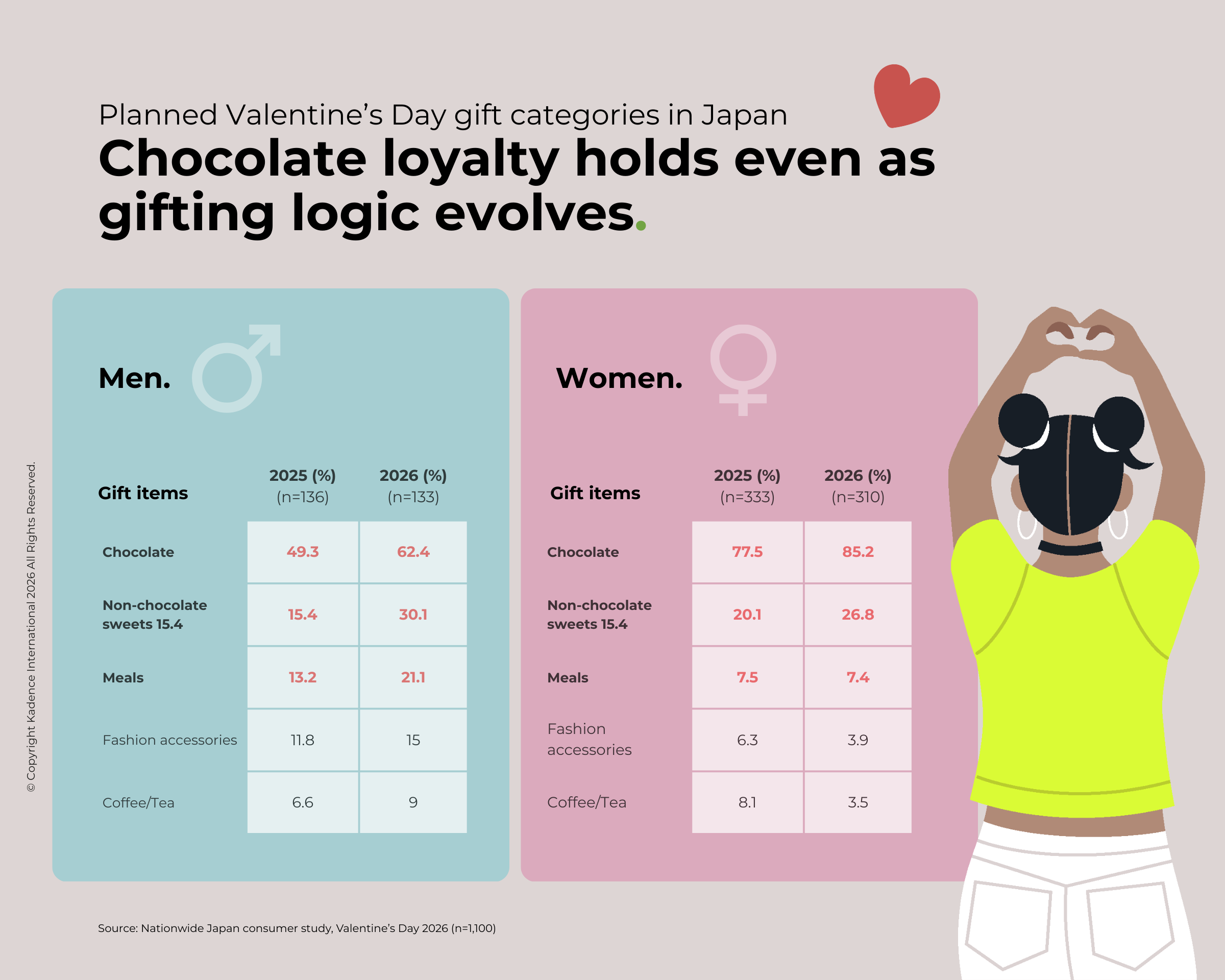
Chocolate continues to rank first, followed by non-chocolate sweets and meals. Compared with last year, participants' intent to give both chocolate and non-chocolate sweets has risen slightly, even as total participation remains flat.
That combination tells its own story.
Fewer people are giving gifts. Those who do prefer to stick with familiar categories that minimize risk. Chocolate is a popular choice because it offers a sense of reassurance.
Dining out, which carries greater emotional and logistical commitment, remains secondary. Accessories and lifestyle items trail further behind, particularly among women. Men show slightly more openness to non-chocolate sweets, but the shift is incremental rather than disruptive.
What emerges is consolidation: when people opt in, they avoid ambiguity.
And that preference shapes how much they are willing to spend.
Spending Has a Ceiling, and Most Japanese Consumers Stay Below It
Once Japanese consumers decide to participate in Valantines Day, spending becomes the main constraint. It’s not about intent or sentiment; it’s all about the price.
Among those planning to give chocolate this Valentine’s Day, most budgets are below ¥2,000 (about $13–15). For obligation gifts, the ceiling drops sharply. More than six in ten keep those purchases under ¥1,000 (roughly $6–7).
.png?width=2400&height=1920&name=Fig3_Chocolate_Budget%20(1).png)
Gifts for partners or spouses span a wider range, but even there the centre of gravity remains modest, typically between ¥1,000 and ¥2,000. Self-purchases tend to be concentrated at the lower end of the spectrum, while obligated gifts are positioned even lower.
People aren’t trading down but setting limits upfront and staying inside them. Valentine’s Day gifting has become something to manage rather than indulge in, particularly when the gift carries symbolic rather than emotional weight.
Rising cocoa prices haven’t changed what people give. They’ve changed how carefully people give it. Chocolate remains acceptable, expected, and legible, but only within a narrow band. Once that band is crossed, participation falls away.
This has consequences for innovation.
When budgets are fixed, the focus shifts from premium cues to value, appearance, and social safety, which become more important.
Curiosity Is Rising, Commitment Is Not
Higher prices and tighter budgets have made alternative chocolate more popular. People are becoming more aware of it. Trying samples seems acceptable, and there is interest in it. However, our study shows how commitment doesn’t match the intent.
.png?width=2400&height=1920&name=Fig4_Alt_Chocolate_Image%20(1).png)
Nearly half of Japanese consumers say they are not particularly interested in alternative chocolate. At the same time, around half express some level of curiosity, such as wanting to taste it, trying it once, or being comfortable receiving it as a gift.
Those positions coexist.
People avoid committing to the category. Curiosity is only at the surface level, and purchase intent remains thin. Fewer than one in ten say they actively plan to buy alternative chocolate, even when health or sustainability benefits are highlighted.
The strongest signals of interest are low-risk behaviors: tasting, sampling, receiving rather than choosing.
This explains why conversion remains difficult. Alternative chocolate isn’t being judged purely on taste or ethics. It’s being evaluated against social expectations. Valentine’s Day is a public moment, gifts are read, and the wrong choice creates friction.
So people wait.
Valentine’s Day Feels Different Now
How people talk about Valentine’s Day has changed.
When asked to describe how the day feels, indifference was dominant among Japanese consumers. “Not interested” ranked highest, alongside quieter associations, spending time with family, enjoying the process of choosing sweets, and buying something for oneself.
.png?width=2400&height=1920&name=Fig5_Feeling_Top10%20(1).png)
Valentine’s Day no longer carries a singular emotional role. It sits alongside other seasonal moments, acknowledged if convenient, ignored if not. Romance remains present, but it no longer defines the occasion. And obligation has receded even further.
Enjoyment hasn’t disappeared. It has just shifted shape. For many, pleasure now lies in the act of choosing rather than the exchange itself. Women, in particular, describe Valentine’s Day as a moment of self-directed enjoyment, where the process matters as much as the outcome.
That shift changes how the occasion functions in the market.
When given a choice, people look past the fluff. They want exactness, not just showing up. What's familiar is better than what's new, and trustworthiness is more important than hype.
A Market Example: How Chocolate Brands Are Responding
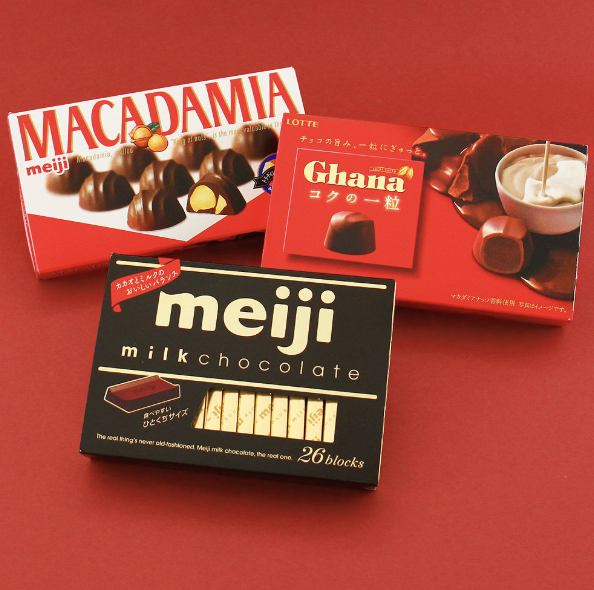
Image Credit- ShopTilt Ltd
This shift is already visible in how major chocolate brands operate in Japan.
Meiji, one of the country’s largest confectionery manufacturers, has responded to sustained cocoa price pressure not by pushing premiumization, but by adjusting pack sizes, formats, and price points to stay within familiar spending thresholds. In 2023 and 2024, Meiji publicly acknowledged rising cocoa costs and implemented selective price increases alongside quantity adjustments, aiming to preserve accessibility rather than reposition chocolate as a luxury item.
The strategy reflects exactly what the data shows: participation depends on predictability. When prices drift too far from expectation, people don’t trade up — they step away. Chocolate still sells when it feels safe.

What Japan’s Changing Valentine’s Day Means for Market Strategy
Valentine’s Day in Japan no longer rewards scale or repetition. Participation is narrower, expectations are tighter, and misjudgments surface quickly. What works now is not louder execution, but better alignment with how people decide whether to participate at all.
That alignment doesn’t come from instinct. It comes from understanding when rituals loosen, where obligation gives way to choice, and how decision rules shift before behavior fully settles. Surface-level data can’t capture that. It requires market research grounded in cultural context, local nuance, and real consumer evidence.
With deep roots in Japan and teams on the ground, Kadence helps organizations read these shifts early, translating changing consumer intent into decisions that feel proportionate, credible, and well-timed. If you want to understand how seasonal behaviors are evolving in Japan — and what that means for your category — our team can help.