
Filipino consumers are not necessarily spending less. They are spending differently, and many of the metrics brands rely on are failing to capture where demand is actually moving.
While the Philippines' economy grew 2.8% in the first quarter of 2026, performance came in below expectations as the Middle East crisis and delayed budget passage weighed on growth. Household consumption has also softened compared to previous years. In response to global uncertainty, the government has lowered its medium-term growth forecast, while inflation has re-emerged as a more immediate pressure point.
In April 2026, headline inflation rose to 7.2%, up sharply from 4.1% in March, according to the Philippine Statistics Authority. The increase was not limited to fuel. Transport inflation accelerated to 21.4%, while food and non-alcoholic beverages rose 6.0%, and housing, water, electricity, gas, and other fuels rose 8.2%. For brands, the fuel-linked price shock matters because it is working its way through household budgets in multiple ways, raising the cost of mobility, cooking, delivery, logistics, and daily essentials.
These macroeconomic trends only partially explain consumer behavior. Deeper behavioral data reveals a clear shift in household response: a significant number of consumers are prioritizing value brands, purchasing in bulk, and restricting spending to necessary goods. This is changing where consumers spend, which pack sizes they choose, and when they make purchases.
More than 70% of Filipino consumers are now limiting purchases to essential items, which has direct implications for how demand is distributed across categories.
This is consistent with broader regional performance, where FMCG growth in Southeast Asia remains positive despite inflation, driven by mix shifts rather than volume expansion.
Inflation is no longer sitting comfortably within the central bank’s 2% to 4% target range, and price pressure is not being felt evenly. Fuel-linked costs are feeding into transport, food, utilities, and daily household routines, creating a clear pattern: spending on essentials remains protected, while discretionary purchases are becoming less consistent. Spending is not disappearing evenly across the market. It is concentrating around categories, formats, and channels that feel safer and easier to justify.

Price sensitivity is restructuring how spending decisions are made
Filipino households are becoming more deliberate about which purchases deserve space in the budget. The April inflation spike makes this behavior even more urgent, as fuel-linked costs affect far more than transport. They raise the effective cost of getting to stores, moving goods through supply chains, preparing meals, and managing daily household routines.
Essentials are covered first, with the remaining budget allocated across categories based on how long products are expected to last and how urgently they are needed. This shifts decision-making from individual purchases to total basket management, where categories compete for allocation before consumers enter a store or platform.
Across Southeast Asia, NielsenIQ data reveals that value growth is concentrated in larger pack formats and multi-buy promotions, suggesting consumers are focused on extending usage cycles. This behavior is mirrored in the Philippines, where the growth of bulk and family-sized packs for staple items, such as rice and cooking oil, is on the rise.
Price is assessed based on total cost over time rather than the purchase price. Products that reduce replenishment frequency or extend usage are prioritized even at higher upfront prices. World Bank analysis of emerging markets supports this pattern, showing that households under inflationary pressure favor purchases that stabilize future expenditure. For example, Filipino households are not behaving consistently across categories. The same consumers move between bulk purchasing and sachet buying, balancing long-term savings with immediate cash constraints. This is making traditional indicators harder to interpret because spending behavior now changes by category, channel, timing, and pack format.
As a result, the point of decision moves earlier in the purchase cycle, where products that don't match planned usage are more likely to be deferred or substituted.
Competition is increasingly being shaped by portfolio design rather than headline pricing alone. Brands that fail to align pack sizes, pricing, and channel strategy with real purchasing behavior are often excluded before consumers even enter the store.
Where Filipino consumers are pulling back, and where they are holding ground
Category performance is diverging in ways not reflected in topline metrics. Total household spending continues to grow in nominal terms, reaching record levels in 2025, while projections indicate slower growth ahead. These signals coexist, making category-level interpretation critical.
Essential categories continue to anchor spending, supported by consistent purchase cycles and limited substitutability. Discretionary categories show greater variability, with reduced frequency and increased substitution shaping performance.
Retail dynamics reflect this split. Sari-sari stores, small neighborhood convenience shops common across the Philippines, recorded around 5% sales growth in 2024, driven by their role in providing affordable, small-format access to essential goods. In contrast, categories dependent on discretionary engagement are more exposed to adjustment.
Growth and decline are now happening inside the same categories. Some formats and channels continue gaining momentum while others weaken, making topline category performance harder to interpret.
How Filipino households are adjusting their spending through channels and pack formats
Price sensitivity is being executed through how purchases are structured. The Philippines operates a highly developed small-pack system, where low-unit formats allow purchases to align with daily cash availability. This structure enables continued participation in branded categories without requiring higher upfront spend.
Traditional retail remains central to this system. Sari-sari stores provide proximity, flexible pricing, and small-quantity purchasing, enabling daily consumption across income segments. Industry data shows continued growth in these channels, reinforcing their role in managing short-term spending.
Modern trade and e-commerce serve a different function. Bulk packs, bundled offers, and multi-buy promotions help households optimize the cost per unit. Consumers move between these channels depending on whether immediacy or value is the priority.
Case Study: Unilever and sachet economics in the Philippines
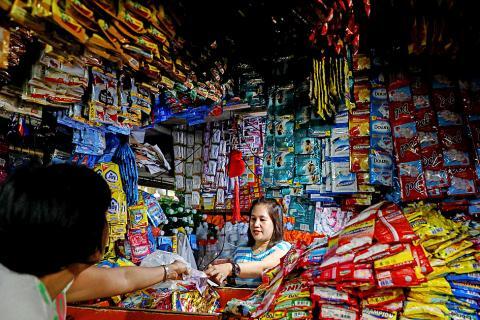
Image credit: Reuters
Unilever has built scale in the Philippines through single-use formats across personal and home care. Products such as shampoo and detergent sachets are priced for daily purchase, enabling broad participation without requiring bulk buying. Industry tracking shows that sachet formats dominate volume in categories such as hair care and laundry across Southeast Asia.
Products priced for daily or short-term spending remain accessible, while purchases requiring larger upfront spend are easier to postpone.
Without this format strategy, a significant portion of demand would shift out of reach, particularly among consumers managing daily cash flow. In categories such as laundry and hair care, this would translate directly into lost penetration rather than reduced consumption.
This reliance on single-use formats also raises sustainability considerations, particularly around packaging waste.
Why perceived value is driving brand switching in the Philippines
Brand choice is increasingly determined at the point of comparison rather than through established preference. Inflation continues to shape purchasing behavior, with households adjusting product selection, pack size, and brand mix to manage spend.
Market performance across price tiers reflects this shift. Research analysis indicates that value segments have gained traction across Southeast Asia, while premium products with clear functional differentiation continue to attract demand. This is concentrating growth at the value and premium ends of the market.
Price transparency is accelerating brand substitution. Retail and digital platforms enable direct comparisons of price, quantity, and product attributes, reducing switching friction. Brand preference becomes conditional on the ability to demonstrate value under current constraints.
Case Study: Century Pacific Food

Image Credit: YouTube
Century Pacific’s portfolio structure allows consumers to trade across price tiers without leaving the company’s ecosystem. In periods of financial pressure, this becomes strategically important because households can adjust spending while remaining within familiar brands and categories. Continued revenue growth reflects sustained demand in shelf-stable food categories, which remain central to household consumption. This portfolio structure allows participation across value-driven and higher-priced segments.
Brands that offer multiple price tiers give consumers room to adjust spending without leaving the brand entirely.
Why brands are misreading consumer demand in the Philippines
The primary failure is not declining demand, but responding to it incorrectly. Most performance tracking relies on aggregate indicators that assume uniform movement across categories. Consumer behavior no longer follows this pattern. Volume declines are often interpreted as a sign of weakening demand, prompting pricing or promotional responses.
This is already visible in how brands are reacting. In several FMCG categories, falling volumes have triggered aggressive discounting and heavier promotions in modern trade. Yet many of these efforts fail to recover growth because the problem is not simply price resistance. Demand has shifted into smaller packs, traditional retail, different purchase cycles, and more selective category participation, while investment remains concentrated in formats that are losing relevance. This creates a feedback loop where performance deteriorates despite increased spend. In categories with thin margins, this compounds quickly into sustained profitability loss.
Data shows continued growth in value segments and traditional trade, even as other parts of the category slow.
These dynamics compound across the organization. Category-level signals obscure where growth is actually consolidating, portfolio performance appears inconsistent, and SKU-level outcomes are misattributed to execution rather than structural shifts in demand. As a result, investment is directed toward segments that are already weakening, while innovation targets areas where consumer participation is declining.
Many tracking systems still measure the market as though consumer behavior is moving uniformly, and growth is fragmenting across channels, pack formats, and price tiers.
The consequence is misallocated investment: pricing is adjusted in segments where demand has shifted away, promotions are increased in channels where participation is declining, and innovation is directed toward categories that consumers are actively de-prioritizing.

What price sensitivity means for pricing, pack strategy, and growth in the Philippines
Pricing must reflect how products are purchased rather than being applied uniformly across categories. Effective pricing architecture includes differentiated entry points and higher-value options aligned with different purchasing conditions.
Pack architecture plays a central role. Small formats enable access under constrained cash flow, while larger packs capture value-driven purchasing. A narrow pack range limits relevance across these contexts.
Promotional strategy works best when it supports how consumers already buy. Multi-unit offers and channel-specific promotions are proving more effective than broad discounting in categories where households actively manage timing and spend. These approaches perform more consistently in Southeast Asia.
Channel roles should be clearly defined. Traditional retail supports immediacy, while modern trade and e-commerce support value optimization. Aligning formats and pricing with these roles improves efficiency without increasing reliance on discounts.
This requires a clear trade-off. Expanding into smaller formats or new channel roles cannot be funded through incremental investment. It requires reducing SKU complexity, reallocating marketing spend, or exiting segments where demand is weakening. Without this, brands remain overexposed to markets where returns are declining.
The risk is no longer misreading the consumer. It is continuing to act on signals that no longer reflect how demand is formed. Pricing adjustments, promotional intensity, and portfolio expansion will not improve performance if applied to the wrong parts of the market.
What changes next is not how much brands spend, but where they choose to compete. Growth is increasingly consolidating around brands that align with how Filipino consumers actually manage spending today, across pack size, timing, and channel choice. The market is still growing, but the path to demand has changed.
The brands that move first will capture demand where it is consolidating. Those that do not will continue to lose relevance in parts of the market that no longer drive growth.
Understanding where demand is shifting requires more than tracking outcomes. It requires identifying how decisions are formed before they appear in topline data. At Kadence, we combine market research methodologies to help brands see where demand is moving before performance reflects it.
If your current metrics no longer explain performance, it may be time to reassess how demand is measured.
FAQs
What is driving consumer spending changes in the Philippines?
Consumer spending in the Philippines is being shaped by renewed inflation pressure, oil-linked cost increases, food price volatility, and shifting purchasing behavior. Households are prioritizing essential categories, adjusting pack sizes, and changing where and how purchases are made, rather than reducing consumption entirely.
How are Filipino consumers responding to rising prices?
Filipino consumers are responding by reallocating budgets rather than cutting spending uniformly. This includes switching to value brands, buying in smaller or larger formats depending on cash flow, and shifting between traditional retail and modern trade to manage costs.
Why are brands misreading demand in the Philippines?
Many brands rely on aggregate metrics such as category growth and volume trends, which do not capture shifts in formats, channels, and purchasing behavior. This leads to incorrect responses such as price reductions or increased promotions in segments where demand has already shifted.
What does price sensitivity mean for FMCG brands in Southeast Asia?
How should brands adapt pricing and product strategy in the Philippines?
Brands need to align pricing, pack architecture, and channel strategy with how consumers are making decisions. This often requires trade-offs, including reducing SKU complexity, reallocating marketing spend, and adjusting product formats to remain relevant across different purchasing conditions.