

Thirty-five years ago, a market researcher needed a particular set of technical skills to do the job well. Designing questionnaires, managing fieldwork, analyzing data and producing reports required considerable expertise, time and resources. Of course, the best researchers brought much more than technical competence to their work. Curiosity, creativity and the ability to understand human behavior have always been part of what makes research valuable.
Today, many of the tasks that once took days or weeks can be completed in hours, sometimes minutes. And with AI advancing at its current pace, it's reasonable to wonder how much of what researchers do today will still require human involvement ten or twenty years from now.
I find that prospect more interesting than threatening. Technology has transformed the mechanics of research before, but AI raises a more fundamental question about where our professional value will lie in the future.
Will technical proficiency still distinguish the best in our profession? Or will the advantage increasingly belong to researchers who combine methodological expertise with curiosity, imagination, and the ability to anticipate change?
The next generation may need to be just as technically capable as its predecessors, but the skills that make someone exceptional could look very different.

Thirty-five years can change a profession
Think back to what market research looked like in 1991. Telephone interviewing, face-to-face surveys, paper questionnaires, and focus groups were familiar parts of the job. Fieldwork required substantial coordination, data processing took time, and producing a report involved considerably more manual effort than most researchers experience today.
Yet the profession was never simply about collecting information. A good researcher needed to know which questions to ask, recognize when respondents weren't telling the whole story, and interpret findings in the context of a client's business. Those skills were just as important then as they are today.
What has changed dramatically is the technology surrounding them. Tasks that once required entire teams can now be managed through digital platforms, automated systems, and increasingly sophisticated analytical tools. The technical barriers to producing research have fallen, and the speed at which information can be gathered and processed has transformed.
But perhaps the more interesting change is how that transformation is redefining the expertise clients expect from researchers. 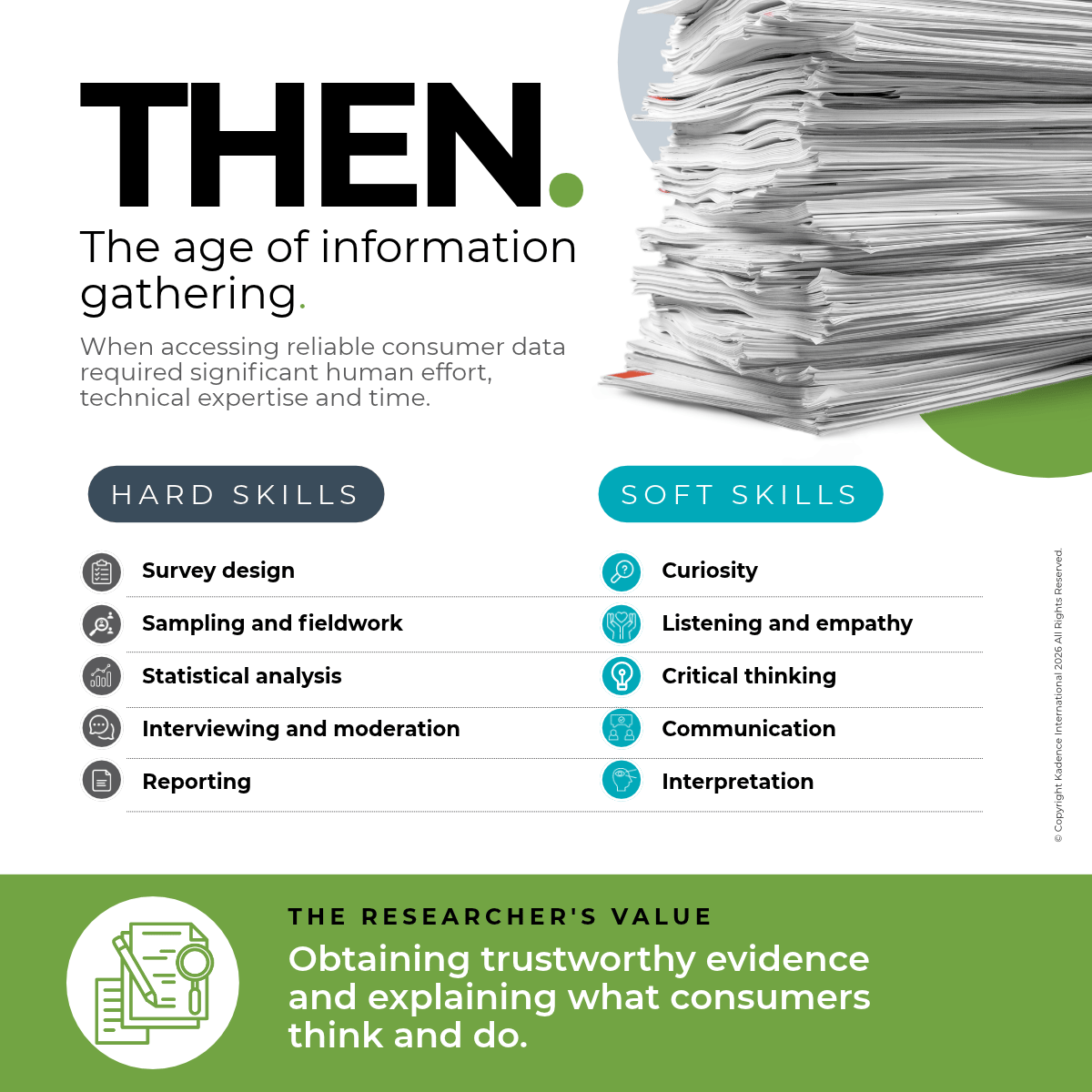
What AI is changing about research
Market research has already undergone an extraordinary transformation. Online panels, digital behavior tracking, automated dashboards and increasingly sophisticated analytics have made it possible to collect and process information at a scale that would have been difficult to imagine 35 years ago.
And now AI is accelerating that transformation. Tasks such as cleaning datasets, coding qualitative responses, identifying patterns, creating visualizations, and producing initial summaries can increasingly be completed with AI assistance, significantly reducing manual effort. Work that once required considerable technical expertise is becoming faster and more accessible. 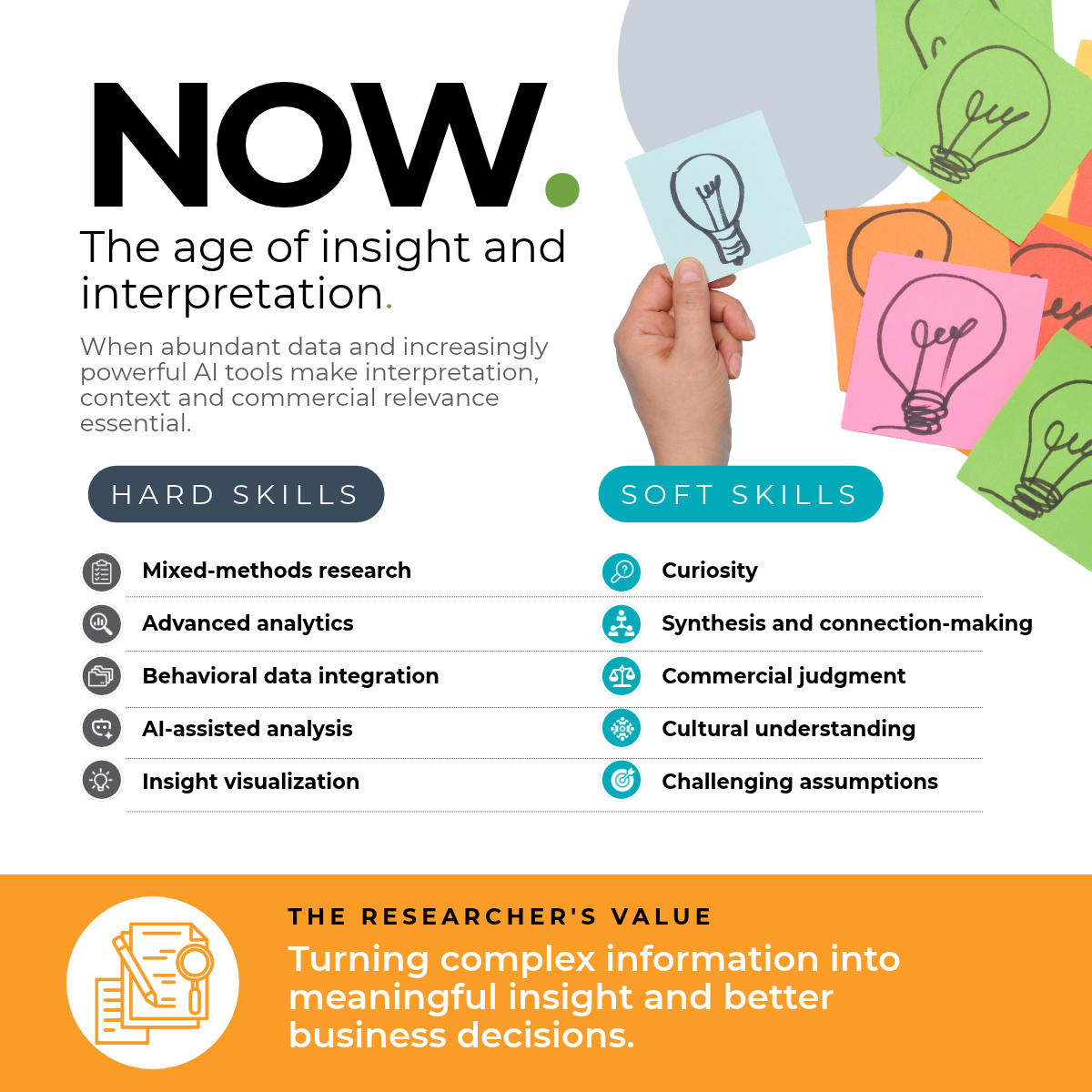
But there's an interesting consequence to all this efficiency. The easier it becomes to produce analysis, the more important it becomes to question what that analysis is actually telling us.
AI can identify correlations, organize complex information, and produce remarkably convincing explanations. What it cannot guarantee is that the underlying data is representative, that the analysis addresses the right commercial problem, or that an apparently meaningful pattern will hold up under closer examination.
That places greater responsibility on the researcher to understand methodology, recognize bias, and interrogate the evidence. These skills aren't becoming obsolete - they're becoming more important when technology can generate authoritative-looking findings at the click of a button.
And as the mechanics of analysis become increasingly automated, the real distinction may be between researchers who can produce findings and those who can establish whether those findings deserve to be trusted.
The value of asking a question nobody else has asked
I've always believed curiosity is one of the most underrated skills in market research. We spend considerable time teaching researchers how to design studies, analyze data, and interpret findings. But how do you teach someone to recognize that the most interesting question might be one nobody included in the original brief?
Think about how research typically works. A brand has a problem, commissions a study, and expects answers. A good researcher delivers those answers. A great researcher might notice something unexpected along the way, question an assumption, or recognize a connection to something happening in an entirely different market.
Consider declining alcohol consumption among younger adults, growing interest in wellness, and changing expectations around social experiences. Each can be investigated independently, producing useful insights for the industries directly affected. But what happens when someone starts wondering whether these behaviors are connected? Could they signal a broader change in how people socialize, what they consider an enjoyable night out, or where they choose to spend their disposable income?
Suddenly, a question about beverage consumption has implications for hospitality, entertainment, retail, and potentially industries nobody considered when the original research was commissioned.
AI can help identify these relationships, generate hypotheses, and explore the available evidence. But someone still needs the curiosity to pursue an unexpected possibility, the judgment to distinguish a plausible connection from an interesting coincidence, and the confidence to challenge the boundaries of the original question.
These are qualities I suspect will become increasingly valuable as AI takes on more of the analytical workload. The ability to explore information at scale is impressive, but it doesn't automatically tell us which discoveries could change how a business thinks about its market.
Sometimes the most important contribution a researcher makes isn't finding the answer. It's recognizing that there's a much bigger question worth asking.
From insight to foresight
For much of its history, market research has focused on understanding consumers as they are today. What do they think? How do they behave? What influences their decisions? And what can businesses learn from those findings?
Those questions remain fundamental. But increasingly, I believe researchers need to take the next step and consider what their findings might tell us about the future.
This is where the relationship between market research and strategic foresight becomes particularly interesting. Futurists don't claim to possess a crystal ball. Their work involves examining emerging signals, exploring how different forces of change might interact, and considering alternative futures that businesses may need to prepare for.
Consider the earlier example of changing social habits. Research might establish that younger consumers are drinking less alcohol, placing greater importance on wellness and looking for different kinds of social experiences. Those are valuable insights in their own right.
But imagine examining those findings alongside developments in healthcare, technology, household spending, and changing attitudes toward work-life balance. What might socializing look like in 2036? Will the traditional economics of bars and nightlife still hold? Could entirely different kinds of hospitality experiences become mainstream? And what opportunities might emerge for businesses that recognize those possibilities early?
We don't know the answers, and that's precisely the point. Foresight isn't about pretending we can predict the future with certainty. It's about using what we know today to investigate what could happen tomorrow, giving businesses an opportunity to test new propositions, reconsider long-term investments, and prepare for changes that haven't yet reached the mainstream.
AI has an important role here. It can monitor emerging developments, analyze enormous volumes of information, identify connections, and generate possible scenarios. As those capabilities improve, researchers will have increasingly powerful tools for exploring the future.
The challenge is determining which scenarios warrant serious consideration. An emerging trend might reshape an industry, or it might remain confined to a relatively small audience. Distinguishing between those possibilities requires sound evidence, an understanding of the wider market and the judgment to recognize when established assumptions may no longer hold. 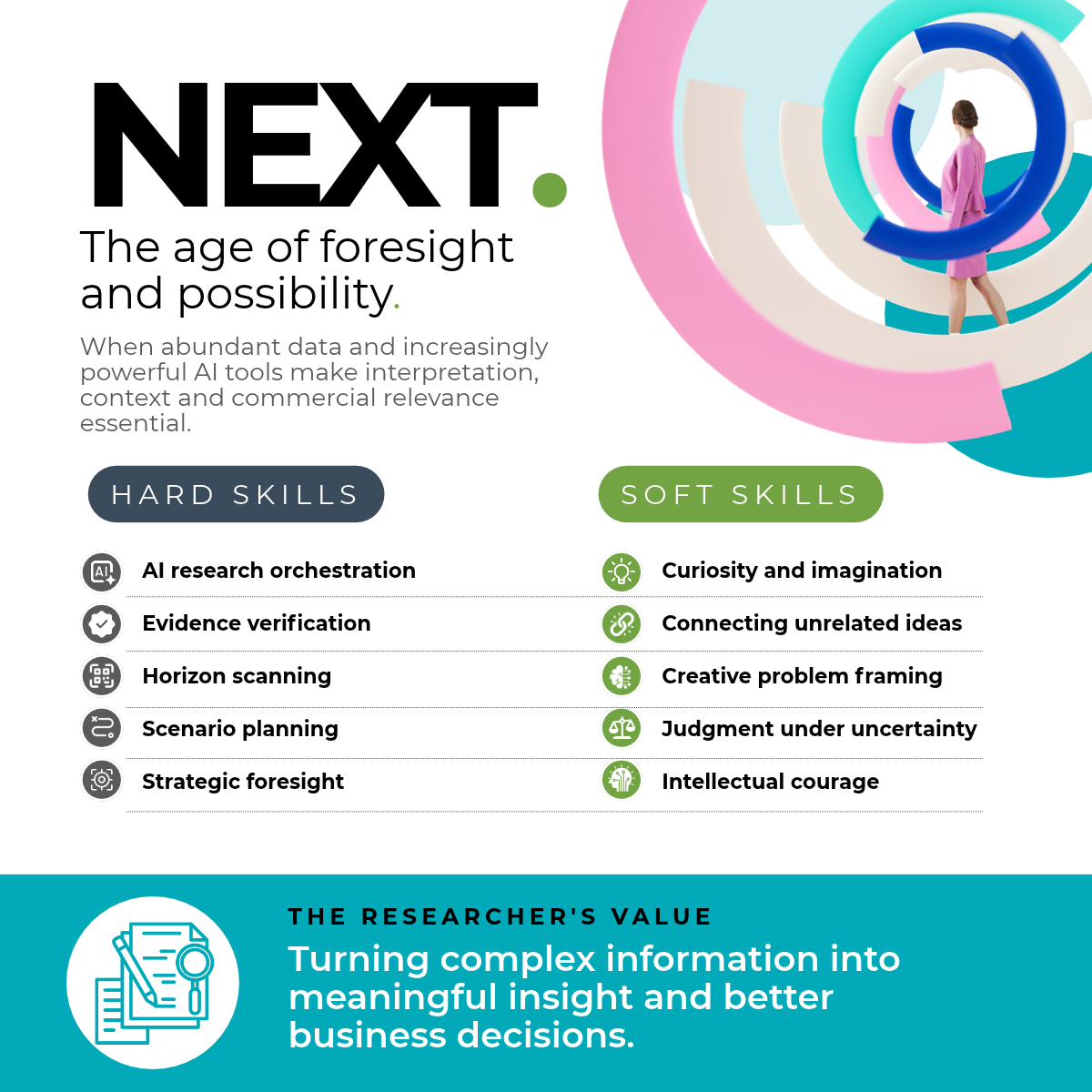
This is where I see an exciting opportunity for the research profession. Rather than stopping at what consumers think and do today, we can use insight as the foundation for asking what might change, why it could change, and how businesses might respond.
For me, foresight isn't a replacement for insight. It's the additional layer that turns an understanding of the present into a more informed exploration of the future.
What will make the next generation indispensable?
I think we're approaching an interesting turning point in market research. For decades, we've invested heavily in developing technical expertise, teaching researchers how to design studies, manage data, apply statistical methods, and communicate findings. Those skills remain essential. But as AI becomes increasingly capable of performing much of the work, we need to reconsider what we're preparing the next generation of researchers to do.
Are we training them to become better operators of technology, or better thinkers?
I'd argue that the distinction matters enormously. A researcher who can generate an analysis in seconds is useful. One who recognizes that the analysis is answering the wrong question, challenges the assumptions behind it or sees an opportunity nobody else has considered is potentially invaluable.
And perhaps we need to rethink how we classify professional skills. Curiosity, imagination, empathy and intellectual courage have traditionally been described as soft skills, almost as though they're pleasant additions to the serious business of technical expertise. Yet as technology changes how research is produced, these qualities may become increasingly important in determining how much value that research delivers.
That doesn't mean abandoning methodological rigor or handing every analytical task to AI. Quite the opposite. Technical expertise and human judgment will need to develop together. Researchers who understand both the capabilities and limitations of AI will be better equipped to use it effectively without surrendering their professional independence.
I'm optimistic about where this could take our profession. We have an opportunity to move beyond being the people who provide answers to becoming the people who help businesses recognize possibilities, challenge their assumptions, and prepare for change.
Thirty-five years from now, I doubt anyone will be particularly impressed by how quickly a researcher can produce a report or analyze a dataset. But I suspect businesses will still remember the researcher who asked the question that changed their understanding of an entire market.
Because the future of market research won't be defined solely by what tech allows us to discover. It will be shaped by what we have the curiosity to question, the imagination to explore, and the judgment to pursue.
Is your market research helping you prepare for what's next?
At Kadence International, curiosity drives us to look beyond the immediate findings and explore the bigger questions shaping consumer behavior and market change. We combine rigorous market research, strategic thinking, and a futurist mindset to help brands turn today's insights into a clearer understanding of tomorrow's opportunities.
Talk to Kadence about turning insight into foresight.
FAQs
How will AI change the future of market research?
AI is transforming market research by automating tasks such as data processing, qualitative coding, pattern identification and reporting. As these capabilities advance, researchers will increasingly focus on research design, validating findings, interpreting consumer behavior and identifying strategic opportunities. AI is likely to change the skills researchers need rather than eliminate the need for research expertise.
Will AI replace market researchers?
AI is expected to automate many routine market research tasks, but replacing individual activities is different from replacing the entire research profession. Researchers provide methodological expertise, contextual understanding, critical judgment and strategic advice. As AI becomes more capable, their roles are likely to evolve toward supervising AI-enabled research, challenging findings, asking new questions and helping businesses make decisions.
What skills will market researchers need in the future?
Future market researchers will need a combination of technical and human-centered skills. AI literacy, research methodology, statistical understanding and data validation will remain important. Curiosity, creativity, critical thinking, empathy, commercial judgment and the ability to connect developments across industries may become increasingly valuable as researchers move beyond analysis toward strategic insight and foresight.
What is the difference between market research, insight and strategic foresight?
Market research systematically gathers and analyzes information about consumers, markets and competitors. Insight emerges from interpreting that evidence to understand behavior, motivations and commercial implications. Strategic foresight builds on research and other evidence to explore emerging changes, alternative future scenarios and their potential consequences. Unlike prediction, foresight considers multiple possible futures to support better strategic decisions.
Why will human researchers still be important in an AI-driven future?
Human researchers will remain important because effective research requires more than processing information. Researchers help determine which questions matter, assess the reliability of evidence, interpret cultural and behavioral context, and challenge assumptions. Their ability to combine analytical rigor with curiosity, creativity and commercial judgment can help businesses identify opportunities and prepare for change, even as AI becomes increasingly capable.