
Asia is often described as a single growth engine, driven by rising incomes and expanding consumer classes. That is no longer the case. When you look closely at how people across the region allocate income, assess risk, and think about the future, a deeper divide appears.
Data from our six-country study show that Asia is no longer moving along a single trajectory. Japan and the region’s faster-growing markets now operate under fundamentally different consumer logics. In Japan, discretionary spending has tightened to levels that would feel extreme elsewhere in Asia. In India and Southeast Asia, spending reflects confidence in forward movement.
This is not a story of wealth versus poverty. It is a story of belief. Data from our six-country study reveal that Asia is no longer moving along a single trajectory. Japan and the region’s faster-growing markets now operate under fundamentally different consumer logics. In Japan, discretionary spending has tightened to levels that would feel extreme elsewhere in Asia. Conversely, in India and Southeast Asia, spending reflects a deep-seated confidence in the forward momentum of the economy.
This divergence is not a story of wealth versus poverty. It is, fundamentally, a story of belief and consumer confidence.
Two Consumer Logics, One Region
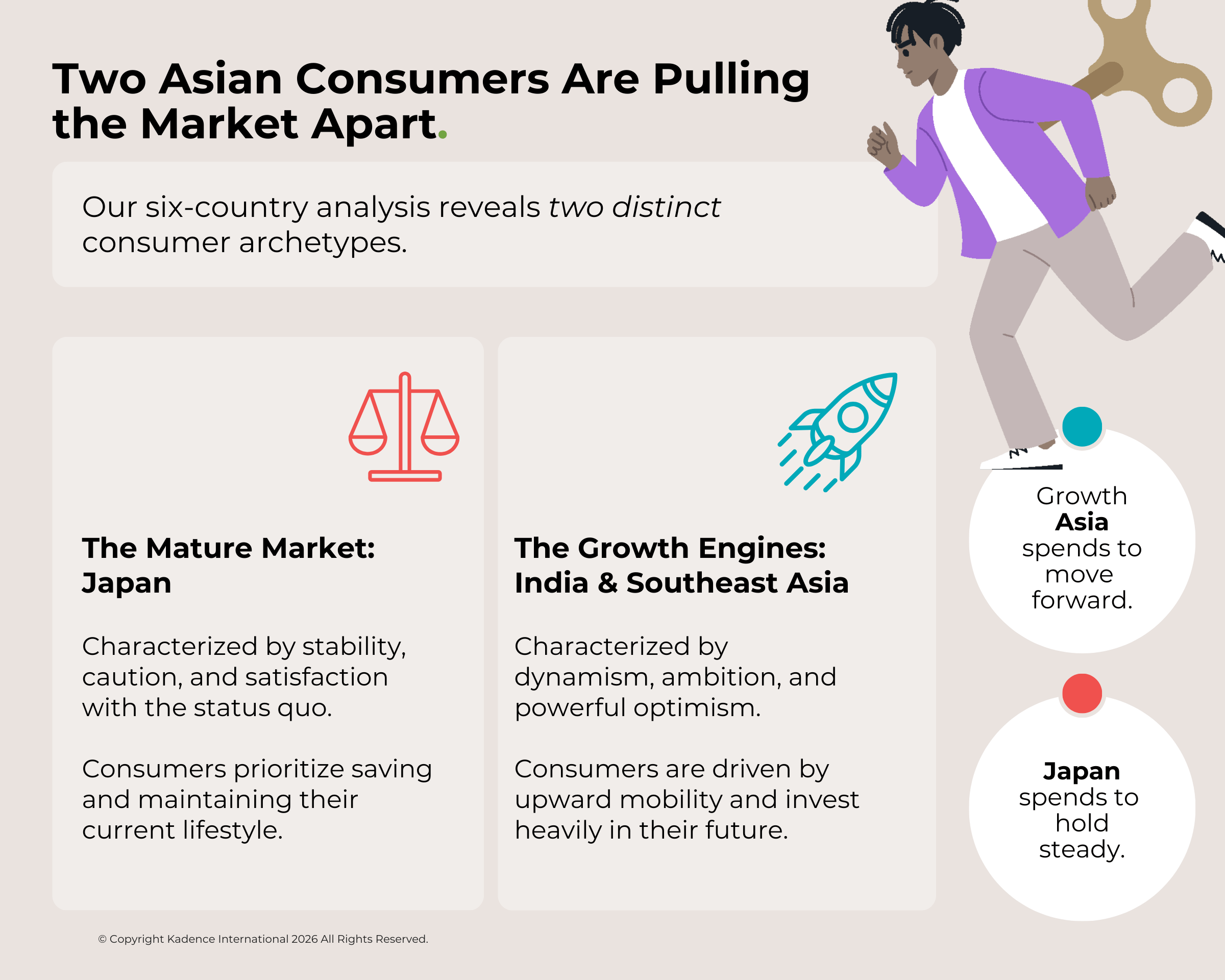
Income alone does not explain Asia’s consumer divide. The sharper distinction lies in how people think about progress.
In Japan, spending behavior reflects a present-focused mindset shaped by long-term economic stagnation, demographic pressure, and rising living costs. Essentials dominate household budgets. Housing alone absorbs a significant share of income, while discretionary categories remain tightly constrained. Fewer than half of consumers say they want to advance their careers for a higher income. Even fewer are actively investing in self-improvement.
This is not a disengagement; it is a recalibration. Stability holds more value now than acceleration, suggesting a shift toward more cautious and deliberate growth.
In contrast, consumers across India, Thailand, Vietnam, Indonesia, and the Philippines approach spending as a tool for progress. A larger share of income flows into lifestyle, travel, and future-oriented categories. Career ambition is nearly universal. These consumers behave on the assumption that effort will pay off.
Spending Patterns Reveal Intent, Not Excess
The spending gap is often misread as indulgence. However, the data suggests something more deliberate.
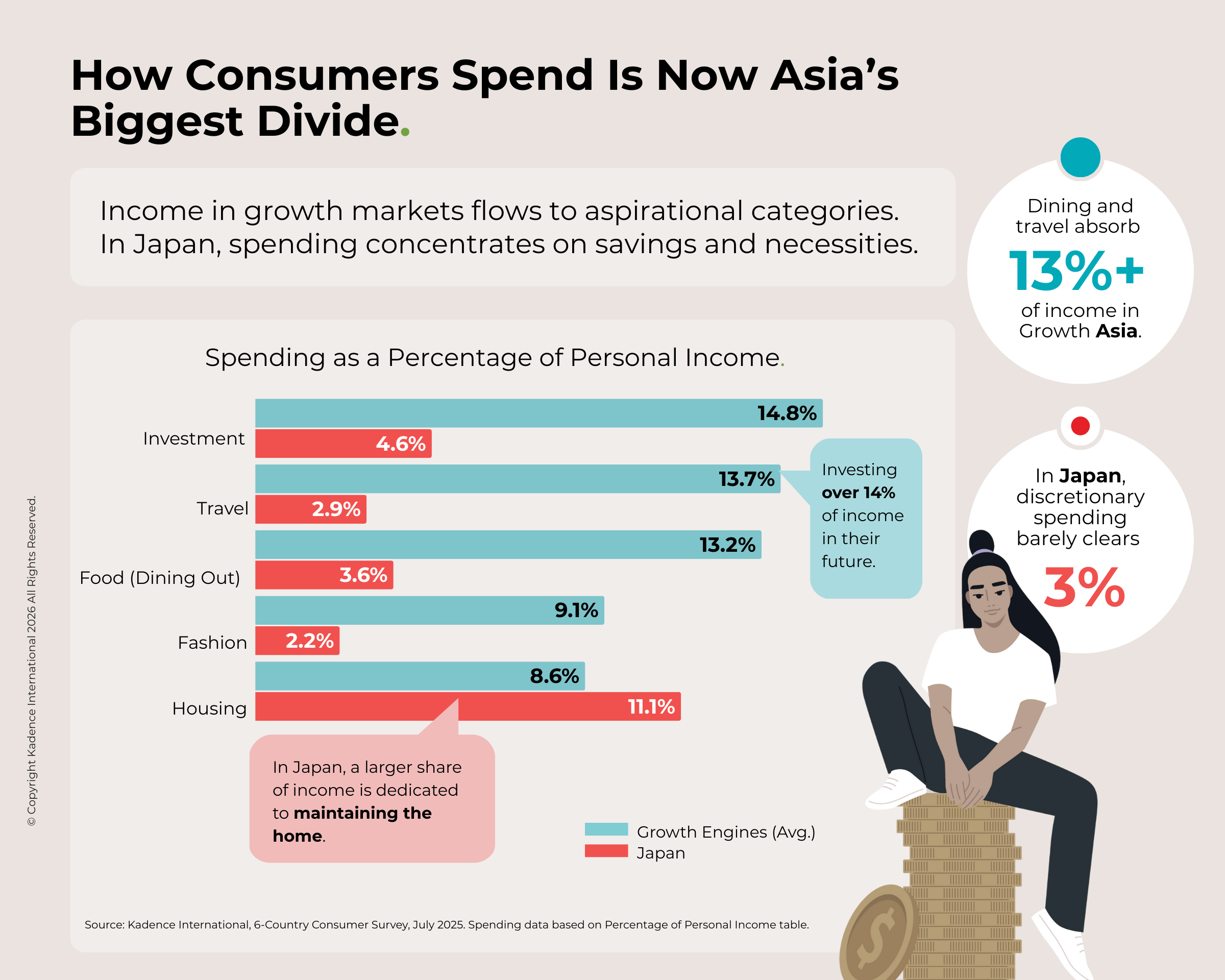
Across the growth markets, higher allocations to travel, dining, and investments function as mechanisms for upgrading daily life and accelerating mobility. These are not impulse categories but expressions of intent.
Japan’s profile reflects the opposite logic. Investment, travel, and dining each take up minimal shares of income. More money flows toward necessities and buffers against uncertainty. This behavior is rational within a context where future gains feel less predictable.
Vietnam stands out even within the growth group. Consumers there allocate the highest share of income to investments, signalling a strong future-building orientation. Thailand and Indonesia lean more heavily toward lifestyle spending, particularly dining and everyday enjoyment.
Taken together, these patterns make one thing clear: Asia’s spending divide is driven by outlook, not wallet size.

Ambition Has Become a Demand Engine
Belief in upward mobility translates directly into behavior.
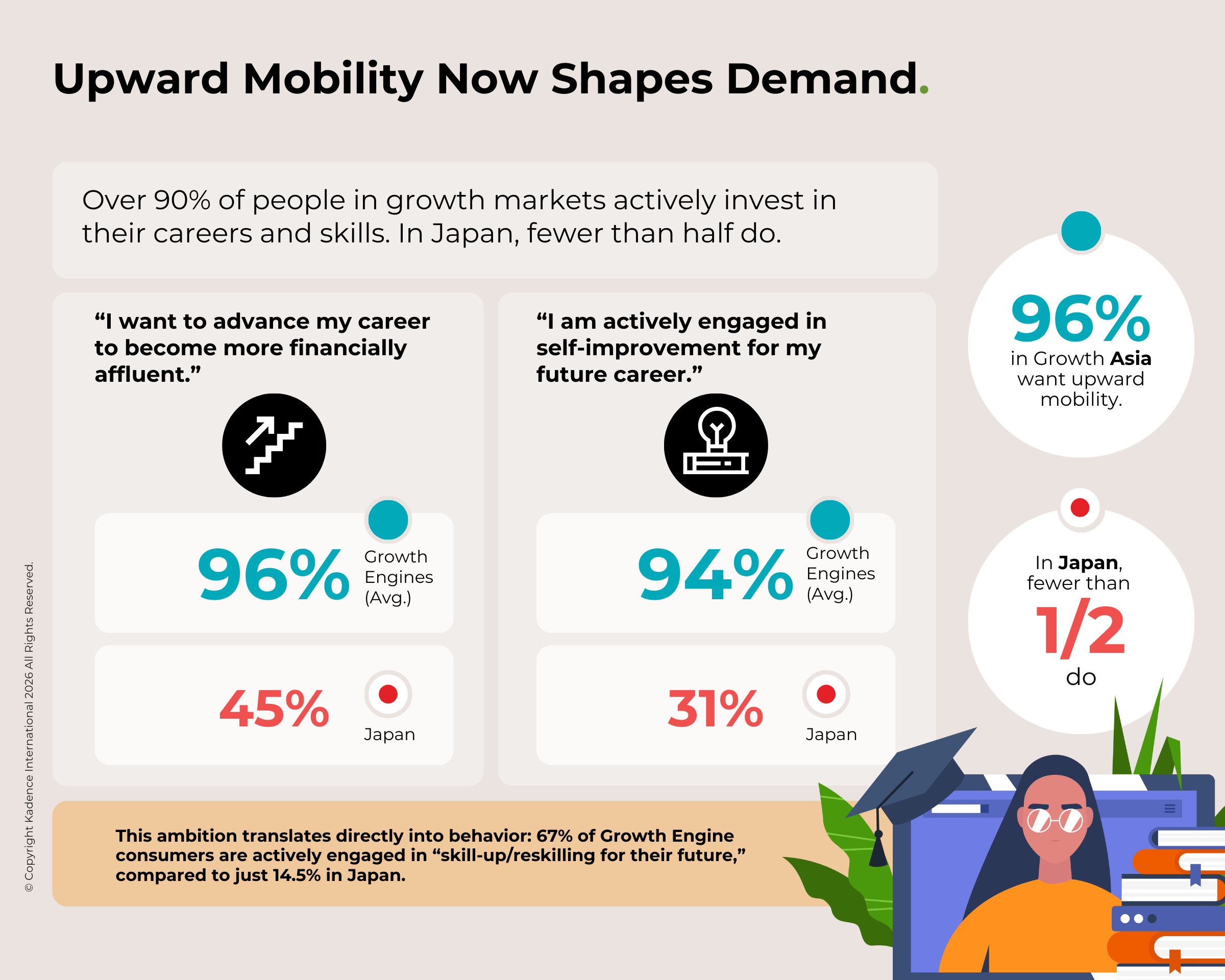
Across India and Southeast Asia, ambition is near-universal. The vast majority of consumers want to advance their careers and actively work to improve their skills. This belief reshapes demand across categories, from education and finance to beauty, technology, and travel.
Japan again presents a different picture. Fewer than half say they prioritize improving their financial situation. Only a minority are actively engaged in self-improvement. This reflects a shift in priorities rather than a lack of capability.
Ambition, in this context, is not abstract. It determines where demand concentrates and how quickly categories grow.
Confidence in the Future Changes How Money Moves
Optimism acts as a multiplier. Where people believe their lives will improve, they behave differently today.
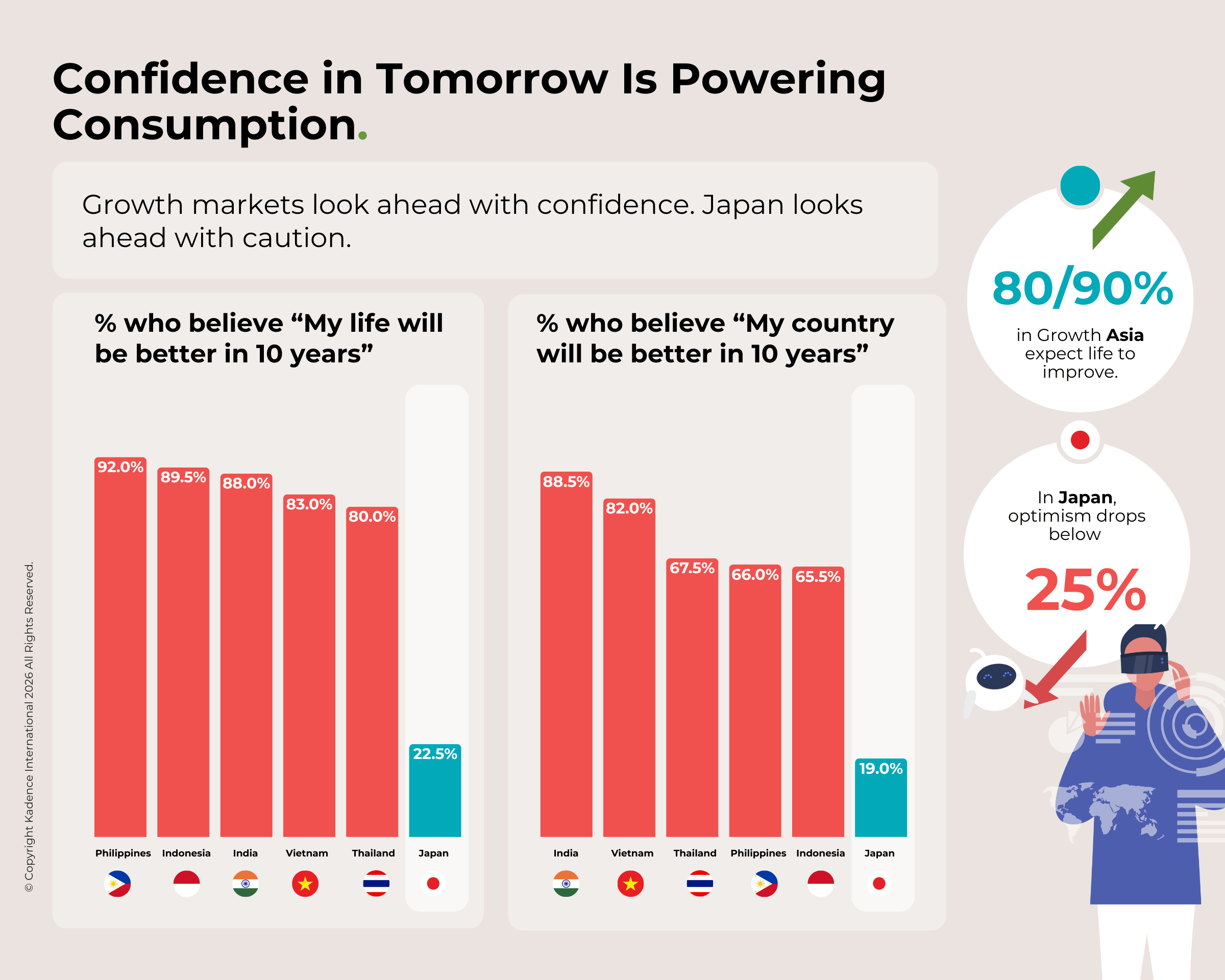
Across the growth markets, confidence in the next decade is strikingly high, both at a personal and national level. This belief gives consumers permission to spend, invest, and experiment. It shortens decision cycles and accelerates adoption in lifestyle-led categories.
Japan sits at the opposite end of the spectrum. Fewer than one in four consumers believe their life will improve over the next decade. Confidence in national progress is even lower. In this environment, conservative spending is not emotional pessimism; it is a rational response to prolonged uncertainty.
Japan illustrates a critical insight: higher incomes alone do not unlock discretionary demand if optimism is absent.
Satisfied, Yet Still Willing to Spend
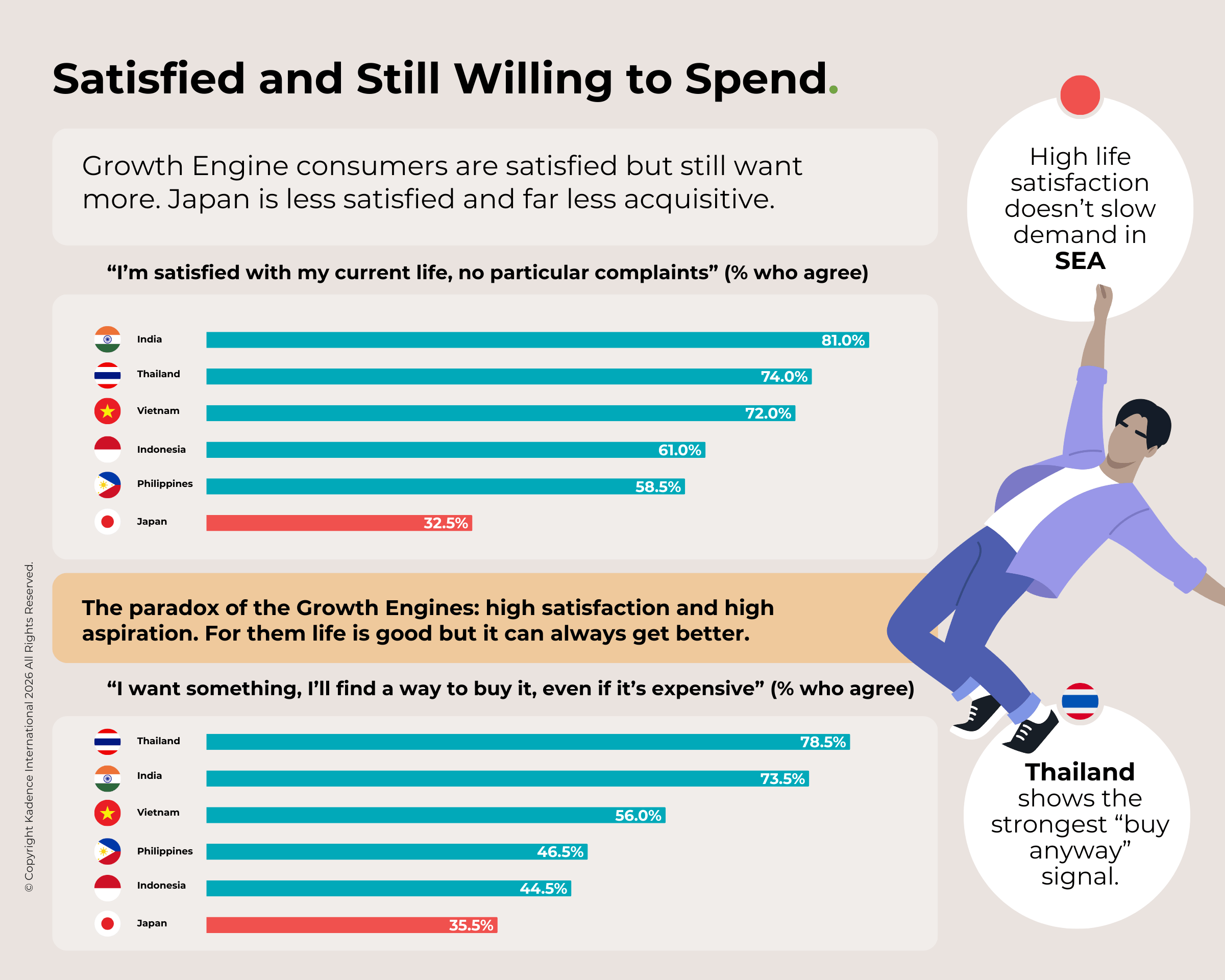
One of the most distinctive patterns in Southeast Asia is the coexistence of satisfaction and ambition.
Consumers across India, Thailand, Vietnam, and Indonesia report relatively high life satisfaction despite income inequality. This satisfaction does not suppress demand. Instead, it reinforces confidence that progress is achievable.
This shows up in willingness to stretch budgets. In Thailand and India, a majority say they would find a way to buy something even if it is expensive. Japan again diverges, with far fewer consumers willing to do so.
At the same time, growth-market consumers remain disciplined about future preparation. Most say they are actively planning ahead. Enjoyment of the present and preparation for the future coexist.
What This Means for Brands
Asia’s consumer landscape is now driven by two fundamentally distinct market logics.
In India and Southeast Asia, growth is propelled by confidence. Brands thrive here by positioning themselves as enablers of progress, offering clear pathways for consumers to trade up, and moving swiftly across social, digital, and physical channels. Emotional value is key, as optimism creates significant room for aspiration and premiumization.
In Japan, growth relies on assurance. Brands win by demonstrating unwavering reliability, precision, and demonstrable long-term value. Innovation is most effective when it enhances predictability rather than disrupting established routines. A strong physical presence remains foundational for building and maintaining trust.
The critical mistake is treating "Asia" as a single, homogenous growth narrative. The data clearly shows that underlying belief systems are now more influential than simple market averages.
In markets where consumers believe effort will yield future success, demand accelerates rapidly. Where this collective confidence is muted, value must be meticulously earned and proven.
Asia’s opportunity is real, but it is no longer uniform. The brands that will succeed are those that consciously identify which consumer logic they are serving and design their entire strategy to align with it.