
The household is changing faster than many of the products built for it. Euromonitor projects single-person households will grow by 44.8% between 2024 and 2040, reaching roughly 26% of households worldwide. In Asia-Pacific alone, half of all new single-person households created over that period are expected to come from the region.
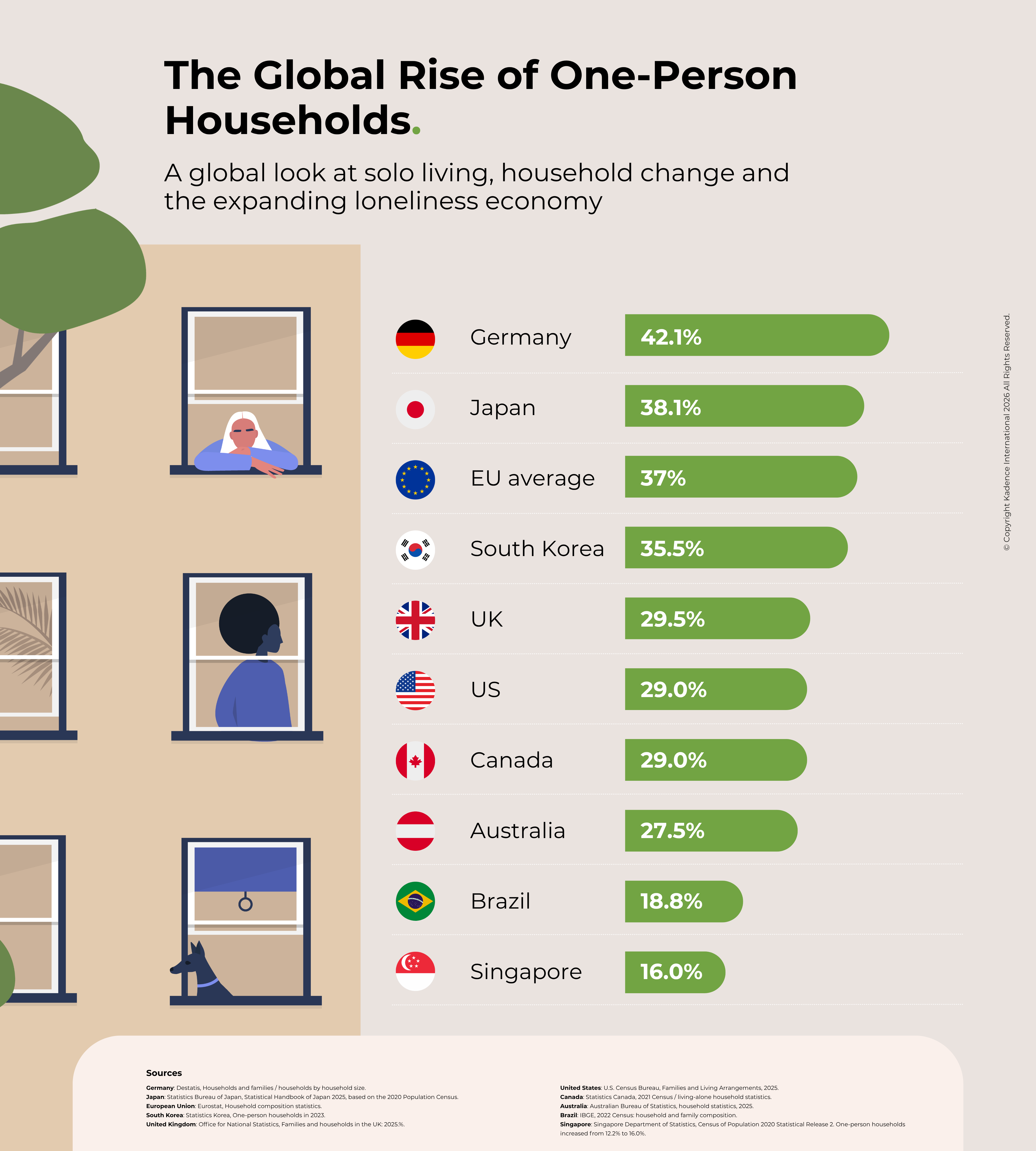
That shift is already visible in markets as diverse as Germany, Japan, South Korea, the UK, the US and Thailand, where one-person households now account for a substantial share of the population. In Germany, they make up more than 42% of households. In Japan, 38.1%. South Korea is above 35%, while the UK and the US are both around 29%.
But many business models still assume two or more people are sharing the cost, the product, or the experience.
Food packs are often optimized for families. Hotel rooms are priced around double occupancy. Subscriptions become better value when more people use them. Appliances are frequently sized for larger households. Even healthcare can assume there is another adult at home to drive, collect medication, or help with recovery.
For a growing share of consumers, those assumptions no longer fit. The solo economy is not a niche built around young singles or urban professionals. It spans older adults ageing alone, divorced consumers, people delaying partnership, those choosing independence, and people whose household structure has changed over time.
The commercial question is becoming harder to ignore: how many products and services are still designed around a household structure that is steadily losing share?
This Is Not a Western Lifestyle Trend
The geography of solo living is one reason the trend deserves more attention.
Europe has some of the world’s highest concentrations of one-person households, but Northeast Asia is just as important. Japan and South Korea are already mature solo-household markets, shaped by ageing populations, later marriage, and decades of urban concentration. Thailand is moving quickly in the same direction, while Singapore continues to see household sizes shrink.
In South Korea, one-person households reached 8.04 million in 2024, while one- and two-person households together accounted for 65.1% of all general households. Thailand has also moved much further than many global brands may realize: recent research found that solo-living households accounted for 29.5% of the total in 2025, with projections suggesting they could approach 40% by 2042 if current trends continue.
China is another market to watch closely. Estimates drawing on official data put the number of single-person households above 100 million, with further growth expected this decade. India and the Philippines remain much less solo at a national level, but falling household sizes, urbanization, and later family formation suggest that national averages may hide faster change in large cities.
What appears to be one global trend is actually a collection of distinct demographic stories.
In Germany and the UK, ageing is a major driver. In Japan and South Korea, delayed marriage and long-term demographic change play a bigger role. In Southeast Asia, urbanization and changing social norms are reshaping household formation. In India, the shift may emerge first through metropolitan, professional and higher-income segments rather than the country as a whole.
For global brands, market maturity is more useful than a blanket “single consumer” label. The household structure may be converging, but the cultural meaning of living alone is not.

The Economics of One Are Different
A household of one is not simply a smaller version of a household of two.
Many fixed costs barely change. Rent, broadband, insurance, appliances and utility standing charges still have to be paid. There is no second income absorbing the cost, no one else using the subscription and no partner sharing the risk if something goes wrong.
That changes consumption in ways brands can easily miss.
ONS analysis in the UK found that working-age adults living alone spent 92% of their disposable income, compared with 83% among two-adult households. Solo households also devoted a larger share of spending to essentials such as housing, food and furnishing the home.
The pressure shows up elsewhere too. A hotel room built for two often costs almost the same for one. A streaming plan may offer better value per person when several people share it. Grocery packaging frequently rewards larger households with lower unit prices, while smaller formats can cost more per gram or per serving.
The result is a quiet “solo premium” running through parts of the economy.
For brands, that creates both a risk and an opportunity. If a consumer repeatedly pays more per unit simply because they live alone, resentment builds quickly. But if a product is genuinely designed around one person’s needs, the value equation changes.
The future opportunity is not “miniature everything.” It is better economics for one.
That could mean modular food packs that reduce waste without punishing the buyer on price, individual subscriptions that do not feel like stripped-down versions of family plans, travel products that remove arbitrary single supplements, or household products sized for one person without sacrificing quality.
The companies that solve those frictions will not be targeting a niche. They will be fixing a structural mismatch between how people live and how many categories are still priced.
The Biggest Product Gaps Are Hiding in Plain Sight
Some of the clearest opportunities are already visible. Food is an obvious one. Smaller households waste more when products are packaged for family consumption, yet smaller packs often have worse unit economics. The smarter response is not simply a single-serve format, but packaging that lets one person consume at their own pace: resealable formats, modular portions, freezer-friendly components, and products designed to stay fresh longer.
Appliances are another. South Korea offers an early glimpse of where this could go. Lotte Himart launched PLUX, a private-label electronics range aimed at one- and two-person households. The important idea is not just compactness. It is the emergence of what could become a much bigger category: premium compact. Smaller refrigerators, washing machines, kitchen appliances, and home technology designed for limited space without being positioned as basic or entry-level.
Restaurants are beginning to confront the same shift. OpenTable reported that US solo dining reservations rose 23% year over year, while solo diners spent an average of $94 per meal, compared with $60 per person across all party sizes. That is a striking finding because it turns a common operating assumption on its head. A table for one may look inefficient on a floor plan, but the customer may be more commercially valuable than expected.
Travel still has some of the most obvious catching up to do. Single supplements, double-occupancy pricing, and tours designed primarily around couples remain common, even as solo travel grows. The white space is not “singles travel” in the old sense. It is independent travel without financial penalty, with social interaction available when wanted rather than built in as the point of the trip.
Across all of these categories, the same lesson keeps surfacing: the gap is not about making products smaller. It is about redesigning around one person’s economics, habits, and autonomy.
The Bigger Shift Is in How Brands Define the Market
The rise of one-person households should change more than packaging sizes and service options. It should change the assumptions that researchers, product teams, and marketers use when they define demand in the first place.
For market researchers, the first problem is segmentation. “Single” is too broad to be useful. A 29-year-old professional living alone in Bangkok, a divorced 52-year-old in Chicago, and a 74-year-old widow in London may all belong to one-person households, but their needs, spending power, routines, and reasons for living alone are entirely different.
The better questions are more specific. Is solo living chosen or circumstantial? How financially resilient is the household? Which categories carry the greatest burden because there is no second income or user? Where does independence increase willingness to spend? Which products create friction because they assume another person is present?
Those questions can reveal opportunities that demographic labels miss.
Product teams should be looking for categories where the current offer is built around an outdated household norm. The strongest opportunities are likely to appear where one-person households are paying for excess capacity, accepting poor unit economics or working around products that were never designed for them.
Marketers have a different challenge. Too much communication still frames solo living as temporary, deficient, or transitional. That may alienate consumers who do not see themselves that way. The more effective approach is likely to focus on control, flexibility, convenience, and independence rather than treating partnership as the default end state.
Over the next decade, I would expect the most successful brands in the solo economy to do three things well: identify where household assumptions create friction, design around one-person economics rather than smaller formats, and resist turning “solo consumer” into another lazy global segment.
There is still significant white space because many industries have only partially adapted. Travel pricing, subscriptions, financial services, housing, healthcare support, food formats, and home products all contain offers that still work better for two than for one.
That gap will become harder to ignore as the household mix changes.
The brands that move early will not simply capture a growing segment. They will be better aligned with how millions of consumers are already living.
The Household of One Will Become a Mainstream Design Brief
The bigger risk for brands is not missing a niche. It is continuing to design around a household structure that is becoming less dominant in many of the world’s most important consumer markets.
Over the next decade, I expect “household of one” to become a much more common input into product development, pricing, and service design. Not as a special segment, but as a standard use case.
That will force harder questions.
Why should one person pay almost the same as two for a room, subscription, or service? Why should smaller food formats cost more per unit? Why should compact appliances be positioned as basic? Why should financial products assume a spouse, or healthcare systems assume someone is waiting at home?
Those are not edge cases anymore. They are signs that markets have not fully caught up with consumers.
The opportunity for researchers is to identify where those assumptions are breaking first. For product teams, it means redesigning around actual household behavior rather than inherited norms. For marketers, it is to stop treating solo living as a temporary state on the way to something else.
The companies that get this right will not win because they have created more “products for singles.” They will win because they have recognized something more fundamental: the unit of consumption is changing.
And when the unit of consumption changes, everything from packaging and pricing to service, experience, and innovation eventually has to change with it.
At Kadence International, we help brands understand how changing household structures are reshaping demand, decision-making and product expectations across markets. From segmentation and usage studies to product development and global consumer research, our work helps businesses identify where existing offers no longer fit the way people actually live.
Talk to us about uncovering the unmet needs, market gaps and growth opportunities emerging from the rise of the solo economy.