

Brand budgets are under more scrutiny than at any point in the past. Leadership want clear evidence that brand investment is paying off, not broad claims about awareness. At the same time, consumer sentiment now moves faster than most reporting cycles, faster than quarterly brand trackers, and often quicker than the internal decision-making structures meant to respond to it, which leaves marketing and product teams explaining last quarter’s story while the market has already moved on.
Brand tracking sits at the centre of this tension because it is where belief meets proof. It shows how people think, feel, and behave toward your brand across markets, touchpoints, and time. When it works, it makes change visible: whether campaigns are shifting perception, whether equity is compounding or eroding, and where competitive ground is being gained or quietly lost.
Brand tracking is the systematic process of measuring and analyzing a brand’s performance, perception, and impact in the marketplace.
A well-designed tracker stops being a dashboard once people start using it to make uncomfortable calls. It exposes momentum before revenue catches up, surfaces risk while it can still be managed, and forces trade-offs about where investment should go based on what is actually changing, not what teams hope is changing.
Benefits of Brand Tracking
Implementing brand tracking strategies offers numerous advantages and benefits to companies.
- Informed decision-making
Brand tracking gives leaders evidence, not anecdotes. By tracking awareness, consideration, usage, and loyalty over time, marketers can see which campaigns shift behavior, which channels pull their weight, and where to reallocate budget. - Clear view of brand equity
Measuring brand equity – familiarity, preference, and perceived quality – shows whether your brand is gaining or losing strength in the minds of consumers. It also reveals which levers (communication, product, pricing) are actually moving that equity. - Early warning on perception risk
Regular tracking of perceptions and sentiment helps identify issues before they appear in sales. Declines in trust, relevance, or value perceptions can be spotted and addressed before they turn into churn. - A map for improvement
When tracking is tied to business outcomes, it becomes a roadmap. Weak conversion from awareness to consideration, loyalty gaps within a particular segment, or declining share in one channel all point to specific actions, not vague “brand work”.
Key Metrics and KPIs
Effective brand tracking follows the customer journey from first exposure to repeat purchase. Most trackers organize metrics into a simple funnel: awareness, consideration, trial or usage, loyalty, and advocacy. In this context, perception and sentiment metrics explain why the numbers fluctuate.
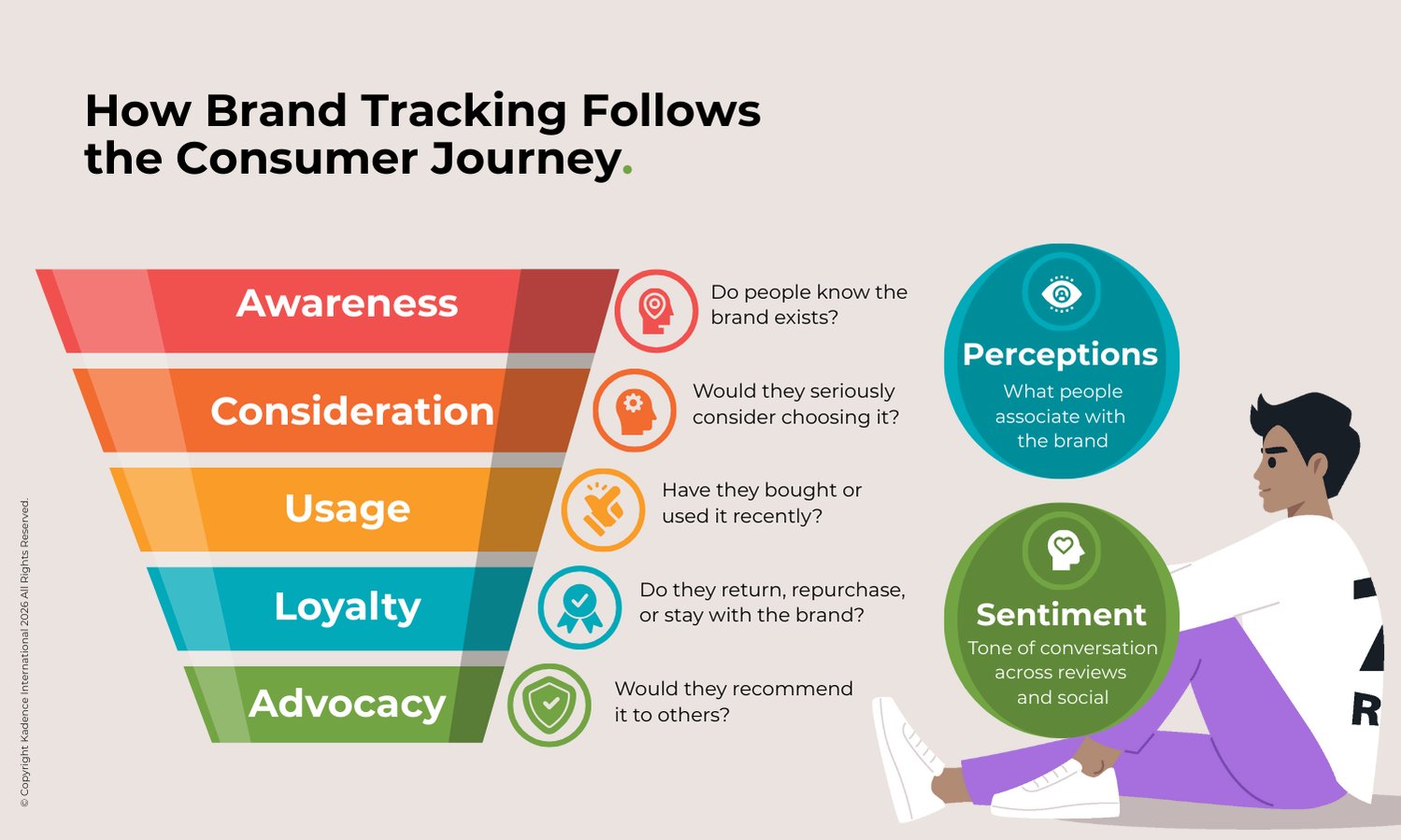
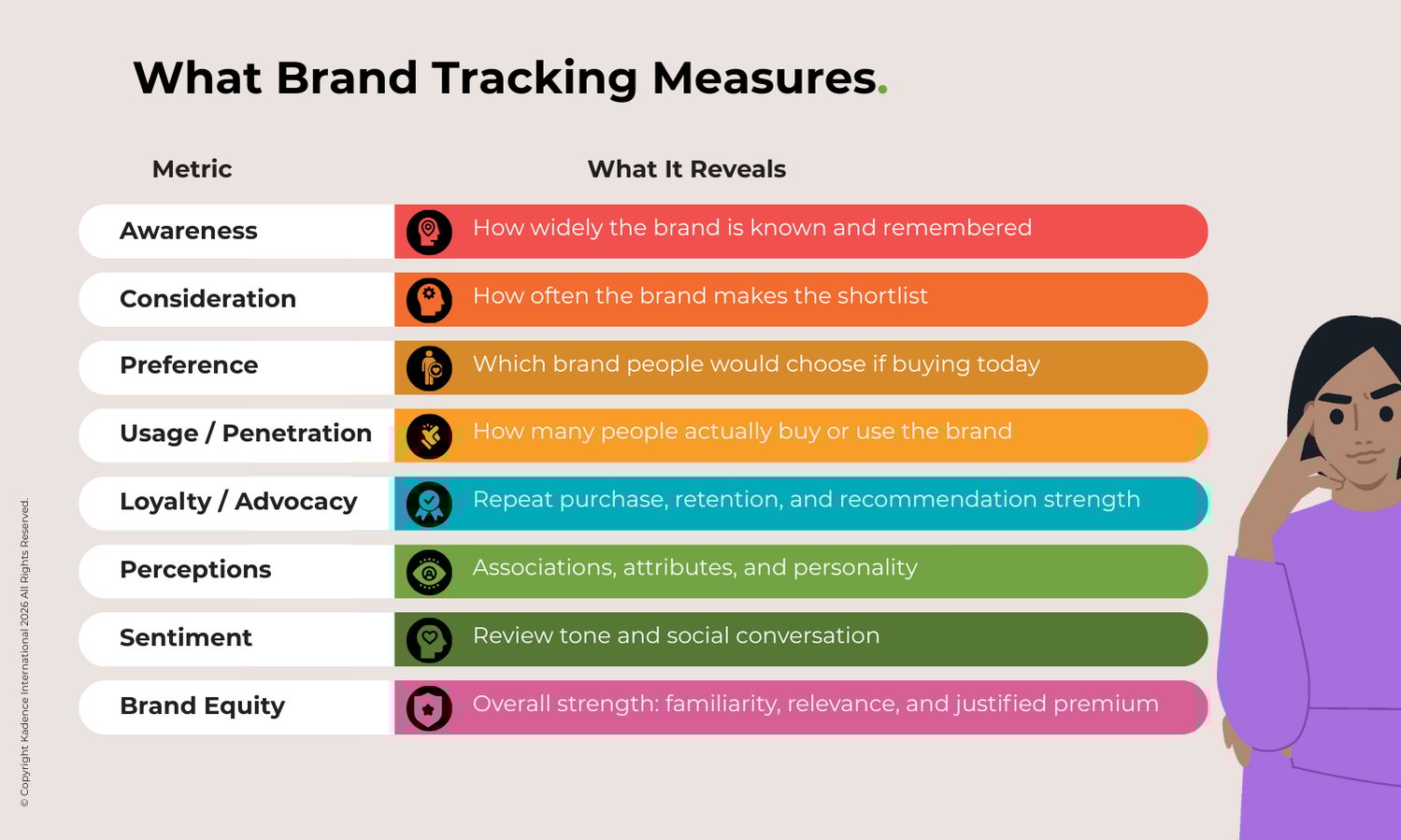
- Brand awareness – aided and unaided awareness, recall, and recognition. These show whether people know you exist and remember you at the right moments.
- Brand consideration and preference – measures of which brands people would seriously consider buying, and which they prefer. This reveals your competitive set and how often you make the shortlist.
- Usage and penetration – past purchase, share of wallet, and category usage. These show how many people are actually buying the brand and how that changes over time.
- Loyalty and advocacy – repeat purchase, retention, and NPS or other advocacy measures. These metrics highlight the strength and stability of your customer base.
- Brand perception and image – associations, personality traits, and perceived performance on key attributes (quality, value, innovation, trust). This is where you see whether your positioning lands.
- Sentiment and conversation – social listening, review scores, and open-ended feedback. These provide texture behind the numbers and expose emerging issues or themes.
- Brand equity – composite indices of familiarity, consideration, preference, and premium justified. These help summarize the trajectory of the brand for board-level reporting.
Brand Tracking Methods and Tools
Brand tracking relies on a blend of traditional research and digital signals. The strongest programmes use multiple sources to build a consistent view of brand momentum.
Surveys
Survey-based tracking provides stable trend data on awareness, consideration, perceptions, and loyalty. Online panels are the most common method because they provide scale, speed, and consistency. Telephone and in-person surveys are used less frequently but still play a role in markets where digital penetration is lower.
When to use: Measuring brand equity and funnel shifts over time.
Social Media Monitoring
Social platforms reveal what people say spontaneously about a brand. Monitoring tools track mentions, themes, share of voice, and emerging risks.
When to use: Understanding conversations that drive sentiment in real time.
Sentiment Analysis
Using natural language processing, sentiment analysis tools classify customer comments as positive, neutral, or negative. This helps identify early warning signals around trust, value, or product performance.
When to use: Adding emotional and contextual depth to tracker data.
Web Analytics
Traffic, search trends, and on-site behavior show whether interest in the brand is rising or falling. These behaviors often shift earlier than perceptions.
When to use: Connecting brand interest with digital demand and campaign impact.
Competitive Benchmarking
Comparing performance against competitors reveals relative strength. Benchmarking includes share of voice, perception gaps, media spend patterns, and thematic analysis of competitor messaging.
When to use: Understanding whether your gains reflect category growth or genuine competitive advantage.
Online Reviews and Ratings
Review platforms offer ongoing qualitative signals about product performance and customer satisfaction.
When to use: Diagnosing product-level issues and sentiment drivers.
At Kadence, we typically combine survey-based tracking with behavioral data, social listening, and category context. This mix helps clients see not only what is changing, but why it is changing.

How to Set Up a Brand Tracking Study
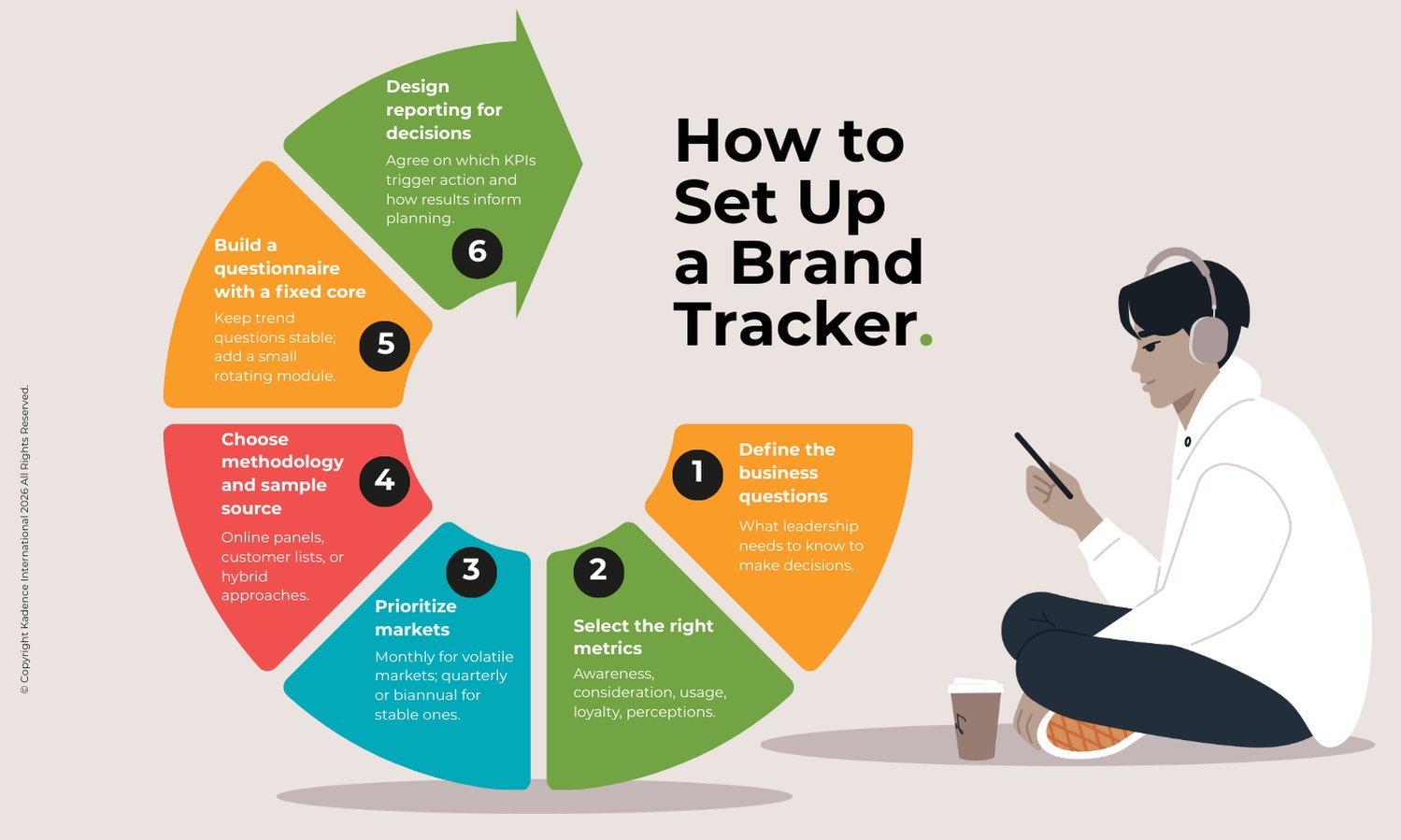
1. Define the business questions that matter
Start by identifying what leadership genuinely needs to know.
Examples:
- Is the new positioning landing with our target audience?
- Are we closing the gap with our primary competitor?
- Are younger buyers shifting away from the brand?
These questions determine the metrics you track and the structure of the study.
2. Select the metrics that match those questions
Choose a small, focused set of KPIs across the brand funnel:
- Awareness
- Consideration and preference
- Usage or penetration
- Loyalty and advocacy
- Perceptions and associations
This ensures the tracker measures both outcomes and diagnostics.
3. Prioritize markets, audiences, and cadence
Decide which markets and segments matter most to the business.
- High-growth or high-risk markets may require monthly reads.
- Mature or stable markets may only need quarterly or biannual measurement.
- If certain age, income, or attitudinal groups drive revenue, sample them consistently.
4. Choose the methodology and sample source
Trackers typically use:
- Online panels
- Customer lists
- Hybrid approaches
Consistency is critical. Use stable sampling and fieldwork methods each wave so trends are comparable.
5. Build a questionnaire with a fixed core and a flexible module
Keep the core questions identical wave to wave.
Add a small rotating module for emerging issues, campaign read-outs, or new competitors.
This protects trendability without limiting relevance.
6. Design reporting for decisions, not decoration
Agree in advance:
- Which KPIs require action
- How results will feed into media planning, creative development, and budgeting
- What will be shared at the board level versus the team level
A tracker is only valuable if it shapes decisions.
Brand Tracking Best Practices
Brand tracking only creates value when it informs decisions. The most effective programmes follow a disciplined set of practices:
Set clear commercial goals.
Trackers work best when anchored to specific business questions: penetration growth, repositioning success, competitive shifts, or loyalty gaps.
Use focused, stable metrics.
A tracker should not measure everything. A tight set of core KPIs — awareness, consideration, usage, advocacy, and key perceptions — provides comparability over time.
Ensure data accuracy and sample consistency.
Reliable trackers use consistent sampling, fieldwork, and weighting each wave. This protects the integrity of trends and prevents false movement.
Interpret results in context.
Numbers only make sense alongside category dynamics and competitor activity. Category inflation, media shifts, or promotional cycles often explain changes in the data.
Act on the findings.
Tracking without action becomes reporting. Insights must feed into creative decisions, media choices, product improvements, and customer experience design.
Review and refine the programme.
As the brand’s priorities evolve, the tracker should evolve too. Many brands update modules annually to reflect new category issues, competitive moves, or brand ambition.
A global FMCG brand, for example, tied its tracker to a single KPI — penetration among younger households. Awareness and consideration were only counted as “success” if they moved that number, keeping focus sharp and budgets defensible.
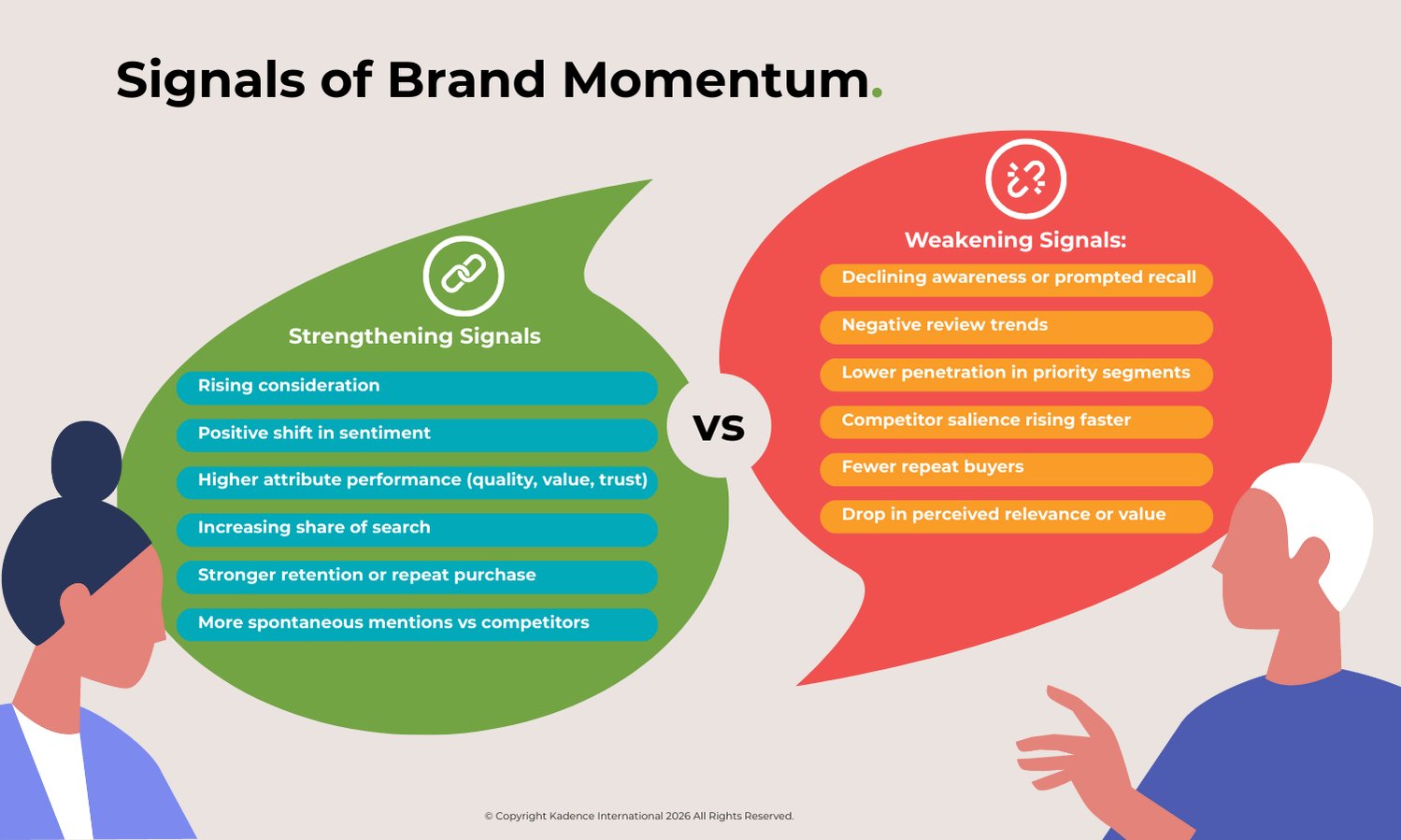
The best brand trackers are never completely finished, and treating them as if they could be is usually the first mistake. As goals move, categories reconfigure, and new data sources enter the picture, the program has to be revisited and adjusted with intent, not patched reactively when questions get uncomfortable. What stays stable are the core metrics that anchor; what changes are the modules, markets, and methods that determine whether the tracker is still answering the questions marketing leaders are actually being asked to decide.
Measurement only has value if it remains aligned with how decisions are made today, not with how they were made when the tracker was commissioned. Locking a tracker in place may feel disciplined, but it usually just freezes assumptions that the market has already invalidated.
A tracker that can’t adapt becomes ceremonial. It still runs, still reports, still consumes budget, and still produces numbers that look respectable in a deck.
Common Brand Tracking Challenges and Solutions
Even strong trackers can encounter issues. The most common challenges are operational rather than strategic.
Data accuracy
Inconsistent sampling or data cleaning leads to false signals.
Solution: Standardize fieldwork, validate data, and ensure stable quotas wave to wave.
Sample bias
If the sample does not match the target audience, results drift.
Solution: Use stratified sampling and routinely test representativeness across demographics and behaviors.
Misinterpretation
Teams often misread normal variation as meaningful movement.
Solution: Use significance testing, look at multi-wave trends, and pair quantitative results with contextual evidence.
Privacy and compliance
Tracking often involves personal data.
Solution: Follow GDPR/CCPA standards, minimize personally identifiable data, and store information securely.
Future Trends in Brand Tracking
Brand tracking is shifting from slow, periodic measurement to more responsive and predictive systems.
AI-enhanced analytics
Machine learning can detect patterns in perception shifts, predict likely outcomes, and surface emerging risks earlier than manual analysis.
Real-time social and behavioral signals
Brands increasingly blend survey results with social listening, search behavior, and digital footprints to get a fuller view of momentum.
Cross-channel tracking
As customer journeys span platforms, trackers are evolving to capture brand interactions across media, retail, product, and service touchpoints.
Voice and visual signals
As consumers interact through voice assistants and visual search, trackers will incorporate these modalities as sources of sentiment and intent.
These trends make brand tracking faster, more connected, and more predictive — but only when paired with strong fundamentals.
Segmentation in Brand Tracking
Segmentation strengthens a brand tracker by revealing how different groups experience the brand.
- Preference differences: Age, income, attitude, and region often shape brand appeal.
- Behavioral contrasts: Some segments may engage heavily on social media; others rely on search or retail cues.
- Perception gaps: Trust, value, or relevance may vary widely between groups.
- Targeted actions: When you know which segment is drifting or improving, interventions become sharper and budgets more efficient.
Segmentation moves a tracker from general reporting to a targeted strategy.
How Often Should You Track Your Brand?
There is no universal rule, but three principles guide frequency:
- Fast-moving categories (tech, retail, FMCG): monthly or continuous tracking.
- Moderate categories (finance, automotive): quarterly tracking.
- Slow-moving categories (B2B, utilities): biannual or annual tracking.
Cadence should reflect volatility, marketing spend, customer lifecycle, and the commercial importance of early signals. More data is only useful if it leads to clearer and more informed decisions.
Brand Tracking Across Markets
Global brands face additional complexity. Cultural norms, language, media consumption, and category maturity vary widely across regions.
The strongest global trackers:
- Use locally adapted questionnaires while protecting trendability.
- Apply consistent fieldwork standards across countries.
- Analyze local context so perception shifts are not misread.
- Combine global KPIs with market-specific insight modules.
- Engage local research partners who understand cultural nuance.
A unified global tracker works when it preserves comparability but respects local realities.
The Point of Brand Tracking
Brand tracking won’t make decisions for you. It tells you whether your story is landing in the market, where ground is being lost, and which levers are plausibly worth pulling next based on observable change rather than internal belief.
Under the level of scrutiny brand spend now attracts, that evidence isn’t a nice-to-have. When budgets are tight and attribution-heavy initiatives sit across the table, a lack of credible signal becomes its own conclusion, and it’s rarely one marketers get to control.
Kadence runs brand trackers for global and regional brands across categories and markets. If you want to design a tracker that links brand health to real business outcomes, speak to our team about what the right programme could look like for you.
If you're looking for a trusted partner to support your brand tracking initiatives, consider partnering with Kadence International. As a leading market research agency, we offer expertise, industry knowledge, and tailored solutions to help you gain actionable insights and drive your brand's success. Contact us to learn more about our services and start your brand tracking journey today.
FAQs
What is brand tracking?
Brand tracking is the ongoing measurement of how people think about, choose, and experience a brand. It monitors awareness, consideration, usage, perceptions, and loyalty over time.
How often should a brand be tracked?
Fast-moving categories often track monthly. Most brands track quarterly. Slower-moving categories may use biannual or annual waves. The right cadence depends on market volatility, media spend, and strategic priorities.
What’s the difference between brand tracking and brand health tracking?
Brand health focuses on perceptions — trust, relevance, value, and quality.
Brand tracking includes these, but also tracks behavior: awareness, consideration, usage, and loyalty. It connects perceptions with outcomes.
How many metrics should a brand tracker include?
The strongest trackers utilize a focused set of 12–20 core questions, plus a small rotating module. Too many metrics dilute insight and make trends harder to interpret.
Can small or emerging brands run brand tracking?
Yes. Smaller brands often run annual or semi-annual trackers, focusing on a narrow set of priority segments. Even limited data provides early signs of brand momentum and competitive pressure.
Why do results sometimes move slowly?
Brand metrics typically shift gradually. Slow movement is not failure; it reflects real-world behavior. Large shifts typically indicate significant changes in competition, the economy, or messaging.
How do I know if my tracker is working?
A tracker is effective if it helps you prioritize investment, diagnose risk early, and explain performance patterns across markets or segments. If it only produces dashboards, it needs re-engineering.