
Concept testing used to exist to stop bad launches. Now it exists to rubber-stamp them on deadline.
What once functioned as a pause point for judgment is now a throughput mechanism. Synthetic audiences and modeled panels promise answers in hours, not weeks, and those answers are clean enough to survive executive review. Under sprint pressure, some teams increasingly treat these outputs as substitutes for people.
That substitution only holds in one narrow condition: when nothing important is changing. Synthetic testing performs tolerably when categories are stable, and the cost of being wrong is trivial. It fails the moment a brand tries to price a new behavior, enter a new category, or read a shift before it hardens into a habit.
The danger is not that synthetic tests generate obvious errors. The danger is that they generate answers that feel finished, defensible, and complete while quietly shrinking the range of questions teams allow themselves to ask. At the moment, concept testing should unsettle direction; synthetic validation often locks it in instead.
What Synthetic Concept Testing Is Actually Doing
Calling synthetic concept testing “faster research” obscures what is actually happening. misstates the trade-off. What is being gained is speed. What is being lost is exposure to reality.
Synthetic testing replaces live human judgment with modeled estimation. Instead of watching people encounter a new idea and form meaning in real time, it infers likely reactions from how adjacent profiles behaved in the past. The output feels empirical, but it is structurally retrospective.
Most systems are built on three elements: historical preference data, AI-generated respondents that approximate segments, and large-scale pattern replication that rewards internal consistency. None of those inputs involves a real person confronting a genuinely new stimulus in a real decision context.
These systems do not register hesitation, discomfort, reinterpretation, or emerging intent. They cannot detect the moment when something feels wrong, confusing, or unexpectedly compelling. They extend encoded logic forward and label it foresight. By design, they carry yesterday’s behavioral assumptions into tomorrow’s decisions.
Synthetic testing answers one narrow question well: what someone like this would probably have done before. It cannot answer the question brands actually need answered: what a real person is about to do next when the category rules no longer feel stable.
Where Synthetic Testing Earns Its Keep
Synthetic concept testing is useful when it reduces waste, not when it creates belief. In those conditions, it functions as a filter, not a compass.
It performs adequately in early-stage screening when teams are choosing among variations of familiar idea types. In mature categories with stable heuristics, it can quickly eliminate options that are clearly weaker than the rest. Here, the goal is not discovery. It is triage.
It also works for message and claim iteration inside known brand and category norms. Synthetic testing can help compare benefit leads, proof points, or calls to action when the underlying meaning is already understood. It optimizes clarity and internal coherence. It does not evaluate interpretation, emotional resonance, or trust.
It can also support scenario exploration. Stress-testing pricing bands, bundle structures, or feature trade-offs under fixed assumptions is a legitimate use case, particularly for internal planning. These “what if” exercises are valuable when their limits are explicit.
Across all of these applications, the constraint is the same: synthetic testing can only rank options that already exist inside your mental model. It cannot introduce a new direction. It cannot reveal a reframing. It cannot surface the option that would have made the rest irrelevant.
Where Synthetic Testing Quietly Becomes a Liability
Synthetic testing becomes fragile when applied to decisions that are uncertain by nature.
The first failure appears in novel categories and first-of-their-kind concepts. Without precedent, models substitute similarity for understanding, mapping new ideas onto adjacent mental models that feel close enough to be misleading. Breakthrough concepts often register as unnecessary or confusing when evaluated through backward-looking logic. Early direct-to-consumer subscription models famously tested poorly because consumers lacked reference points, only to gain traction once behavior adapted. Synthetic testing reproduces that conservatism at scale.
The second failure emerges during cultural inflection. Shifts in values, identity, and trust do not announce themselves cleanly. Early signals are weak, contradictory, and uncomfortable. Because synthetic systems rely on stabilized patterns, they encode cultural lag. Tension between stated values and actual behavior (common in sustainability, privacy, and wellness) gets averaged away, even though that tension is often the insight.
The third failure shows up in trust-weighted decisions such as healthcare, finance, education, and data privacy. In these contexts, perceived risk overwhelms feature appeal. Synthetic respondents assume rational evaluation. Real people look for reassurance, credibility, and safety. The result is confidence curves that imply clarity while masking anxiety thresholds.
This is the moment uncertainty disappears from your slide deck and reappears as rejection in the market.
The False Confidence Problem
Synthetic concept testing is persuasive because it produces outputs that look decisive. Large sample sizes and clean segmentation create a sense of control that is difficult to challenge under deadline pressure. Compared to live research, which introduces disagreement and ambiguity, synthetic outputs feel disciplined and complete.
Precision, however, is not accuracy. Confidence intervals in synthetic testing reflect internal model coherence, not proximity to market truth. The system is consistent with itself, which is not the same as being correct.
This dynamic produces what can be described as false consensus. Synthetic respondents tend to agree with one another more than real people do. Edge cases, discomfort, and ambivalence are averaged out in favor of central tendencies. As a result, concepts appear safer than they are, differences narrow, and outliers disappear.
In practice, this shifts risk rather than removing it. Concepts move forward with fewer visible objections, only for uncertainty to reappear later in pricing resistance, adoption gaps, or post-launch repositioning. The cost of being wrong does not vanish; it migrates downstream.

A Hybrid Proof Framework for Concept Testing
The question is not how to blend synthetic testing with human research. The question is which decisions synthetic testing is never allowed to make.
Rule One: Synthetic testing is never allowed to decide meaning or trust.
If a decision depends on how people interpret a concept, hesitate around it, or decide whether to believe it, synthetic output is disqualified. Meaning, trust, and resistance only surface through live exposure. If you replace that exposure with a model, you are not validating a concept. You are deleting the only evidence that matters.
Rule Two: Synthetic testing is only allowed to rank options you already understand.
If the decision structure is already known and the downside of being wrong is trivial, synthetic output can reduce waste. It can eliminate weak variants. It can compare trade-offs. It cannot introduce a new direction. The moment it does, it stops being a filter and starts being a liability.
Rule Three: Synthetic testing is never allowed to go first.
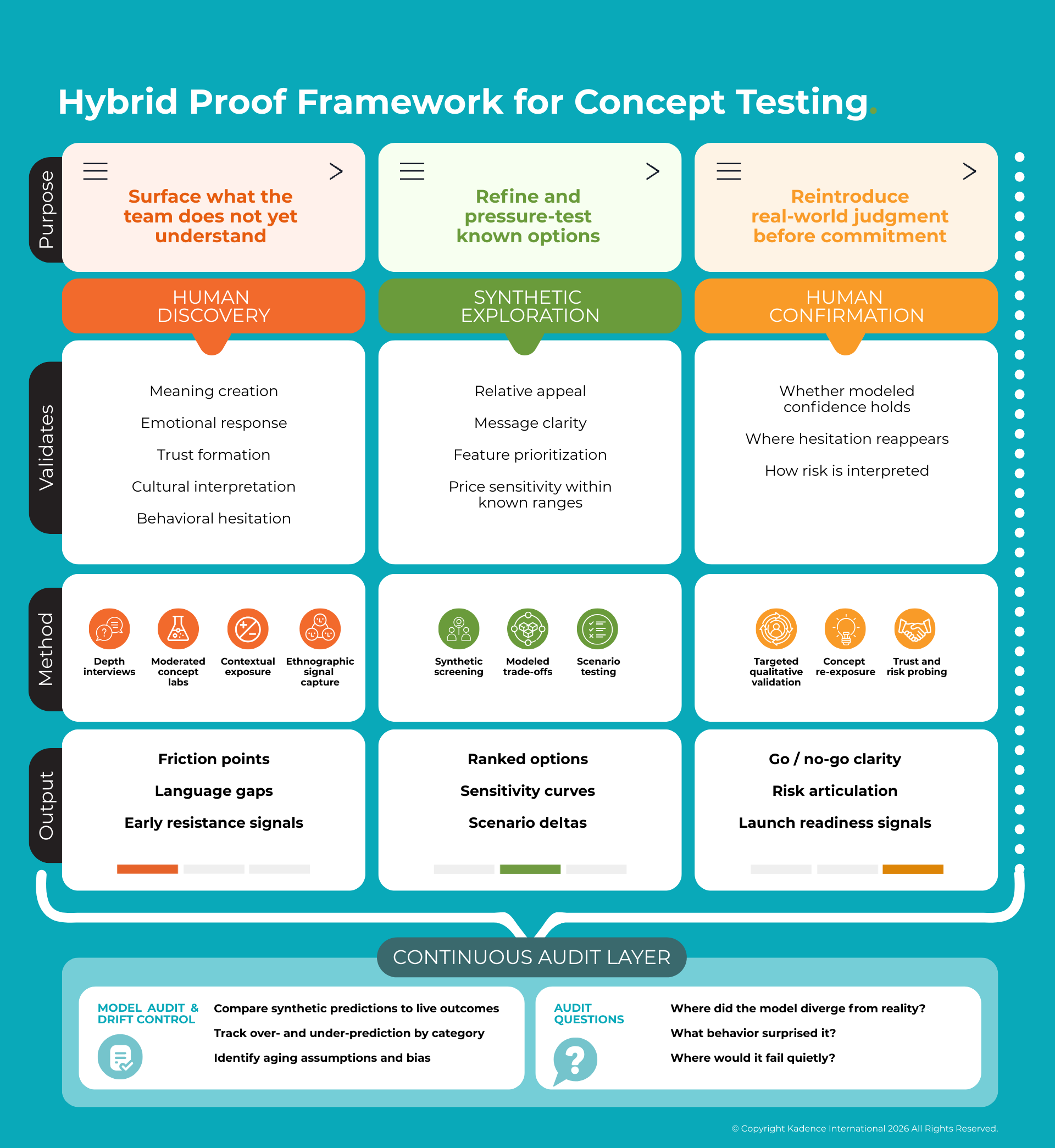
If you start with a model, you lock your thinking to what the past already knows. You narrow the field before uncertainty has been exposed. Human-first research is the only stage that surfaces what teams do not yet understand. Synthetic output can then be used to pressure-test those insights. Final confirmation with people is mandatory. Any sequence that begins with a model replaces discovery with assumption.
Rule Four: Synthetic models are guilty until proven accurate.
Every synthetic prediction must be compared against live market outcomes. Over- and under-predictions must be tracked by category and decision type. Patterns of error are not noise. They are evidence of embedded bias. If those errors are not surfaced and corrected, the model will quietly hard-code yesterday’s assumptions into tomorrow’s decisions.
How Synthetic Overreach Actually Happens
Synthetic overreach rarely presents as failure. More often, it shows up as unexamined confidence. Senior leaders should watch for several warning signs.
The first is when synthetic results are treated as final validation rather than directional input. When modeled outputs replace live research instead of informing it, decision risk increases.
A second red flag is the absence of documentation around training data or model assumptions. If teams cannot explain what a synthetic audience is built on, they cannot assess where it may be wrong.
Another signal is uniformity. Identical confidence patterns across very different concepts often indicate that the model is responding to structure rather than substance.
Resistance to additional human research, particularly when justified by statements such as “the model already told us,” is another indicator that output has replaced judgment.
Marketing and Product leaders should ask three questions.
- What would make this model wrong?
- What behavior would surprise it?
- Where would it fail quietly?
If those questions cannot be answered clearly, the insight is brittle, regardless of how polished the results appear.
Speed Is Not Strategy
Synthetic concept testing is sold as a shortcut to better decisions. In practice, it is a force multiplier for whatever a team already believes. It does not correct weak judgment; it just scales it.
The real cost of synthetic overreach is not a bad test result. It is the moment a brand commits to the wrong meaning, prices the wrong promise, and spends real money teaching the market something it will later have to unlearn.
FAQs
Is synthetic concept testing accurate?
Synthetic concept testing is internally consistent, but that is not the same as being accurate.
These systems generate outputs that align with their training data and embedded assumptions. They are good at reproducing known behavioral patterns at scale. They are weak at detecting emerging behavior, cultural shifts, or new meaning formation.
If nothing important is changing in the category, synthetic outputs can be directionally useful. The moment a brand is testing a new behavior, a new value proposition, or a trust-weighted decision, synthetic accuracy drops sharply because the model is projecting the past into a future that no longer matches it.
When does synthetic concept testing actually work well?
Synthetic testing works best when the downside of being wrong is low and the decision structure is already understood.
Typical high-fit use cases include early-stage concept screening in mature categories, message and claim iteration within known brand norms, and scenario modeling for pricing or feature trade-offs under fixed assumptions.
In these contexts, synthetic tools function as filters. They help eliminate weaker options and narrow executional choices. They should not be used to set strategic direction, define meaning, or validate breakthrough ideas.
Why do synthetic tests fail with new or innovative products?
Synthetic systems rely on historical data and adjacent category logic. When a product or category is genuinely new, the model substitutes similarity for understanding.
Breakthrough ideas often test poorly because consumers lack reference points, language, or stable expectations. Synthetic models interpret that unfamiliarity as rejection rather than as early-stage uncertainty.
As a result, the most strategically valuable ideas are often filtered out before they ever reach live human validation. What looks like rigor is actually conservatism at scale.
Can synthetic testing replace qualitative research?
No. Synthetic testing can complement qualitative research, but it cannot replace it.
Qualitative research is the only method that surfaces hesitation, reinterpretation, emotional resistance, trust formation, and meaning creation. These are precisely the dynamics that determine whether a concept will work in the real world.
Synthetic tools can rank options, compare trade-offs, and stress-test assumptions. They cannot observe how people make sense of something new. Any workflow that removes live human exposure from discovery is structurally blind to the insights that matter most.
What is a safer way to use synthetic testing in product development?
The safest approach is a human-first, hybrid validation sequence.
Start with live human research to surface unknowns, emotional reactions, and meaning gaps. Use synthetic testing next to explore variations, compare trade-offs, and pressure-test insights at scale. Then return to live research for final confirmation before committing to market.
In this sequence, synthetic tools accelerate refinement without replacing discovery. When models go first, they narrow thinking too early and lock teams into yesterday’s logic before uncertainty has been exposed.