
Japan’s convenience stores were built to save time. Instead, they reshaped how people move through daily life.
A commuter withdraws cash on the way to work. A student prints official documents before class. A late-night shift worker grabs dinner after other shops have closed. None of these moments look extraordinary on their own. Yet together they reveal something unusual about Japan’s retail system.
Convenience stores have become one of Japan’s most dependable pieces of everyday infrastructure.
More than 56,000 convenience stores operate across Japan, according to data from the Japan Franchise Association. The industry generates over ¥11 trillion (about US$75 billion) in annual sales, reflecting how deeply embedded these stores have become in daily routines.
The sector is dominated by three major chains—7-Eleven Japan, FamilyMart, and Lawson, each operating thousands of outlets nationwide. Together, they control roughly 90 percent of the convenience store market, forming one of the densest retail networks in the world. Many stores are located near residential areas, offices, and railway stations, making them a constant presence in everyday life.
New findings from our Convenience Store Study conducted in Japan provide additional insight into how consumers use this network. The nationwide study of men and women aged 20–69 examined visit frequency, purchase behavior, private label preferences, price perceptions, and the products and services consumers want from convenience stores in the future.
The results reveal a retail format built on a delicate balance between habit, utility, and perceived value.
Consumers visit frequently and rely on stores for everyday services. At the same time, they recognize that convenience often comes at a premium.
Understanding that balance helps explain why Japan’s convenience store model remains one of the most resilient retail ecosystems in the world.

Convenience Stores Are a Weekly Habit for Nearly Half of Japan
Convenience stores occupy a unique position in Japanese consumer behavior. They are neither occasional retail stops nor purely impulse destinations. Instead, they function as routine touchpoints woven into everyday schedules.
Our 2026 survey shows that 46 percent of consumers visit convenience stores at least once a week. For many shoppers, visits are far more frequent.
Usage is especially high among younger men. Among men in their twenties, more than half visit convenience stores weekly, and many report going almost every day.
This pattern reflects the way convenience stores intersect with urban life in Japan. Cities are structured around dense rail networks and long commuting hours. Workers and students often move between multiple neighborhoods during the day. A convenience store located near a station exit or residential street becomes an easy stop between activities.
Over time, that accessibility has turned into a habit.
Rather than planning visits, consumers simply integrate the store into their daily path. For retailers and brands, that kind of behavioral integration creates a powerful advantage. Channels that consumers visit repeatedly during the week become default purchasing environments for beverages, snacks, quick meals, and small everyday needs.
The frequency also explains why convenience stores remain a central distribution channel for new food products, seasonal launches, and beverage innovations in Japan.
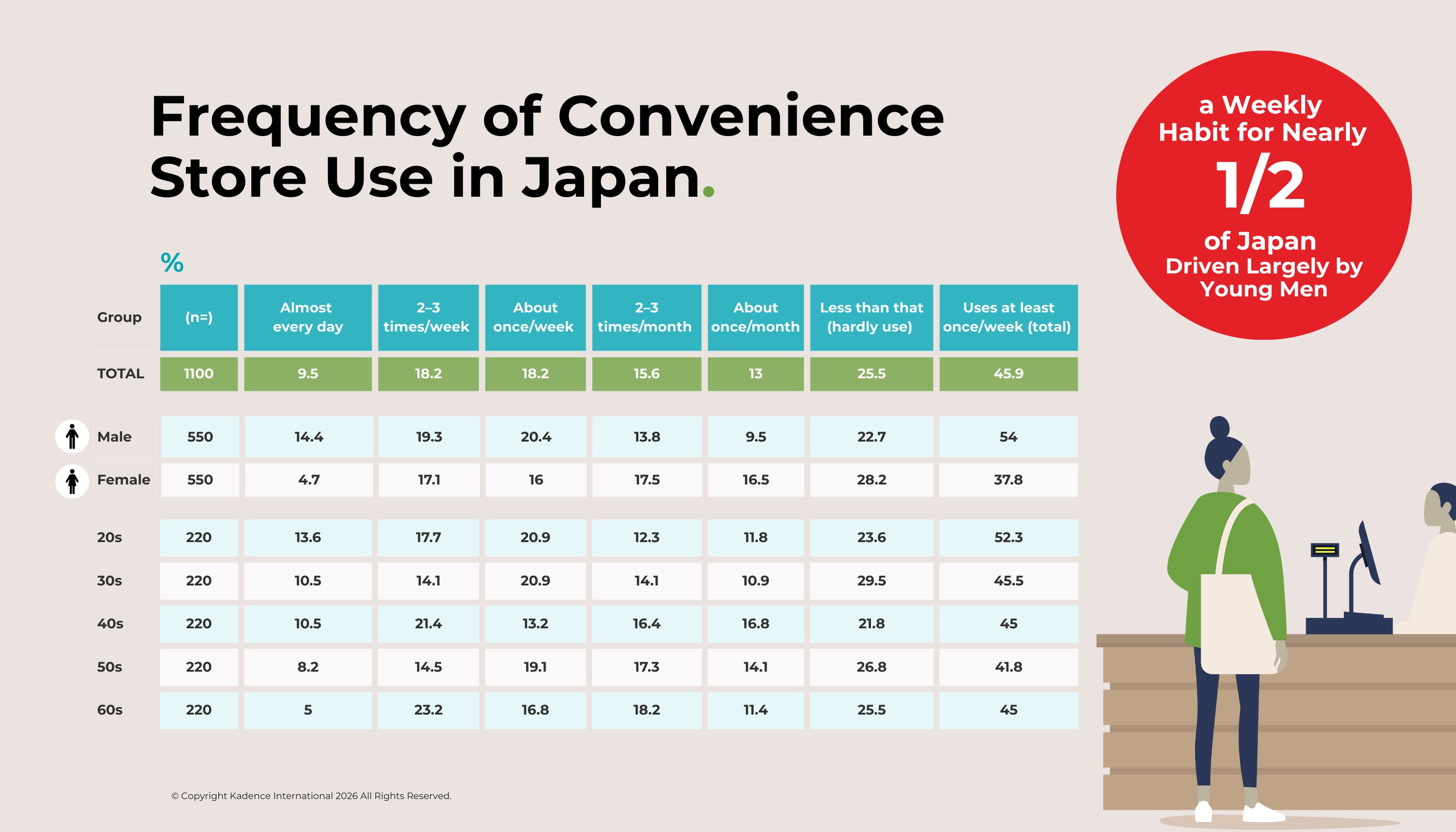
Insight: 46 percent of consumers visit convenience stores weekly, with usage highest among men in their twenties.
In Japan, Convenience Stores Solve Everyday Problems, Not Just Hunger
Outside Japan, convenience stores are often associated primarily with snacks and drinks.
Our study suggests a very different reality.
The most common reason consumers stop by a convenience store is to use an ATM, cited by more than 25 percent of respondents. Hunger comes in second, while printing or issuing official documents ranks third.
Rather than serving a single purpose, convenience stores function as multi-service hubs, supporting everyday tasks ranging from banking to quick meals and administrative errands.
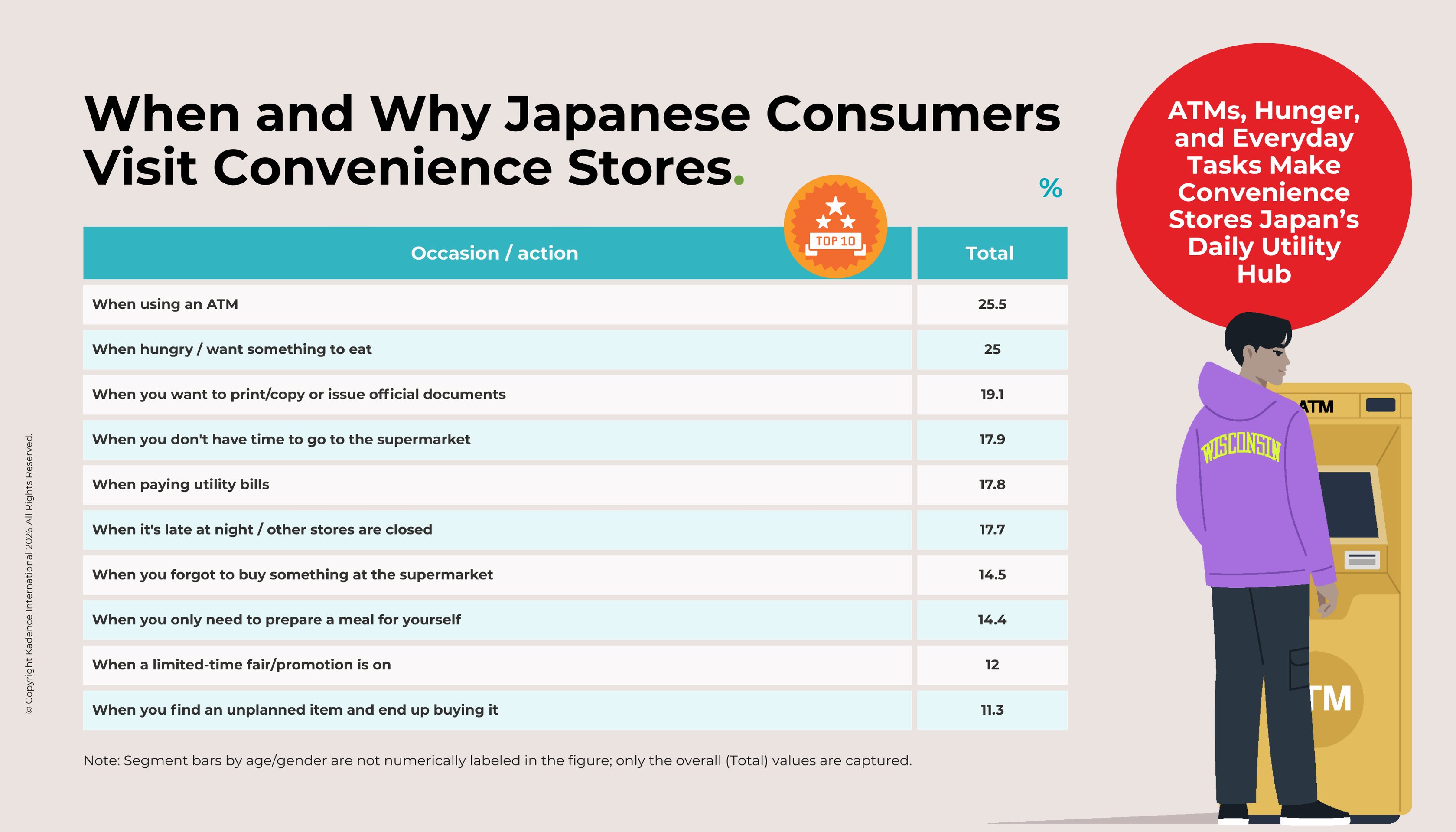
Insight: ATMs, hunger, and administrative tasks such as document printing are the top triggers for store visits.
The range of reasons highlights how convenience stores in Japan operate less like small retail outlets and more like neighborhood service nodes.
Konbini, Japan’s convenience store chains, have gradually expanded their services to cover a wide range of everyday needs. Stores offer ATM banking, parcel delivery and pickup, ticket purchases, bill payments, and access to government document printing services.
Food has also become central to the convenience store model. Ready-to-eat meals, prepared foods, and fresh items now account for more than one-third of convenience store sales in Japan, according to industry reports. Daily deliveries allow stores to restock items such as bento meals, rice balls, sandwiches, and desserts several times per day.
For many residents, especially in urban neighborhoods, these services replace multiple errands with a single stop.
This broad functionality explains why convenience stores remain resilient even as e-commerce and grocery delivery expand. Digital channels can replicate product purchasing, but they cannot easily replace the services convenience stores provide.
The model succeeds because it solves everyday problems quickly and reliably.
Private Labels Win the Battle for Everyday Staples
Convenience stores are also important battlegrounds for private label strategies.
In many markets, retailer brands compete primarily on price. In Japan, the relationship between private labels and national brands is more nuanced.
Our survey shows that more than half of consumers choose private-label products when purchasing bottled water or tea at convenience stores.
These categories are highly standardized. Consumers expect reliability and convenience rather than strong brand differentiation, allowing retailer brands to compete effectively.
However, the pattern changes in categories where taste and brand identity matter more.
Nearly 70 percent of consumers say they do not choose private brand coffee or juice, preferring national brands instead.
This reveals a two-tier structure in beverage purchasing.
Private labels dominate where the product serves a functional role, such as hydration or routine consumption. National brands remain influential when purchase decisions are driven by taste, familiarity, or brand reputation.
For consumer packaged goods companies, this distinction highlights where brand investment remains defensible and where retailer competition is likely to intensify.
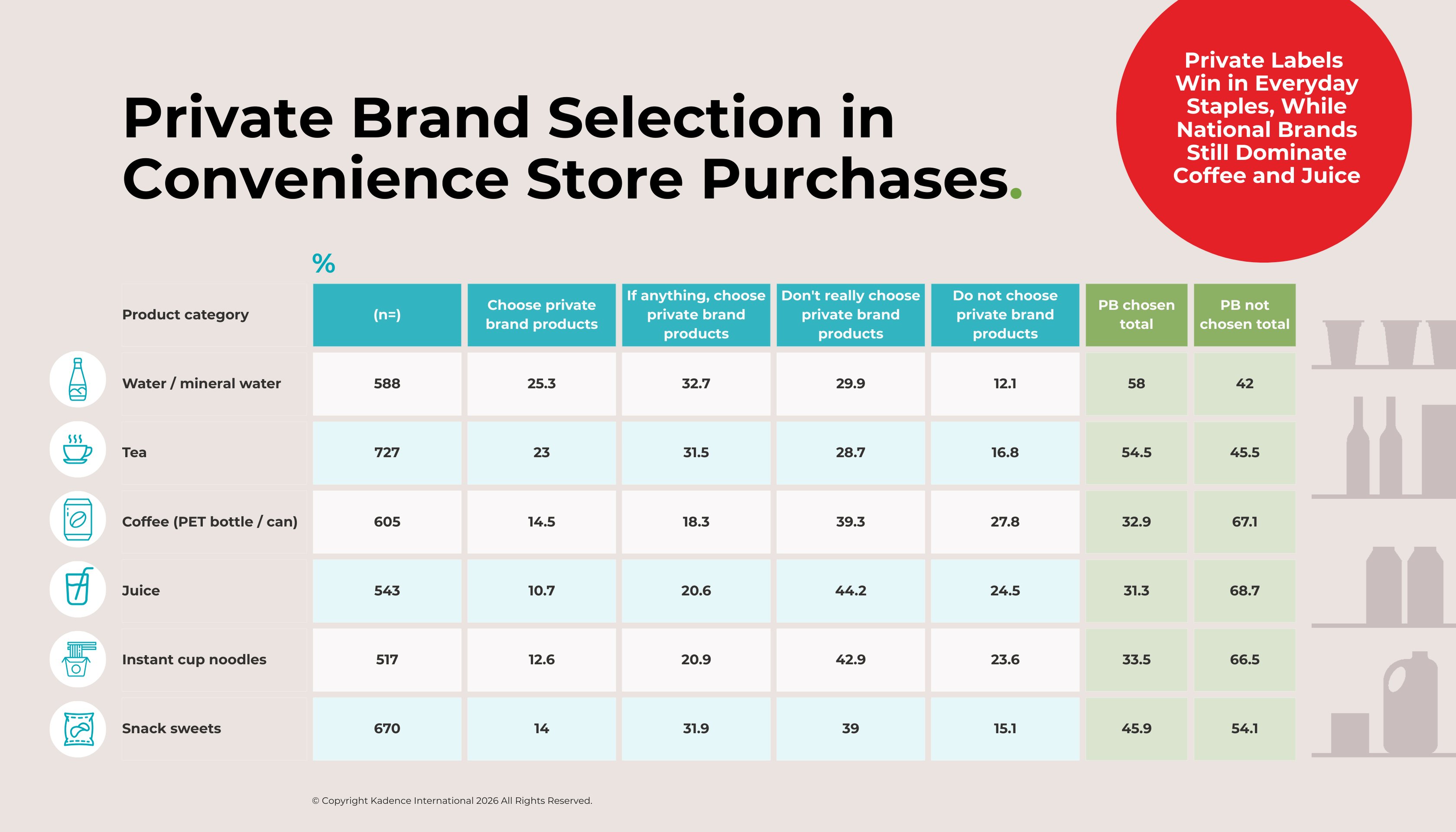
Insight: Private labels dominate staple beverages like water and tea, while national brands remain preferred for coffee and juice.
The Convenience Premium Is Real, and Japanese Consumers Notice It
Convenience stores are built around accessibility and speed. But that convenience comes with a cost.
According to the survey, 76 percent of shoppers say their purchase total felt more expensive than expected after shopping at a convenience store.
This perception increases among older consumers. More than 80 percent of men in their fifties and sixties, as well as women in their forties and sixties, reported experiencing this feeling.
The finding does not necessarily signal dissatisfaction. Instead, it reflects a psychological trade-off embedded in the retail model.
Consumers recognize they are paying for convenience and speed. The store is closer, the transaction is faster, and the purchase requires less planning. In economic terms, shoppers pay a convenience premium.
The important insight is that while consumers accept this trade-off, they remain aware of it. As inflation and cost sensitivity rise globally, retailers must work harder to maintain the perception that convenience justifies the price.
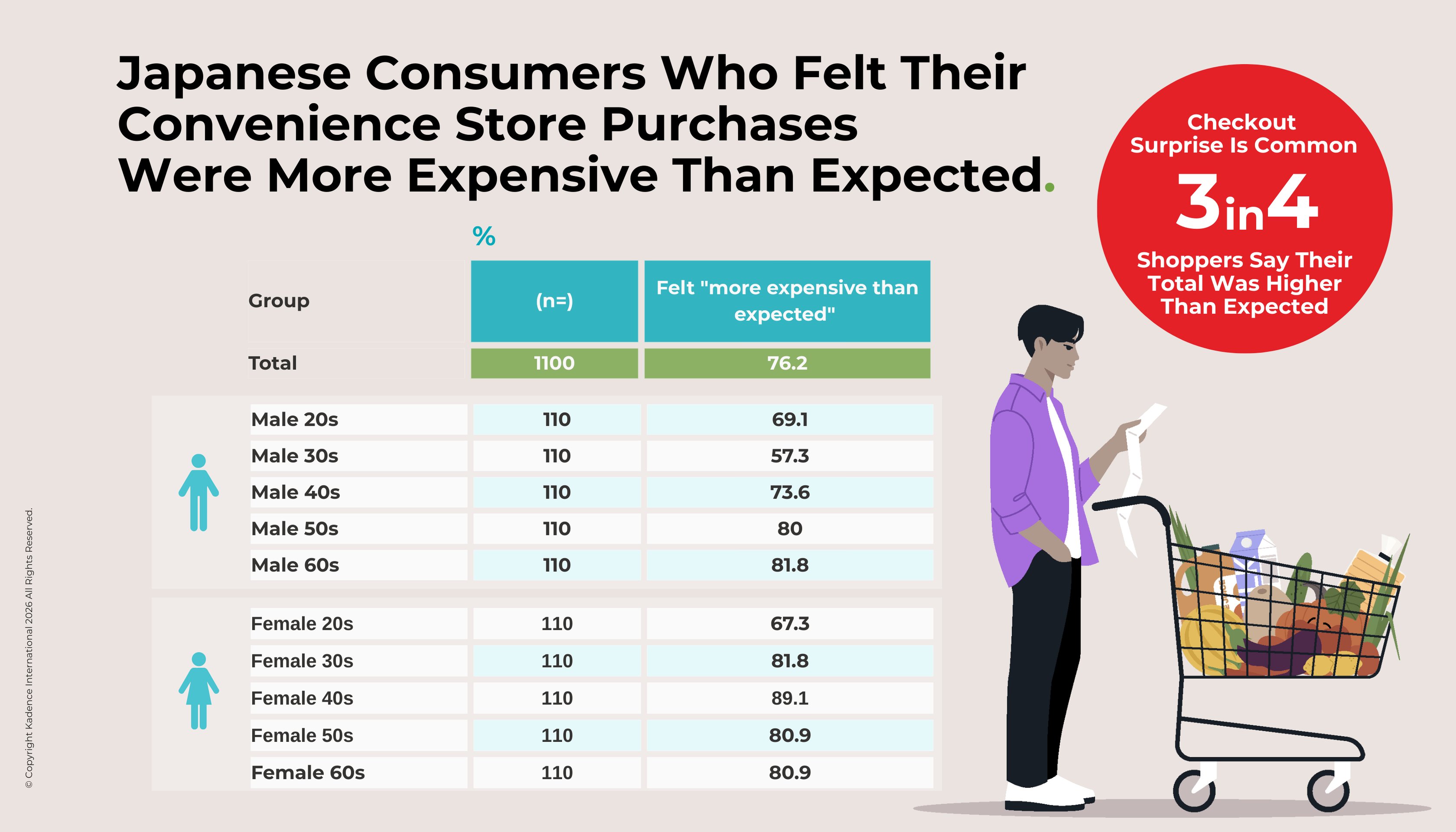
Insight: More than three-quarters of shoppers say their convenience store purchases cost more than expected.
Japanese Consumers Want Value Signals, Not Just Lower Prices
If shoppers recognize the convenience premium, the next question becomes how retailers maintain a sense of value.
The survey highlights several mechanisms consumers would like to see more often in convenience stores.
The most requested features include:
- More reward points with cashless payments
- Coupons or free exchange vouchers printed on receipts
- Larger portions or more content for the same price
These responses show that consumers are not necessarily asking for lower prices. Instead, they want visible signals that reinforce value.
Loyalty programs, promotional coupons, and points systems provide reassurance that the transaction remains worthwhile.
The survey also highlights product innovations consumers would like to see.
Many respondents expressed interest in freshly prepared food options, including baked bread, pizza, desserts, smoothies, and in-store-prepared frappes.
These categories blur the boundary between convenience stores and specialty food outlets. For retailers, they offer opportunities to increase perceived value while expanding margins.
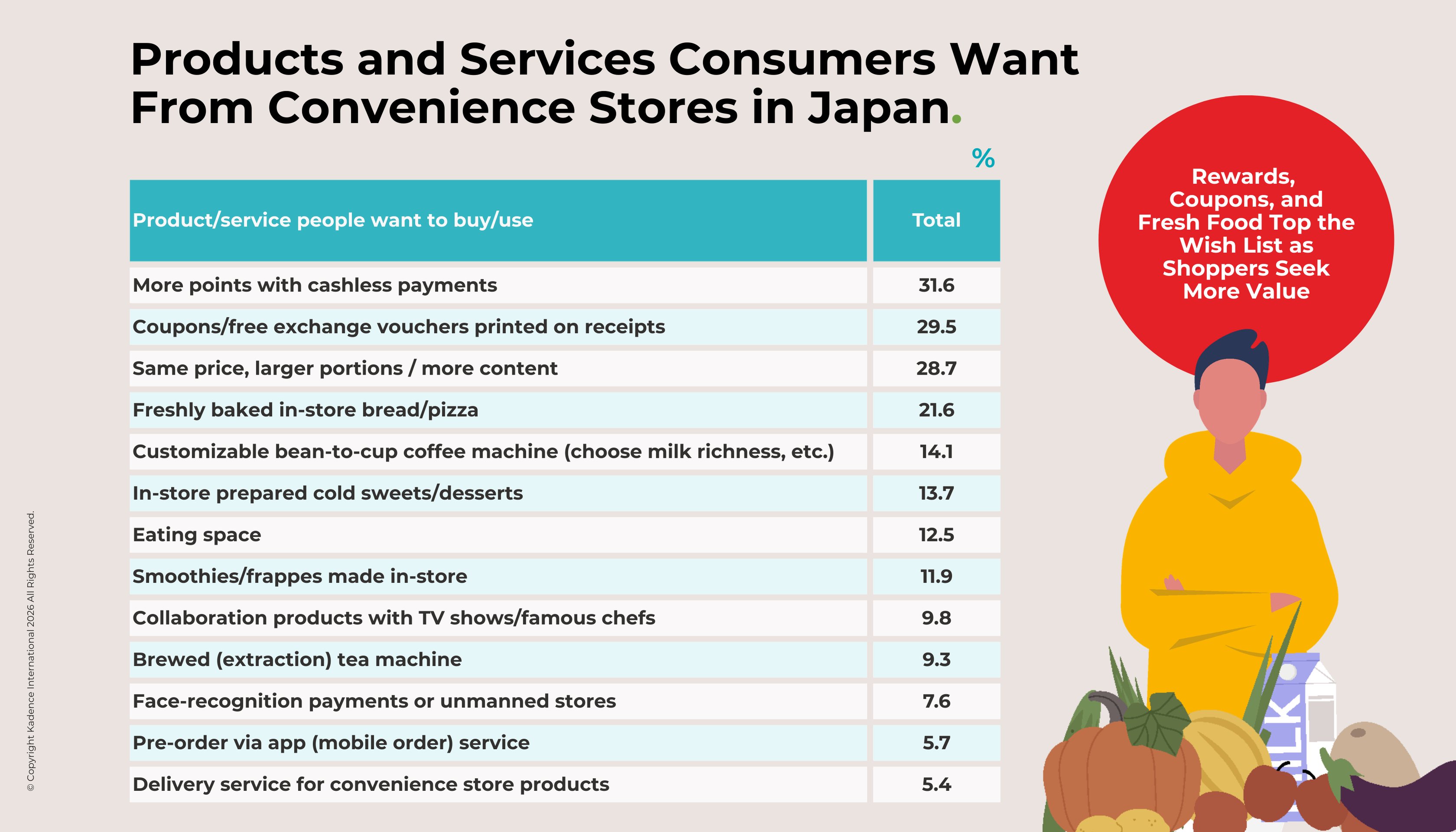
Insight: Loyalty rewards, coupons, and value-driven promotions rank highest among desired services.
Why Japan’s Convenience Store Model Is Hard to Replicate
Retailers around the world have attempted to replicate Japan’s convenience store success. Few have achieved similar results.
The model depends on a combination of structural conditions that are difficult to reproduce elsewhere.
Urban density
Japan’s cities support extremely high store density, allowing consumers to encounter convenience stores multiple times during a single commute.
Operational precision
Convenience chains operate sophisticated supply chains that restock fresh products several times per day.
Service integration
Partnerships with banks, utilities, and government agencies allow stores to provide services far beyond retail.
Consumer trust
Japanese shoppers expect reliability, cleanliness, and product consistency from convenience stores. This trust reinforces frequent usage.
Together, these conditions transform convenience stores into something larger than retail outlets. They become part of the country’s daily infrastructure.

Convenience Wins When It Becomes Indispensable
Japan’s convenience stores exemplify what happens when a retail format becomes deeply ingrained in daily life. Consumers visit these stores frequently and rely on them for essential services, accepting higher prices in exchange for speed and accessibility. Despite this, they remain sensitive to value.
Private labels often compete with national brands, depending on the product category. Loyalty rewards help mitigate price concerns, and the expansion of prepared foods enhances the store’s role as a quick meal solution.
The broader lesson extends beyond snacks and beverages; it is about infrastructure. When retail effectively addresses everyday problems, such as banking, payments, meals, and logistics, it becomes woven into daily life. Once a retail channel achieves this level of integration, it transcends convenience and becomes indispensable.
Understanding Japan’s Consumers Requires Local Insight
Japan’s convenience store ecosystem illustrates how retail behavior evolves when infrastructure, culture, and consumer expectations intersect. For brands looking to enter or expand in Japan, understanding these behavioral dynamics is essential. We conduct market research across Japan, helping brands understand consumer behavior, retail ecosystems, pricing sensitivity, and market entry opportunities. Learn how our Japan research team can support your market strategy.