
Uniform products once offered reassurance. Today, they risk signalling detachment from how people actually live. Across categories, from footwear to furniture, consumers describe a landscape of sameness: limited colourways, standardized fits, rigid routines, and fixed bundles. As choice narrows, the desire for products that reflect personal identity becomes stronger. Individual expression now carries cultural and economic weight, and people look for goods and services that recognise their preferences without forcing compromise.
This expectation is no longer niche. McKinsey’s global personalization study found that 71 percent of consumers expect some degree of personal relevance, and 76 percent feel frustrated when they do not receive it. When products feel generic, dissatisfaction rises; when they reflect individual context, attachment deepens. Personalization has evolved from embellishment to a marker of value, shaping purchasing behavior, influencing loyalty and reshaping how organizations design, manufacture, and deliver.
Why Personalization Carries Psychological Force
Identity increasingly guides preference formation. People assign higher value to items they help shape, and behavioral economics explains why: participation heightens emotional ownership. When an outcome aligns with personal context—climate, lifestyle, or aesthetic sensibility—the product feels uniquely theirs. This deepens satisfaction and reduces post-purchase doubt.
Digital life reinforces the expectation. Algorithms curate content around taste and rhythm, normalising precision. Once this becomes standard in digital environments, generic physical products stand out for the wrong reasons. The tension between mass production and personal identity becomes clear, and consumers gravitate toward brands that acknowledge individuality rather than assume uniformity.
Regional nuances strengthen the pattern. Japanese shoppers are experimenting with climate-responsive skincare because humidity, seasonality, and commuting conditions significantly impact the results. In North America and Europe, customization often signals style, differentiation, and personal authorship. In Southeast Asia, personalization blends aesthetic expression with environmental realities, from humidity-proof cosmetics to region-specific product variants.
Across markets, people want products that adapt to them, not the other way around.

Personalization Across Sectors
Personalization is expanding across industries once defined by fixed product lines. Consumers are shaping design, formulation and configuration, and brands that enable this participation secure stronger engagement.
Footwear and Apparel
Digital configuration tools offer levels of variation once impossible for traditional retail. Platforms that allow control over materials, colors, and detailing tap into the desire for authorship. The appeal is not a limitless choice but an informed, purposeful variation: something that signals intention rather than conformity.
Forecasts show sustained growth in custom apparel as digital design environments become mainstream. Consumers increasingly expect this flexibility, where fit, expression, and lifestyle alignment matter more than the pace of seasonal releases.
Beauty and Skincare
Advances in diagnostics and data capture are redrawing expectations in beauty. Tailored formulations based on climate, hydration levels, biometrics, and daily conditions are gaining traction, particularly in Japan and South Korea.
Adaptive routines illustrate a broader shift: people want relevance, not approximation. Brands that shape products using real-world variables demonstrate heightened credibility in categories where performance is closely scrutinised.
Automotive
Drivers now expect cabins that recognise them. Personalized settings for lighting, media, comfort, and interfaces are increasingly influencing buyer decisions. Younger generations, accustomed to adaptive digital environments, tend to gravitate toward vehicles that automatically adjust to their habits and routines.
Automakers are responding with modular trims, software-driven upgrades, and subscription features. Personalization is becoming central to the in-car experience rather than a premium add-on.
Furniture and Home
Home environments serve as expressions of identity and serve a functional purpose. Modular and made-to-order furniture allows consumers to tailor products to their specific spaces, constraints, and aesthetic preferences. Digital visualization tools reduce uncertainty and allow for greater ownership of the design process.
As homes evolve into hybrid work–leisure spaces, demand for personalized furnishings continues to rise, reinforcing the idea that comfort and spatial efficiency resist standardization.
How Manufacturing Is Re-Engineering Itself for Personalization
Personalization is transforming how factories operate, not just the appearance of products. Production systems built for scale are being redesigned for variation, speed, and proximity.
Flexible Production Systems
Automation and modular assembly enable rapid switching between variants without compromising efficiency. Manufacturers are investing in adaptable cells that support small-batch runs, reducing setup costs and shortening lead times. Variation becomes an expected input rather than a complication.
Additive and On-Demand Manufacturing
Additive manufacturing supports customization at low volumes by eliminating the need for extensive tooling. Footwear components, protective equipment, furniture elements, and automotive parts are increasingly relying on additive manufacturing methods, especially in markets that require on-demand fulfillment.
Environmental gains are substantial. By producing only what is needed, brands reduce waste, limit excess inventory, and minimize the ecological impact of overproduction, an angle that resonates with sustainability-conscious consumers.
Localised Production Networks
Distributed microfactories shorten delivery times, allowing brands to incorporate regional preferences quickly. They reduce exposure to supply-chain bottlenecks, lower transportation emissions, and enable more responsive replenishment. Apparel, sporting goods, and furniture companies are early adopters, signalling a broader shift toward proximity-based production.
Digital Configuration Pipelines
Three-dimensional configurators and real-time design tools form the link between consumer intent and factory output. They translate preference data into production-ready specifications, reducing friction and increasing accuracy. Once consumers experience this clarity, it becomes an expectation elsewhere.
Where Personalization Fails: The Risk Factors
The move toward personal choice creates strategic risks if not managed carefully:
- Unstructured choice sets can overwhelm customers and depress conversion.
- Data collection without clear value exchange erodes trust.
- Over-complexity in supply chains increases costs if modularity is not built at the core.
- Personalization that feels superficial, such as colour swaps without functional relevance, can damage credibility.
Recognizing these risks helps ensure that personalization remains an asset rather than an operational strain.
How Insight Shapes Meaningful Personalization
Personalization works when anchored in evidence. Insight reveals what consumers value, which variations feel meaningful, and where complexity adds friction. When research informs design and production, personalization becomes intuitive rather than ornamental.
SK-II Magic Ring

A diagnostic system built on dermatological and behavioral data that analyzes hydration, texture, elasticity, and tone. Its personalised recommendations helped set expectations for data-driven skincare and strengthened loyalty through clarity and precision.
Nike By You
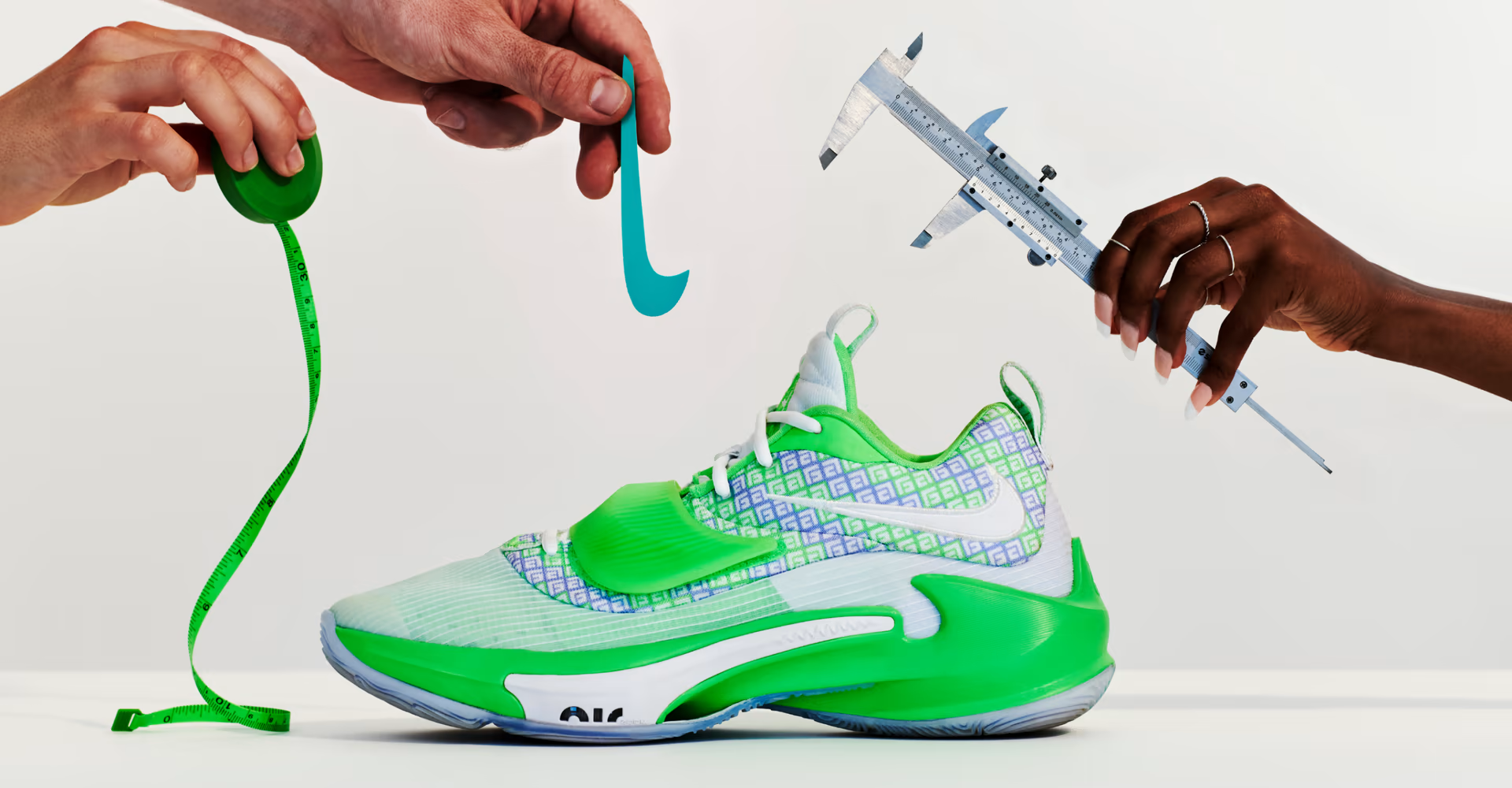
Image Credit: Nike
A platform built on insight into younger consumers’ desire for authorship. The customization data loop, where consumer choices inform future product design, creates a strategic advantage and illustrates how personalization fuels creative development.
Shiseido Optune

Image Credit: Cosmetics Design Asia
An adaptive skincare system that generates daily formulations based on environmental conditions and personal routines. It reframed the idea of a “routine” by making skincare dynamic rather than fixed.
Inside Weather

Image Credit: Inside Weather
A made-to-order furniture model driven by insight into urban space constraints. By manufacturing after configuration, the brand reduced waste and increased relevance, showing how insight shapes production strategy as much as design.
Personalization Across the Customer Experience
Recognition matters at every stage of the journey, not only at the point of purchase.
Discovery That Reflects Individual Preferences
Consumers rely on curated feeds, personalised recommendations, and location-aware suggestions. When discovery aligns with personal taste or circumstance, exploration becomes purposeful rather than overwhelming.
Decision Journeys Built Around Context
Guided configuration, tailored content, and regional options help consumers filter choices with less cognitive load. In complex categories, such as beauty, furniture, and automotive, clarity becomes a competitive advantage.
Service That Recognises Individual Needs
Support that acknowledges past behavior signals attentiveness. Usage-based reminders, adaptive tutorials, and personalized guidance increase satisfaction and strengthen long-term engagement.
Ownership That Evolves Over Time
Digital ecosystems extend personalization beyond purchase. Software updates, adaptive features, and tailored insights ensure products evolve alongside the user.
Advanced Strategic Considerations for Brands
To compete in markets shaped by individuality, brands must master strategic levers beyond design and production.
Elasticity of Choice
More options do not always lead to increased conversion. Evidence across retail environments suggests that:
- Three to seven meaningful variations often maximise engagement.
- Beyond this, cognitive load rises, and decision rates fall.
- Structured choice—tiered, guided, intuitive—outperforms wide catalogues.
The goal is not more choice but better architecture of choice.
Price vs Personalization Trade-offs
Consumers pay more when personalization:
- Strengthens identity (beauty, footwear, furniture).
- Improves function (fit, comfort, climate relevance).
- Communicates status or distinction.
Willingness to pay varies by region:
- Japan & South Korea: strong appetite for precision and data-backed routines.
- North America & Europe: higher willingness to pay for authorship and style.
- Southeast Asia: stronger response to environmental relevance and scarcity.
Understanding elasticities by market and category is essential for a pricing strategy.
Competitive Moats
Differentiation emerges from capabilities competitors cannot easily copy:
- Proprietary insight pools revealing deep preference patterns
- Closed-loop data ecosystems where consumer input shapes product evolution
- Modular architecture enabling variation at low marginal cost
- Distributed manufacturing that accelerates responsiveness
The moat is rarely the feature itself; it is the infrastructure enabling variation at scale.
Workforce Transformation
Hyper-personalization reshapes roles and skills:
- Designers move from fixed collections to modular systems.
- Manufacturing teams require fluency in automation and the ability to rapidly retool.
- Insight teams link behavioral understanding to product architecture.
- Marketing and CX teams act as curators, orchestrating personalized journeys rather than broadcasting general messages.
The operating model becomes interdisciplinary, adaptive, and insight-led.
Sustainability as a Competitive Advantage
Personalization and sustainability increasingly reinforce each other:
- On-demand production eliminates excess inventory.
- Additive manufacturing reduces material waste.
- Localised production cuts transport emissions.
- Tailored products stay in use longer, lowering replacement cycles.
Brands that connect personal relevance with environmental responsibility gain both cultural and competitive advantage.

Strategic Frameworks for Organizations Moving Toward Personalization
- Build Modular Product Systems
Variation is efficient when the architecture is stable. - Develop a Personalization Intelligence Layer
Insight should clarify what matters and what creates noise. - Strengthen Agile Manufacturing Capabilities
Flexible, distributed, and additive systems enable variation without cost spirals. - Integrate Personalization Into the Service Model
Recognition across the journey sustains engagement. - Align Storytelling With Individual Expression
Marketing must reflect cultural nuance and the consumer’s role in shaping the outcome.
Final Thoughts
Personalization is reshaping how consumers interpret value. Recognition now extends across products, services, and experiences, and the distance between personal identity and commercial offering continues to narrow. As manufacturing becomes more adaptive and digital systems learn from behavior in real-time, personalization will shift from a differentiator to an expectation. The next phase is responsiveness: products that evolve with the user rather than remain fixed.
Organizations that treat individuality as a design principle, not a feature, will be best positioned in markets where distinction carries greater influence than scale.
At Kadence International, we help organizations uncover the motivations, behaviors, and cultural signals that drive demand for personalized products and experiences. Our research identifies where personalization creates real value and how to build strategies that reflect genuine consumer intent. Connect with us to shape offerings that remain relevant as expectations continue to rise.